(Have a queer / antiracist / anti-ableist, otherwise liberationist or justice-focused worship resource that’s not on this list? Let me know at queerlychristian36@gmail.com!)
When aiming to expand understandings of the divine, it’s always good to gather as many voices as you can! So while I welcome you to use any of the liturgy, hymns, and preaching prep material you find here on my site, I also want to share places to find other people’s worship materials + lectionary / preaching prep.
To queer worship is not only to pay attention to gender identity and sexuality, but to interrogate all the ways our worship excludes and harms so that we may then cultivate worship that intentionally centers all marginalized people’s voices, gifts, and ways of being and moving in the world.
So while many of these resources will indeed focus on LGBTQIA+ subjects and creators, I also include resources that center BIPOC, disabled people, immigrants, and others who are too often denied full belonging even within communities of faith.
On queering worship — the why, the how, the theology
Queering the Liturgy is a fantastic resource created by multiple queer ministers and theologians, divided into sections. You can find all sections at the above link; I’m pasting a selection below:
(Note: Call to Worship offers a limited number of free articles before asking you to subscribe. You can get to a few more by opening links in a private browser; but if you / your church has the budget for it, this is a worthwhile journal to subscribe to!)
Queering Christian Worshipprovides new imagination and tools to those who study and curate Christian worship across traditions.
The book is organized into three main parts:
An introduction to queer engagement with ritual practices,
Case studies that examine queer texts and contexts,
An examination of the horizons of queer liturgical theology and practice.
Queer Grace is Rev. Emmy Kegler’s website collecting queer Christian resources of all kinds. Here are a few pertaining to worship:
What would it look like if women built a lectionary focusing on women’s stories?
What does it look like to tell the good news through the stories of women who are often on the margins of scripture and often set up to represent bad news? How would a lectionary centering women’s stories, chosen with womanist and feminist commitments in mind, frame the presentation of the scriptures for proclamation and teaching?
The scriptures are androcentric, male-focused, as is the lectionary that is dependent upon them. As a result, many congregants know only the biblical men’s stories told in the Sunday lectionary read in their churches. A more expansive, more inclusive lectionary will remedy that by introducing readers and hearers of scripture to “women’s stories” in the scriptures.
Enfleshed’s Liturgy Library offers truly gorgeous, embodied worship materials from writers from various marginalized experiences. Explore all their stuff in the above link, or check out specific collections:
Note: much of this liturgy still makes use of binary language like “brothers and sisters.” I advise revising that language (e.g. to “sisters, brothers, and nonbinary siblings,” “kin in Christ,” “beloved community,” or other alternatives) if you make use of this liturgy.
Beyond Worship seeks to show LGBTQIA+ people that they are divine, here for a reason, and have so much to contribute to their communities.
Whether a poem, a short story, a psalm, a meditative guide, or an academic paper, each LGBTQIA+ author in this anthology explores what it means to find community and love in a society that tells them they are undeserving of both. From all over the world and from a variety of faith traditions, each author’s piece shows readers different ways of being in a world worth experiencing.
Black Liturgies is a project that integrates spiritual practice with Black emotion, Black literature, and the Black body. You can find them on places like Instagram, or in an upcoming book.
These pieces are written by queer Black woman Cole Arthur Riley, who also wrote This Here Flesh.
Pentecost Sunday, 1 Corinthians 12:3b-13 and Acts 2:1-21 through a queer, liberationist lens
Key points:
Throughout scripture and culminating in Pentecost, God’s breath pervades all creation and lavishes gifts upon all persons — yet also demonstrates what liberation theologians call a “preferential option for the poor,” often selecting society’s shamed and shunned to speak God’s good news to the world.
Too often, we dismiss God-given wisdom and leadership as it manifests in the oppressed; we must resist the hierarchy of gifts humans construct and learn to recognize Spirit wherever She moves.
For instance, many dismiss the powerful Spirit-movement of Pentecost; they aren’t prepared to see God among Galilean hicks, so they don’t. But there is Spirit-movement there, which lesbian theologian Kittredge Cherry envisions as an erotic, ecstatic, polyamorous marriage between Holy Spirit and human spirits (passage below).
At Pentecost, it’s people who know society’s in-between spaces, the not-quite-belonging-anywhere that many bi- or multicultural people experience — Jews who were immigrants or visitors from outside Judea. Spirit speaks to them in their own heart languages! We too are called to practice linguistic hospitality and the radical belonging and centering of marginalized voices, vocations, movements.
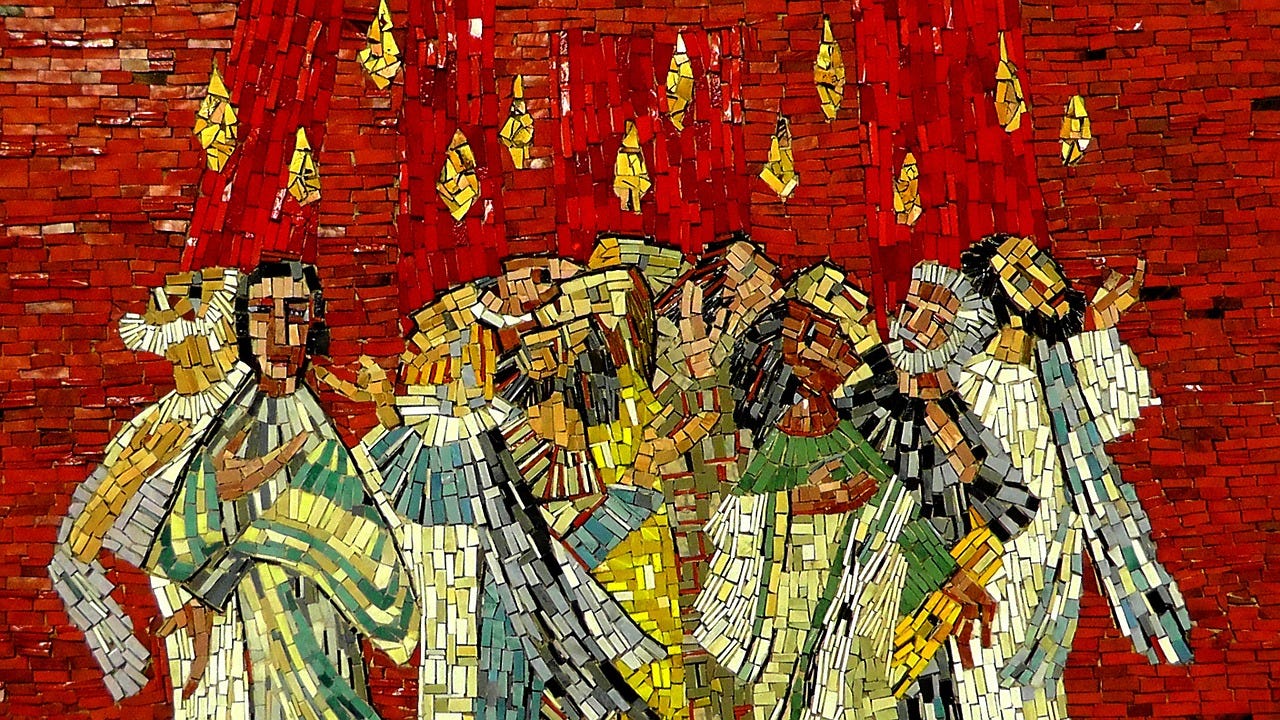
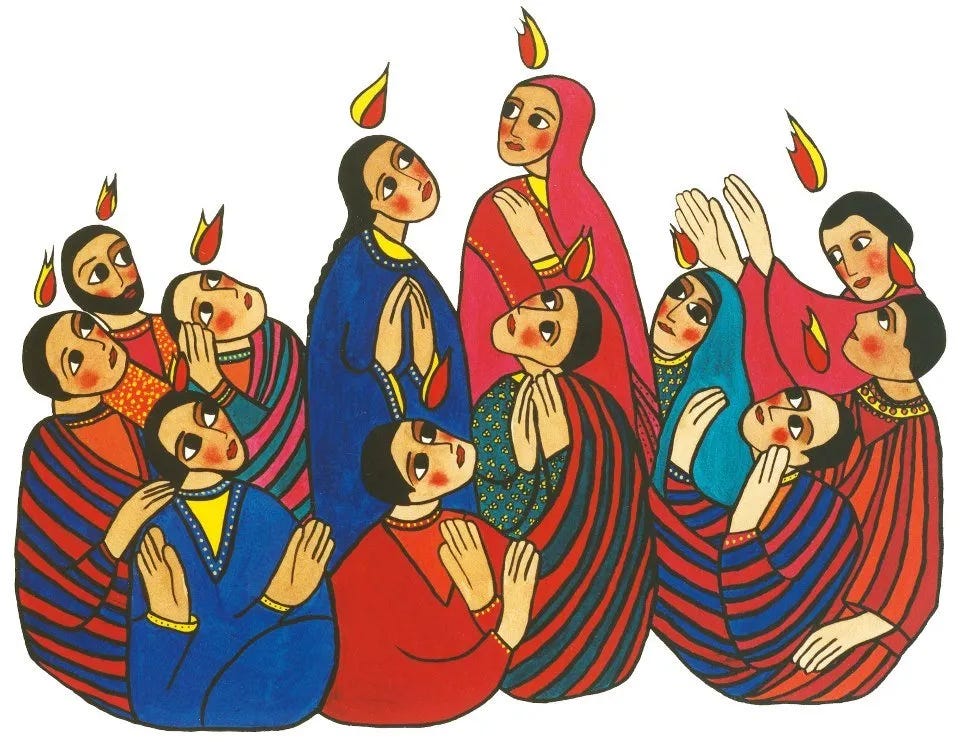
Happy Pentecost! This Sunday’s readings show us a Spirit who blows across all creation, blazes into the bustling heart of community life, and bestows Xir manifold gifts prodigally yet particularly — prodigal as in almost “wastefully” generous, an overflowing abundance of blessing lavished over all created things; and particular in that Xe is intentional about which gifts each individual receives, often with what liberation theologians call a “preferential option” for strangers and outcasts.
There’s Psalm 104, wherein God’s Spirit, or breath, is what animates all things — then Numbers 11:24-30, in which Spirit rests upon a select group in a particular way:
“I’ll take some of the spirit that is on you and place it on them. Then they will carry the burden of the people with you so that you won’t bear it alone.” So Moses…assembled seventy men from the people’s elders and placed them around the tent. …When the spirit rested on them, they prophesied, but only this once.
Two men had remained in the camp, one named Eldad and the second named Medad, and the spirit rested on them. They were among those registered, but they hadn’t gone out to the tent, so they prophesied in the camp. – vv. 24-26
Along with the recognition that we all need support and that decision-making power must be shared, what I love about this passage is how God’s Spirit does what She always does — surprises us.
We expectDivinity to remain within the safe confines of the boundaries we devise — in this case, the meeting tent Moses established where he and God carry out important conversations. But God’s breath blows where it will; the Spirit isn’t solely in the tent! Off in the center of things, out among the people, She gifts Eldad and Medad with prophecy too.
Now there are varieties of gifts but the same Spirit, and there are varieties of services but the same Lord, and there are varieties of activities, but it is the same God who activates all of them in everyone. To each is given the manifestation of the Spirit for the common good. – 1 Corinthians 12:4-7
Resisting a hierarchy of gifts
All of us carry gifts from the Spirit intended for communal good; it is in using and joining our God-given gifts that we participate in the delivery of God’s Kin-dom here on earth.
Unfortunately, we tend to create a hierarchies out of these spiritual gifts, vocations, and activities: some are put on pedestals, while others are belittled, overlooked, or even cursed as sin.
For instance, we too often fail to recognize disabled persons’ unique gifts — and I don’t mean “they have so much to teach us” in the paternalistic, infantilizing way that is mainstream. I mean that their/our experiences of moving through a society structured to exclude them/us often compels them/us to cultivate wisdom and resourcefulness that could help liberate everyone.1 This is true of every oppressed group that “makes a way out of no way.”2
Some of our God-given gifts are even denounced as curses. Take queer ways of loving and being — ways that defy and demolish normative constrictions, that challenge society to think beyond “the way things are.”
This is why I can’t tolerate the “love the sinner, hate the sin” rhetoric or see it as anything but hate wrapped up in pretend piety — you are calling Divine activity in my life, the bounty of love and holy transformation flowing out from my queer experiences, sin.
I’m not one to throw around words like blasphemy, but Jesus does warn us that insults against the Holy Spirit — which I interpret as divine activity in the world — are unforgivable. Now, Jesus often employed hyperbole to get vital points across, and I don’t think that by “unforgivable” he means “damnable”; even so, we must all take great care not to rush to denounce God’s movement as sin just because it grates against the status quo.
In Acts 2’s Pentecost story, some of those who witness God’s movement in the disciples’ multilingual exclamations of Christ’s liberation don’t declaim it as sin, but do dismiss it as drunken ranting (v. 13).
A queer vision: Pentecost as erotic, ecstatic union
What some dismiss as debauchery was in reality an ecstatic encounter with the divine. Lesbian theologian and QSpirit host Kittredge Cherry envisions Pentecost’s arrival of the Spirit as an orgy-like ecstasy of mystical love-making; Holy Spirit weds human spirit as divinity is distributed through a fiery kiss:
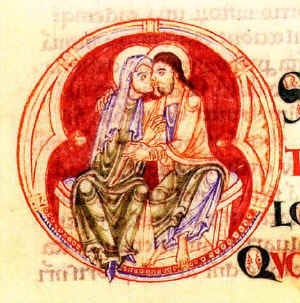
Kittredge Cherry is by no means the first Christian to envision Pentecost as betrothal, Divinity erotically wed to humanity, or the Holy Spirit as a kiss, as evinced in this illumination of Christ the Lover kissing the Church his beloved in a medieval manuscript of the Song of Songs. St. Bernard of Clairveax was particularly smitten with the concept of a kissing Trinity: “If … the Father is he who kisses, the Son he who is kissed, then it cannot be wrong to see in the kiss the Holy Spirit, for he is the imperturbable peace of the Father and the Son, their unshakable bond, their undivided love, their indivisible unity.”
When the Holy Spirit loved me, our contact produced a ripple of energy similar to a heartbeat. She was ringing me like a bell, and the “sound” would roll on forever.
“It is without end, because it is without beginning,” She said. She rang me again, and this time when the edge of her heart crossed mine, the rapture made me lose control and we melted into One. …
We kissed everyone in the room…We licked them with Our flaming tongues. They welcomed Our electric kisses. Each of them inhaled sharply and deeply in preparation for a sigh. We swept into them as breath, passed through each soul’s new doorway and fertilized the sacred chamber within. At the same time, their sparkling souls penetrated my divine heart and swam into a new womblike space that had just unfurled for them. The glorious friction made me feel flushed.
Holy Spirit and human spirit were wedded, catalyzing a chain reaction of power bursts. Every soul in the room ignited in such a way that flames appeared to blaze from each person’s body. They looked around at each other’s auras in astonished admiration.
All that happened on one inhalation. When they exhaled, they could taste how much God loved them as We flowed over their tongues. They let their tongues flutter and writhe in ecstatic abandon. Each one released the tension of the wedding consummation in his or her own unique speaking style. Some of it sounded like gibberish to them as they praised God. Others spoke in exalted words. …
The Holy Spirit and I rode the sound waves of their voices, still actively making love. We granted everyone within listening range the same gift that I had received that morning: the ability to hear pure thought.3
Pentecost’s preferential option for the poor
As the disciples’ spirits merge with the Divine Spirit, their joyful response flows out into Jerusalem. As aforementioned, some dismiss their ecstasy as inebriation.
To them, these students of the executed rabbi Jesus are nothing more than homeless hicks who’ve wandered too far from their backwater region of Galilee. Perhaps they should “go back to where they came from” instead of continuing to disrupt the peace — peace as in “quiet,” in this case; but also as in the Pax Romana, empire’s false peace of enforced order.
Of course many dismiss them, just as we today dismiss the ways God is speaking through those we consider backwards, badly behaved, or unworthy of our time.
But others are drawn to the disciples’ boisterous babble.
Peter explains that they are full of Spirit, not spirits!
“Devout Jews from every nation under heaven”
The Jews who stop to listen to what these Spirit-filled vagabonds are actually saying are foreign Jews, coming from nations outside Judea.
Some of them are ethnically Jewish, born in diaspora; others are previously-gentile converts to the Jewish religion.
Some are only visiting Jerusalem on pilgrimage to celebrate Pentecost, the Greek word for the Jewish holiday Shavuot, which celebrates Moses receiving the Ten Commandments. They’ve only left their gentile-majority communities for a short while.
Others have taken up more permanent residence in Jerusalem, where they get to live among fellow Jews — but, with their foreign languages and customs, they still don’t quite fit in.
Overall, these are people of the in-between:
Too Jewish for the gentiles of their homelands; too foreign for the Jews of Jerusalem, they know what it is to not quite belong anywhere.
Here in Jerusalem, these pilgrims and immigrants probably get by with the lingua franca of the Roman Empire, Greek (or, for more official occasions, Latin). They are heartsick for the ease and comfort of their mother tongues, their regional dialects. Strange idioms trip them up; miscommunications abound; jokes and banter are belabored.
As these people of the in-between journey through Jerusalem to the temple for Shavuot, I bet the last thing they expected to hear was their own heart language, breaking through a wall of Greek and Aramaic.
What wonder! What relief! What…on earth are these Galileans; where did they pick up so many languages??
Of course these are the kinds of people who stopped to listen. Judeans accustomed to communicating easily, to hearing their first language everywhere they go, are more likely to react with scorn at the boisterousness of these country bumpkins.
But for those who yearn for a quality conversation in their heart language, it’s good news. They’re disturbed all right — but in a wondrous way. They are ready to have their lives shaken up by proclamations of a Messiah of the in-between — a fringe Jew like themselves, who made time for outcasts like themselves.
…Isn’t it always the people on the outskirts, in the gaps and on the borders of things, who are most ready for revolution?
Pentecost is sometimes referred to as a reversal of what happened at Babel — but I don’t think that’s quite right. At Babel, God creates a diversity of language; a reversal of that act would be to reduce human speech to just one language.
But that is not what God does — that’s what Empire does: It bulldozes difference and calls enforced conformity peace.
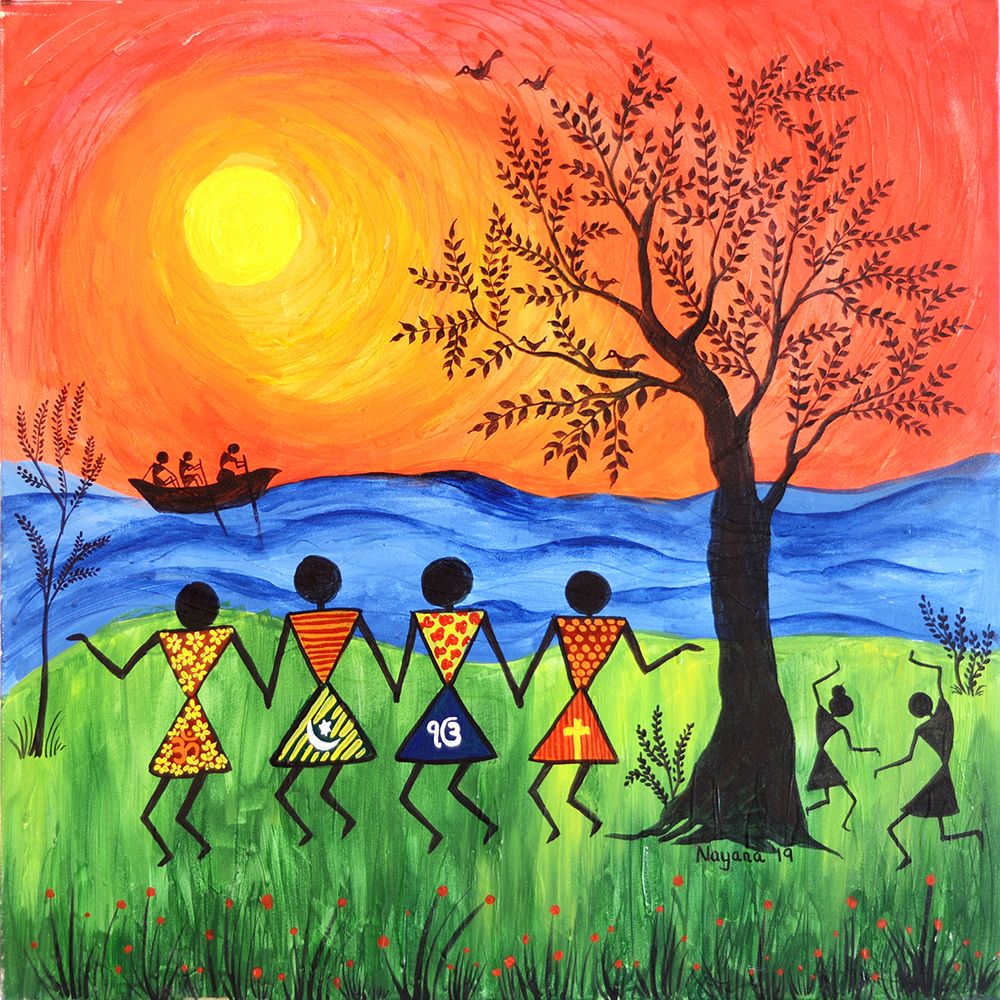
God speaks to us and hears us in our own language, whatever that language may be, and delights in our diversity! We, in turn, are called to exercise what the philosopher Paul Ricoeur called “linguistic hospitality,” rejoicing in our cultural diversity and enjoying the richness of our variety of language, united in the One who prays for us “with sighs too deep for words” (Romans 8: 26).
At Pentecost, the apostles invite others into their community as they are — sharing much in common, devoted to one passion, but maintaining core differences, like language. Oppressive differences like class are broken down, but the things that make us unique are welcomed.
Speaking as a USAmerican, this posture of humility and hospitality goes against everything we are taught here in the imperial core. I can’t dominate you if I know I have a lot to learn from you. You can’t dehumanize me when you acknowledge the value that I alone can bring to the table.
Rejoicing in this expectation-exploding, harmonizing Spirit, let us pray:
Holy Spirit of breath and flame, howling gale and still small voice,
We praise you in your elusiveness, how you whirl through the world wherever you — not we — will.
You dodge every attempt to pin you down, slipping through our fingers like thin air when we try to claim control of you —
yet at the same time, you pulse through our cells with every heartbeat, settle deeper into our lungs with every breath.
As you, Irresistible Wind, pour over us now, set our hearts on fire with passion for your justice, for hospitality and mutuality, for abundance beyond reckoning.
For more on the unique gifts that disabled persons often bring to the table, see Leah Lakshmi Piepzna Samarasinha’s book The Future Is Disabled — or their article on the topic here, where they declare, “At the core of my work and life is the belief that disabled wisdom is the key to our survival and expansion. Crip genius is what will keep us all alive and bring us home to the just and survivable future we all need. If we have a chance in hell of getting there.” ↩︎
“Making a way out of no way” is an expression of Black wisdom frequently referenced by Womanists, as in Monica A. Coleman’s book that uses the phrase as its title. ↩︎
Kittredge Cherry, Jesus in Love: At the Cross, 2018. ↩︎
Year A, Sixth Sunday of Easter, John 14:15-21 & Acts 17:22-31 through a queer & interfaith lens.
Both the John 14 and Acts 17 readings for this Sunday depict a God who is wholly interconnected within Godself and with all humanity (and all Creation). Paul references two Greek poet-philosophers to describe this state of interbeing. We too can respectfully draw from various traditions to get a better picture of what that means.
Key points
Jesus promises not to leave his disciples orphaned, or “fatherless,” and names that he is in the Father and the Father is in him. Exploring this “father” language alongside other terms Jesus uses for himself across the Gospels, we uncover something of the limitations of human language for relationships both human and divine. Jesus, like many queer found families, is taking the words he has available to him and ascribing them with deeper meaning.
The concept that Jesus is in the Parent as the Parent is in Jesus, and that we too are in Jesus as he is in us, has parallels to the Buddhist concept of interbeing. Paul’s reference to a classical Greek philosopher-poet’s words, “In [God] we live and move and have our being,” reiterates this inextricable interconnectedness, or mutual indwelling.
Paul quotes two Greek poet-philosophers to carry Christ’s good news to the Greeks. When we gather as many voices as possible at the table, we are granted grander glimpses of the divine in whom all things “live and move and have their being.”
I’ll be posting an article on one of those references, Epimenides of Crete, soon, exploring the queer resonances in this sixth century BCE sage.
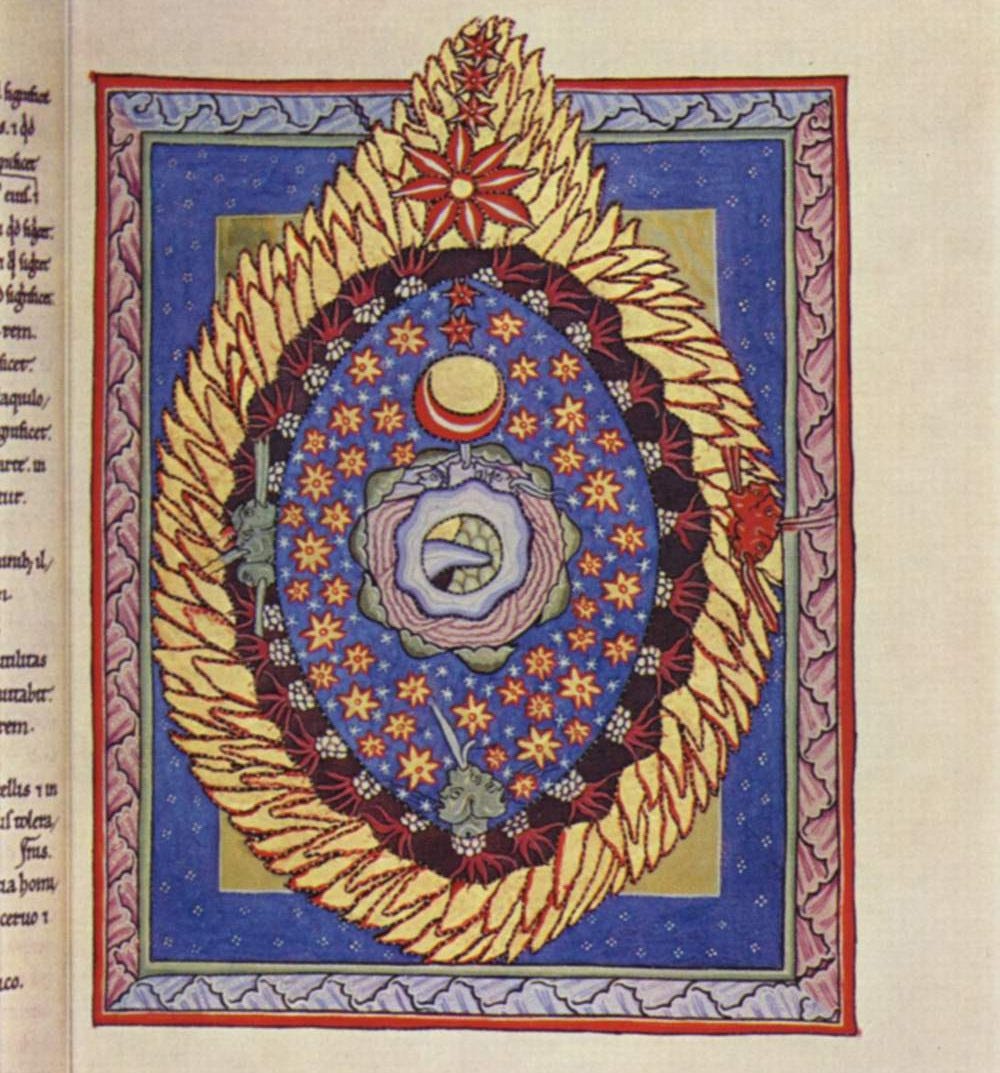
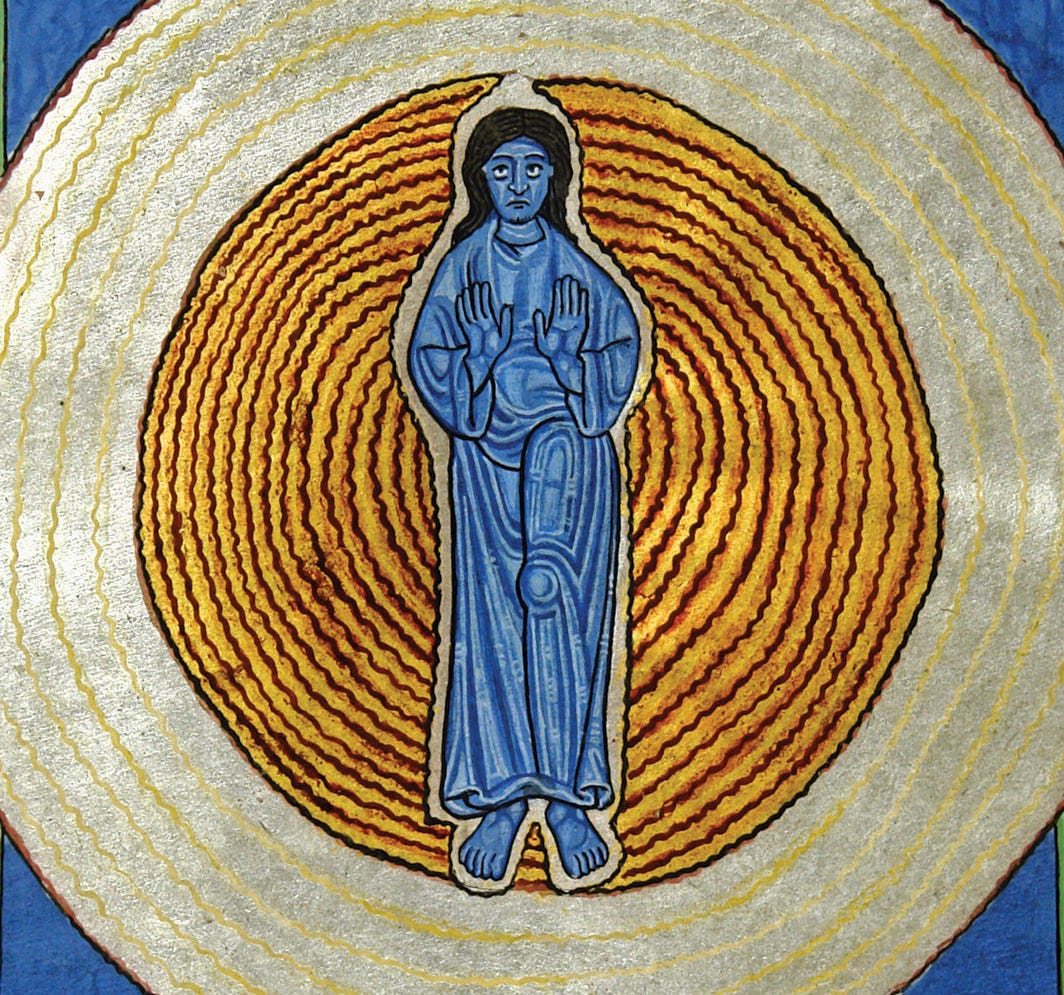
“The Universe” by Hildegard von Bingen, c. 1165 in Scivias. The vulva-shaped cosmos is enfolded in divine fire, which “descended from heaven to earth and…gave help by showing heavenly things to people while they were in their souls and bodies… These people living in their souls and bodies raised the Word up with faithful joy.” Between divine fire is a “globe of reddish fire” that is the “light of burning Love”: “every creature is illuminated by the brightness of the Word’s light.” For more, listen to this.
John 14:15-21
The lectionary continues right where it left off last week, with Jesus’s tender reassurances to his disciples that even though he must soon leave them, he will not abandon — or, as he says here, orphan — them.
“I will ask the Parent, [who] will give you another Advocate, to be with you forever. This is the Spirit of truth…You know hir because xe abides with you, and xe will be in you. I will not leave you orphaned; I am coming to you. In a little while the world will no longer see me, but you will see me; because I live, you also will live. On that day you will know that I am in my Parent, and you in me, and I in you.” – John 14:18-20
The picture Jesus paints here is a queer one, blending relational language and dissolving boundaries.
The limitations of relational language
Shortly, Jesus will tell his disciples that he no longer calls them servants, but friends — which moves him from a higher status of master (the Greek kyrios means master as much as it means lord) to the mutuality of friendship (John 15:15). Meanwhile, Jesus frequently names himself as Son of the Parent God throughout the Gospels. Yet here he promises not to leave his disciples orphaned (from the Greek ὀρφανός, orphanos). The Septuagint uses this Greek word to translate Hebrew’s yāṯôm, “fatherless” — it describes those left bereft and vulnerable due to the loss of either both parents or their father (in biblical iterations of patriarchy, losing your father opened you up to more insecurity and potential exploitation).
If Jesus’s absence could be described as the disciples becoming “fatherless,” then that becomes yet another way to describe his relationship with his followers. He is teacher, friend, father, mother hen, master, servant, bridegroom, God.
In traditional human relational structures, no one person could be all those things to another! But some queer relationships come closer to achieving it. Inqueer found families, the same person might serve as mother and sibling and even lover all at once. To be clear, this is not incestuous! What we are doing is repurposing traditional terms because there are no words in the mainstream lexicon that exactly match what we mean; we use limited language to describe queerly unlimited ways of experiencing each other
…Of course, these queer ways of being in relationship aren’t truly unlimited. But Divinity’s connections both within its Triune self and with its created world might just be!
Jesus as Father or Parent as well as sibling, servant, friend makes perfect paradoxical sense, both through a queer lens and in light of the picture he continues to paint: That he is in the Parent and the Parent is in him.
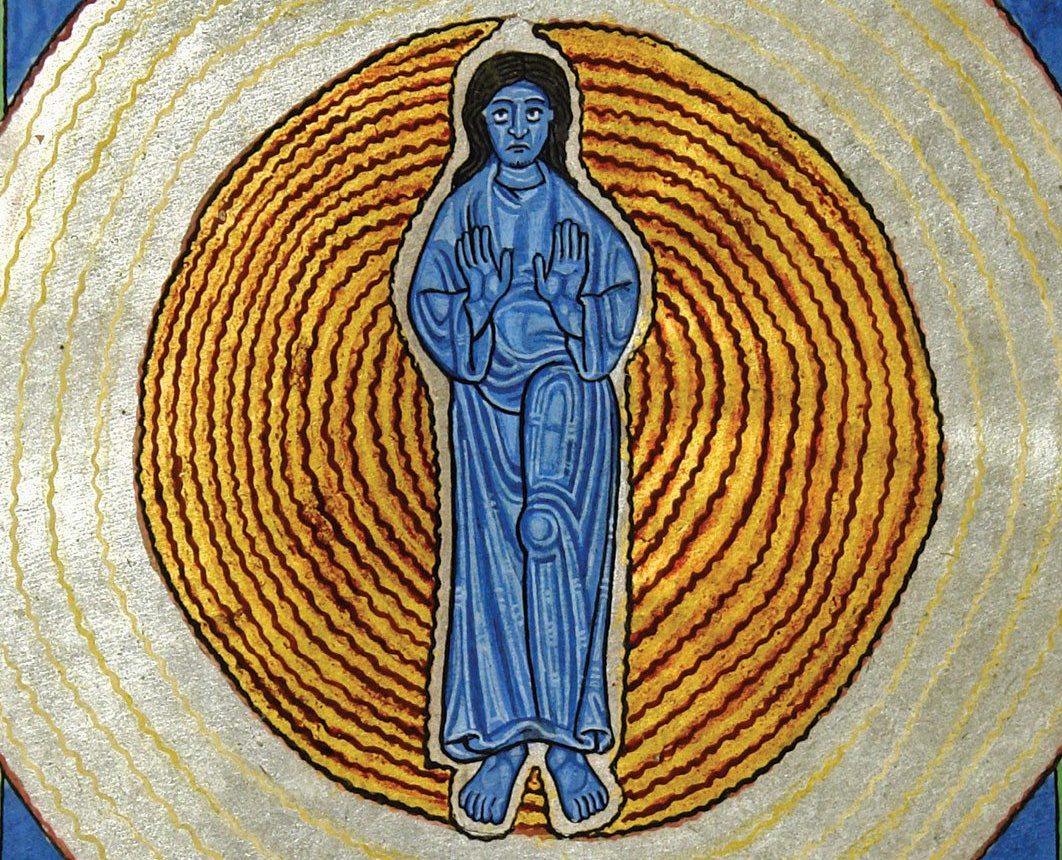
“The True Trinity in True Unity” by Hildegard von Bingen, c. 1165. “Unlike the usual triangular-shaped examples, this one involves nested circles of light. The Trinitarian nature of the divine is hidden under His unity and the emergent figure is God as One.”
And then we are in Jesus as he is in us, which by implication means we are also in the Parent and the Parent is in us — an interconnectedness that would be difficult to draw on paper, as each being involved is both holding and is held by each other being! You might even call this…interbeing!
Interbeing, or the interconnectedness of all things
Interbeing is the term beloved Zen Buddhist monk Thích Nhất Hạnh coined to describe what East Asian Buddhists call perfect interpenetration, complete interfusion, or (and this one sounds very much like Christ’s “I in you and you in me”) — mutual inclusion. Whatever it’s called, this interconnectedness envisions every single thing (every phenomenon, every living being, every atom, etc.) simultaneously and entirely containing andbeing contained by all other things. Or, as Thích Nhất Hạnh puts it after inviting the reader to consider a sheet of paper:
“Everything—time, space, the earth, the rain, the minerals in the soil, the sunshine, the cloud, the river, the heat, and even consciousness—is in that sheet of paper. Everything coexists with it. To be is to inter-be. You cannot just be by yourself alone; you have to inter-be with every other thing. This sheet of paper is, because everything else is.”1
Another metaphor for this complete interfusion is that of Indra’s net, which originates from the Atharva Veda and thus was part of Hindu cosmology before also being adopted by Buddhism:
The net is said to be infinite, and to spread in all directions with no beginning or end. At each node of the net is a jewel, so arranged that every jewel reflects all the other jewels. No jewel exists by itself independently of the rest. Everything is related to everything else; nothing is isolated.2
An artistic rendition of Indra’s Net by Ganesh Rao; click here for the entire gallery. You might also imagine a spiderweb with beads of rain all along it.
Triune interbeing
It’s notoriously difficult to talk of the Trinity without committing one heresy or another (whenever I try, these two grumpy Irishmen pop in my head grumbling That’s modalism, Patrick!). But I think that this concept of interbeing can be employed to get across some of the Trinity’s key aspects: first, that while the Persons of God are indeed three distinct Persons, they are also inextricably One.
Trying to eff the ineffable, we label the three Persons of God things like “Father, Son, and Holy Spirit” or “Creator, Redeemer, and Sustainer” or “Lover, Beloved, and Love itself.” (Note how, as with queer found family, these names sometimes seem to clash “incestuously” — how can Father and Son also be Lover and Beloved? But it’s because we’re using limited human terms to describe the ineffable. The words fail as much as they succeed in helping us grasp God; for instance, “Father” and “Son” traditionally indicates hiearchy and difference in age, neither of which is accurate for the Persons of the Trinity.)
These names certainly describe elements of our Triune God, including some of the distinctions between each Person. However, if we solidify these distinctions too much, attempting to keep the Trinity neat and tidy with firm boundaries between each Person, we cease to speak of a God who is One. No one Person holds sole “dominion” over one quality of the Divine; each Person expresses all qualities. For example, the “Son” also has creative power; the “Father” also sustains all things; the Spirit also brings liberation; and so on.
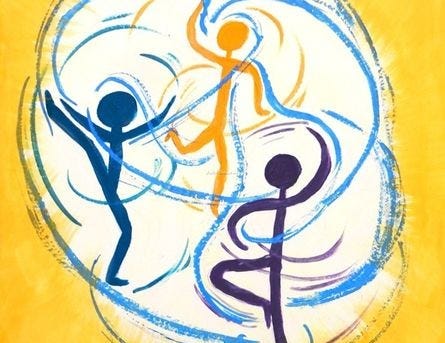
Some of the earliest Christians employed a Greek term to describe this Triune interfusion, or mutual indwelling: perichoresis(from peri, “around,” and chōreō, “come” or “go”). Modern theologians have drawn from this concept the allegory of Trinity as a dance between three partners spinning together so perfectly harmoniously that they begin to blur.
[…P]erichoresis invites us to think in a new way about the very meaning of ‘one’ and ‘personal.’ The oneness of God is not the oneness of a distinct, self-contained individual; it is the unity of a community of persons who love each other and live together in harmony. And ‘personal’ means by definition inter-personal; one cannot be truly personal alone but only in relation to other persons.
Such is the unity and personal character of God the Father, Son, and Holy Spirit. There is a deep, intimate, indissoluble unity between them. They are not three independent persons who decide to get together to form a club (or a dance group!) that might break up if the members decide to go it alone. They are what they are only in relationship to each other. Each exists only in this relationship and would not exist apart from it.
…Father, Son, and Holy Spirit are one social person, for each is with and for the other so intimately that they can be said to live in and through each other.
Interbeing between divinity, humanity, and all creation
The Son is in the Parent is in the Spirit is in the Son is in the Spirit is in the Parent is in the Son ad infinitum; together, they are a perfect community, a perfect relationship.
Yet God chose to create, to let that perfect, self-contained love overflow beyond Godself! Thus we are invited into this perichoresis, this interbeing, invited to recognize the truth of Jesus’s words: “I am in my Parent, and you and me, and I in you” — all bound together with the Spirit, our advocate (or, as the CEB translates, companion) whom God is sending (v. 17) and who has been here all along, from the Beginning.
That’s the picture Jesus paints in this John 14 passage: thedistances of time and space melt away; the boundaries between beings merge and mix!
It’s fitting that the lectionary pairs this passage with Acts 17, in which Paul notes that “God is not far from each one of us” (v. 27b) and that
“In [God] we live and move and have our being.” – Acts 17:28
Acts 17:22-31
The verses of Acts 17 leading up to this week’s passage recount Paul’s flight from alleged persecution3 to Athens, where he spends weeks engaging not only with Athenian Jews, but gentiles as well. Due to their love of new and interesting ideas (v. 21), the gentile Athenians take an interest in his proclamations about Jesus. They lead Paul to Areopagus, where he gets the chance to give “the fullest and most dramatic speech of [his] missionary career.”4
Paul starts by appealing to the Athenians’ spirituality, noting all their altars and shrines — including one dedicated to “an unknown god” (v. 23). He explains that this “unknown” deity is actually the God who “made the world and everything in it” — the Abrahamic God.
Paul, a Roman citizen as familiar with Greek things as Jewish things, smartly finds ways to connect renowned Greek poet-philosophers, quoting two of them:
For ‘In him we live and move and have our being’; as even some of your own poets have said, ‘For we, too, are his offspring.’ – v. 28
The latter half of the verse, “We too are his offspring,” most likely comes from the Stoic philosopher Aratus, who opens his great work Phaenomena thus:
Let us begin with Zeus, whom we mortals never leave unspoken. For every street, every market-place is full of god. Even the sea and the harbour are full of this deity. Everywhere everyone is indebted to god. For we are indeed his offspring …
Paul sure knew how to pick the perfect reference, selecting one that not only supports his point about divinity’s pervasiveness, but is even set in the same scene he and his audience inhabit! Of course, the poem is talking about Zeus, while Paul is winding up for his pitch about the Abrahamic God raising Jesus from the dead.
Meanwhile, in describing a God in whom we “live and move and have our being,” Paul seems to be paraphrasing the sixth-century BCE sage Epimenides of Crete. I have grown short on time to dive into the queer resonance of this prophet; I’ll put out another article soon on how for the Greeks, this sage embodied both the awe and horror of one who is “unnatural” — just as Christ does in exploding the binary between life and death.
Subscribe to be notified when I put out the article on Epimenides!
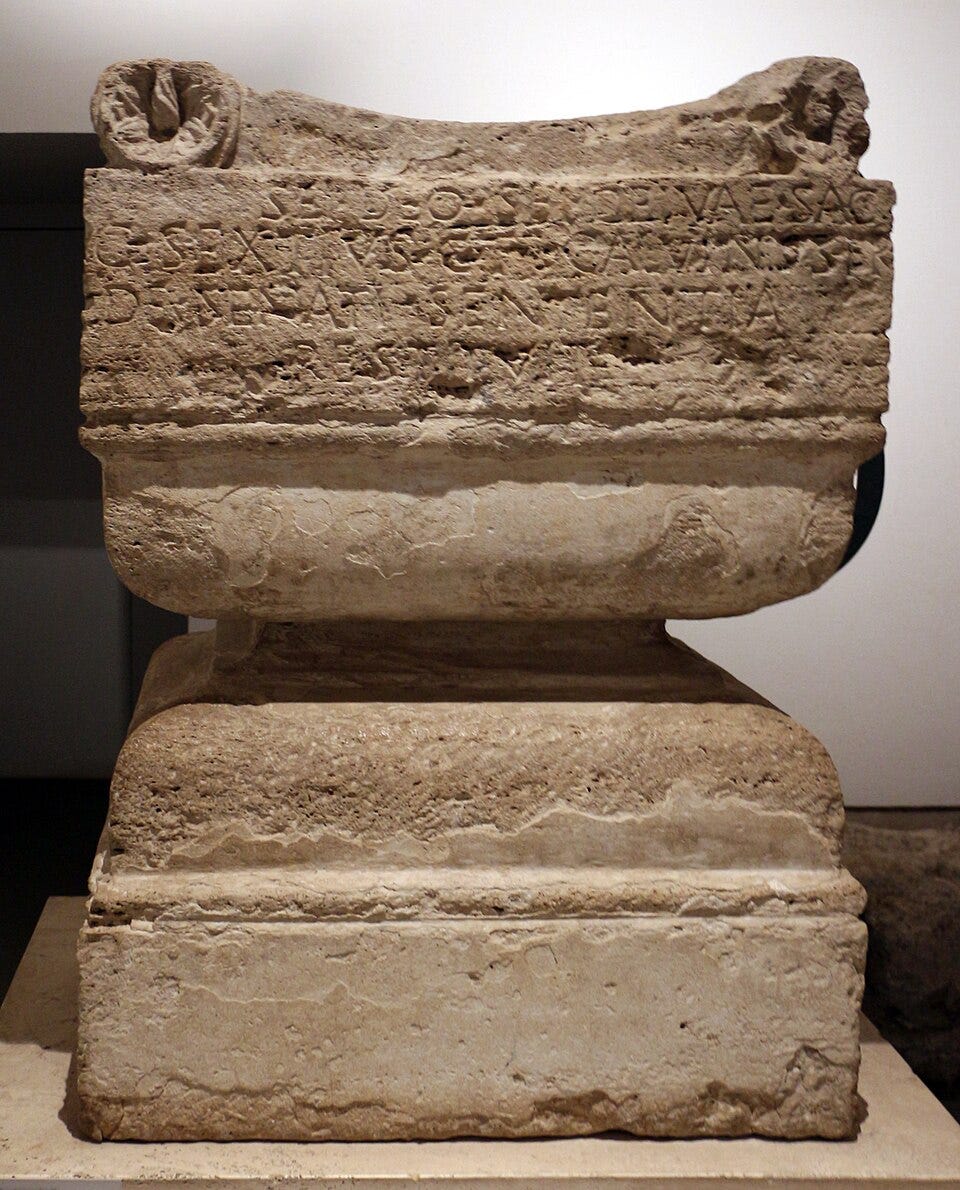
While no altars to an agnostos theos, an unknown god, have been unearthed in Athens, this altar was unearthed on the Palantine Hill. Its inscription reads, “Whether sacred to god or to goddess, Gaius Sextius Calvinus, son of Gaius, praetor, restored this on a vote of the senate.” When purifying Athens of plague, Epimenides ordered the erection of altars in various locations to “whichever god” was god of that location.
At least some of the early Christians recognized this reference to Epimenides, including Clement of Alexandria, who noted that Paul was willing to “attribute something of the truth” to a Greek, a gentile” and was “not ashamed, when discoursing for the edification of some and the shaming of others, to make use of Greek poems.”5
There is somewhat of an air of condescension in both Paul’s and Clement’s words, but I do appreciate the biblical precedent in quoting voices from other religions and cultures. If God truly is the one in whom we all move and live and have our being; if we truly are all interconnected like jewels in a net or raindrops in a web, then the divine pervades all peoples. God’s Spirit, God’s Breath “blows wherever she wills” (John 3:8). Only when we invite all voices to the table do we begin to catch a grander glimpse of God.
Footnotes
Thích Nhất Hạnh, In The Other Shore: A New Translation of the Heart Sutra with Commentaries, 2017. For more on Buddhist conceptions of interconnectedness, check out this article. ↩︎
For information on Acts’ depictions of Jews as violent persecutors of Paul and other apostles and how these depictions have motivated antisemitism across Christian history, give this video a watch. ↩︎
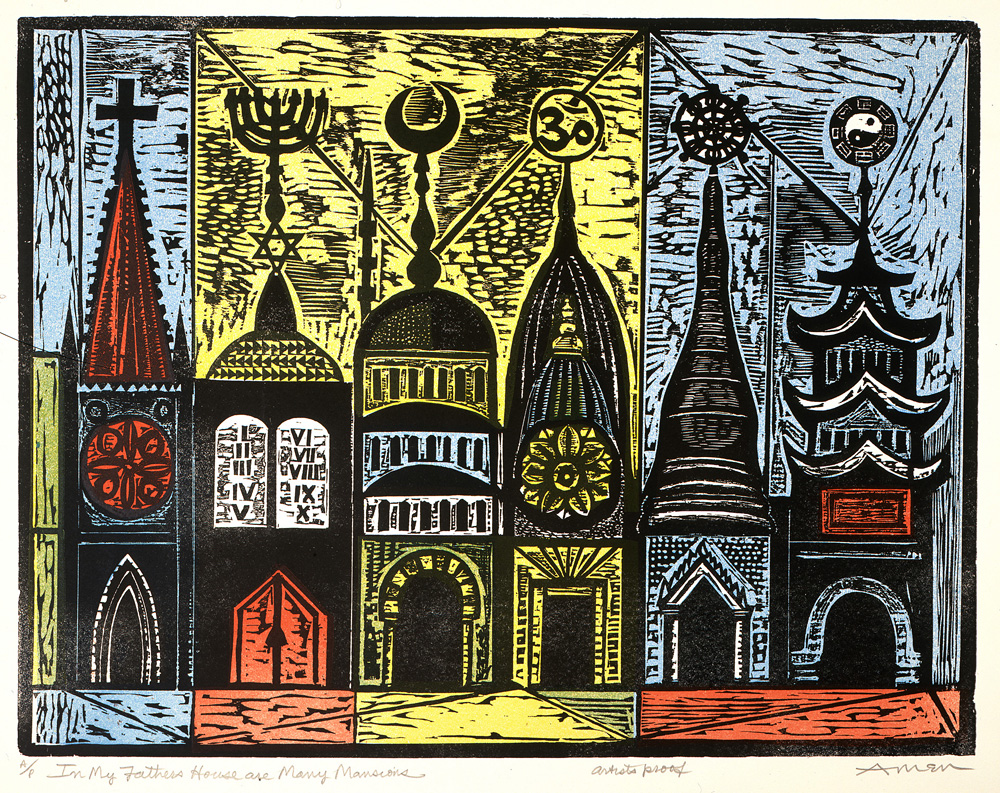
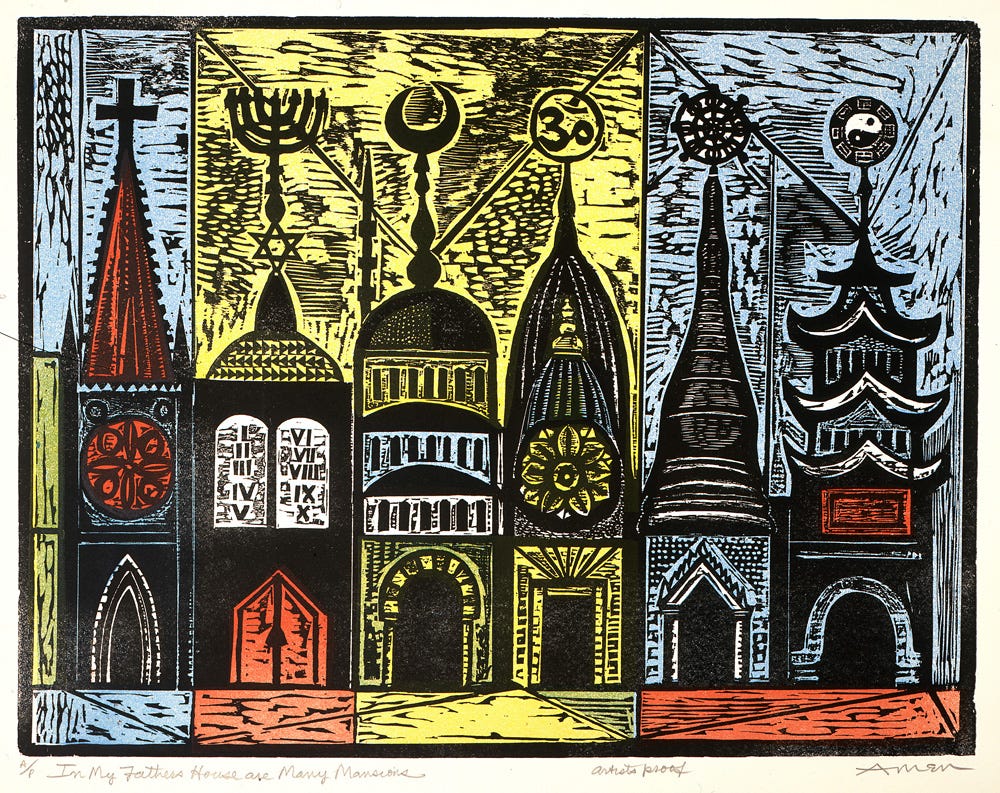
Yes, I’m reusing this image from last week. It fits better here anyhow! “In My Father’s House There Are Many Mansions” by Irving Amen
Year A, Fifth Sunday of Easter. Using a queer lens + addressing anti-Jewish supersessionism.
This Sunday’s readings explore what it means to be followers of the Jesus Way. Is this an exclusive path? Do we supersede the Jewish people as God’s chosen people? (Spoiler: hell no!)
Taking these passages together, we can paint a picture of a Way wherein we dismantle standing structures in favor of building up with living stones, with the rejected stone as the chief cornerstone — creating a Kin-dom home that has room enough for all.
Key points
The passages from Acts 7 and 1 Peter 2 embody the tension present in so many parts of scripture: They offer gorgeous glimpses into God’s Kin-dom, and they lay the groundwork for later Christian antisemitism.
I urge preachers and teachers to name the danger in these texts, rather than simply skirt around it. Address these verses so that your audience won’t fill the void of your avoidance with the assumption that “we” agree with this rhetoric.
At the same time, these two passages can help us explore what it means to be followers of the Jesus Way. We open ourselves to the multitudinous ways God speaks to us through diverse voices. We celebrate the people rejected by the upholders of unjust structures and systems. We commit ourselves to unpacking our biases and learning how to be in solidarity with oppressed peoples, even when we mess up.
And we remember that, as Jesus promises us in the John 14 passage, God’s home has room enough for us all. Everybody belongs. Everybody feasts.
Acts 7:55-60
Queer meditation
But filled with the Holy Spirit, [Stephen] gazed into heaven and saw the glory of God and Jesus standing at the right hand of God. “Look,” he said, “I see the heavens opened and the Son of Man standing at the right hand of God!” But they covered their ears, and with a loud shout all rushed together against him.
How do we respond to divergent interpretations of our shared faith? Are we open to and interested in mutual dialogue, eager to potentially glean new wisdom — or do we cover our ears in horror? Do we let ourselves sit in the discomfort of possibly being wrong (or at least not wholly right) — or shame and shun the “heretic”?
One of my partners grew up in a fundamentalist household in which new ways of understanding God and scripture were received as threats.
Once when he was a teen, he dared to wonder whether every single sentence in the Bible had to exactly reflect God’s will — or whether it might make more sense that human biases entered the text. His father flushed beet red, face twisting as he pointed a shaking finger at his child: “Don’t you dare say that. Don’t you dare blaspheme God under my roof.”
There was rage in his father’s voice — but more than that, there was fear. A real, ferocious terror in what could happen if his child were to rebel against what he believed were God’s truth and will.
Maybe something deep inside him recognized that his faith in a punishing God who despises queerness, deputizes whiteness, and demands perfect obedience was actually quite flimsy — that it was utterly dependent on this understanding of scripture as the literal and inerrant Word of God (with very specific interpretations of said scripture); and that if he were to allow himself to start asking questions, his entire belief system would crumble around him and leave him floundering. And wouldn’t that mean that his whole life had been empty, shameful, wrong? He simply had too much to lose to risk even a shred of doubt or questioning.
…Maybe that’s where his fear came from, maybe not. I think also of the flip-side fear: the terror of growing up being told God hates you, has no options for you but a hollow life or hellfire.
Sometimes the good news of God’s expansive and unconditional love, the holy truth that humanity is intentionally, divinely diverse — how else could we be in the Image of an infinite God? — is received with trepidation rather than relief. Could it be true, or do I just want to believe it’s true to “justify my sin”?1 What happens if I embrace my queerness and it turns out I’m wrong?
We can turn to Thomas Merton and his beloved prayer of unknowing (which matches the John passage we’ll get to later very well):
My Lord God, I have no idea where I am going. I do not see the road ahead of me. I cannot know for certain where it will end. Nor do I really know myself, and the fact that I think I am following Your will does not mean that I am actually doing so.
But I believe that the desire to please You does in fact please You. And I hope I have that desire in all that I am doing. I hope that I will never do anything apart from that desire.
And I know that, if I do this, You will lead me by the right road, though I may know nothing about it.
Therefore I will trust You always, though I may seem to be lost and in the shadow of death. I will not fear, for You are ever with me, and You will never leave me to face my perils alone. Amen.
We can live in fear of new perspectives. Of admitting we were wrong. Of punishment. Of exclusion. Of a scarcity of love and grace.
Or we can place our trust in Divine Wisdom to guide us, in Christ’s mercy to cover us — and take the plunge.
Naming anti-Jewish rhetoric
The above meditation takes the Acts reading as it is laid out for us. But context matters, and Acts 7’s is rather troubling.
So to start with, I urge preachers to provide context for the lectionary passage by summing up the events of Acts 6 as well as Stephen’s speech in Acts 7, especially its closing lines in verses 51-53.
After all, the lectionary passage severs the alleged reason that the Jerusalem Council supposedly stoned Stephen. It’s not just that he’s a Jesus-follower. It’s that he accused them of setting themselves against God’s Spirit (v. 51).
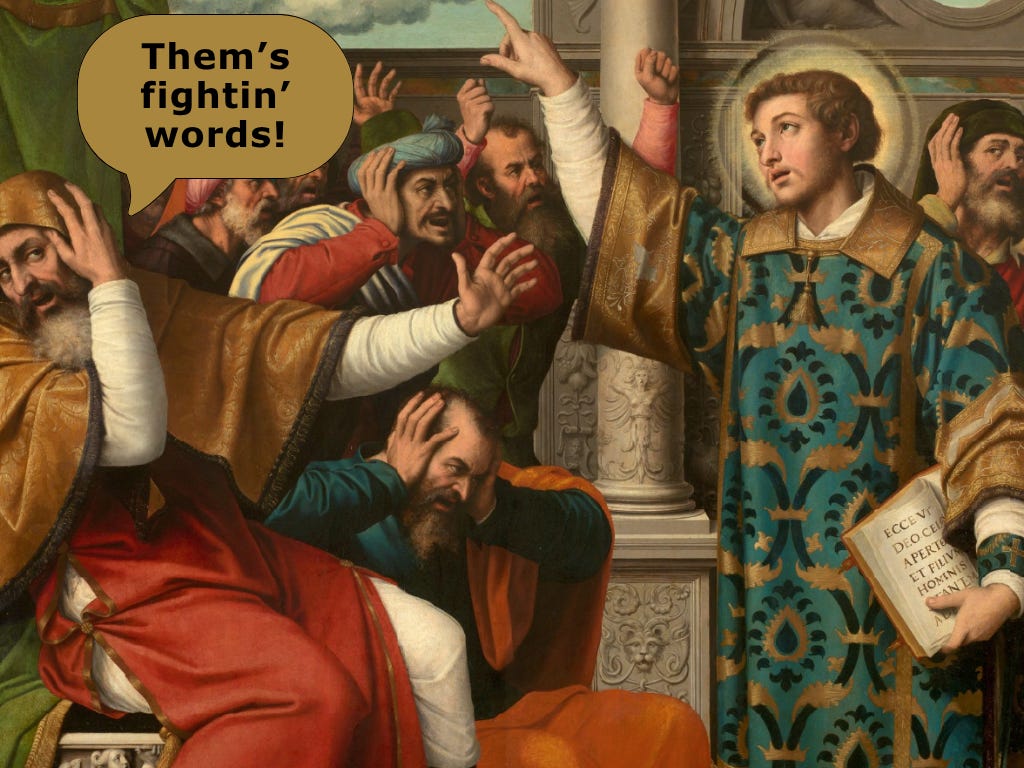
“Saint Stephen Accused of Blasphemy” by Juan de Juanes, 1560s. This is just a silly meme, but the artist’s choice to give the Council members exaggerated noses while depicting Stephen, who is likewise Jewish, with more “European” features certainly highlights the effectiveness of Acts’ rhetoric in distancing Stephen and the other Jewish Jesus-followers from their kin.
When Stephen adds perceived blasphemy to that accusation, proclaiming Jesus stands at “the right hand of God” — that Jesus is himself divine — it’s enough to spur them to violent action.
…Or is it? Did the stoning of Stephen really take place? And if it did, did it occur exactly as the author of Acts recorded it?
As is so often the case, it’s important to note is the possibility of anti-Jewish polemic in this text — inherent to the text, and/or easily produced by our interpretations of it. I recommend this YouTube lecture on the stoning of Stephen, which draws heavily from Shelly Matthews book Perfect Martyr: The Stoning of Stephen and the Creation of Christian Identity. Starting especially around 25 minutes into the video, a shift is pointed out between more positive depictions of the Jerusalem Jews in the first 6 chapters of Acts, and the vilification of non-Christ-following Jews after the account of Stephen’s martyrdom. From that point on, Jewish people are no longer described as the People of God.
Stephen’s own speech highlights this rhetorical distancing of Jesus-followers from other Jews; he opens his speech by naming “ourancestor Abraham” (v. 2), yet ends with:
“You continuously set yourself against the Holy Spirit, just like your ancestors did. Was there a single prophet yourancestors didn’t harass? …” – Acts 7:51-52a
While Stephen is most likely a Hellenized Jew, e.g. one who speaks Greek and holds a lot of Greek culture and values, he is a born Jew. These are his ancestors too! But here the author writes Stephen as setting up an usandthem binary in which Jews with no interest in Jesus are “those people,” stiff-necked and murderous enemies of God Themself.
It’s important to recognize the biases in the NT texts, the context that caused these anti-Jewish polemics. We can recognize that the majority of the NT writers were Jews, that this was for these earliest Christians largely an intra-community conflict, while also naming the harm these texts have done and continue to do. We can experience these scriptures as sites where God’s Word speaks to us, while acknowledging their imperfections as human-written documents. In so doing, we refuse binaries of good and bad, us and them, that don’t leave room for the messiness of human realities.
1 Peter 2:2-10
Continuing to address antisemitism
They stumble because they disobey the word, as they were destined to do. But you are a chosen race, a royal priesthood, a holy nation, God’s own people…
The author of this epistle has such a gorgeous vision of the margins being made central, which I’ll get to in a minute; the tragedy is that he turns that vision into polemic, using his words to sever the Jewish people from their status as “God’s own people” and bestow that title upon Jesus-followers instead.
With passages like these in scripture, it’s no wonder supersessionism — the notion that Christians replace, or supersede, Jews; that our covenant through Christ renders their covenant through Abraham null-and-void — is so prevalent and deeply-rooted in Christianity.
I urge preachers and teachers to name this rhetoric, rather than simply skirt around it. Address these verses so that your audience won’t fill the void of your avoidance with the assumption that “we” agree with the letter writer’s point of view.
Like all of us, the Bible’s authors contained multitudes — their transcendent glimpses into the divine are weighed down by worldly ideologies that say God’s love is a finite resource; that life is a competition; that there can only be one “first,” one “beloved”; that to uplift one group is necessarily to sideline another.
Let’s keep naming that truth as we seek to follow Jesus in ways that bring justice and joy, rather than harm.
And central to the Jesus Way is the declaration that the ones rejected by human structures and systems are the very ones God works in and through! This too is something 1 Peter’s author recognized, as the next section explores.
Queer stones
Come to him, a living stone, though rejected by mortals yet chosen and precious in God’s sight, and like living stones let yourselves be built into a spiritual house… For it stands in scripture: “See, I am laying in Zion a stone, a cornerstone chosen and precious, and whoever believes in him will not be put to shame” […and] “The stone that the builders rejected has become the very head of the corner.”
This passage is very queer indeed. A stone rejected by the builders becomes the chief cornerstone! The ones who fabricated the structures that enclose us all are not the ones with the final say — God is!
The God of the stranger, Liberator of the oppressed, the One who always chooses to stand outside any dividing line we draw between “us” and “them,” finds that castoff rock and makes it central, indispensable:
[The] members of the body that seem to be weaker are indispensable… God [gives] the greater honor to the inferior member.
We the shunned and shamed ones, we who are considered to be “no people” (v. 10) — nobodies — become the living stones with which Divinity constructs a new Creation.
We whom dominant cultures despise create our own cultures — queer culture, Black culture, disability culture, and more — where our unique gifts and ways of manifesting God’s love to the world are uplifted.
We are Christ’s hands and feet on earth, helping usher in a Kin-dom in which the last are first, the margins are drawn to the center, and all dividing walls are dismantled, piece by piece.
Babies in Christ: we learn along the way
Like newborn infants, long for the pure, spiritual milk, so that by it you may grow into salvation — if indeed you have tasted that the Lord is good.
When we taste that God is good, we grow hungry for more. One major way we taste that divine goodness is when we look to the poor for God’s good news and join in liberation movements with the captive and oppressed (see Luke 4:18-19). By becoming co-conspirators with those “living stones” God centers in the building up of Their Kin-dom, we are submerged in Spirit.
Peter doesn’t elaborate on “spiritual milk” in this chapter, but Paul does in his first letter to the Corinthians:
…I could not speak to you as spiritual people but rather as fleshly, as infants in Christ.I fed you with milk, not solid food, foryou were not ready for solid food. Even now you are still not ready, for you are still fleshly. For as long as there is jealousy and quarreling among you, are you not fleshly and behaving according to human inclinations?…
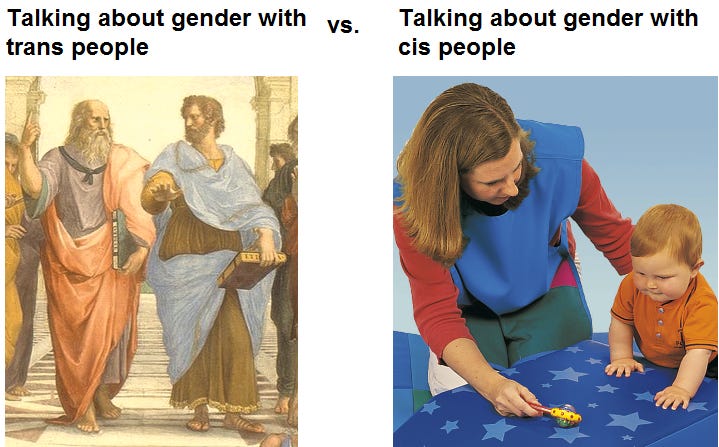
This old-school trans meme identifies a truth about what it’s like to start down the road of solidarity with any oppressed group to which we don’t belong: We are like babies! (But babies with capacity to cause harm.)
As we unpack the presumptions, prejudices, and skewed perspectives we’ve been absorbing since birth, we’re left with big gaps in knowledge. We finally know how little we know.
And as we live into a commitment to true solidarity with the oppressed, we mess up. To step up is to mess up, over and over — and remain committed to making amends and continuing to show up.
Back to John 14
Thomas said to him, “Lord, we do not know where you are going. How can we know the way?” Jesus said to him, “I am the way and the truth and the life.”
As we devote ourselves to uplifting the stones rejected by the builders and keepers of our unjust systems, as we grow in our purpose as the living stones God uses to build up Their Kin-dom, how do we know we are headed in the right direction? What happens if we get it wrong?
I think again of my partner and his father. The feral fear of fire and brimstone awaiting the ones who believe wrong, let alone do wrong.
But God doesn’t await us with hellfire. God waits to welcome us into Their home with open arms:
“Do not let your hearts be troubled. Believe in God; believe also in me. In my Father’s house there are many dwelling places. If it were not so, would I have told you that I go to prepare a place for you? And if I go and prepare a place for you, I will come again and will take you to myself, so that where I am, there you may be also.”
I hear so much tenderness in Jesus’s voice here. He knows his friends are anxious and uncertain about what the future holds, so he paints them a picture of where their journey is headed: Past the terror and trouble, there is a beautiful home where a place has been prepared for us. For you! for me! — and not just for “us,” but for “them” as well.
Here we find the antidote to the supersessionism in the story of Stephen’s martyrdom and Peter’s first letter. In those two readings, there is an assumption that God can have only one favorite. Only one people. That as the divide between the followers of the Jesus Way and Jews with no interest in Jesus grew, it necessarily required a dethroning of Jews as God’s chosen people so that that title could belong to Christians.
That myth of scarcity sure has been around a while, huh?
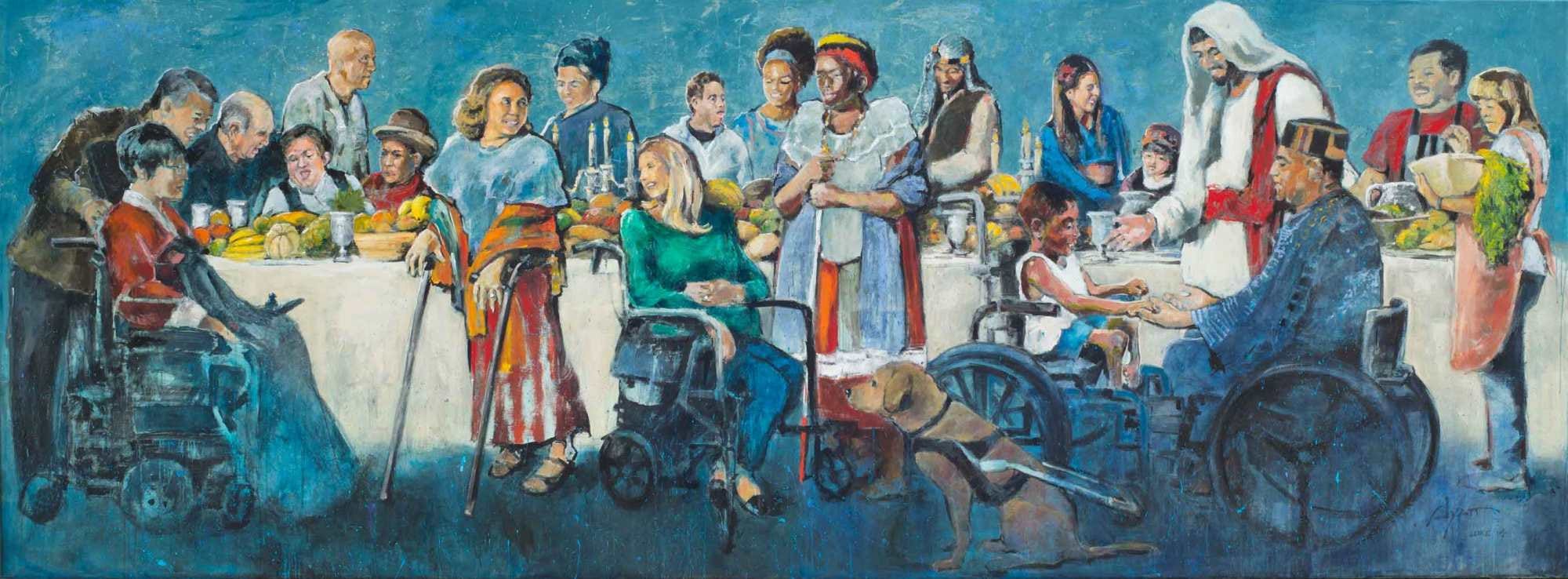
Jesus tells a different story: God’s home has rooms, has room, for everyone. Everyone!
The very nature of God is overflowing love — infinite love, love enough to go around and still spill over. Just like we saw last week, Jesus ushers in life abundant — there is plenty for all.
No one gets scraps — everybody feasts!
Thanks be to God.
Art by Ayeola Omolara Kaplan. Audre Lorde’s powerful words can help guide us as we deconstruct and rebuild: We do not dismantle unjust systems by using the same tools of exclusion and exceptionalism, purity and punishment, suspicion and shame that built them in the first place. Thus antisemitism, Christian nationalism, and other key components of the white supremacist project have no place in the Kin-dom God is building with and in and through us.
So many of us get told we’re “reading into” the Bible what we want to see there. But there are other ways of understanding our relationship to the Bible! Visit here for my framework on understanding scripture — particularly the last section, “You’re just reading into it.” ↩︎
If I had to pick a favorite single Bible verse that isn’t part of one of my favorite passages, John 10:10 would probably be it. In many ways it encapsulates Jesus’s ministry and purpose — what he is for, and what he is against. In other words, it names what Christ’s salvation actually is — what we’re saved from, and what we’re freed for.
Jesus is for life abundant — or, as the CEB translates it, “life to the fullest.” The Greek adverb he uses is περισσός (perissos), which has an intensity to it, a vehemence, a sense of excess. One might also translate it “excessively” or “overflowingly.” Because it has that prefix peri, one source1 suggests you could even translate it “all-around.”
However you translate it, it’s clear that Jesus’s liberation is all-encompassing, is holistic, floods every area of our lives, individual and communal. We aren’t freed just to survive, but truly and fully live.
As a queer person, this truth set me free to pursue the things I needed to live fully.
It’s possible I could have eeked out a shell of a life constrained to my assigned gender, in a body I felt utterly severed from rather than experiencing my body as me. (It’s also very possible I couldn’t have survived that way; one of the violent fruits of nonacceptance and restricting trans people’s access to affirming healthcare is suicide.) However, I could not have lived life to the full that way. I would not have experienced Christ’s salvation holistically. I wouldn’t be open to the divine presence in my body, mind, psyche, and relationships with other people and all living things.
Embracing my trans self, daring to fall in love with someone of my assigned sex, discovering the power of queer community — these are some of the things Jesus liberated me for; these are the things that have brought me into life that overflows outward, joyously spilling out into my connections with everyone and everything.
Liberated from
In this example from my own life, we also see what kinds of things Jesus liberates us from — the thieves that break in to steal our joy and destroy our peace, who attempt to rob us even of our inherent dignity as creatures made in the divine image.
Any person or group that preaches Jesus’s salvation only as something we’ll experience in some abstract heaven, that denies the divinity in flesh and dirt and the everyday mess and miracle that is embodied life, is one of these thieves who threaten to destroy us.
Those who seem to hold nothing but contempt for this life, to hate this world — who seek to control other bodies and minds as well as the created earth, to constrain sexuality, to bring shame and fear and starvation of body and spirit — work against the abundant life Jesus came to bring. Even and especially when they do so in Christ’s name.
caption…
“Us” and “them”
I’ve been saying “we” and “they” in too vague a way — who are “we,” the sheep whom Jesus the gate protects and guides into flourishing?
Whether the Gospel writer meant Jews, or early Christians, or something else when writing about Jesus’s “flock,” the verses leading up to verse 10 make it clear that the evangelist doesn’t mean all humanity; it’s a limited group. So did Jesus come to bring abundant life, life to the full, to his followers alone?
If we continue reading beyond the lectionary passage, the question of who gets included in this overflowing abundance expands exceedingly:
“I have other sheep that don’t belong to this sheep pen. I must lead them too. They will listen to my voice and there will be one flock, with one shepherd.” – John 10:16
In her book Holy Envy: Finding God in the Faith of Others, Barbara Brown Taylor refers to this passage to explore salvation beyond Christianity. God’s liberation, the abundant life that we as Christians believe Jesus came to bring into the world, is for all people.
At the same time, Taylor warns us against disrespecting our non-Christian neighbors when naming this not-Christian-exclusive, universal liberation:
“Once my holy envy led me to ask more of my tradition than the narrative of exclusive salvation and everlasting triumph, I began to search for counternnarratives that sounded more like Jesus to me. In particular, I looked for stories that supported Christian engagement with religious strangers — not as potential converts but as agents of the God who transcends religion and never met a stranger. …
In Judaism they are called ‘righteous gentiles.’ I do not know what they are called in Christianity, but Jesus receives them more than once, whether they come from Samaria, Syrophoenicia, Canaan, or Rome. …
If it is easy for Christians to overlook the ‘otherness’ of these religious strangers, then I think that is because we assume that once they enter our story they never leave it. In gratitude for their blessing, we baptize them as anonymous Christians. We make them one of us. A few do join us, but this is not the norm…”
Rather than declaring John 10 is evidence of “anonymous Christians” — Karl Rahner’s idea that non-Christians who sincerely seek to live ethical lives are essentially living as Christians and thus included in Christ’s salvation2 — perhaps we can focus less on the hypothetical details of Jesus’s gate and shepherd analogies and more on its overarching sense of radical inclusion and belonging.
As Taylor explains, Jesus does not elaborate on these many sheep of other flocks, but we can imagine a “God of many sheeps, many folds, many favorites, many mansions.” With this good news, we are challenged to engage respectfully with people of all religions and values, and work towards their abundant life as fervently as our own.
“In My Father’s House There Are Many Mansions” by Irving Amen
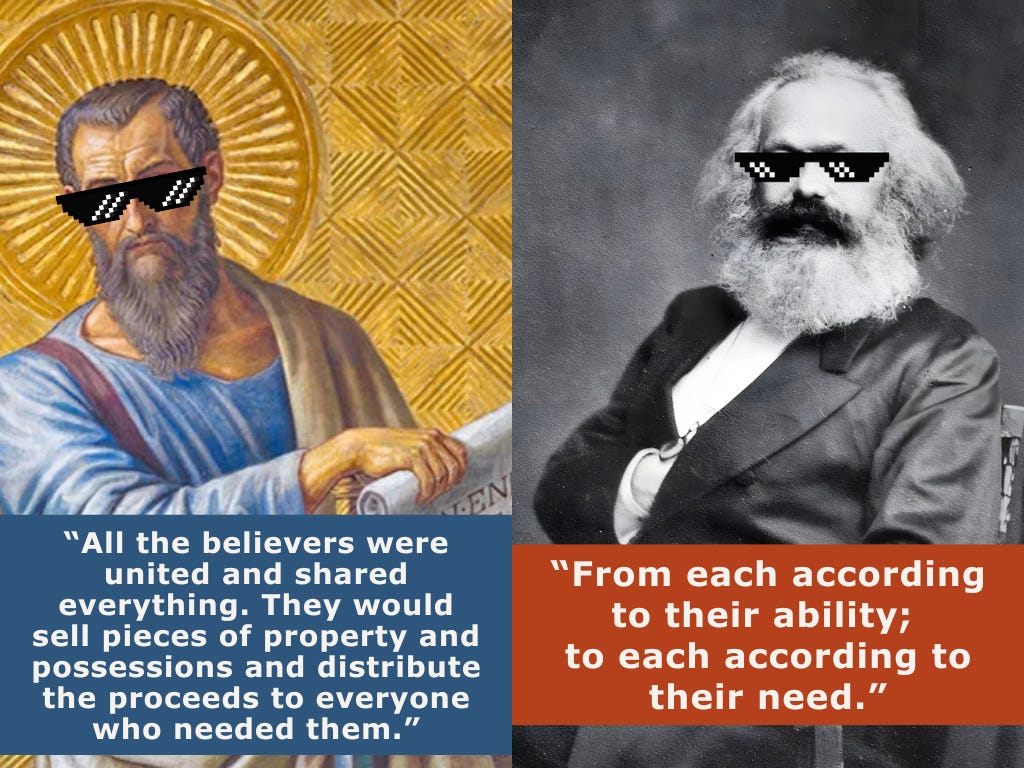
And that leads us to the anarchy and mutual aid of Acts 2:42-47!
I know that for many, the term anarchy evokes visions of Heath Ledger’s Joker who “just wants to watch the world burn.” But the anarchists I hang out with are deeply committed to the world’s flourishing, believing that true equity and justice can only be achieved by removing all hierarchy.
An anarchic community has no central leaders. Decisions are made communally. Resources are shared equally. A core component to anarchy is a complete leveling of class, the systems by which the few wield power over the many. There’s no bigger threat to Empire. To white supremacy. To capitalism.
In Acts and various Pauline epistles, we see an effort to dismantle hierarchies, reflecting Mary’s Luke 1 proclamation that God lifts up the lowly and casts down the powerful, fills up the hungry and sends the rich away empty.
Here in Acts 2, the rich Jesus-followers liquidate their wealth and distribute it among the poor Jesus-followers, effectively making themselves one of the poor. What a radical act of faith and commitment to true equity!
The mutual living, or koinonia, of this community reminds me of one disabled activist’s care webs.
In texts like Care Work: Dreaming Disability Justice, Leah Lakshmi Piepzna Samarasinha describes webs of care that they have participated in among other disabled queer and trans BIPOC — i.e., people who are failed by the government and institutions, by school and church and even family, and who therefore know deep in their bones that only “We keep us safe.” Because disabled persons often need to figure out mutual aid in order to literally survive, Piepzna Samarasinha explains, the disability community has much to teach everybody about how to live into mutual care.
The first such care web Piepzna Samarasinha helped form came together when “three disabled queer Asian femmes” were prepping to travel to a conference and going through the “very common disability experience” of “having your freak-out about how badly the whole thing will fuck up your body.” They decided that instead of choosing “between handling our access needs on our own or crossing our fingers that the conference and the airlines would come through to take care of us,” they would “experiment in coming together and caring for each other,” with powerful results:
We didn’t just survive the conference—we made powerful community. Committed to leaving no one behind, we rolled through the conference in a big, slow group of wheelchair users, cane users, and slow-moving people…People got out of the way. Instead of going out to inaccessible party sites, we chose to stay in, and ate and shared about our disabled lives. For some of us, it was our first time doing that. People cried, flirted, and fell in love.
…It was just four days, but people went home to their communities transformed.
We were no longer willing to accept isolation, or a tiny bit of access, or being surrounded by white disabled folks as the only kind of disability community we could access, or being forgotten. …We came back less willing to accept ableism from conferences and community spaces, because we knew it could be different—and if CCA could happen in someplace with scarce physical resources like Detroit, it could happen anywhere. Being part of that wild pack of slowness, talking tentatively about our disabled lives in ways we’d never said out loud before, changed everybody’s lives.
Of course, these care webs are never perfect. Piepzna Samarasinha describes how many fall apart due to unresolved harm, disagreements, or other interpersonal conflict. But they’ve never seen that as a reason to give up on the concept altogether:
“[T]he struggles we hit weren’t failures or signs of how inadequate we were but incredibly valuable learnings. …[O]ur struggle to figure these questions out is at the heart of our movement work. CCA [a disbanded care web] is another worthy, imperfect model in my body’s archive, one I build on as I build care in my life now.”
We can say the same for the earliest communities that sought to live by Jesus’s example, in and through and as Christ’s body.
The early Church did not live out Acts 2’s vision perfectly.
“First of all, when you meet together as a church, I hear that there are divisions among you, and I partly believe it. 19 It’s necessary that there are groups among you, to make it clear who is genuine. 20 So when you get together in one place, it isn’t to eat the Lord’s meal. 21 Each of you goes ahead and eats a private meal. One person goes hungry while another is drunk.” – 1 Corinthians 11:18-21
Eavesdropping on Paul’s first letter to the Corinthians, we learn that the Corinthian community of Christ-followers is not living the way Acts 2 claims the Jerusalem community was living. Instead of unity, they form cliques. Instead of divvying up resources, some eat richly while others go hungry.
None of us manages to live into our own values all the time. Paul is as human as the rest of us in that matter:
At some points, Paul seems to possess a transcendent glimpse of a Kin-dom that demolishes the systems that pit one ethnicity above another, that enslave some and empower others to dominate, and that situate men over women and all other “non-men.3
At other points, Paul (if Paul is indeed the author of these passages) clearly retains the biases he’s spent a lifetime absorbing. Take Ephesians 5 and 6, where Paul instructs wives to obey their husbands (5:22) and enslaved people to obey their masters (6:5). He does so while acknowledging that God does not classify people by status (6:9), seeming not to notice the cognitive dissonance in therefore reinforcing these hierarchies of sex and class.
Paul, if you believe that God’s Kin-dom is one in which these human hierarchies are no more, live into that now! For God’s Kin-dom isn’t just a far-away dream; it’s here, and we are the midwives tasked with delivering it.Paul, as you tell us, don’t conform to worldly systems and structures — be transformed by the renewing of your mind, constantly reassessing your presumptions and beliefs through the lens of Christ’s words and actions.
Decolonizing one’s mind is a lifelong effort.
Just when we think we’ve unpacked all the biases we’ve been absorbing from birth, we mess up again, cause harm. Thus it is essential to keep paying attention, to keep listening to those whom unjust systems place under us — so that we might partake in both the daily work of lifting up the oppressed and casting down the powerful, and the big-picture struggle to completely dismantle the systems that created poor and rich, oppressed and oppressor, powerful and disempowered.
In essence, let us always strive to be Christ’s hands and feet on earth, living in ways that bring life — full, abundant life that spills over into all things! — to ourselves, to each other, and even to those we think of as “other.”
https://biblehub.com/greek/622.htm. I’m not a fan of HELPS Word-studies in general, or the Discovery Bible that produces them, but I did find this “all-around” translation option intriguing. ↩︎
Admittedly, this explanation of “anonymous Christians” is oversimplified and Rahner himself would probably have a bone to pick about how I’ve summed up his concept. Go read his own writing for more depth. ↩︎
“There is neither Jew nor Greek; there is neither slave nor free; nor is there male and female, for you are all one in Christ Jesus.” – Galatians 3:28↩︎
One way we might interpret the disciples’ inability to recognize Jesus is by looking at how cultural expectations shape what we see and fail to see.
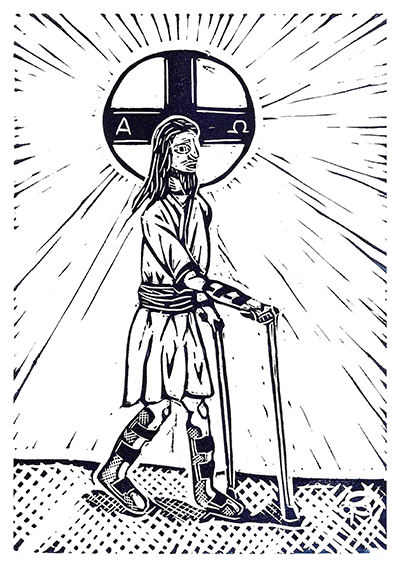
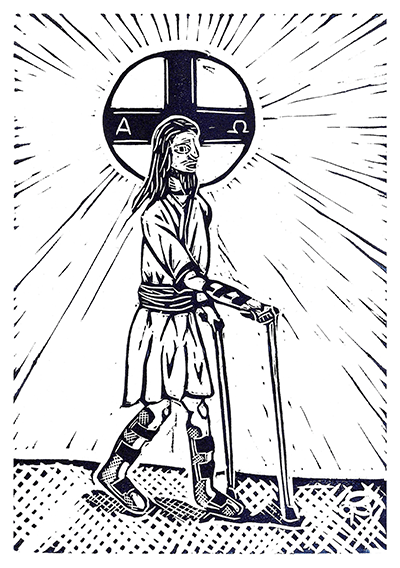
Perhaps the risen Christ’s wounds cause him to walk differently than he used to — slowly, haltingly, with a cane. Just as the blind man isn’t recognized by his neighbors once he becomes sighted, perhaps no one recognizes Jesus because he has become more visibly disabled. They don’t expect to see Jesus alive, or the divine in a disabled body — so they don’t.
When trans people transition, loved ones often “grieve” the person they “lost.” But you didn’t “lose a son”; you gained a daughter! Your beloved is not dead — they are becoming ever more alive!
The Emmaus story of Luke 24 reminds us that there are more disciples than just the Marys, Martha, and the main 12: Cleopas and an unnamed Jesus-follower are the ones to whom the risen Christ first appears.
And they fail to recognize him. Or, as verse 16 puts it, their eyes were “prevented” from recognizing Jesus — what’s that all about?
The Greek root for that word “prevented” is κρατέω (krateó), which more literally means “take hold of,” “take control of.” The passive voice used in this verse begs the question, taken control of by what/whom?Many, many people have speculated, but here’s my queer/crip reading:
It’s normativity that has taken control of the disciples’ gaze.
When you are trans or disabled, people frequently misperceive you; they see what they want to see, what they expect to see.
Cisnormativity tells us that humans come in two and only two types — woman and man. Our brains have been trained to categorize every person we encounter into one of those two boxes so rapidly we don’t even notice it’s happening unless. If you haven’t done the work to truly retrain your brain to understand that anyone of any gender can look like anything, you will fail to see us for who and what and all we are.
Ableism tells us that disabled persons are not whole human beings, that a disabled life is a tragic life. Wheelchair users, d/Deaf persons, people with intellectual disabilities, and others frequently report being talked over as if they weren’t there, or down to as if they were a baby. When we find a disabled person who is simply, you know, living their lives — making dinner, getting married, hiking, having kids, writing poems — we turn them into inspiration porn because in society’s eyes, disabled achievement, disabled genius, disabled joy is an anomaly. In reality, actor and playwright Neil Marcus tells us, “Disability is not a brave struggle or ‘courage in the face of adversity.’ Disability is an art. It’s an ingenious way to live.”
So what form did Jesus come in that the disciples’ eyes simply couldn’t process him as Christ?
As I brought up for John 20’s story of Thomas, disability theology proclaims a risen Christ who is disabled, whose crucifixion wounds would have been impairing wounds. The feet that carried Jesus across the entire Palestinian region now bear the wounds of crucifixion — his gait, his posture, his movement forever transformed.
Maybe the “stranger” who joins these two on their way walks differently than Jesus did before his death. Maybe he uses a cane. Moves slowly, haltingly, as if relearning how to walk.
John 9’s story of the man born blind was in the lectionary just a few weeks ago. In that tale, a man born blind is no longer recognized by his neighbors once he becomes sighted. They don’t expect a blind man to suddenly see — so they don’t see him. More importantly, they don’t expect a blind man to act with agency, to speak up for himself, to be anything but the street corner beggar — so they don’t believe him. Insist on getting his parents so that they can confirm his identity.
I imagine something similar is happening here on the road to Emmaus. They don’t expect to see Jesus alive, or the divine in a disabled body — so they don’t.
When do they finally recognize Jesus? When he breaks bread with them.
Perhaps Jesus has a certain way of saying the blessing, or of holding up the loaf as he breaks it; perhaps he puts so much warmth into his words that logic and biases simply crumble apart as he does so. Yes, Jesus is dead. Yes, this man moves differently than Jesus did. Nonetheless this isJesus! “Were not our hearts strangely warmed within us?” The heart burns past presumption.
A Queer joy: What we see as death is sometimes new life
The lectionary reading ends with these two disciples going to tell the others about their encounter with Christ, only to find that the others are already talking excitedly amongst themselves because Jesus appeared to Simon too! But I recommend reading a couple verses longer:
36 While they were saying these things, Jesus himself stood among them and said, “Peace be with you!” 37 They were terrified and afraid. They thought they were seeing a ghost.
38 He said to them, “Why are you startled? Why are doubts arising in your hearts? 39 Look at my hands and my feet. It’s really me! Touch me and see, for a ghost doesn’t have flesh and bones like you see I have.” 40 As he said this, he showed them his hands and feet. 41 Because they were wondering and questioning in the midst of their happiness, he said to them, “Do you have anything to eat?” 42 They gave him a piece of baked fish. 43 Taking it, he ate it in front of them.
There is a tenderness in how Jesus addresses his friends. He knows they don’t get it; in coming back to life, he’s exploded the very definition of death. So he guides them — to touch, to see, to understand.
A narrative I hear too often from the families of a trans person who has begun to live into the fullness of who they are is that of death. You cannot conceive of someone you’ve always seen as one gender — with all the expectations and familial roles tied into that gender — being anything else. So you grieve as if that person has died — but the reality is that their loved one is finally becoming more and more alive. Becoming more and more themselves.
Once your eyes adjust, you’ll see your loved one is still who they always were — just brighter, lighter, freer. Pay attention, and you’ll know them in their “breaking of the bread” — their quirks and passions, laughter and memories.
Perhaps one day they’ll share an old inside joke and — oh, I see now! It is you!! — and your heart will be strangely, surprisingly, stupendously warmed.
God comes to upturn our every expectation. Blessed are the ones who see past presumptions, who break beyond binaries, who remain steadfast even when the world flips upside-down.
For the Easter Season, I want to offer brief * commentary on each week’s lectionary readings through a liberative lens — largely from my perspective as a trans, disabled Christian scholar, but also drawing from other liberationist traditions. The goal is not to write my own extended essay each week, but to prompt preachers and other worship leaders to incorporate some of these ideas into Sunday worship.
*…I say brief, but John 20:19-31 is my favorite Gospel passage to preach on so this one’s gonna get a little lengthy!
In rising with a physical body that retains its crucifixion wounds, Jesus demonstrated once and for all that our flesh is good, is part of what it means to be in God’s image; and that stigmatized bodies — especially disabled bodies — are not incompatible with divinity, but rather are intimately entwined with divinity.
Presumably Jesus had the power to rise in spirit alone, but instead he keeps his wounded body. Why?
Having entered the material world, Jesus understands the human need for evidence we can experience with our senses. All throughout the Gospel of John, Jesus made use of things people can touch and taste and see – water and bread, vine and branches, baptism and the washing of feet – to embody the less tangible aspects of himself.
Jesus fed and cared for people’s bodies as well as their spirits, because he too is human, he too knows that sometimes we need to reach out and touch the Divine in order to believe. So Jesus holds out his hands, he offers his side, so that Thomas can see, can touch, can then proclaim “My Lord and my God!”
I believe Jesus also kept his body so that he can keep experiencing, with us, all that comes with having a body. He’ll still feel the breeze on his sweaty brow, feel the tug of hunger and the satisfaction of a full stomach, laugh and weep and sing with friends who hug and hold him.
He keeps his body to remind us that physicality is good. He keeps his body for the sake of all who have been told that they should hate their body, should punish it, should avoid its natural pleasures and healthy desires.
If Jesus — who is goodness itself, who is God themself — retains his body, we must conclude that physicality is part of our goodness. We are not spirits trapped in flesh prisons — we are embodied spirits, inspirited bodies.
And if that’s the case, then we cannot avoid learning to love our own bodies and learning to celebrate the amazing diversity of our species with the excuse that it’s all transitory! Our diversity is vital to our humanity. Embodiment is here to stay.
And what about the fact that Jesus not only retained his flesh, but retained the marks of crucifixion upon it?
Disability theology: The resurrected God is disabled
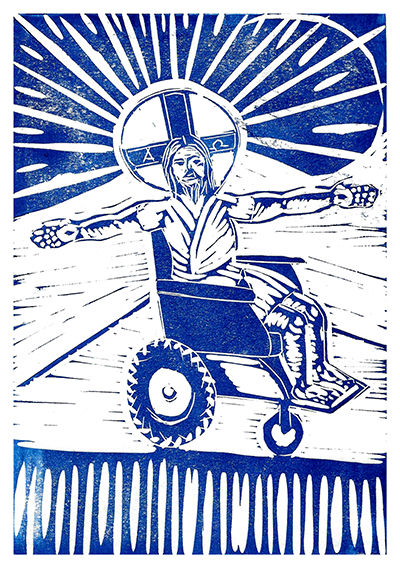
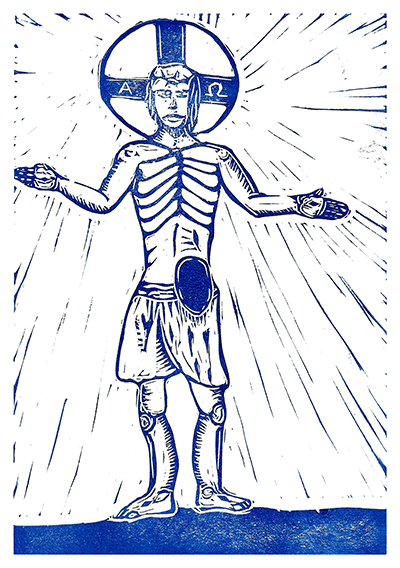
“Jesus with a Stoma” by Rachel Holdforth“Braced Christ” by Rachel Holdforth
Across the Roman Empire, crucifixion was a shameful death, a criminal’s death. For Jesus’s people, those “hanged on a tree” were cursed by God (Deuteronomy 21:23). And this is how the God incarnate, the Creator of the universe, died!! No wonder Paul describes Christ crucified as a scandal to Jews and foolishness to Gentiles (1 Cor 1:23).
For many Christians, disabled bodyminds are a site of scandal and shame. Drawing on the Gospels’ healing narratives, disabled persons may be accused of not having enough faith if and when efforts to miraculously remove their disabilities fail. When we envision the Kin(g)dom of heaven, do we imagine disabled people front and center? Or do we see disabled bodyminds as signs of a fallen world, things to be eradicated in the world to come?
While both mainstream Christianity and mainstream society view disability as brokenness, many disabled scholars argue that disability is fundamental to the human experience.1 It therefore stands to reason that Jesus, being fully human as well as fully divine, experienced disability.
In her foundational work The Disabled God (1994), Nancy Eiesland describes how through his crucifixion Jesus took on disabling wounds — nail holes that would have impaired his mobility and the use of his hands; a spear in his side that would have caused him chronic pain.
Other authors over the years have joined her in this vision of a disabled Christ. For example, John M. Hull supplements it through the theology of kenosis — how, in the Incarnation, God the all-powerful emptiedThemself, in other words disabled Themself, so that “in [Christ] God accepted finitude, the limits of our humanity, our sufferings and our death.”2 I also recently heard someone describe the bruise that would have been left by the cross heavy on Christ’s shoulder as a symbol of invisible disabilities and trauma — the wounds people don’t see.
So ultimately, I believe Jesus kept his wounds for us — for all of us who don’t live into society’s paradigm of the “perfect body.” The glorious body of our God bears wounds, wounds that became for Thomas — and for all of us! — a site of blessing.
What are the implications of a disabled God for our own time and place? Eiesland points out the dissonance that exists in churches that fail to accommodate and accept persons with disability while at the same time accepting “grace through Christ’s broken body” – how is it that we celebrate how Christ’s body became impaired for our sake but judge and cast out the bodies of disabled people in our midst? To worship this God who willingly emptied Themself, who chose to rise from the dead with disabling wounds intact, we must rethink our conceptions of disability and transform our communities into spaces where disabled people fully belong — not just in the pews, but in positions of leadership.
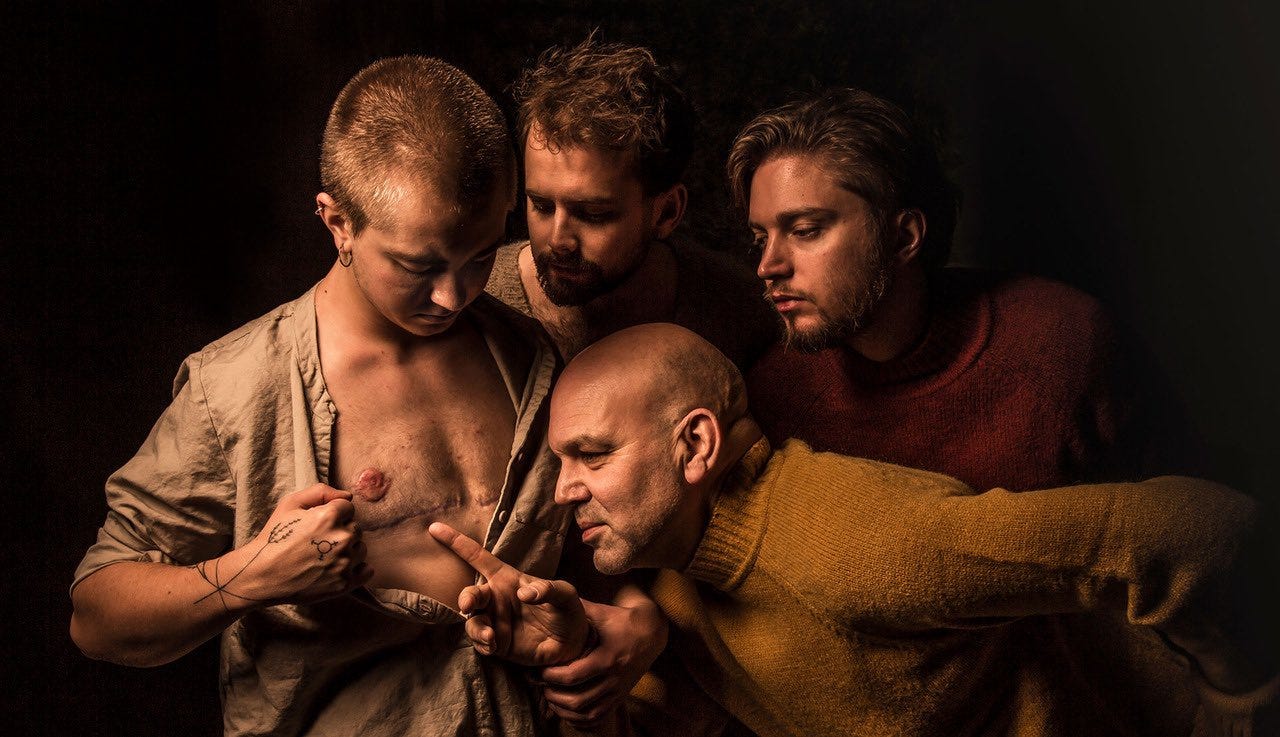
Like other oppressed groups, trans people know what it is to be stigmatized in the eyes of society. Our chosen names and pronouns, our choices in clothing and haircuts, the scars of gender affirming surgeries and full-body tranformations via hormone replacement therapy all mark us as worthy targets of shunning, shaming, and violence. Our non-normative bodies become a site of spectacle, where everyone feels entitled to gawk at our bodies, to know every detail of our medical histories. In our efforts to live into our God-given identities, we face obstacles across every sphere of life — from the legal and medical to religious and social — that remind us that many powerful people aim to strip us of agency and ownership over our own bodies.
Yet many of us revel in the very marks of our Otherness, our defiance of the status quo! My top surgery scars make me feel like me; they are visible marks of the wonder of God’s works, of God’s invitation to join in our own co-creation.
This lectionary reading opens with a verse that can contribute (and historically has contributed) to anti-Jewish sentiments:
“When it was evening on that day, the first day of the week, and the doors were locked where the disciples were, for fear of the Jews, Jesus came and stood among them and said, ‘Peace be with you.’” – John 20:19
This phrase, “The Jews,” shows up 195 times in the NT — 71 of those times are in John’s Gospel. Frequently, “The Jews” are set up in the text as “the enemies of Jesus, and thus of God.”3 That dynamic has been utilized throughout Christian history to malign and persecute Jewish people, often with accusations of deicide.
Because “the Jews” are only mentioned briefly in this passage, preachers may be tempted to gloss over the potential for antisemitism here: naming it won’t relate to the rest of the sermon; it’ll take too much time! Greg Garrett admits to feeling similarly for many years:
“Looking over a dozen years of preaching on Easter 2, I see that there were years when I skipped straight over the fear of the Jews on the way to doubt or faith or epiphany or commitment or any of the other big spiritual lessons that that particular community seemed to need on that particular second Sunday of Easter.
But in the past few years, anytime we encounter one of these parenthetical statements about “the Jews” in a Gospel reading (particularly in John) I have taken to highlighting them, at the very least, as major sources of Christian antisemitism, and sometimes I have devoted substantial space to correcting bad readings and refuting this prejudice…”4
If you aim to be a good neighbor to our Jewish contemporaries, consider taking the time to name the anti-Jewish readings of John, even if it feels like a “tangent.” (At the very least, you might consider including a footnote in the bulletin / worship handout on the topic.)
Some options for addressing the issue on Sunday
State plainly that “ ‘fear of the Jews’ is a ridiculous and inaccurate statement of why the followers of Jesus are gathered behind locked doors in the Gospel lesson. These men are themselves Jews. All of them. Peter is a Jew. Thomas is a Jew. The risen Jesus, the Anointed One who steps miraculously into their midst, is a Jew…”5
Provide some historical context — that by the time the Gospel of John was being written, there had been a major falling-out between those Jews who confessed Jesus as Lord and those who did not. Many progressive Christians suggest that Jewish Jesus-followers had been “expelled” from synagogues; this is possible, but Jewish NT scholar Amy-Jill Levine notes, “we have no examples of such excommunication from antiquity; to the contrary, Paul is disciplined from within the synagogue system, and centuries later, John Chrysostom complains about church members attending synagogue programs.”6 As with so many things, it’s hard to know exactly what was going on so long ago, and the truth involves nuance. Thus, if you go this route, take care to word things in a way that does not place all the blame for this falling out on the Jews who didn’t follow Jesus. Ultimately, what we know is that this was an intra-community conflict, and whatever tensions there were between Jesus-followers and other Jews can help explain (though not justify) John’s language around “the Jews.”
Consider altering the translation from “the Jews” to “Judaeans,” “the Judaean elite,” or something of that nature. The Greek word typically translated “the Jews” throughout the Gospels is Ioudaios/Ioudaioi. If we alter how we translate the term, it becomes clear that “the Ioudaioi in John were neither today’s ‘Jews’ nor the ancient world’s ‘Jews.’“7 When hearing “Judaeans,” worshipers will be less likely to imagine a conflict of Jew vs. Christian; instead, the conflict is between the Galilean disciples — everyday impoverished Jews from a backwater region — and those elites in Judaea/Jerusalem who collaborated with the Roman Empire (e.g. the Sadducees; the Pharisees did not collaborate with Rome).
What other tactics have you taken in addressing anti-Jewish or supersessionist readings of scripture?
Footnotes:
See Rosemarie Garland Thomson’s essay “Becoming Disabled.” See also my introduction to disability basics, which explores disability as a natural part of the human experience and discusses the idea of Disability Culture. ↩︎
John M. Hull, chapter 3 of Disability: The Inclusive Church Resource, 2014. ↩︎
Wes Howard-Brook, “Why We Need to Translate Ioudaioi as “Judeans”, chapter 10 of Jesus Wasn’t Killed by the Jews: Reflections for Christians in Lent, ed. John M. Sweeney, 2020. ↩︎
Greg Garrett, “For Fear of the Jews: Antisemitism in John’s Time and Ours,” chapter 13 of Jesus Wasn’t Killed by the Jews.↩︎
This hymn (original lyrics here) is a beautiful call to solidarity and activism among Christians of all denominations; what if we made it interfaith, too? Revisions alter Christian-specific language and also add in two new verses.
Credit info & explanations of changes are below the lyrics.
We are one in the Spirit, we are one in the Lord, we are one in the Spirit, we are one in the Lord, and we pray that our unity will one day be restored —
Refrain: And they’ll know God is with us by our love, by our love; yes, they’ll know God is with us by our love.
We will move with each other, we will move hand in hand, we will move with each other, we will move hand in hand, and together we’ll spread the news that God is in the land —
(Refrain)
We will work with each other, we will work side by side, we will work with each other, we will work side by side, and we’ll guard each one’s dignity and save each one’s pride —
(Refrain)
All praise to our Maker, from whom all things come and in whose holy image every human belongs. Let us join our rich harmonies in one holy song —
(Refrain)
Credit Info
Please feel free to spread this around, to sing it in your own communities, etc.! Just include credit to Avery Arden at binarybreakingworship.com.
If your community does make use of my revised verses, I would love to know about it. If you post a video of it being sung anywhere, I would love to hear it!! You can contact me at queerlychristian36@gmail.com.
And if you have any suggestions for further revision, please do let me know that too. Let us all join together in the endless effort to draw our circles wider!
Reasons for Revision
Also called “They Will Know We Are Christians,” this hymn was written in the 1960s by Catholic priest Peter Scholtes for use at ecumenical and interracial events. Its themes reflect the post-Vatican II urge to bring Catholic tradition to life in new and active ways, and to interact with our neighbors in faith more intentionally.
As such, “We Are One in the Spirit” “has become an important piece in the church’s efforts to sing a theology of active participation and discipleship in and for the world.”
The songs we sing in worship shape the people’s conception of who God is and what God is doing in the world. I think this song excellent as it is! But I think it could be powerful to utilize at interfaith, not only ecumenical, gatherings — particularly gatherings of persons of the Abrahamic faiths, who share our one God and for whom language of spirit and Lord is familiar.
At this moment in time, I am thinking of places like Minneapolis, where leaders of many faiths — particularly so many Jews and Christians! — have joined together to broadcast the message that God is on the side of the immigrant.
My revisions are light, simply taking out the word Christians and altering the last verse so that it is not longer Trinitarian (praising Father, Son, and Spirit) but emphasizes a shared Creator.
Another small revision is altering “walk with each other” to “move with each other” to include wheelchair users and other modes of transportation. (It could also be interpreted as moving together in the form of dancing, or marching, etc.!)
What wondrous love is this, o my soul, o my soul! What wondrous love is this, o my soul! What wondrous love is this that caused the God of bliss to join earth’s wretchedness and our woe, and our woe — join brokenness to make all things whole.
When I was sinking down, sinking down, sinking down — oppressed and sinking down, o my soul! When I had nearly drowned in suffering’s waves around Christ cast aside his crown for my soul, for my soul! In weakness he was bound, for my soul.
To God and to the Lamb I will sing, I will sing, to God and to the Lamb I will sing — to God and to the Lamb, who is the great I AM, while billions join the theme, I will sing, I will sing! while billions join the theme, I will sing.
And when from death we’re free, we’ll sing on, we’ll sing on; And when from death we’re free, we’ll sing on. And when from death we’re free, we’ll build community in peace and equity in the Son, in the Son — shalom community in the Son.
So all disciples, go, share the news, share the news! All you disciples, go, share the news! All you disciples, go to where injustice grows and be Christ’s truth that sows life anew, life anew! Yes, be Christ’s love that sows life anew.
Credit Info:
Please feel free to spread this around, to sing it in your own communities, etc.! Just include credit to Avery Arden at binarybreakingworship.com.
If your community does make use of my revised verses, I would love to know about it. If you post a video of it being sung anywhere, I would love to hear it!! You can contact me at queerlychristian36@gmail.com.
And if you have any suggestions for further revision, please do let me know that too. Let us all join together in the endless effort to draw our circles wider!
Reasons for Revision
I know too many people — mostly exvangelicals — who grew up with the message “Jesus died for YOUR sins; YOU are the reason God had to suffer and die on the cross; every single sin YOU make is a nail in Christ’s body” drilled into them until they were drowning in shame. In Christian Doctrine, Shirley Guthrie shares an anecdote that conveys this terror and shame:
“Once upon a time a boy went to a revival meeting. …The preacher held up a dirty glass. ‘See this glass? That’s you. Filthy, stained with sin, inside and outside.’
He picked up a hammer. ‘This hammer is the righteousness of God. It is the instrument of God’s wrath against sinners. God’s justice can be satisfied only by punishing and destroying people whose lives are filled with vileness and corruption.’
The preacher put the glass on the pulpit and slowly, deliberately drew back the hammer, took deadly aim, and with all his might let the blow fall.
But a miracle happened! At the last moment he covered the glass with a pan. The hammer struck with a crash that echoed through the hushed church. He held up the untouched glass with one hand and the mangled pan with the other.
‘Jesus Christ died for your sins. He took the punishment that ought to have fallen on you. He satisfied the righteousness of God so that you might go free if you believe in him.’
“What Wondrous Love” perpetuates this kind of substitutionary atonement theology, especially in stanza 2. So I decided to change that.
Removing substitutionary atonement in favor of divine solidarity
We are sinking down to hell “beneath God’s righteous frown,” and that’s why Jesus had to lower himself and suffer. It’s our “fault” — it’s your fault. Don’t you feel horrible? Wallow in your guilt!
Guthrie continues his anecdote by pondering the fruit of such theology:
When the boy went to bed that night, he could not sleep. Meditating on what he had seen and heard, he decided that he was terribly afraid of God. But could he love such a God? He could love Jesus, who had sacrificed himself for him. But how could he love a God who wanted to ‘get’ everyone and was only kept from doing it because Jesus got in the way? The thought crossed the boy’s mind that he could only hate such a hammer-swinging God who had to be bought off at such a terrible price. But he quickly dismissed that thought. That very God might read his mind and punish him.
…Finally, he wondered what good it had all done in the end. The glass had escaped being smashed to bits, but nothing had really changed. After the drama was over, it was still just as dirty as it was before. Even if Jesus did save him from God, how did Jesus’ sacrifice help him to be a better person?
There are other ways to understand the salvific power of Jesus’s incarnation, life, death, and resurrection. That’s why I revised “What Wondrous Love Is This.” My changes remove the disconnect between the will of different Persons of the Trinity: God the Father was wrathful and would have destroyed us; God the Son therefore had to get between us and the Father. As Guthrie says,
“Jesus came to express, not to change, God’s mind. …Reconciliation is the work of God, not…purchased from God. What Jesus does is not done over or against God; his work is God’s work, for he himself is God-with-us.”
So as noted, I removed the sinners in the hands of an angry God type language in stanza 2. What I replaced it with was an emphasis on Christ’s incarnation as kenosis, the divine self-emptying, and as the ultimate act of solidarity — joining in our “wretchedness” in order to transform it into joy. “For God became human so that humans might become God” (Athanasius, On the Incarnation, p. 60).
Moving from the individual to the communal
The other big thing I wanted to change about the song was its individualistic view of salvation.
I kept some uses of “I / my” in order to honor the intimacy of the original, but included shifts into the communal “we” to stress that all humanity together enjoys the love and liberation of God — e.g. “when from death I’m free” becomes “when from death we’re free.”
Still looking forward to the Kin-dom, but also emphasizing the now
“What Wondrous Love” offers us a beautiful, poetic vision of heaven’s eternity of joyful worship. I kept that in (with a small tweak to its heavenly choir of “millions,” making it “billions” in keeping with my universalist views of how many people “get” to heaven).
But I also added a stanza to the end that reminds us that before that happy day, we are called to be the Kin-dom here and now. (By the way, I built that last stanza, “So all disciples go…”, off of a stanza original to the hymn but usually taken out: “Ye wingéd seraphs fly.” There are several other such stanzas; check them out and see if any stand out to you as worth revising!)
What are your favorite hymns? What hymns does your community hold most dear? What makes those specific songs resonate so deeply — their powerful melodies? words of love, of comfort or challenge? Messages that seem to put your most treasured values into words?
On the other hand, are there parts of any of those hymns that don’t sit right with you?
Maybe there’s language that leaves youout as a non-binary person, or implies that your disability makes you broken. Or maybe you have only just noticed that a song you’ve been singing your whole life carries binary language, ableist language, language that equates whiteness with goodness and purity, darkness with sin.
These songs hold a special place in your heart and in your faith; you don’t want to throw them out (or you know that members of your congregation will protest if you try).
But you also know that the words we sing at worship matter — that many people’s beliefs are largely shaped by the hymns we choose. If we keep singing these songs as is, people will continue to absorb their harmful messages.
These hymns call for some wording updates as we seek to draw our circles ever wider, to ensure that we sing out welcome and belonging to all those made in the Divine Image.
For example, “For Everyone Born” is a beloved hymn that Shirley Erena Murray wrote with deep love and a desire to draw people together in our diversity; however, much of the language sets up binaries that unintentionally leave some people out. When I revised it, most of the verses just required breaking out of those binaries — such as expanding “woman and man” to include “all those between, beyond, and besides.”
Hearing these changes to the hymn’s language while in worship was deeply meaningful to me. To have my concerns heard and recommendations acted on, to be acknowledged in that way, explicitly in the song, after so often feeling unheard and left out in faith spaces, was genuinely healing.
…But then there are the hymns that don’t just need some wording tweaks. Some hymns are founded on downright harmful theology — are laden with implications that Christians are supreme; that God’s power is patriarchal; that suffering is either punishment or test; that we are “sinners in the hands of an angry God” who is only kept from smiting us because Jesus puts his body between us and divine wrath (rather than Jesus being God-with-us, expressing the Triune God’s united will).
So what are we to do with a hymn that perpetuates bad theology?
We might choose to dispose of it completely.
Maybe some songs can’t be redeemed. Maybe no changes to it could ever ease the pain you or your community members feel about it.
For me, a song goes straight in the trash if I look into the songwriter and find that they were racist, antisemitic, or even guilty of sexual abuse; if the writer was violently bigoted or abusive, I am not going to try to “fix” their music. There is no fixing the harm that person did. I’m not going to sing any of an abuser’s words in a space where we’re trying to ensure that all belong, especially the most vulnerable.
Even outside that exception, I respect any person or community who decides they would rather retire any given song from their worship, for any reason.
However, I have found that many people find it extremely healing to sing a once-hurtful hymn anew, now with lyrics that talk back to and refute the original message. In bringing the song back transformed instead of quietly discarding it, a more overt, unambiguous message is made about what we believe, who God is, and who we are as a community.
To return to the example of “For Everyone Born,” there is one stanza that needed more than updated wording. The verse beginning “for just and unjust, a place at the table” doesn’t just leave some people out; it has brought deep pain to many survivors of abuse.
The stanza envisions a “table,” a community, where both “abuser, abused” are present, “with need to forgive.” However, ethical frameworks for responding to abuse emphasize the abuser’saccountability and the victim/survivor’s safety, comfort, and even their right to withhold forgiveness if they choose.
So I had to make a choice: throw the stanza out, or rewrite it in a way that directly addresses the old harm? I chose the latter:
For just and unjust, a place at the table, a chance to repent, reform, and rebuild, protecting the wronged, without shame or pressure, for just and unjust, God’s vision fulfilled.
More people have reached out to me about this stanza than any other that I’ve revised, expressing how healing it was to be in worship and hear the old message refuted and replaced with one that prioritizes the person harmed.
If your community simply never speaks of a toxic hymn again, the memory of the pain the song caused you may remain deep in your psyche. You may even believe that that bad theology is the only traditional or “authentic” Christian theology — that you’re a “bad Christian” for hating it. You might think, “my church isn’t singing that hymn anymore because it makes people feel bad; but that doesn’t mean the hymn is wrong.”
But if you can receive the song anew, now with words that tear down that bad theology to build up something better, you receive an explicit message that yes, you were right, that theology was harmful. Your memories, your trauma, can be rewritten or re-woven into a new narrative:
This was a song that hurt; now it is a song that reminds us that we as Christians are constantly reforming and being reformed — constantly being called by God to unlearn and relearn divine love.
What do you think? Which hymns would you love to see transformed — and which would you simply like to never hear again?