Categories
bible study Queer Lectionary Unpacking Antisemitism worship-planning

“You in me and I in you”: Many voices on the interbeing of God and all things

Year A, Sixth Sunday of Easter, John 14:15-21 & Acts 17:22-31 through a queer & interfaith lens.

Both the John 14 and Acts 17 readings for this Sunday depict a God who is wholly interconnected within Godself and with all humanity (and all Creation). Paul references two Greek poet-philosophers to describe this state of interbeing. We too can respectfully draw from various traditions to get a better picture of what that means.

Key points

  • Jesus promises not to leave his disciples orphaned, or “fatherless,” and names that he is in the Father and the Father is in him. Exploring this “father” language alongside other terms Jesus uses for himself across the Gospels, we uncover something of the limitations of human language for relationships both human and divine. Jesus, like many queer found families, is taking the words he has available to him and ascribing them with deeper meaning.
  • The concept that Jesus is in the Parent as the Parent is in Jesus, and that we too are in Jesus as he is in us, has parallels to the Buddhist concept of interbeing. Paul’s reference to a classical Greek philosopher-poet’s words, “In [God] we live and move and have our being,” reiterates this inextricable interconnectedness, or mutual indwelling.
  • Paul quotes two Greek poet-philosophers to carry Christ’s good news to the Greeks. When we gather as many voices as possible at the table, we are granted grander glimpses of the divine in whom all things “live and move and have their being.”
  • I’ll be posting an article on one of those references, Epimenides of Crete, soon, exploring the queer resonances in this sixth century BCE sage.
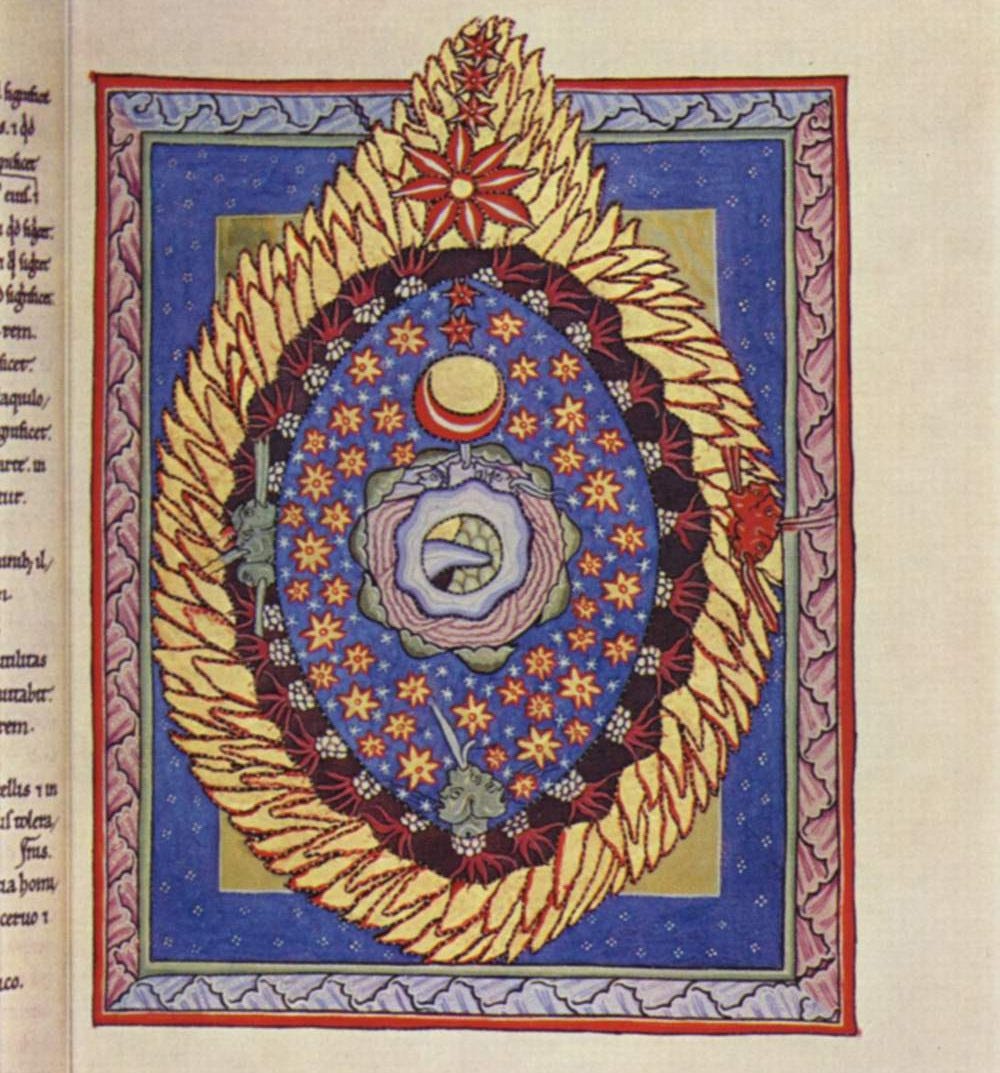
Page from an illuminated medieval book featuring Hildegard's Universe. Yellow petal-looking flames form a vulvic shape. Inside is a border of red "flames," inside which is a blue sea of white stars and red and yellow starbursts. At the center of this is a round mound of moutains / hills, waters, fields.
“The Universe” by Hildegard von Bingen, c. 1165 in Scivias. The vulva-shaped cosmos is enfolded in divine fire, which “descended from heaven to earth and…gave help by showing heavenly things to people while they were in their souls and bodies… These people living in their souls and bodies raised the Word up with faithful joy.” Between divine fire is a “globe of reddish fire” that is the “light of burning Love”: “every creature is illuminated by the brightness of the Word’s light.” For more, listen to this.

John 14:15-21

The lectionary continues right where it left off last week, with Jesus’s tender reassurances to his disciples that even though he must soon leave them, he will not abandon — or, as he says here, orphan — them.

“I will ask the Parent, [who] will give you another Advocate, to be with you forever. This is the Spirit of truth…You know hir because xe abides with you, and xe will be in you.
I will not leave you orphaned; I am coming to you. In a little while the world will no longer see me, but you will see me; because I live, you also will live. On that day you will know that I am in my Parent, and you in me, and I in you.” – John 14:18-20

The picture Jesus paints here is a queer one, blending relational language and dissolving boundaries.

The limitations of relational language

Shortly, Jesus will tell his disciples that he no longer calls them servants, but friends — which moves him from a higher status of master (the Greek kyrios means master as much as it means lord) to the mutuality of friendship (John 15:15). Meanwhile, Jesus frequently names himself as Son of the Parent God throughout the Gospels. Yet here he promises not to leave his disciples orphaned (from the Greek ὀρφανός, orphanos). The Septuagint uses this Greek word to translate Hebrew’s yāṯôm, “fatherless” — it describes those left bereft and vulnerable due to the loss of either both parents or their father (in biblical iterations of patriarchy, losing your father opened you up to more insecurity and potential exploitation).

If Jesus’s absence could be described as the disciples becoming “fatherless,” then that becomes yet another way to describe his relationship with his followers. He is teacher, friend, father, mother hen, master, servant, bridegroom, God.

In traditional human relational structures, no one person could be all those things to another! But some queer relationships come closer to achieving it. In queer found families, the same person might serve as mother and sibling and even lover all at once. To be clear, this is not incestuous! What we are doing is repurposing traditional terms because there are no words in the mainstream lexicon that exactly match what we mean; we use limited language to describe queerly unlimited ways of experiencing each other

…Of course, these queer ways of being in relationship aren’t truly unlimited. But Divinity’s connections both within its Triune self and with its created world might just be!

Jesus as Father or Parent as well as sibling, servant, friend makes perfect paradoxical sense, both through a queer lens and in light of the picture he continues to paint: That he is in the Parent and the Parent is in him.

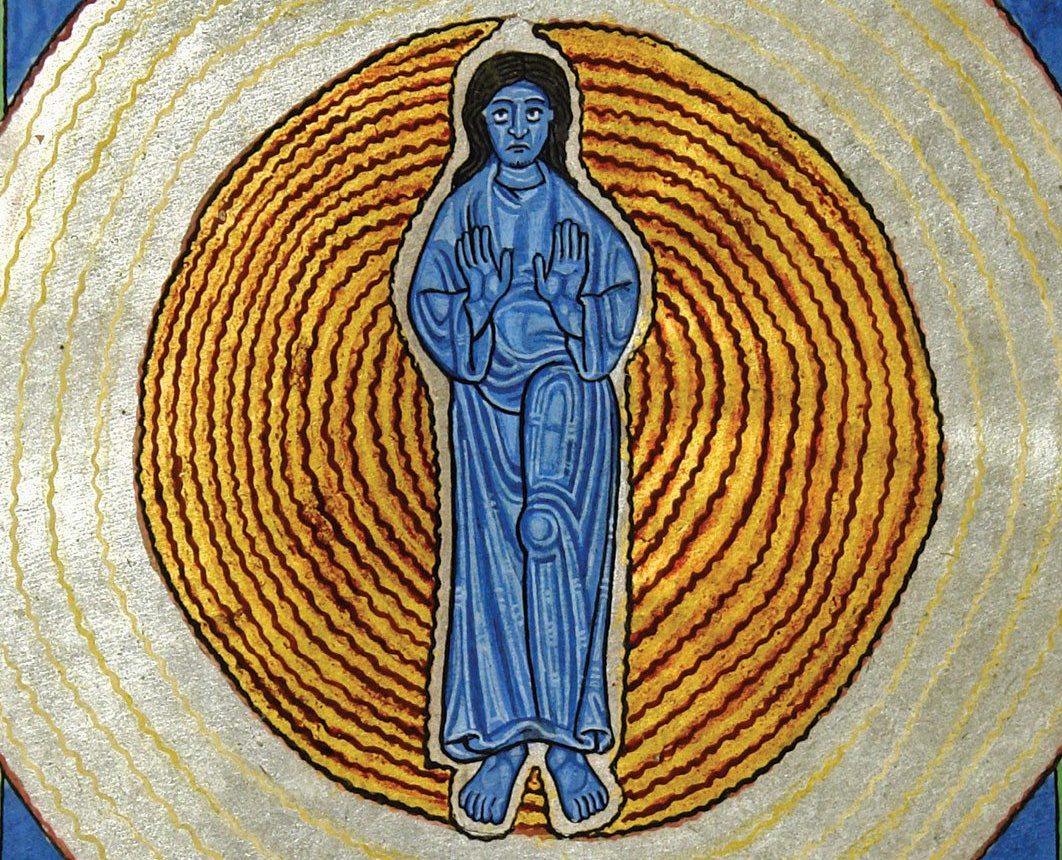
Another medieval manuscript page featuring golden concentric circles around a blue figure of Jesus, who has long hair and is beardless.
“The True Trinity in True Unity” by Hildegard von Bingen, c. 1165. “Unlike the usual triangular-shaped examples, this one involves nested circles of light. The Trinitarian nature of the divine is hidden under His unity and the emergent figure is God as One.”

And then we are in Jesus as he is in us, which by implication means we are also in the Parent and the Parent is in us — an interconnectedness that would be difficult to draw on paper, as each being involved is both holding and is held by each other being! You might even call this…interbeing!

Interbeing, or the interconnectedness of all things

Interbeing is the term beloved Zen Buddhist monk Thích Nhất Hạnh coined to describe what East Asian Buddhists call perfect interpenetration, complete interfusion, or (and this one sounds very much like Christ’s “I in you and you in me”) — mutual inclusion. Whatever it’s called, this interconnectedness envisions every single thing (every phenomenon, every living being, every atom, etc.) simultaneously and entirely containing andbeing contained by all other things. Or, as Thích Nhất Hạnh puts it after inviting the reader to consider a sheet of paper:

“Everything—time, space, the earth, the rain, the minerals in the soil, the sunshine, the cloud, the river, the heat, and even consciousness—is in that sheet of paper. Everything coexists with it. To be is to inter-be. You cannot just be by yourself alone; you have to inter-be with every other thing. This sheet of paper is, because everything else is.”1

Another metaphor for this complete interfusion is that of Indra’s net, which originates from the Atharva Veda and thus was part of Hindu cosmology before also being adopted by Buddhism:

The net is said to be infinite, and to spread in all directions with no beginning or end. At each node of the net is a jewel, so arranged that every jewel reflects all the other jewels. No jewel exists by itself independently of the rest. Everything is related to everything else; nothing is isolated.2

A kind of dizzying spread of blue "netting" on a black background, almost kaleidoscopic.
An artistic rendition of Indra’s Net by Ganesh Rao; click here for the entire gallery. You might also imagine a spiderweb with beads of rain all along it.

Triune interbeing

It’s notoriously difficult to talk of the Trinity without committing one heresy or another (whenever I try, these two grumpy Irishmen pop in my head grumbling That’s modalism, Patrick!). But I think that this concept of interbeing can be employed to get across some of the Trinity’s key aspects: first, that while the Persons of God are indeed three distinct Persons, they are also inextricably One.

Trying to eff the ineffable, we label the three Persons of God things like “Father, Son, and Holy Spirit” or “Creator, Redeemer, and Sustainer” or “Lover, Beloved, and Love itself.” (Note how, as with queer found family, these names sometimes seem to clash “incestuously” — how can Father and Son also be Lover and Beloved? But it’s because we’re using limited human terms to describe the ineffable. The words fail as much as they succeed in helping us grasp God; for instance, “Father” and “Son” traditionally indicates hiearchy and difference in age, neither of which is accurate for the Persons of the Trinity.)

These names certainly describe elements of our Triune God, including some of the distinctions between each Person. However, if we solidify these distinctions too much, attempting to keep the Trinity neat and tidy with firm boundaries between each Person, we cease to speak of a God who is One. No one Person holds sole “dominion” over one quality of the Divine; each Person expresses all qualities. For example, the “Son” also has creative power; the “Father” also sustains all things; the Spirit also brings liberation; and so on.

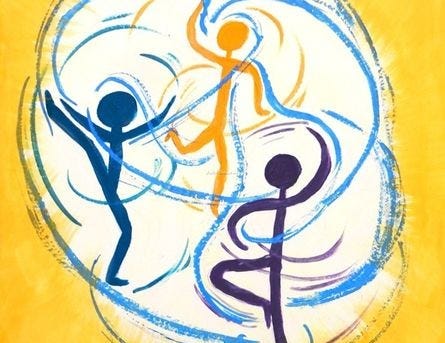
Some of the earliest Christians employed a Greek term to describe this Triune interfusion, or mutual indwelling: perichoresis (from peri, “around,” and chōreō, “come” or “go”). Modern theologians have drawn from this concept the allegory of Trinity as a dance between three partners spinning together so perfectly harmoniously that they begin to blur.

[…P]erichoresis invites us to think in a new way about the very meaning of ‘one’ and ‘personal.’ The oneness of God is not the oneness of a distinct, self-contained individual; it is the unity of a community of persons who love each other and live together in harmony. And ‘personal’ means by definition inter-personal; one cannot be truly personal alone but only in relation to other persons.

Such is the unity and personal character of God the Father, Son, and Holy Spirit. There is a deep, intimate, indissoluble unity between them. They are not three independent persons who decide to get together to form a club (or a dance group!) that might break up if the members decide to go it alone. They are what they are only in relationship to each other. Each exists only in this relationship and would not exist apart from it.

…Father, Son, and Holy Spirit are one social person, for each is with and for the other so intimately that they can be said to live in and through each other.

– Shirley Guthrie, Christian Doctrine

painting on a yellow background of three figures circling each other in a whirling dance
Perichoresis” by Jutta Bluehberger

Interbeing between divinity, humanity, and all creation

The Son is in the Parent is in the Spirit is in the Son is in the Spirit is in the Parent is in the Son ad infinitum; together, they are a perfect community, a perfect relationship.

Yet God chose to create, to let that perfect, self-contained love overflow beyond Godself! Thus we are invited into this perichoresis, this interbeing, invited to recognize the truth of Jesus’s words: “I am in my Parent, and you and me, and I in you” — all bound together with the Spirit, our advocate (or, as the CEB translates, companion) whom God is sending (v. 17) and who has been here all along, from the Beginning.

That’s the picture Jesus paints in this John 14 passage: the distances of time and space melt away; the boundaries between beings merge and mix!

It’s fitting that the lectionary pairs this passage with Acts 17, in which Paul notes that “God is not far from each one of us” (v. 27b) and that

“In [God] we live and move and have our being.” – Acts 17:28

Acts 17:22-31

The verses of Acts 17 leading up to this week’s passage recount Paul’s flight from alleged persecution3 to Athens, where he spends weeks engaging not only with Athenian Jews, but gentiles as well. Due to their love of new and interesting ideas (v. 21), the gentile Athenians take an interest in his proclamations about Jesus. They lead Paul to Areopagus, where he gets the chance to give “the fullest and most dramatic speech of [his] missionary career.”4

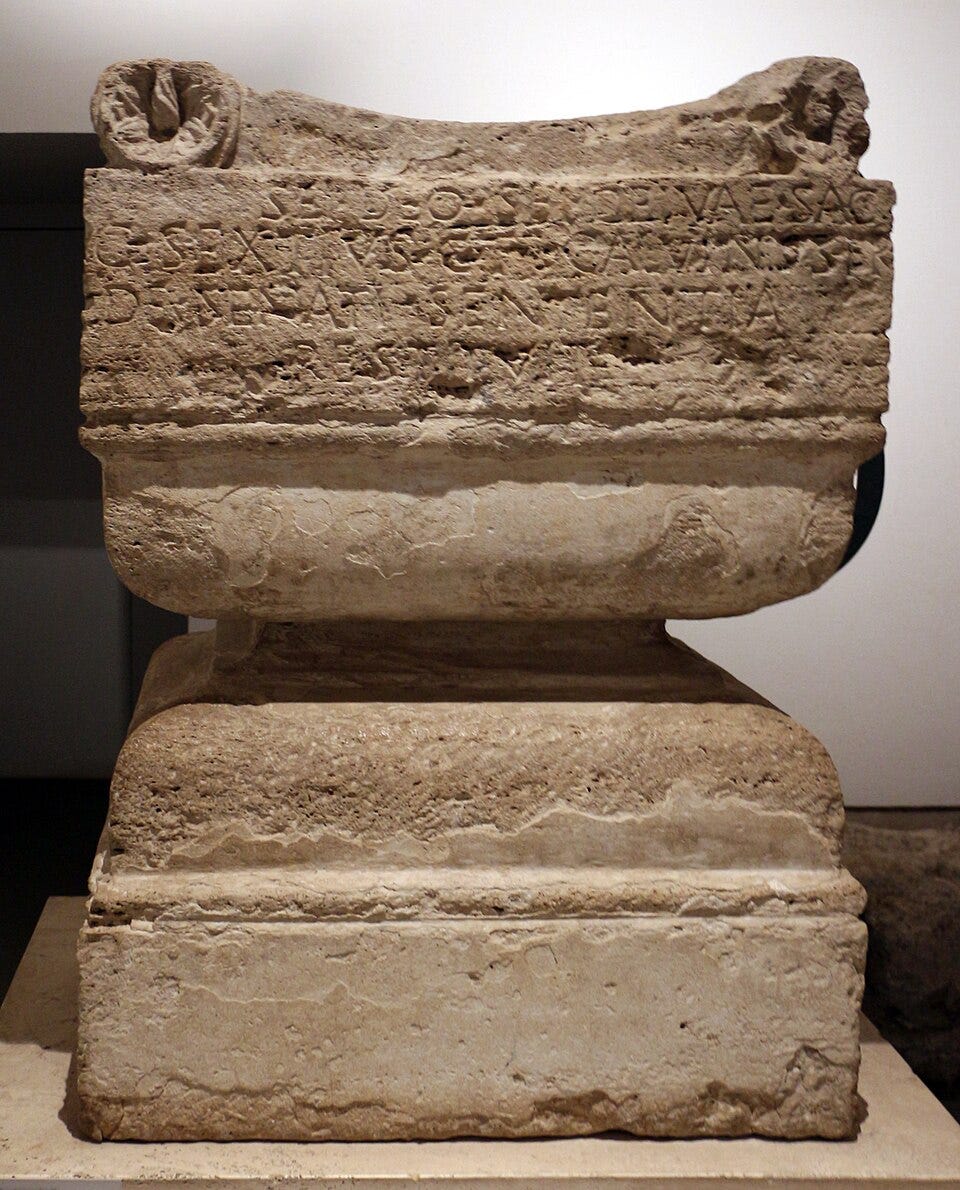
Paul starts by appealing to the Athenians’ spirituality, noting all their altars and shrines — including one dedicated to “an unknown god” (v. 23). He explains that this “unknown” deity is actually the God who “made the world and everything in it” — the Abrahamic God.

Paul, a Roman citizen as familiar with Greek things as Jewish things, smartly finds ways to connect renowned Greek poet-philosophers, quoting two of them:

For ‘In him we live and move and have our being’; as even some of your own poets have said, ‘For we, too, are his offspring.’ – v. 28

The latter half of the verse, “We too are his offspring,” most likely comes from the Stoic philosopher Aratus, who opens his great work Phaenomena thus:

Let us begin with Zeus, whom we mortals never leave unspoken.
For every street, every market-place is full of god.
Even the sea and the harbour are full of this deity.
Everywhere everyone is indebted to god.
For we are indeed his offspring …

Paul sure knew how to pick the perfect reference, selecting one that not only supports his point about divinity’s pervasiveness, but is even set in the same scene he and his audience inhabit! Of course, the poem is talking about Zeus, while Paul is winding up for his pitch about the Abrahamic God raising Jesus from the dead.

Meanwhile, in describing a God in whom we “live and move and have our being,” Paul seems to be paraphrasing the sixth-century BCE sage Epimenides of Crete. I have grown short on time to dive into the queer resonance of this prophet; I’ll put out another article soon on how for the Greeks, this sage embodied both the awe and horror of one who is “unnatural” — just as Christ does in exploding the binary between life and death.

Subscribe to be notified when I put out the article on Epimenides!

stone altar with Latin inscribed, which is translated below
While no altars to an agnostos theos, an unknown god, have been unearthed in Athens, this altar was unearthed on the Palantine Hill. Its inscription reads, “Whether sacred to god or to goddess, Gaius Sextius Calvinus, son of Gaius, praetor, restored this on a vote of the senate.” When purifying Athens of plague, Epimenides ordered the erection of altars in various locations to “whichever god” was god of that location.

At least some of the early Christians recognized this reference to Epimenides, including Clement of Alexandria, who noted that Paul was willing to “attribute something of the truth” to a Greek, a gentile” and was “not ashamed, when discoursing for the edification of some and the shaming of others, to make use of Greek poems.”5

There is somewhat of an air of condescension in both Paul’s and Clement’s words, but I do appreciate the biblical precedent in quoting voices from other religions and cultures. If God truly is the one in whom we all move and live and have our being; if we truly are all interconnected like jewels in a net or raindrops in a web, then the divine pervades all peoples. God’s Spirit, God’s Breath “blows wherever she wills” (John 3:8). Only when we invite all voices to the table do we begin to catch a grander glimpse of God.

Footnotes

  1. Thích Nhất Hạnh, In The Other Shore: A New Translation of the Heart Sutra with Commentaries, 2017. For more on Buddhist conceptions of interconnectedness, check out this article. ↩︎

  2. https://pragyata.com/the-vedic-metaphor-of-indras-net/ ↩︎
  3. For information on Acts’ depictions of Jews as violent persecutors of Paul and other apostles and how these depictions have motivated antisemitism across Christian history, give this video a watch. ↩︎
  4. Mikael C. Parsons, https://www.workingpreacher.org/commentaries/revised-common-lectionary/sixth-sunday-of-easter/commentary-on-acts-1722-31-5 ↩︎
  5. Clement of Alexandria, Stromata Book 1, chapter 14, c. late second century. ↩︎
Categories
bible study Other search markers Queer Lectionary Unpacking Antisemitism worship-planning

“How can we know the way?” From exclusivity into God’s home of many rooms

Year A, Fifth Sunday of Easter.
Using a queer lens + addressing anti-Jewish supersessionism.

This Sunday’s readings explore what it means to be followers of the Jesus Way. Is this an exclusive path? Do we supersede the Jewish people as God’s chosen people? (Spoiler: hell no!)

Taking these passages together, we can paint a picture of a Way wherein we dismantle standing structures in favor of building up with living stones, with the rejected stone as the chief cornerstone — creating a Kin-dom home that has room enough for all.

Key points

  • The passages from Acts 7 and 1 Peter 2 embody the tension present in so many parts of scripture: They offer gorgeous glimpses into God’s Kin-dom, and they lay the groundwork for later Christian antisemitism.
  • I urge preachers and teachers to name the danger in these texts, rather than simply skirt around it. Address these verses so that your audience won’t fill the void of your avoidance with the assumption that “we” agree with this rhetoric.
  • At the same time, these two passages can help us explore what it means to be followers of the Jesus Way. We open ourselves to the multitudinous ways God speaks to us through diverse voices. We celebrate the people rejected by the upholders of unjust structures and systems. We commit ourselves to unpacking our biases and learning how to be in solidarity with oppressed peoples, even when we mess up.
  • And we remember that, as Jesus promises us in the John 14 passage, God’s home has room enough for us all. Everybody belongs. Everybody feasts.

Acts 7:55-60

Queer meditation

But filled with the Holy Spirit, [Stephen] gazed into heaven and saw the glory of God and Jesus standing at the right hand of God. “Look,” he said, “I see the heavens opened and the Son of Man standing at the right hand of God!” But they covered their ears, and with a loud shout all rushed together against him.

Acts 7:56-57

How do we respond to divergent interpretations of our shared faith? Are we open to and interested in mutual dialogue, eager to potentially glean new wisdom — or do we cover our ears in horror? Do we let ourselves sit in the discomfort of possibly being wrong (or at least not wholly right) — or shame and shun the “heretic”?

One of my partners grew up in a fundamentalist household in which new ways of understanding God and scripture were received as threats.

Once when he was a teen, he dared to wonder whether every single sentence in the Bible had to exactly reflect God’s will — or whether it might make more sense that human biases entered the text. His father flushed beet red, face twisting as he pointed a shaking finger at his child: “Don’t you dare say that. Don’t you dare blaspheme God under my roof.”

There was rage in his father’s voice — but more than that, there was fear. A real, ferocious terror in what could happen if his child were to rebel against what he believed were God’s truth and will.

Maybe something deep inside him recognized that his faith in a punishing God who despises queerness, deputizes whiteness, and demands perfect obedience was actually quite flimsy — that it was utterly dependent on this understanding of scripture as the literal and inerrant Word of God (with very specific interpretations of said scripture); and that if he were to allow himself to start asking questions, his entire belief system would crumble around him and leave him floundering. And wouldn’t that mean that his whole life had been empty, shameful, wrong? He simply had too much to lose to risk even a shred of doubt or questioning.

…Maybe that’s where his fear came from, maybe not. I think also of the flip-side fear: the terror of growing up being told God hates you, has no options for you but a hollow life or hellfire.

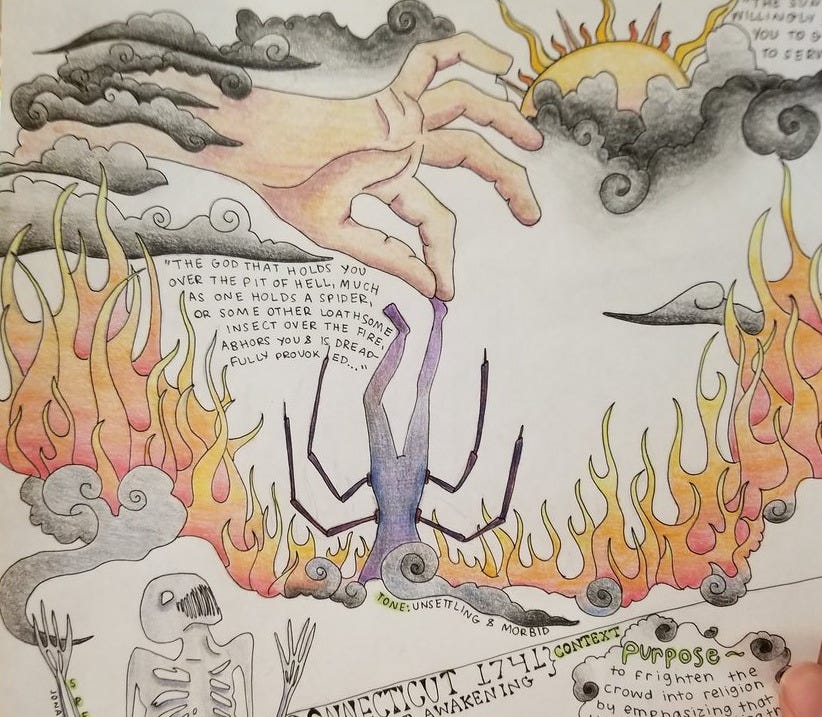
Drawing of stormclouds from which a huge pale hand holds a person dangling by one foot over a huge crevice of hellfire. A gaunt / skeletal being stands with arms raised looking up towards the figure. Text from Edwards' sermon is also on the page, as is notes on the sermon's "Purpose: to frighten the crowd into religion..."
Art by student Lucy Wright based on Jonathan Edwards’ “Sinners in the Hand of an Angry God”

Sometimes the good news of God’s expansive and unconditional love, the holy truth that humanity is intentionally, divinely diverse — how else could we be in the Image of an infinite God? — is received with trepidation rather than relief. Could it be true, or do I just want to believe it’s true to “justify my sin”?1 What happens if I embrace my queerness and it turns out I’m wrong?

We can turn to Thomas Merton and his beloved prayer of unknowing (which matches the John passage we’ll get to later very well):

My Lord God, I have no idea where I am going. I do not see the road ahead of me. I cannot know for certain where it will end.
Nor do I really know myself, and the fact that I think I am following Your will does not mean that I am actually doing so.

But I believe that the desire to please You does in fact please You.
And I hope I have that desire in all that I am doing.
I hope that I will never do anything apart from that desire.

And I know that, if I do this, You will lead me by the right road,
though I may know nothing about it.

Therefore I will trust You always, though I may seem to be lost
and in the shadow of death. I will not fear, for You are ever with me,
and You will never leave me to face my perils alone. Amen.

We can live in fear of new perspectives. Of admitting we were wrong. Of punishment. Of exclusion. Of a scarcity of love and grace.

Or we can place our trust in Divine Wisdom to guide us, in Christ’s mercy to cover us — and take the plunge.

Naming anti-Jewish rhetoric

The above meditation takes the Acts reading as it is laid out for us. But context matters, and Acts 7’s is rather troubling.

So to start with, I urge preachers to provide context for the lectionary passage by summing up the events of Acts 6 as well as Stephen’s speech in Acts 7, especially its closing lines in verses 51-53.

After all, the lectionary passage severs the alleged reason that the Jerusalem Council supposedly stoned Stephen. It’s not just that he’s a Jesus-follower. It’s that he accused them of setting themselves against God’s Spirit (v. 51).

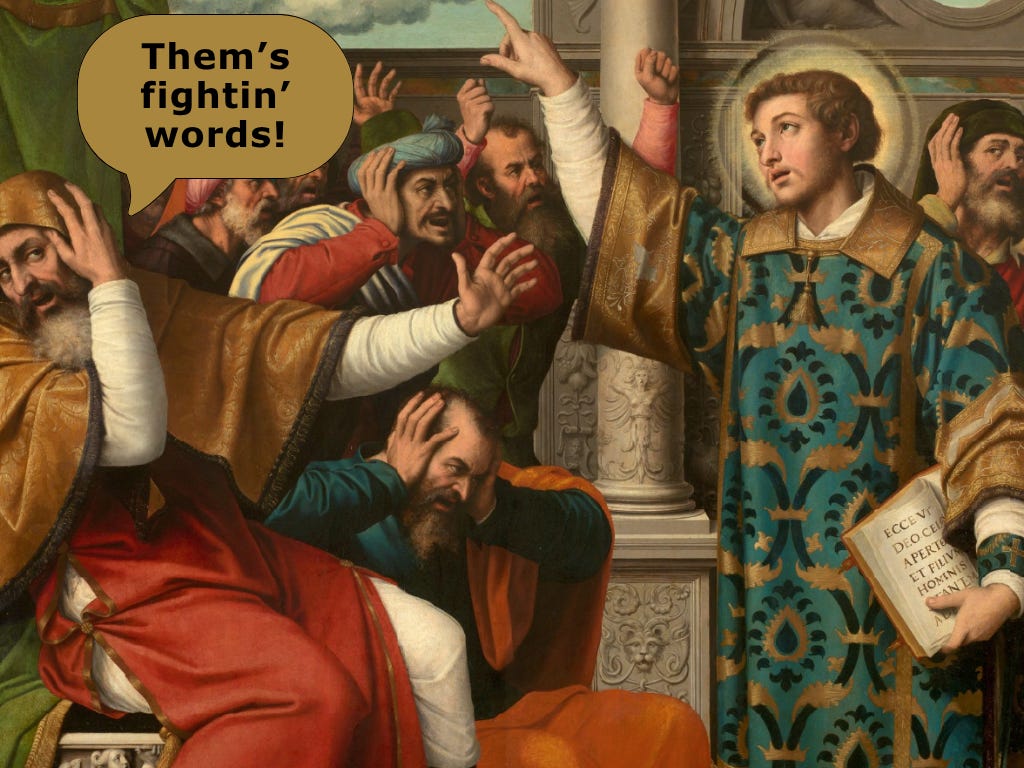
Painting of Stephen, with pale skin and light brown hair pointing heavenwards as he stands in a fancy chamber with the Council, who are covering their ears and looking horrified or ferious. The Council are designed with stereotypically large, hooked noses. A speech bubble has been added so that one of them says "Them's fightin' words!"
“Saint Stephen Accused of Blasphemy” by Juan de Juanes, 1560s. This is just a silly meme, but the artist’s choice to give the Council members exaggerated noses while depicting Stephen, who is likewise Jewish, with more “European” features certainly highlights the effectiveness of Acts’ rhetoric in distancing Stephen and the other Jewish Jesus-followers from their kin.

When Stephen adds perceived blasphemy to that accusation, proclaiming Jesus stands at “the right hand of God” — that Jesus is himself divine — it’s enough to spur them to violent action.

…Or is it? Did the stoning of Stephen really take place? And if it did, did it occur exactly as the author of Acts recorded it?

As is so often the case, it’s important to note is the possibility of anti-Jewish polemic in this text — inherent to the text, and/or easily produced by our interpretations of it. I recommend this YouTube lecture on the stoning of Stephen, which draws heavily from Shelly Matthews book Perfect Martyr: The Stoning of Stephen and the Creation of Christian Identity. Starting especially around 25 minutes into the video, a shift is pointed out between more positive depictions of the Jerusalem Jews in the first 6 chapters of Acts, and the vilification of non-Christ-following Jews after the account of Stephen’s martyrdom. From that point on, Jewish people are no longer described as the People of God.

Stephen’s own speech highlights this rhetorical distancing of Jesus-followers from other Jews; he opens his speech by naming “our ancestor Abraham” (v. 2), yet ends with:

You continuously set yourself against the Holy Spirit, just like your ancestors did. Was there a single prophet your ancestors didn’t harass? …” – Acts 7:51-52a

While Stephen is most likely a Hellenized Jew, e.g. one who speaks Greek and holds a lot of Greek culture and values, he is a born Jew. These are his ancestors too! But here the author writes Stephen as setting up an us and them binary in which Jews with no interest in Jesus are “those people,” stiff-necked and murderous enemies of God Themself.

It’s important to recognize the biases in the NT texts, the context that caused these anti-Jewish polemics. We can recognize that the majority of the NT writers were Jews, that this was for these earliest Christians largely an intra-community conflict, while also naming the harm these texts have done and continue to do. We can experience these scriptures as sites where God’s Word speaks to us, while acknowledging their imperfections as human-written documents. In so doing, we refuse binaries of good and bad, us and them, that don’t leave room for the messiness of human realities.

1 Peter 2:2-10

Continuing to address antisemitism

They stumble because they disobey the word, as they were destined to do. But you are a chosen race, a royal priesthood, a holy nation, God’s own people…

1 Peter 2:8b, 9a

The author of this epistle has such a gorgeous vision of the margins being made central, which I’ll get to in a minute; the tragedy is that he turns that vision into polemic, using his words to sever the Jewish people from their status as “God’s own people” and bestow that title upon Jesus-followers instead.

With passages like these in scripture, it’s no wonder supersessionism — the notion that Christians replace, or supersede, Jews; that our covenant through Christ renders their covenant through Abraham null-and-void — is so prevalent and deeply-rooted in Christianity.

I urge preachers and teachers to name this rhetoric, rather than simply skirt around it. Address these verses so that your audience won’t fill the void of your avoidance with the assumption that “we” agree with the letter writer’s point of view.

Like all of us, the Bible’s authors contained multitudes — their transcendent glimpses into the divine are weighed down by worldly ideologies that say God’s love is a finite resource; that life is a competition; that there can only be one “first,” one “beloved”; that to uplift one group is necessarily to sideline another.

Let’s keep naming that truth as we seek to follow Jesus in ways that bring justice and joy, rather than harm.

And central to the Jesus Way is the declaration that the ones rejected by human structures and systems are the very ones God works in and through! This too is something 1 Peter’s author recognized, as the next section explores.

Queer stones

Come to him, a living stone, though rejected by mortals yet chosen and precious in God’s sight, and like living stones let yourselves be built into a spiritual house…
For it stands in scripture:
“See, I am laying in Zion a stone,
a cornerstone chosen and precious,
and whoever believes in him will not be put to shame”
[…and]
“The stone that the builders rejected
has become the very head of the corner.”

1 Peter 2:4-7

This passage is very queer indeed. A stone rejected by the builders becomes the chief cornerstone! The ones who fabricated the structures that enclose us all are not the ones with the final say — God is!

The God of the stranger, Liberator of the oppressed, the One who always chooses to stand outside any dividing line we draw between “us” and “them,” finds that castoff rock and makes it central, indispensable:

[The] members of the body that seem to be weaker are indispensable… God [gives] the greater honor to the inferior member.

1 Corinthians 12: 22, 24b
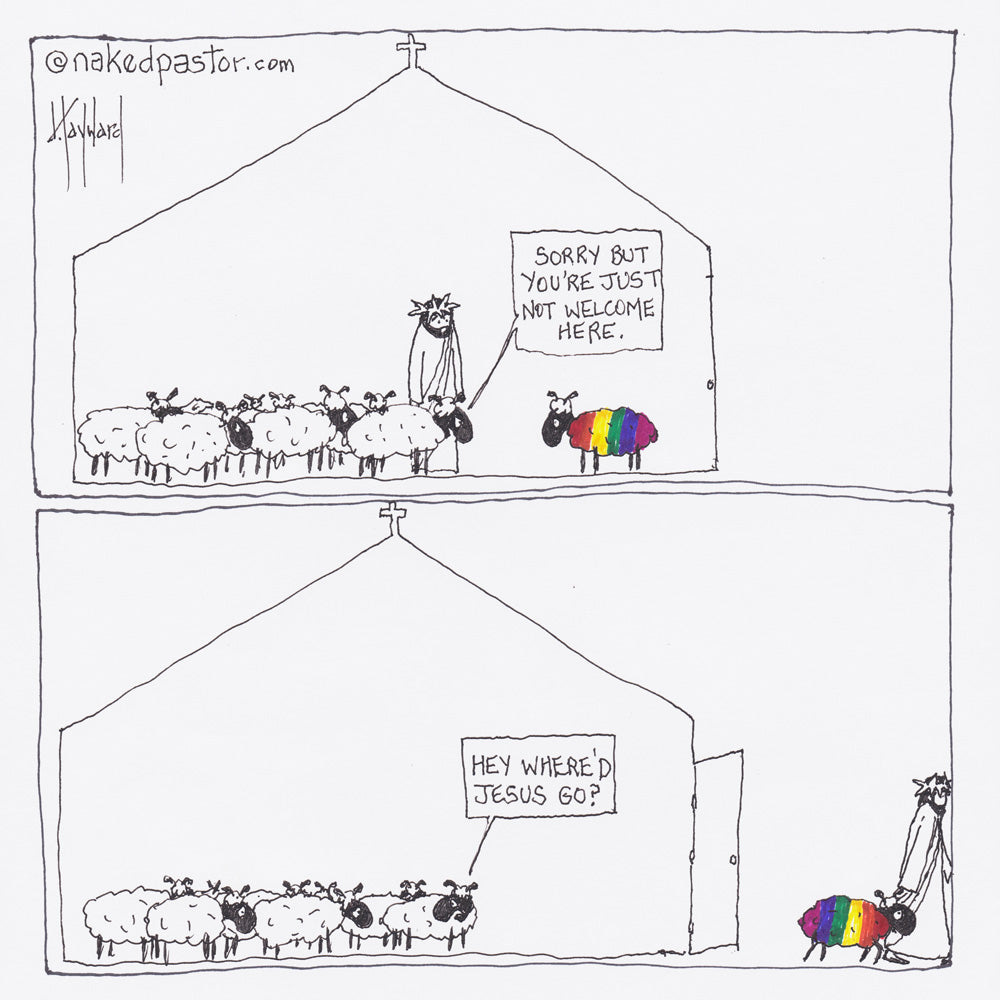
Two panel comic. The outline of a church holds a bunch of white sheep telling a rainbow sheep, "Sorry but you're just not welcome here." Second panel shows the rainbow sheep walking out the church door with Jesus by its side as the white sheep go, "Hey, where'd Jesus go?"
Comic by NakedPastor.

We the shunned and shamed ones, we who are considered to be “no people” (v. 10) — nobodies — become the living stones with which Divinity constructs a new Creation.

We whom dominant cultures despise create our own cultures — queer culture, Black culture, disability culture, and more — where our unique gifts and ways of manifesting God’s love to the world are uplifted.

We are Christ’s hands and feet on earth, helping usher in a Kin-dom in which the last are first, the margins are drawn to the center, and all dividing walls are dismantled, piece by piece.

Babies in Christ: we learn along the way

Like newborn infants, long for the pure, spiritual milk, so that by it you may grow into salvation — if indeed you have tasted that the Lord is good.

1 Peter 2:2

When we taste that God is good, we grow hungry for more. One major way we taste that divine goodness is when we look to the poor for God’s good news and join in liberation movements with the captive and oppressed (see Luke 4:18-19). By becoming co-conspirators with those “living stones” God centers in the building up of Their Kin-dom, we are submerged in Spirit.

Peter doesn’t elaborate on “spiritual milk” in this chapter, but Paul does in his first letter to the Corinthians:

…I could not speak to you as spiritual people but rather as fleshly, as infants in Christ. I fed you with milk, not solid food, for you were not ready for solid food. Even now you are still not ready, for you are still fleshly. For as long as there is jealousy and quarreling among you, are you not fleshly and behaving according to human inclinations?…

1 Cor 3:1-3
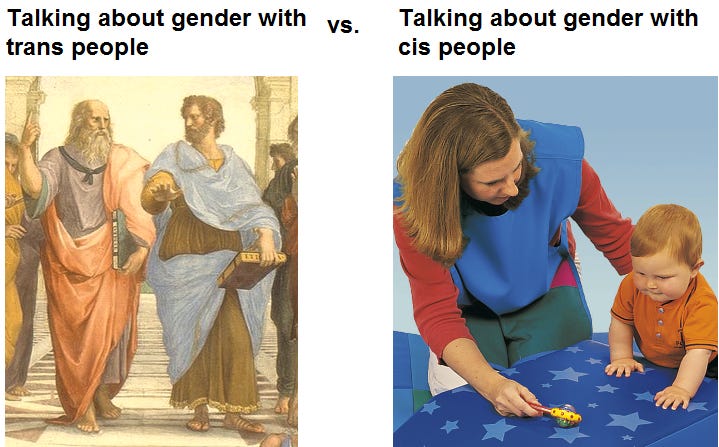
Meme in a two column format. There's "talking about gender with trans people," showing a detail from that famous painting of Greek philosophers conversing; versus "talking about gender with cis people," showing an adult guiding a baby with a toy.

This old-school trans meme identifies a truth about what it’s like to start down the road of solidarity with any oppressed group to which we don’t belong: We are like babies! (But babies with capacity to cause harm.)

As we unpack the presumptions, prejudices, and skewed perspectives we’ve been absorbing since birth, we’re left with big gaps in knowledge. We finally know how little we know.

And as we live into a commitment to true solidarity with the oppressed, we mess up. To step up is to mess up, over and over — and remain committed to making amends and continuing to show up.

Back to John 14

Thomas said to him, “Lord, we do not know where you are going. How can we know the way?” Jesus said to him, “I am the way and the truth and the life.”

John 14:5-6a

As we devote ourselves to uplifting the stones rejected by the builders and keepers of our unjust systems, as we grow in our purpose as the living stones God uses to build up Their Kin-dom, how do we know we are headed in the right direction? What happens if we get it wrong?

I think again of my partner and his father. The feral fear of fire and brimstone awaiting the ones who believe wrong, let alone do wrong.

But God doesn’t await us with hellfire. God waits to welcome us into Their home with open arms:

“Do not let your hearts be troubled. Believe in God; believe also in me. In my Father’s house there are many dwelling places. If it were not so, would I have told you that I go to prepare a place for you? And if I go and prepare a place for you, I will come again and will take you to myself, so that where I am, there you may be also.”

John 14:1-3

I hear so much tenderness in Jesus’s voice here. He knows his friends are anxious and uncertain about what the future holds, so he paints them a picture of where their journey is headed: Past the terror and trouble, there is a beautiful home where a place has been prepared for us. For you! for me! — and not just for “us,” but for “them” as well.

Here we find the antidote to the supersessionism in the story of Stephen’s martyrdom and Peter’s first letter. In those two readings, there is an assumption that God can have only one favorite. Only one people. That as the divide between the followers of the Jesus Way and Jews with no interest in Jesus grew, it necessarily required a dethroning of Jews as God’s chosen people so that that title could belong to Christians.

That myth of scarcity sure has been around a while, huh?

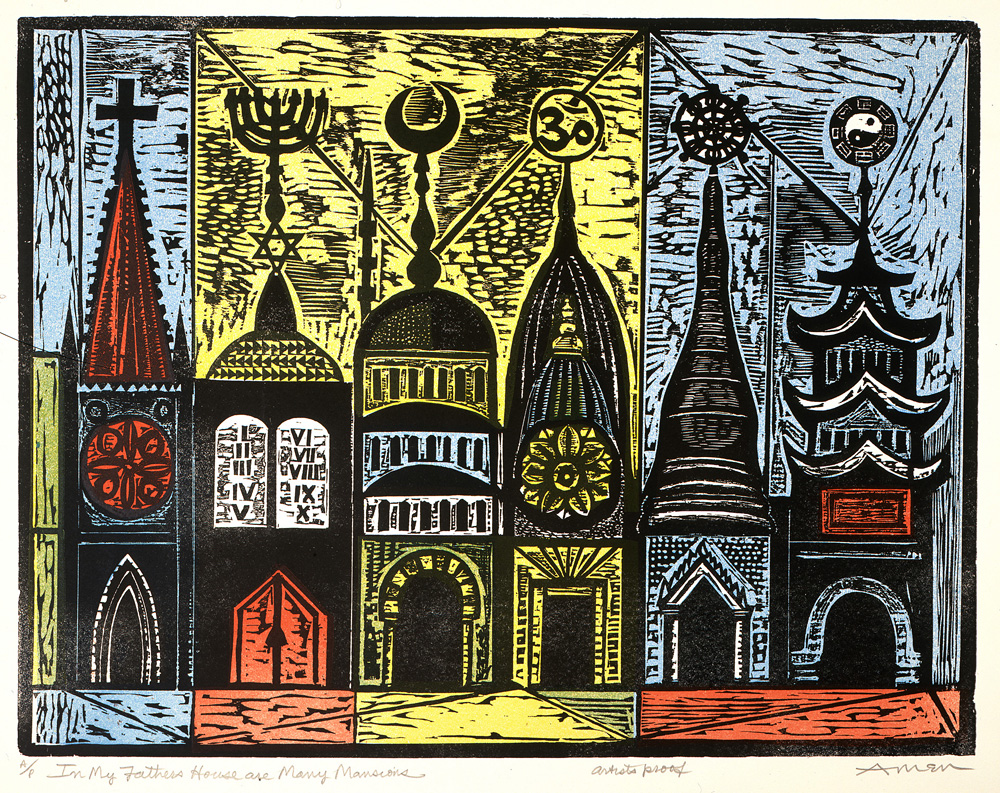
Jesus tells a different story: God’s home has rooms, has room, for everyone. Everyone!

The very nature of God is overflowing love — infinite love, love enough to go around and still spill over. Just like we saw last week, Jesus ushers in life abundant — there is plenty for all.

No one gets scraps — everybody feasts!

Thanks be to God.

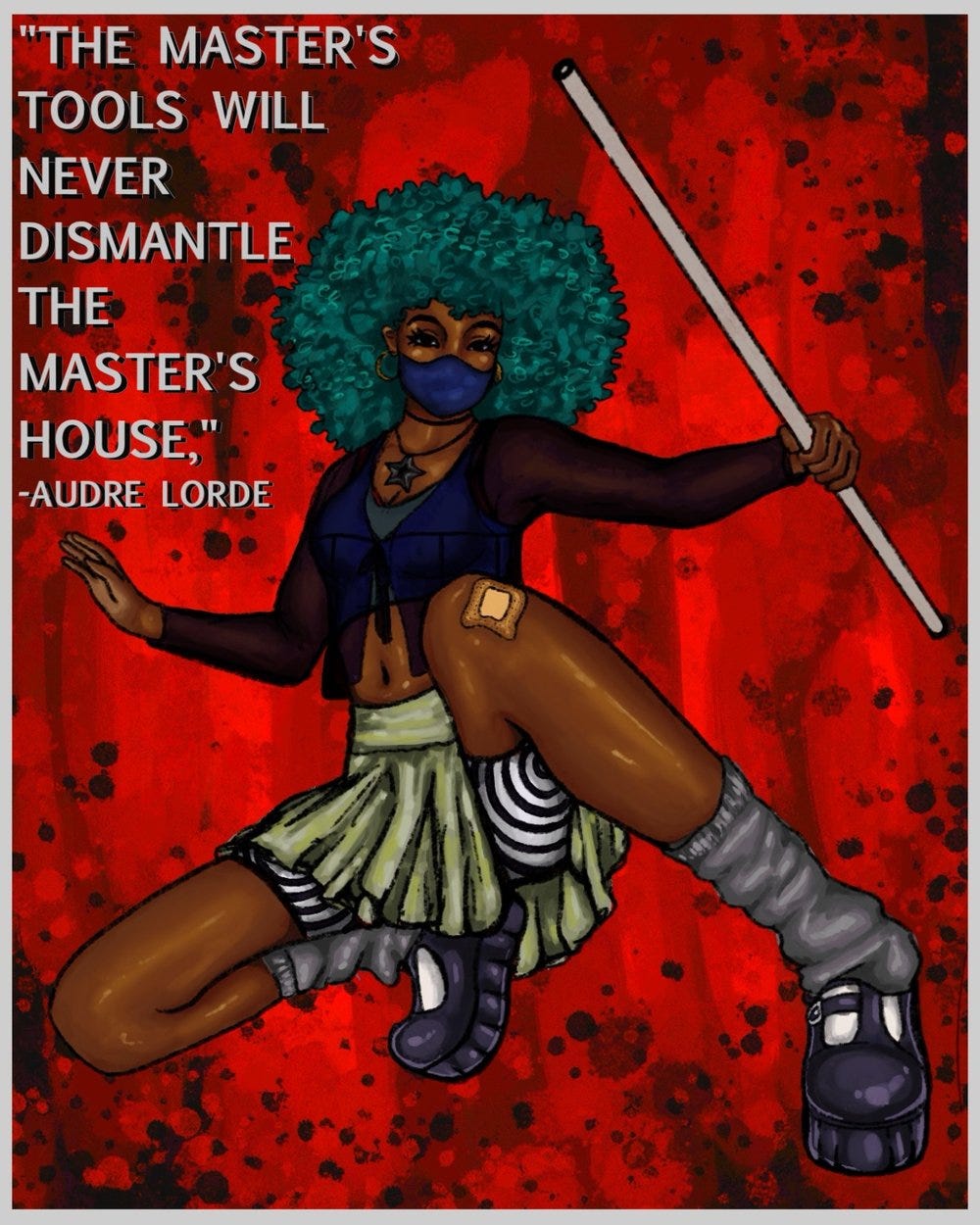
Illustration on a red background of a Black fem person with a curly blue afro, a medical mask, a crop top and skirt, wielding a staff while striking a cool pose. A quote from Audre Lorde reads "The master's tools will never dismantle the master's house"
Art by Ayeola Omolara Kaplan. Audre Lorde’s powerful words can help guide us as we deconstruct and rebuild: We do not dismantle unjust systems by using the same tools of exclusion and exceptionalism, purity and punishment, suspicion and shame that built them in the first place. Thus antisemitism, Christian nationalism, and other key components of the white supremacist project have no place in the Kin-dom God is building with and in and through us.

  1. So many of us get told we’re “reading into” the Bible what we want to see there. But there are other ways of understanding our relationship to the Bible! Visit here for my framework on understanding scripture — particularly the last section, “You’re just reading into it.” ↩︎
Categories
bible study easter LGBT/queer Queer Lectionary Unpacking Antisemitism worship-planning

Liberative lectionary: John 20’s enfleshed, disabled Christ

Year A, Second Sunday of Easter.
John 20:19-31.
Trans & disability theologies; addressing antisemitic implications.

Page contents:

For the Easter Season, I want to offer brief * commentary on each week’s lectionary readings through a liberative lens — largely from my perspective as a trans, disabled Christian scholar, but also drawing from other liberationist traditions. The goal is not to write my own extended essay each week, but to prompt preachers and other worship leaders to incorporate some of these ideas into Sunday worship.

*…I say brief, but John 20:19-31 is my favorite Gospel passage to preach on so this one’s gonna get a little lengthy!

Worship materials

Hymn suggestions:

Liturgy suggestions:

Key point

In rising with a physical body that retains its crucifixion wounds, Jesus demonstrated once and for all that our flesh is good, is part of what it means to be in God’s image; and that stigmatized bodies — especially disabled bodies — are not incompatible with divinity, but rather are intimately entwined with divinity.

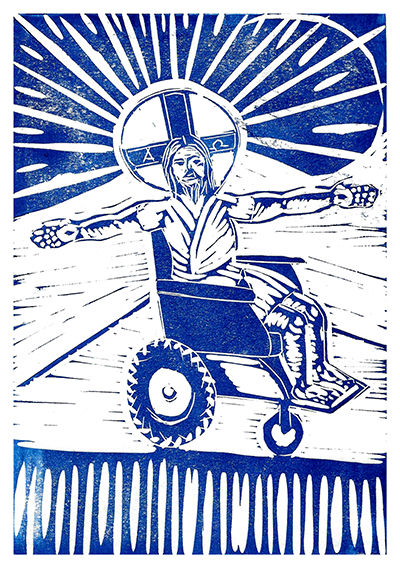
Ink drawing of Jesus rolling down a street in a wheelchair, arms extended outward and a radiant halo behind his head
“Wheelchair Christ” by Rachel Holdforth.
Visit her website for information on this piece and others.

Embodied theology

Presumably Jesus had the power to rise in spirit alone, but instead he keeps his wounded body. Why?

Having entered the material world, Jesus understands the human need for evidence we can experience with our senses. All throughout the Gospel of John, Jesus made use of things people can touch and taste and see – water and bread, vine and branches, baptism and the washing of feet – to embody the less tangible aspects of himself.

Jesus fed and cared for people’s bodies as well as their spirits, because he too is human, he too knows that sometimes we need to reach out and touch the Divine in order to believe. So Jesus holds out his hands, he offers his side, so that Thomas can see, can touch, can then proclaim “My Lord and my God!”

I believe Jesus also kept his body so that he can keep experiencing, with us, all that comes with having a body. He’ll still feel the breeze on his sweaty brow, feel the tug of hunger and the satisfaction of a full stomach, laugh and weep and sing with friends who hug and hold him.

He keeps his body to remind us that physicality is good. He keeps his body for the sake of all who have been told that they should hate their body, should punish it, should avoid its natural pleasures and healthy desires.

If Jesus — who is goodness itself, who is God themself — retains his body, we must conclude that physicality is part of our goodness. We are not spirits trapped in flesh prisons — we are embodied spirits, inspirited bodies.

And if that’s the case, then we cannot avoid learning to love our own bodies and learning to celebrate the amazing diversity of our species with the excuse that it’s all transitory! Our diversity is vital to our humanity. Embodiment is here to stay.

And what about the fact that Jesus not only retained his flesh, but retained the marks of crucifixion upon it?

Disability theology: The resurrected God is disabled

Across the Roman Empire, crucifixion was a shameful death, a criminal’s death. For Jesus’s people, those “hanged on a tree” were cursed by God (Deuteronomy 21:23). And this is how the God incarnate, the Creator of the universe, died!! No wonder Paul describes Christ crucified as a scandal to Jews and foolishness to Gentiles (1 Cor 1:23).

For many Christians, disabled bodyminds are a site of scandal and shame. Drawing on the Gospels’ healing narratives, disabled persons may be accused of not having enough faith if and when efforts to miraculously remove their disabilities fail. When we envision the Kin(g)dom of heaven, do we imagine disabled people front and center? Or do we see disabled bodyminds as signs of a fallen world, things to be eradicated in the world to come?

While both mainstream Christianity and mainstream society view disability as brokenness, many disabled scholars argue that disability is fundamental to the human experience.1 It therefore stands to reason that Jesus, being fully human as well as fully divine, experienced disability.

In her foundational work The Disabled God (1994), Nancy Eiesland describes how through his crucifixion Jesus took on disabling wounds — nail holes that would have impaired his mobility and the use of his hands; a spear in his side that would have caused him chronic pain.

Other authors over the years have joined her in this vision of a disabled Christ. For example, John M. Hull supplements it through the theology of kenosis — how, in the Incarnation, God the all-powerful emptied Themself, in other words disabled Themself, so that “in [Christ] God accepted finitude, the limits of our humanity, our sufferings and our death.”2 I also recently heard someone describe the bruise that would have been left by the cross heavy on Christ’s shoulder as a symbol of invisible disabilities and trauma — the wounds people don’t see.

So ultimately, I believe Jesus kept his wounds for us — for all of us who don’t live into society’s paradigm of the “perfect body.” The glorious body of our God bears wounds, wounds that became for Thomas — and for all of us! — a site of blessing.

What are the implications of a disabled God for our own time and place? Eiesland points out the dissonance that exists in churches that fail to accommodate and accept persons with disability while at the same time accepting “grace through Christ’s broken body” – how is it that we celebrate how Christ’s body became impaired for our sake but judge and cast out the bodies of disabled people in our midst? To worship this God who willingly emptied Themself, who chose to rise from the dead with disabling wounds intact, we must rethink our conceptions of disability and transform our communities into spaces where disabled people fully belong — not just in the pews, but in positions of leadership.

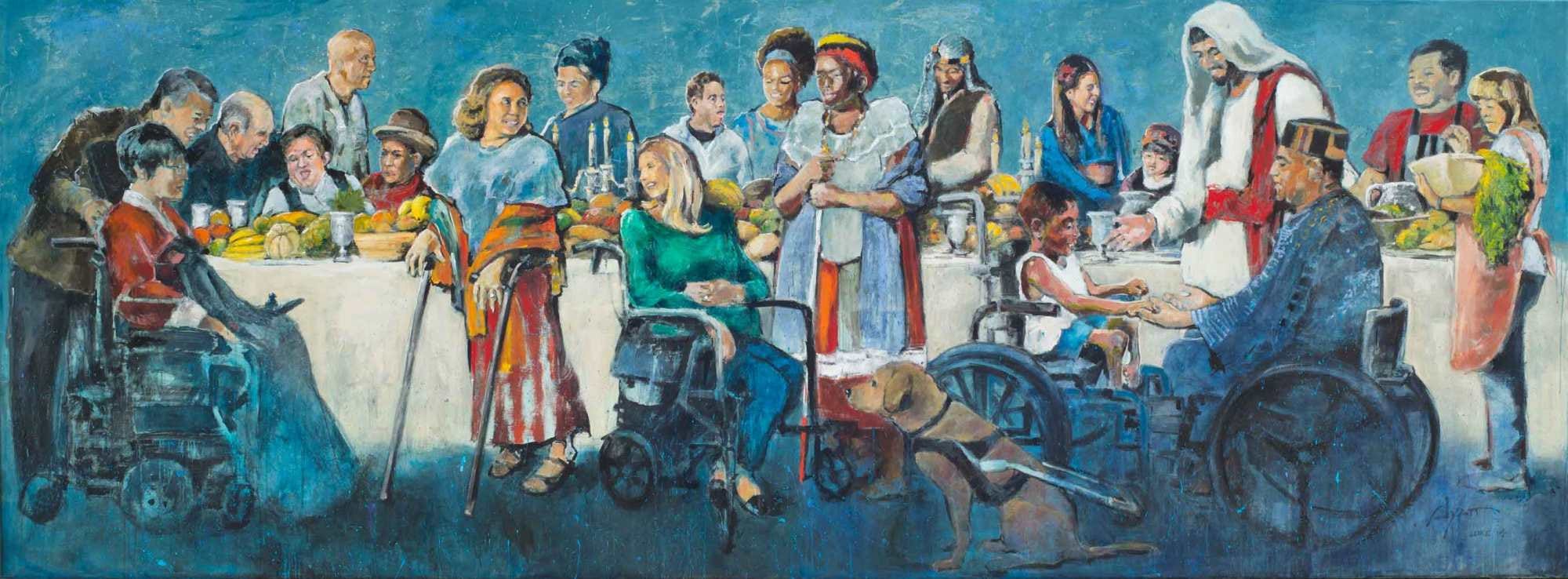
Mural on a blue background and lots of people gathered at a long table with a white tablecloth piled with food. There are persons of many different races and cultures and with various disabilities, including several in wheelchairs or with canes or crutches, several who have down syndrome, one with a service dog, and so on. Jesus stands near the right end of the canvas, conversing with a child of color in a wheelchair and an older Black man in a wheelchair.
“Luke 14 Banquet” by Hyatt More.

Trans theology: Christ embraces stigma

The Christian term for Christ’s crucifixion wounds, stigmata, is the same Greek word from which we get the term stigma. It means “mark,” and it refered to a mark cut or branded into the flesh of a soldier or enslaved personthe visible, painful sign that their bodies were not their own.

Like other oppressed groups, trans people know what it is to be stigmatized in the eyes of society. Our chosen names and pronouns, our choices in clothing and haircuts, the scars of gender affirming surgeries and full-body tranformations via hormone replacement therapy all mark us as worthy targets of shunning, shaming, and violence. Our non-normative bodies become a site of spectacle, where everyone feels entitled to gawk at our bodies, to know every detail of our medical histories. In our efforts to live into our God-given identities, we face obstacles across every sphere of life — from the legal and medical to religious and social — that remind us that many powerful people aim to strip us of agency and ownership over our own bodies.

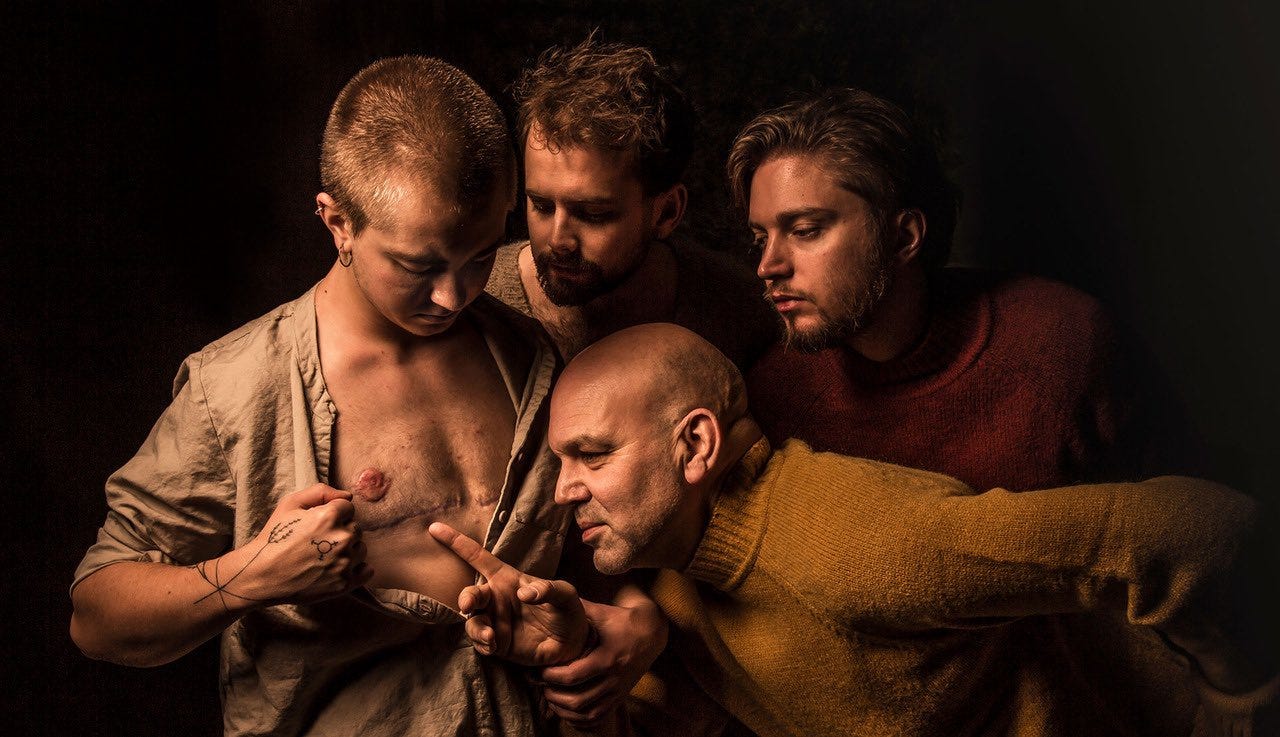
Yet many of us revel in the very marks of our Otherness, our defiance of the status quo! My top surgery scars make me feel like me; they are visible marks of the wonder of God’s works, of God’s invitation to join in our own co-creation.

Photograph of four figures staged to imitate Caravaggio's famous painting of Thomas touching Christ's side wound. In this version, the person playing Jesus has top surgery scars, which his three friends marvel at. He is guiding the hand of one friend so that the friend's pointer finger rests just under the scar.
From Swedish photographer Elisabeth Ohlson Wallin’s 2017 exhibit, “id:TRANS.”

Caveats: John 20’s anti-Jewish implications

This lectionary reading opens with a verse that can contribute (and historically has contributed) to anti-Jewish sentiments:

“When it was evening on that day, the first day of the week, and the doors were locked where the disciples were, for fear of the Jews, Jesus came and stood among them and said, ‘Peace be with you.’” – John 20:19

This phrase, “The Jews,” shows up 195 times in the NT — 71 of those times are in John’s Gospel. Frequently, “The Jews” are set up in the text as “the enemies of Jesus, and thus of God.”3 That dynamic has been utilized throughout Christian history to malign and persecute Jewish people, often with accusations of deicide.

Because “the Jews” are only mentioned briefly in this passage, preachers may be tempted to gloss over the potential for antisemitism here: naming it won’t relate to the rest of the sermon; it’ll take too much time! Greg Garrett admits to feeling similarly for many years:

“Looking over a dozen years of preaching on Easter 2, I see that there were years when I skipped straight over the fear of the Jews on the way to doubt or faith or epiphany or commitment or any of the other big spiritual lessons that that particular community seemed to need on that particular second Sunday of Easter.

But in the past few years, anytime we encounter one of these parenthetical statements about “the Jews” in a Gospel reading (particularly in John) I have taken to highlighting them, at the very least, as major sources of Christian antisemitism, and sometimes I have devoted substantial space to correcting bad readings and refuting this prejudice…”4

If you aim to be a good neighbor to our Jewish contemporaries, consider taking the time to name the anti-Jewish readings of John, even if it feels like a “tangent.” (At the very least, you might consider including a footnote in the bulletin / worship handout on the topic.)

Some options for addressing the issue on Sunday

  1. State plainly that “ ‘fear of the Jews’ is a ridiculous and inaccurate statement of why the followers of Jesus are gathered behind locked doors in the Gospel lesson. These men are themselves Jews. All of them. Peter is a Jew. Thomas is a Jew. The risen Jesus, the Anointed One who steps miraculously into their midst, is a Jew…”5
  2. Provide some historical context — that by the time the Gospel of John was being written, there had been a major falling-out between those Jews who confessed Jesus as Lord and those who did not. Many progressive Christians suggest that Jewish Jesus-followers had been “expelled” from synagogues; this is possible, but Jewish NT scholar Amy-Jill Levine notes, “we have no examples of such excommunication from antiquity; to the contrary, Paul is disciplined from within the synagogue system, and centuries later, John Chrysostom complains about church members attending synagogue programs.”6 As with so many things, it’s hard to know exactly what was going on so long ago, and the truth involves nuance. Thus, if you go this route, take care to word things in a way that does not place all the blame for this falling out on the Jews who didn’t follow Jesus. Ultimately, what we know is that this was an intra-community conflict, and whatever tensions there were between Jesus-followers and other Jews can help explain (though not justify) John’s language around “the Jews.”
  3. Consider altering the translation from “the Jews” to “Judaeans,” “the Judaean elite,” or something of that nature. The Greek word typically translated “the Jews” throughout the Gospels is Ioudaios/Ioudaioi. If we alter how we translate the term, it becomes clear that “the Ioudaioi in John were neither today’s ‘Jews’ nor the ancient world’s ‘Jews.’7 When hearing “Judaeans,” worshipers will be less likely to imagine a conflict of Jew vs. Christian; instead, the conflict is between the Galilean disciples — everyday impoverished Jews from a backwater region — and those elites in Judaea/Jerusalem who collaborated with the Roman Empire (e.g. the Sadducees; the Pharisees did not collaborate with Rome).
  4. What other tactics have you taken in addressing anti-Jewish or supersessionist readings of scripture?

Footnotes:

  1. See Rosemarie Garland Thomson’s essay “Becoming Disabled.” See also my introduction to disability basics, which explores disability as a natural part of the human experience and discusses the idea of Disability Culture. ↩︎
  2. John M. Hull, chapter 3 of Disability: The Inclusive Church Resource, 2014. ↩︎
  3. Wes Howard-Brook, “Why We Need to Translate Ioudaioi as “Judeans”, chapter 10 of Jesus Wasn’t Killed by the Jews: Reflections for Christians in Lent, ed. John M. Sweeney, 2020. ↩︎
  4. Greg Garrett, “For Fear of the Jews: Antisemitism in John’s Time and Ours,” chapter 13 of Jesus Wasn’t Killed by the Jews. ↩︎
  5. ibid. ↩︎
  6. Amy-Jill Levine, “If not now, when?”, afterword of Jesus Wasn’t Killed by the Jews. ↩︎
  7. Wes Howard-Brook, “Why We Need to Translate Ioudaioi as “Judeans.” ↩︎
Categories
advent bible study Holy Days Multifaith Other search markers Unpacking Antisemitism

Addressing Advent Anti-Judaism

During the season of Advent, Christians traditionally read Luke’s and Matthew’s Nativity stories alongside the book of Isaiah. It makes sense to do so, as Matthew himself makes the connection:

22 Now all of this took place so that what the Lord had spoken through the prophet would be fulfilled:

23 Look! A virgin will become pregnant and give birth to a son,
        And they will call him, Emmanuel. (Matthew 1:22-23)

– Matt 1:22-23, referencing Isaiah 7:14

But when we read Isaiah only in service to our Christian story, we do harm to our Jewish neighbors with whom we share these scriptures. To utilize the Hebrew Bible (= “Old Testament,” the Jewish Bible) solely as a promise fulfilled through Christ is to suggest that these scriptures are incomplete without and dependent upon Jesus — and therefore that Jews’ interpretation of their own Bible is incorrect and irrelevant.

So how do we simultaneously honor our Advent traditions, draw from Isaiah’s wisdom, and respect the vibrant, living faith of our Jewish neighbors?

Dr. Tyler Mayfield provides some excellent options in his 2020 book Unto Us a Son Is Born: Isaiah, Advent, and Our Jewish Neighbors.

The purpose of this post is to share some of the wisdom from Mayfield’s work, and to urge pastors, teachers, and others who help shape the Advent experience for their communities to check out the entire text for even more invaluable commentary.

A photo of Tyler Mayfield, a white man with short graying hair and short gray-brown beard smiling in the woods. To his right is the cover of his book

Contents of Unto Us a Child Is Born:

  • An introduction that, well, introduces the issues with current Christian uses of Isaiah and suggests a bifocal framework as remedy
  • Chapter 1: Using Our Near Vision During Advent
  • Chapter 2: Using Our Far Vision to Love Our Jewish Neighbors
  • The remainder of the chapters delve into each of the Isaiah passages offered by the Revised Common Lectionary for the Advent season.

This post will survey key points from the intro and first two chapters, and close with actionable ways to incorporate Mayfield’s message into Sunday worship and classes. Preachers and teachers will find it immensely helpful to read the rest of the book’s chapters as lesson/sermon preparation for each week of Advent.

The Bifocal Lens

Image of one side of a pair of bifocals, with the smaller, near lens fused in the larger, far lens. A line connects the larger lens to "Far Vision: Openness to our religious neighbors; paying attention to ways we may cause harm." A line drawn from the near lens leads to "Near Vision: Our sense of identity; e.g. worship rituals, cherished hymns"

In order to maintain our Christian traditions without monopolizing the Hebrew Bible, Mayfield recommends a bifocal view:

  • Our near vision focuses on our worship practices and liturgical celebrations, grounding us in our living religious tradition;
  • Our far view pays attention to the ways those practices affect those not in our communities and “compels us to critique and reject some aspects of this tradition, those that are hurtful, inaccurate, and derogatory toward our religious neighbors” (intro).

Using Isaiah and other Jewish scriptures responsibly during worship is not merely a scholarly endeavor; as Mayfield reminds us, reading and interpreting the Bible is a matter of ethics:

[…L]iturgy and ethics are not easily separated. In her excellent and provocative book on racism and sexism in Christian ethics, Traci West notes, “The rituals of Sunday worship enable Christians to publicly rehearse what it means to uphold the moral values they are supposed to bring to every aspect of their lives, from their attitudes about public policy to their intimate relations.” …We want our worship to spur us to live out our ethical claims. (Introduction)

Using Mayfield’s bifocal lens, we can ethically navigate “the tension between identity within a particular faith tradition and openness to the faith traditions of others.”

So what are some of the ways that traditional Advent worship can lead us to do harm to our Jewish neighbors?

Supersessionism

Supersessionism, also called replacement theology, claims that Christianity has replaced or supplanted Judaism; that our covenant through Christ cancels out Jews’ covenant through Abraham and Moses (hence the labeling of the two parts of the Christian Bible as the Old and New Testaments, from the Latin word for covenant).

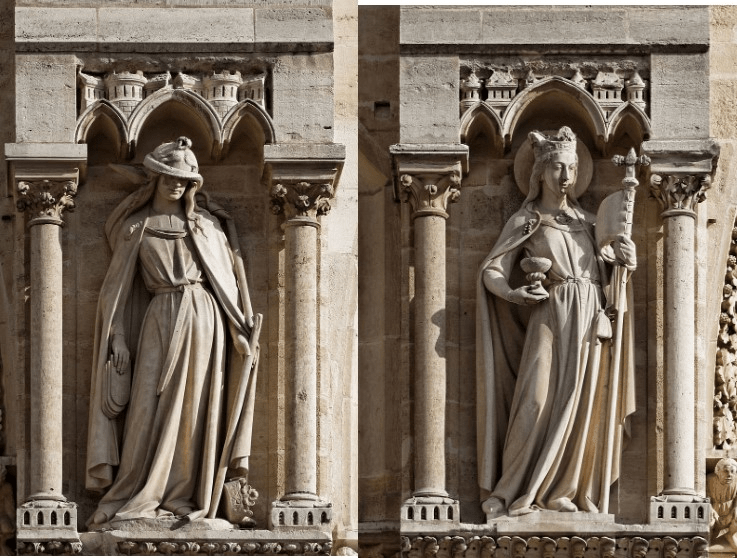
Synagoga et Ecclasia, two statues on the Notre Dame cathedral representing the Jewish and Christian faiths. This juxtaposition of crowned Church standing strong next to the Synagogue who is “blind to Jesus,” the ten commandments almost falling from her hand, is unfortunately depicted in numerous artworks of Medieval Europe.

Mayfield brings in Susannah Heschel’s description of supersessionism as a “theological colonization of Judaism“; she defines it as:

“The appropriation by the New Testament and the early church of Judaism’s central theological teachings, including messiah, eschatology, apocalypticism, election, and Israel, as well as its scriptures, its prophets, and even its God, while denying the continued validity of those teachings and texts within Judaism as an independent path to salvation.” (Heschel, The Aryan Jesus, 2008)

The seeds that the early church planted have born violent fruit across the centuries. This attitude of judgment and/or pity has led both to ideological violence — “render[ing] Jews invisible or irrelevant or as incomplete Christians” (intro) — and immense physical violence through to the segregation, scapegoating, forced conversions, expelling, and flat-out murder of the Jewish people across multiple continents.1

Medieval painting of figures gathered around a fire on which a book is burning. One person presses a poker onto it, while another person holds up a book to throw it into the fire. There are piles of books around this figure
Detail from Pedro Berruguete’s “Saint Dominic and the Albigensians” (1490s), depicting a Medieval “trial by fire” in which potentially heretical texts were determined to be “false” if they burned.

There are multiple instances of the Talmud — the central text of rabbinical Judaism alongside the Jewish Bible — being likewise gathered and burned across Medieval Europe due to the anti-Jewish belief that the Talmud was the primary obstacle keeping Jews from converting to Christianity. In 1242, for instance, King Louis IX of France ordered the burning of “24 cartloads” — something like 12,000 volumes — of priceless, scribe-written copies of the Talmud. This event devastated France’s Jewish community, which had been one of the seats of Jewish scholarship. Louis also followed up the book burning with a decree to expel all Jews from France: violence against Jewish scripture goes hand-in-hand with violence against Jewish bodies.

All this to say, the views we shape through worship and elsewhere truly do have real-world implications.

Mayfield argues that it is possible — indeed, necessary — to share scriptures respectfully. After all, he says, Judaism and Christianity are siblings.

While Christianity is often envisioned as the “shoot” growing from the dead stump of Jesse in Isaiah 11:1, a child who has improved upon the parent, in reality Judaism and Christianity are more like two branches extending from the same tree. They “grew out of the same milieu,” developing from the religion depicted in the Hebrew Bible during the chaotic era of that first century CE:

While early Jesus followers were formulating an identity distinct from Christ’s Jewish origins, Rome’s 70 CE destruction of the Second Temple spurred on new iterations of Jews’ own religion; following the Pharisees,2 they recentered faith around local life rather than the temple. In this way, the two religions are around the same age, growing from the same foundations! We are sibling religions; and we are neighbors. The problem is that we Christians have frequently behaved as very poor neighbors indeed.

Why Jewish “Neighbors”?

In Isaiah, Advent, and Our Christian Neighbors, Mayfield has opted for the term neighbor to describe the Christian relationship to Jews in the present day. Why? For one thing, love of neighbor is a central tenet of both Jewish and Christian tradition, originating in Leviticus 19:18 and emphasized by Jesus in Mark 12:31 and Matthew 22:39. Reading scripture through the ethic of love thy neighbor, we must ask, “If a particular reading of Scripture leads us to think badly of Jews, then is this reading Christian?” (chapter 2).

Furthermore, Mayfield continues,

I also use the concept of neighbor because neighbors do not always agree. In fact, they sometimes disagree and have to take seriously one another’s perceptions, feelings, and opinions. Being neighborly is being attentive and listening well to the concerns of others. It is realizing that your actions affect those around you. Christians act neighborly when they take seriously Jewish critiques of Christianity and Christian teachings, just as Jews act neighborly when they offer these critiques. (Chapter 2)

In reconsidering how we read and teach scripture, we can imagine that scripture is the fence we share with our Jewish neighbors, even while we dwell in different “geographies.” But when we accept supersessionist theology, we deny Jews their side of the fence; we colonize it.

Let’s look at how supersessionism manifests specifically in the ways we use Isaiah during Advent.

Resisting a Christian Isaiah

Mayfield describes how, over the past two millennia, Christians have disconnected Isaiah from his ancient Jewish context and Christianized him, even going so far as to call this eighth-century BCE prophet’s book the “fifth Gospel” alongside Mark, Matthew, Luke, and John (intro).

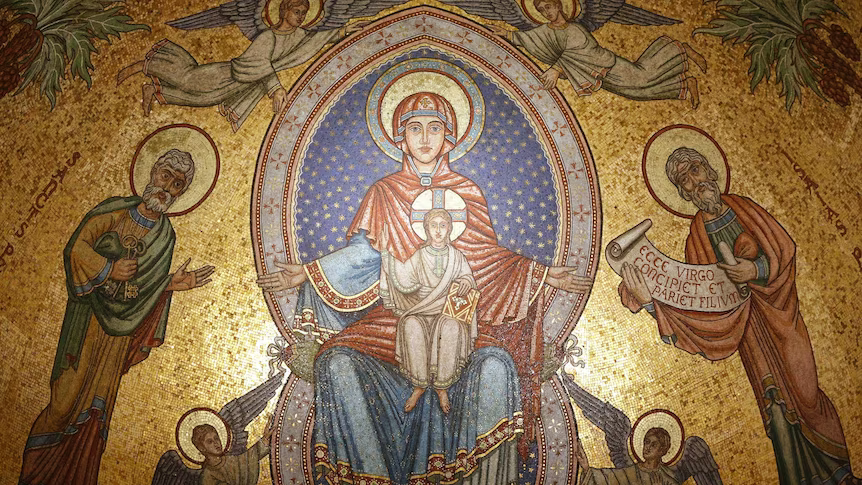
ID; ancient mural of Mary on a throne with a young Jesus in her lap. To her right is Peter holding a key. To her left is Isaiah holding a scroll on which the Latin for "Behold, a virgin will conceive and birth a son" is written
The Virgin Mary and Jesus, flanked by Isaiah (right) and Peter (left).

In lifting Isaiah from his seat among Jeremiah, Amos, and all the Hebrew Bible’s prophets, we sever him from his original ancient Jewish audience and deny his relevance to our Jewish neighbors today.

We hear Isaiah (and Handel in his Messiah) proclaim: “For unto us a child is born; unto us a son is given” (Isaiah 9:6) and everything in our tradition preps us to assume that the “us” in question is us Christians; that this child must be Jesus!

In our presumption that Isaiah’s prophecies are all about Jesus, we render this prophet irrelevant to our Jewish neighbors, denying the validity of their interpretations of this biblical book. But if we dig into the historical context, we can broaden our ways of understanding these texts and thus learn how to better share these scriptures.

A Christ-exclusive interpretation of Isaiah misunderstands what biblical prophets did.

We hear the word “prophecy” and think of foreseeing the future, often the distant future. But the prophets of the Bible, from Joel to John the Baptist, were largely focused on their own here-and-now:

The prophets of ancient Israel (and ancient Mesopotamia) did not see their sole activity as foretelling. They were also “forthtellers,” speaking to the religious and political issues of their day with courage and strength. As mediators between God and the people, prophets delivered messages, oracles, and visions to audiences that included kings and commoners. They interpreted the past, analyzed the present, and spoke of the future but were undoubtedly more concerned with events of the present than events several hundred years in the making. …

[T]he notion of prophecy as foretelling renders the prophet’s words irrelevant to, and uninspired for, the first hearers and readers of these messages. (Chapter 1)

There’s another historical issue with reading Isaiah’s prophecies as exclusively about Jesus as his people’s anticipated Messiah:

At the time of Isaiah in the 700s BCE, the concept of the eschatological Messiah had not yet been developed!

While the Hebrew Bible does describe figures like David and Cyrus as anointed ones (which is what the Hebrew word mashiach, “messiah,” means), the concept of The Messiah who would usher in an age of justice and peace was most likely a later development of Second Temple Judaism (516 BCE – 70 CE).

We only see The Messiah in Isaiah’s descriptions of a “Wonderful Counselor…Prince of Peace” (Isaiah 9:6b) and a just judge on whom God’s spirit rests (Isaiah 11:1-10) because of our own bias: “We think we know what we will find before we look” (chapter 1).

Learning about a passage’s original context helps us interpret the text more faithfully as we seek its relevance today. What is more, we can and should consider its multiple historical contexts, the whole breadth of what it has meant for different groups in different eras:

Texts in Isaiah have an entire history of interpretation, which includes the “originating” context in ancient Israel, their reuse and interpretation in Second Temple Judaism perhaps, their Christian context in which some Isaiah texts became christological, the Jewish context in which some texts became messianic, and then later Christian context, that is, when these texts were attached to Advent.

The book of Isaiah was composed by ancient Israelites over several centuries, from the eighth to the fifth centuries BCE. These authors wrote for their ancient Israelite audiences with no comprehension of later events such as the life of Jesus and the growth of Christianity. Thus, the book of Isaiah does not predict the birth of Jesus. (Chapter 1)

Recognizing the long history of a piece of scripture helps reduce our sense of ownership over the text; we realize that its messages are not for Christians alone, but for faithful Jews and Christians (and Muslims, to an extent) across the millennia and today. This recognition is vital for unpacking biases and beliefs we often don’t even realize we carry deep in our psyches — and that some of the tools we use reinforce.

A Complicit Lectionary?

A key concern Mayfield explores throughout Unto Us a Child Is Born is how the lectionaries we use can guide us towards supersessionist readings during Advent. He focuses on the Revised Common Lectionary (RCL) because of its popularity: Denominations ranging from the UCC to the Roman Catholic Church make use of it; overall, a huge portion of all sorts of Christians (largely in Canada and the USA) use it. 

Mayfield explains that for each Sunday, the ecumenical team that created the RCL selected the Gospel reading first, and then selected an “Old Testament” text (plus a psalm & Acts/epistles/Revelation passage) to complement that Gospel reading.

The theological ramifications of always prioritizing the Gospel in this way include an unbalanced dialogue: If we imagine the readings in conversation with each other, the Gospel always gets to choose the topic; the “Old Testament” only ever gets to respond.

Actionable Ways to Be Good Neighbors

After learning about Advent’s supersessionist pitfalls, you might be tempted simply to drop Isaiah in an effort to avoid the issue entirely. But Mayfield argues that that is a mistake:

We need Isaiah to celebrate Advent. The book’s treasures are too marvelous to set aside as ancient history or consign to another liturgical season. As we begin the liturgical year, we need to hear of swords beaten into plowshares and of barren lands blooming. …To use only the Gospel readings during Advent limits our theological reflections while also insinuating that only those four biblical books are worthy of public reading and proclamation. (Chapter 1)

Instead of ditching Isaiah, Mayfield offers practical suggestions for using the prophet responsibly:

First, we can open readings of Isaiah in church with an explicit statement: “Today we hear words from a book held sacred by both Jews and Christians.” As Mayfield explains, “This simple and accurate statement…compels us to recognize our religious neighbors even as we worship” (chapter 2).

Going further, a preacher can remind congregants that “As Christians, we understand Isaiah through our histories and theologies, but Jews do not read Isaiah this way.”

(My own thought: A pastor can even take time in an Advent sermon to acknowledge some of the history of misusing Jewish scriptures / debunking common presumptions about Isaiah’s role in the Nativity story. A Sunday School teacher has even more space to explore that history and context, and to invite attendees to imagine how Isaiah speaks to us today.)

Beyond simple statements and one-time mentions, Mayfield urges us to commit to always interpreting scriptures through a paradigm of “do no harm” — to “share as good neighbors.”

A key part of this paradigm is an intentional shift from “a more linear approach to the narrative of Scripture (in which we read the biblical books as a progression both in time and in theological depth) to a more back-and-forth conversational approach (in which we allow various texts to speak to one another).” This conversational framework creates space for the Bible’s many voices and refuses to let “New Testament” voices dominate.

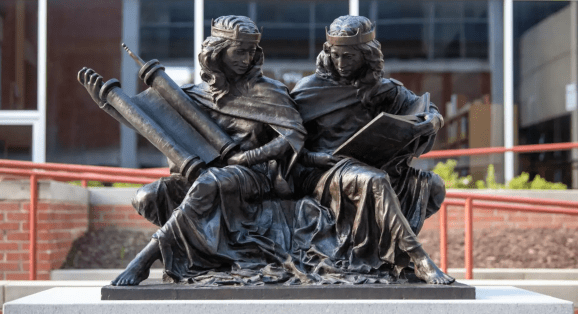
An outdoor statue of two women sitting side by side. Both are robed and crowned. One holds a large torah scroll; the other an open Bible. They are smiling and looking at one another's texts.
A new representation of Synagoga et Ecclasia, mutually crowned and learning from each other. Statue by Joshua Koffman for St. Joseph’s University, commissioned in honor of the 50th Anniversary of the Roman Catholic Church’s 1965 Nostra Aetate declaration, which repudiated past anti-Jewish doctrine and actions and called for more respectful relations.

Here’s a longer excerpt from Mayfield describing how to put this paradigm into practice while remaining true to ourselves:

So, how do we, as Christians, continue to affirm one of our central claims of Jesus as the Messiah while also allowing space for the dismissal of that claim? Perhaps we are helped by returning to the tension between identity and openness.

Christians maintain strong identities in the claim of Jesus as the Christ while also remaining open to other visions of the messianic kingdom, thus realizing that the full realm of God has not come. It is vital to our identity to claim Jesus as the Messiah, and we are also open to other formulations of messiah.

One meaningful way forward along this challenging path is not to claim too much: to be careful, considerate, and humble with our messianic notions. For example, instead of holding to a messianic or christological reading of Isaiah as the only valid notion, Christians could admit openly and explicitly that these texts provide some of the necessary elements that will constitute notions of messiahship in first-century Judaism, notions Jesus and his biographers took up and used. However, these texts do not point immediately to Jesus; there is just not a straight line — historically or theologically — between Point A, Isaiah, and Point B, Jesus.

This sort of admission presents real possibilities for neighborly engagement since it ties the Christian claim about Jesus more closely to sacred texts that are used only by Christians. It does not predetermine the meaning of Isaiah for all traditions, but it allows Jews and Christians to interpret Isaiah’s prophecies based on their respective traditions, with neither tradition holding ultimate authority over the biblical text. …We could go even further to say that the Jewish reading is an important and necessary one from which Christians could learn. (Chapter 2)

More Benefits of Interpreting Responsibly!

Ultimately, a paradigm of respect and mutual conversation bears rich fruit not only in our relationship to our Jewish neighbors, but to our own faith. Letting Hebrew Bible texts stand on their own merit opens us to how a given passage speaks to us here and now, rather than limiting its prophecies to a closed loop of prophecy-fulfilled-in-Christ. Mayfield quotes Ellen Davis’ comment that

“We like to keep the frame of reference for prophecy within the ‘safe’ confines of the Bible, by reading prophecy solely as illuminating what has already happened—the birth, life, and death of Jesus Christ—and not allowing it to meddle much in the current lives of Christians” [and Jews!]. (Chapter 1)

We are not called to play it safe; we are called to let scripture breathe, and to welcome in God’s mischievous spirit! Making room for many interpretations, for multiple messages from Isaiah for different times and contexts, liberates scripture to speak to us in new, challenging, relevant ways today.

Doing so also helps us live into the tension of Advent’s dual theological themes: Incarnation and eschatology. As Mayfield notes,

These two foci do not naturally cohere. The emotions invoked by Advent call us to “prepare joyfully for the first coming of the incarnate Lord and to prepare penitently for the second coming and God’s impending judgment.”3 Joy and penitence. …We are pulled in different emotional directions. (Chapter 1)

Churches tend to lean towards the joy — but we can’t ditch the solemnity, can’t “alleviate the tension,” without robbing ourselves of “the incredible richness and grace that result from the annual eschatological collision in the weeks before Christmas.”4

As someone who centers my ministry around breaking binaries, reveling in the in-betweens where God does Their best work, I appreciate this insistence on the “both/and” of penitence and joy — as well as of Isaiah and Matthew/Mark, and of a prophetic message for Isaiah’s time, and Jesus’s time, and for us and our Jewish neighbors today.

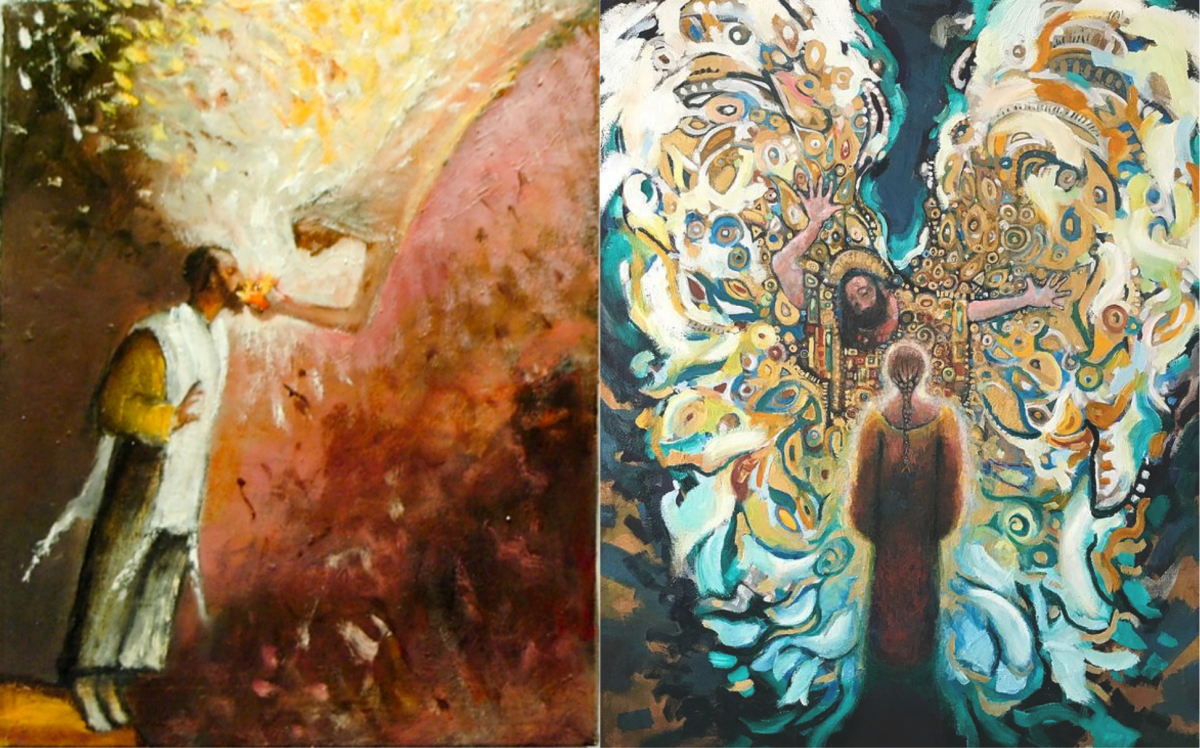
Two contemporary paintings side by side. The first is of Isaiah receiving a burning coal to his lips by an angel. The second is the angel appearing before Mary.
“Isaiah” by Richard McBee; “The Annunciation” by Daniel Bonnell

Closing

In Advent, past, present, and future queerly coalesce:

“We have hope in what the incarnation brings to our world each day, even as we hope for the setting right of things with the culmination of history.” (Chapter 1)

Though the details certainly differ, we can thus proclaim that “even though the Messiah has come, we wait with Jews for the ‘complete realization of the messianic age'” and that in this interim time, “it is the mission of the Church, as also that of the Jewish people, to proclaim and to work to prepare the world for the full flowering of God’s Reign, which is, but is ‘not yet’”5 (chapter 2).

This Advent claim “takes the unique identity of Christians seriously as ones who have seen in Jesus our Messiah yet remain open to the fullness of that claim in the future” (chapter 2).

It is possible to shape Advent into a season wherein we don’t perpetuate harm against our Jewish neighbors, but rather grow in our respect for and mutual relationship with them. The remainder of Unto Us a Child Is Born: Isaiah, Advent, and Our Christian Neighbors is overflowing with more knowledge and advice that further enables this aim. I highly recommend checking it out. If you need help obtaining a copy, hit me up.

Have a blessed, pensive, and joyful Advent.


  1. For a thorough history of antisemitism, and how to be in solidarity both with Jews and Palestinians, I highly recommend Safety through Solidarity: A Radical Guide to Fighting Antisemitism. ↩︎
  2. Pharisees were cool, y’all; go learn from the fabulous Rabbi Danya Ruttenberg about what Pharisees believed, how Jesus may have been a Pharisee himself, and the context around the Gospel writers’ negative depictions of them ↩︎
  3. Mayfield’s quoting Gail R. O’Day, “Back to the Future: The Eschatological Vision of Advent” (2008) ↩︎
  4. Mayfield’s quoting J. Neil Alexander, Waiting for the Coming (1993) ↩︎
  5. Mayfield is quoting Mary Boys, Has God Only One Blessing? (2000) ↩︎
Categories
bible study Current Events / Activism easter Holy Days LGBT/queer Queer Lectionary Reflections for worship services

Today is Easter Sunday. Today is Trans Day of Visibility. Today is day 176 of genocide.

This year the lectionary gives us Mark’s account of the Resurrection, with its fearful cliffhanger ending — an empty tomb, but Jesus’s body missing. And isn’t that unresolved note fitting?

In the face of so much suffering across the world, it feels right to be compelled to sit — even on this most jubilant of days — with the poor and disenfranchised in their continued suffering.

Mark’s account:

Just days before, the women closest to Jesus witnessed him slowly suffocate to death on a Roman cross. Now, now trudge to his tomb to anoint his corpse — and find the stone rolled away, his body gone. A strange figure inside tells them that Jesus is has risen, and will reunite with them in Galilee.

They respond not with joy, but trembling ekstasis — a sense of being beside yourself, taken out of your own mind with shock. They flee.

The women keep what they’ve seen and heard to themselves — because their beloved friend outliving execution is just too good to be true. When does fortune ever favor those who languish under Empire’s shadow?

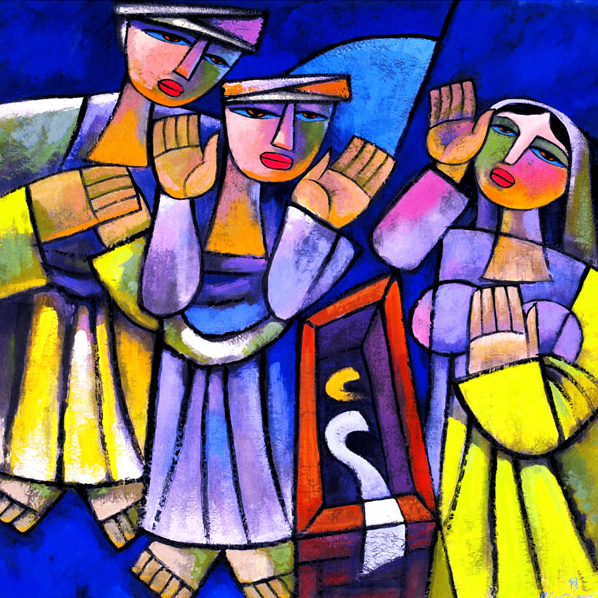
A painting in a style resembling stained glass of three women standing over a coffin, which is empty except for strips of white and yellow linen. The women's hands are raised in confusion and shock.
“The Empty Tomb” by He Qi.

Love wins, yet hate still holds us captive.

I’m grateful that Mark’s resurrection story is the one many of us are hearing in church this year. His version emphasizes the “already but not yet” experience of God’s liberation of which theologians write: Christians believe that in Christ’s incarnation — his life, death, and resurrection — all of humanity, all of Creation is already redeemed… and yet, we still experience suffering. The Kin(g)dom is already incoming, but not yet fully manifested.

Like Mark’s Gospel with its Easter joy overshadowed by ongoing fear, Trans Day of Visibility is fraught with the tension of, on the one hand, needing to be seen, to be known, to move society from awareness into acceptance into celebration; and, on the other hand, grappling with the increased violence and bigotry that a larger spotlight brings.

The trans community intimately understands the intermingling of life and death, joy and pain.

When we manage to roll back the stones on our tombs of silence and shame, self-loathing and social death, and stride boldly into new, transforming and transformative life — into trans joy! — death still stalks us.

We are blessedly, audaciously free — and we are in constant danger. There are many who would shove us back into our tombs.

An art piece structured like a collage featuring an elegant figure wreathed in fire, with text around them reading "& like any goddexx you are scorned & become the fire anyway." The figure is pouring pitchers of water into a pool at their feet; green hills with various flowers stretch up around the pool.
Art by Amir Khadar, based off the poem “litany in which you are still here” by kiki nicole

And of course, the trans community is by no means alone in experiencing the not-yet-ness of God’s Kin(g)dom.

Empire’s violence continues to overshadow God’s liberation.

The women who came to tend to their beloved dead initially experienced the loss of his body as one more indignity heaped upon them by Empire. Was his torture, their terror, not enough, that even their grief must be trampled upon, his corpse stolen away from them?

The people of Gaza are undergoing such horrors now. Indignity is heaped on indignity as they are bombed, assaulted, terrorized, starved, mocked. They are not given a moment’s rest to tend to their dead. They are not permitted to celebrate Easter’s joy as they deserve. They are forced to break their Ramadan fasts with little more than grass.

Photo of a blanket set with bowls of grass soup and slices of lemon
A photo of a Palestinian family’s meal, taken in Gaza.

Those of us who reside in the imperial core — as I do as a white Christian in the United States — must not look away from the violence our leaders are funding, enabling, justifying.

We must not celebrate God’s all-encompassing redemption without also bearing witness to the ways that liberation is not yet experienced by so many across the world.

This Easter, I pray for a free Palestine. I pray for an end to Western Empire, the severing of all its toxic tendrils holding the whole earth in a death grip.

I pray that faith communities will commit and recommit themselves to helping roll the stones of hate and fear away — and to eroding those stones into nothing, so they cannot be used to crush us once we’ve stepped into new life.

I pray for joy so vibrant it washes fear away, disintegrates all hatred into awe.

In the meantime, I pray for the energy and courage to bear witness to suffering; for the wisdom for each of us to discern our part in easing pain; for God’s Spirit to reveal Xirself to and among the world’s despised, over and over — till God’s Kin(g)dom comes in full at last.

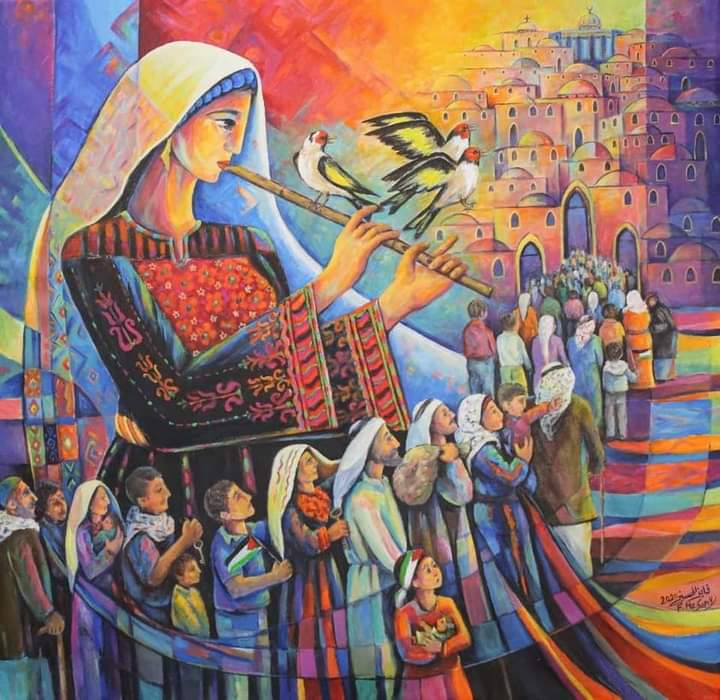
Painting of a woman playing a flute with several birds around her, as below her a line of Palestinians make their way up towards the city of Jerusalem. The colors are warm and bright.
Painting by Palestinian artist Fayez Al-Hasani
Categories
bible study Holy Days lent Reflections for worship services

Ash Wednesday, Isaiah 6, and the blessing in our limitations

Painting by Justin “JUST” Simmons.

The below reflection is cross-posted from Daily Ripple; see the end of this post for more information. Furthermore, if you prefer to listen instead of reading, you can listen to this piece in the latest episode of the Blessed Are the Binary Breakers podcast.

I said, “Mourn for me; I’m ruined! I’m a man with unclean lips, and I live among a people with unclean lips. Yet I’ve seen the king, the Lord of heavenly forces!”

Then one of the winged creatures flew to me, holding a glowing coal that ze had taken from the altar with tongs. Ze touched my mouth and said, “See, this has touched your lips. Your guilt has departed, and your sin is removed.”

Isaiah 6:5-7

Did the glowing coal leave a mark? A smear of dark? A bright burn?

Reading this text on Ash Wednesday, I can’t help but connect Isaiah’s coal and our ashy crosses:

He confesses himself unclean — admits his limits, where he and his people have failed.

We profess ourselves dust — acknowledge our limits, the finite time we have here and now, and how often we’ve failed to cherish that time.

In the confession, we open ourselves to blessing. Accepting our limits, we fall into God’s limitless love.

Why these physical, ritual actions — coal to the lips, ashes to the brow — to mark these limits and the blessings they yield?

God knows, respects, loves our existence as embodied spirits, inspirited bodies. She pairs spiritual gifts with tangible signs to help us experience Her truths with our whole selves.

A glowing coal — dead plants packed deep, transformed over eons, unburied at last and set alight — touches truth-telling lips to set them free.

Ashes of palm branches once waved in worship, burned down to begin the cycle anew, mark us as individually finite, but gathered into an infinite love.

Take time to prayerfully consider your own limits. What blessings, what liberation can you imagine flowing from our individual finitude? How can you connect your limited time and gifts to a greater whole, in small ways with great love?

Photo of a bowl of black ashes, with a small dried palm leaf cross in the middle of the ashes. The bowl sits on a green palm branch.

About Daily Ripple!

I am delighted to have joined the creative team at Daily Ripple — starting with posts this week, including what you just read!

If you want to incorporate queer-affirming, justice-oriented snippets of biblical reflection written by a diverse range of Christians into your everyday life, Daily Ripple is a lovely option. It’s free, and every weekday, subscribers receive a short reflection, ending with a question meant to guide you towards action. 

I’ve been writing the daily posts for this week, incorporating queer and autistic theology into readings of Psalm 119, Mark 4, and Isaiah 6. Check them all out at the Daily Ripple.

Categories
advent bible study Holy Days My poetry Queer Lectionary Reflections for worship services

Christ is barred from Bethlehem

A voice cries out in the wilderness,
“Prepare the way of the Lord! Make straight his paths.”

How do we do that in the present day?
We break down walls that block his family’s way.

As Mary and Joseph draw near Bethlehem
a fence looms over them, some eight yards high

and soldiers watch from towers as they trudge
not straight into the city, but around
to find the checkpoint — where they’re turned away:
“We’re only letting tourists in today.”

So Mary groans outside the barrier
no place to lay her newborn’s bloodied head

and John the Baptist paints in green and red
across that cold wall’s surface — shepherds, lo! —
“Merry Christmas world
from Bethlehem Ghetto”


You are welcome to make use of the above poem or below reflection in worship, in classrooms, on social media, etc. Please credit Avery Arden of binarybreakingworship.com.

_____

In a 2014 article, Medhi Hasan wonders how Mary and Joseph’s trip from Nazareth to Bethlehem would go in the modern day:

“How would that carpenter and his pregnant wife have circumnavigated the Kafka­esque network of Israeli settlements, roadblocks and closed military zones in the occupied West Bank? Would Mary have had to experience labor or childbirth at a checkpoint, as one in 10 pregnant Palestinian women did between 2000 and 2007 – resulting in the death of at least 35 newborn babies, according to the Lancet?

‘If Jesus were to come this year, Bethlehem would be closed,’ declared Father Ibrahim Shomali, a Catholic priest of the city’s Beit Jala parish, in December 2011. ‘Mary and Joseph would have needed Israeli permission – or to have been tourists.’ “

Meanwhile, a Reddit post claims they’d have to get through fifteen checkpoints on their journey. Chances are, they wouldn’t make it through — just get harassed and interrogated for their trouble.

As I reflect on these statements, I ponder also the opening of Mark’s Gospel. This text, which is read in many churches during the Advent season, recalls the prophetic cry of Isaiah 40:

A voice is crying out:
“Clear the Lord’s way in the desert!
    Make a level highway in the wilderness for our God!
Every valley will be raised up,
    and every mountain and hill will be flattened.
    Uneven ground will become level,
    and rough terrain a valley plain.
The Lord’s glory will appear,
    and all humanity will see it together;
    the Lord’s mouth has commanded it.”

What does such a prophetic leveling — a flattening of land so that all people, including children, elderly and pregnant persons, and people with mobility impairments can easily travel — look like today?

I envision the 440 miles of separation wall crumbling into the earth. Watchtowers topple. Barbed wire melts away. Snipers’ guns morph into ploughshares; bombs explode oh-so-gently into fertilizer to feed burned olive groves.

No more are humans caged in the world’s largest open-air prison. No more are children dragged away in the night to be tortured and tried as terrorists.

The land is free. The people are free. God’s liberating Spirit moves unhindered; God’s holy land becomes, as promised, a “house of prayer for all peoples” (Isaiah 56:7).

Thanks be to God. May we be moved to help make it so.

  • A person wearing a keffiyeh secures tear gas canisters to a tree, with normal Christmas ornaments visible on trees behind him
  • A person secures tear gas canisters to a tree with Christmas lights on it

Gallery images: a remake of a famous 1936 “Visit Palestine” poster to show the Holy Family and the separation wall; photos of Palestinians decorating a tree in Bethlehem with tear gas canisters in 2015, as well as a close-up of a canister showing it’s USA-made; and more photos from the separation wall, including the icon “Our Lady of the Wall,” where nuns and pilgrims pray rosaries to dismantle the wall.

Categories
advent Holy Days Hymns Other search markers Unpacking Antisemitism

“O Come Emmanuel” revised for Palestine’s plight

This Advent, some progressive Christians have discussed whether to table one of our religion’s most ancient hymns: “O Come, O Come Emmanuel.” When we sing of God coming to “ransom captive Israel,”
will our congregations recognize we don’t mean the modern Israeli nation?

Honestly, a conversation around this song is long past due (and many have had it over the decades). The truth is, it’s always been laden with supersessionist implications. Depicting the Jewish people as living “in lonely exile here / Until the son of God appear” perpetuates the idea that Jews’ relationship with God is incomplete because they “didn’t accept” Jesus as their Messiah.

How do we resist both antisemitism and Zionism, while seeking to maintain a connection to Christians who came before us? One option may be to reimagine the songs we cherish so that, instead of perpetuating deep-seated hate and Christian supremacy, they challenge us towards joining God in solidarity with the world’s oppressed.

In that spirit, below is my reworking of “O Come Emmanuel” to center the plight of Palestinians (and that removes, I hope, the supersessionism — let me know if I missed any). May our worship songs plant in us a deep desire for justice, and spark our action towards a future where all peoples, all religions live in mutual relationship and respect.

Please feel free to use and share around — just credit Avery Arden of binarybreakingworship.com.

__

O come, o come compassionate Divine,
And ransom captive Palestine
That mourns with tears that will not be soothed
Till empires fall and nations’ hearts are moved.

Rejoice! Rejoice! God’s justice is at hand
To liberate the people and the land.


O come, o bright and ever-burning star;
Bring Gaza comfort from afar!
Dispel from her the shadow of death
That murders dignity and chokes out breath.

Rejoice! Rejoice! God’s justice is at hand
To liberate the people and the land.


O come, o Wisdom from on high,
Take up the outcast’s cause, the captive’s cry.
Guide us to build your kingdom on earth
Where all faiths flourish, and the last are first.

Rejoice! Rejoice! God’s justice is at hand
To liberate the people and the land.


O come, o King of Peace and Justice, break
All weapons down, and from them ploughshares make.
Let all tears dry, all peoples respond:
“We are each other’s magnitude and bond.”

Rejoice! Rejoice! God’s justice is at hand
To liberate the people and the land.

Categories
bible study LGBT/queer Queer Lectionary

Queering Hagar’s Story

A short reflection on this Sunday’s lectionary text, Genesis 21:8-21. Scroll to the end for further resources

 a painting of a figure like Hagar who is smiling as water pours through her hands; above her is a giant eye.

Name changes occur throughout scripture, but there is only one instance in which a human being directly names God!

That person is Hagar — the woman enslaved and then cast off by God’s own chosen people, yet who recognizes God’s solidarity with her in a way that resonates with many marginalized folk, including queer & trans people of faith.

Back in Genesis 16, Hagar is forced to conceive a child with Abraham — her bodily autonomy denied — and then suffers abuse at Sarah’s hand so painful that she prefers almost-certain death in the wilderness. While waiting to die, God comes to her, nourishes her, encourages her with the promise of a better future. For a time, Hagar must return to her oppressors.

This is a hard message, but It may resonate with queer and trans people who make the hard choice to find what safety they can while in the closet, or who choose to remain in relationship with family or faith communities that have caused them harm.

It also isn’t the end of Hagar’s story: when the time is right, God leads her out — as told in this week’s text in Genesis 21.

Sarah continues to abuse Hagar, with Abraham as a passive bystander and enabler. In a society where only one of Abraham’s sons can inherit his wealth and blessing, Sarah sees Hagar’s son Ishmael as a threat to her son Isaac, simply by existing! In our own day and age, this myth of scarcity persists, causing us to hoard resources and compete needlessly.

Sarah cannot stand to see Hagar’s child playing with her own son — as if they were equals! As if a slave boy should be having a moment of fun! She reads something sinister into the play — not unlike how some people today read sinister things into queer play, into drag queens and gender expansive youth.

Having convinced herself that Hagar and her son are a threat, Sarah gets Abraham to cast them out.

But again, God is with the outcast; God comes again to Hagar, who in Genesis 16 had given God the name El Roi — “God sees me.” This God is the god of her oppressors, yet Hagar recognizes that this god is her God as well! This god is a God who sees the suffering of the lowest of society, and responds.

God sees queer and trans people, too. God is our God, too — those who hate us do not have a monopoly on the Divine!

And God walks with us through every struggle, fueling us to fight the good fight and promising blessings to come.

Questions for reflection:

  • When have you witnessed God coming to the Hagars in our midst?
  • When has your community behaved like Abraham & Sarah, hoarding God’s love as if there were not blessing enough to go around?
  • Can you imagine a world in which Sarah, Abraham, and Hagar meet again? What would Hagar need to feel safe to meet with her former abusers? What would Sarah & Abraham need to do to make things right?

Further Reading

Queer-specific resources:

Other resources:

a painting of two women with curly brown hair and brown skin embracing; the one being held has a blue shawl with “Sarah and Hagar” written in Hebrew on it, while the one embracing her has a bright blue dress. A dove with an olive branch hovers behind them
Sarah and Hagar” by Jewish artist Hilary Sylvester, who says: “Sarah the mother of the Jewish People and Hagar the mother of the Arab people finally find reconciliation through Mashiach.”
Categories
bible study easter Holy Days Reflections for worship services

Waiting with Mary Magdalene — lament that wrestles God

A reflection that draws from John 20 and Isaiah 56. Happy Easter, all.

As Mary Magdalene sits alone in the predawn stillness, she weeps — but her tears are not only grief: they are tears of frustration. Tears with questions. Tears that demand something of Divinity.

Mary is not passive in her weeping: she is wrestling the divine.

Rev. Dr. Rachel Wrenn of the First Reading podcast calls what Mary is experiencing “exasperated hope.” She parallels Mary in the garden to God of Isaiah 65, who is “ready to be sought out” by Her people who “sit inside tombs, and spend the night in secret places” (vv. 1, 4a). Magdalene reverses the image of Divinity waiting exasperatedly for humanity — now the human awaits the Divine.

God of Isaiah 65 says, ‘I said, “Here I am, here I am,” to a nation that did not call on my name.’

Magdalene too is saying, “Here I am,” to a God who WILL call her name, soon — but not yet.

First, she must endure the excruciating in-between space.

And she endures that space alone. Peter and the Beloved Disciple enter it for a moment, as first light tentatively touches the tomb’s rolled-back stone.

They sprint into it — that pregnant space between question and answer, death and rebirth — past Mary weeping without a word to her.

They enter the empty tomb and they see the burial cloths that God has stripped off and left behind. They see and the beloved, at least, “believes” (John 20:8). Believes that Jesus is risen — does he also believe that Jesus will return? That they will all see Jesus again, and soon?

If he does, his action is not to hunker down with Mary into the waiting space. He and Peter “return to where they were staying” (v. 10).

They cannot bear the waiting space. Most of us can’t. Who would choose to settle down in hospital halls with figures hunched and haggard, to wait with them for whatever news there may be?

Most of us wouldn’t. Magdalene might.

We can’t skip past the waiting, though. So Mary waits — waits for whatever will come, whenever it comes — and as she waits, she weeps. Her tears are not despair — they are lament.

In This Here Flesh, Cole Arthur Riley describes the power and purpose of lament:

“Lament is not anti-hope. It’s not even a stepping-stone to hope. Lament itself is a form of hope. It’s an innate awareness that what is should not be. As if something is written on our hearts that tells us exactly what we are meant for, and whenever confronted with something contrary to this, we experience a crumbling. And in the rubble, we say, God, you promised.”

Mary believes in the promises of her teacher, his proclamations of a world turned on its head, a new creation born where the poor are lifted from the ashes.

Her hope in that world has crumbled, but she doesn’t abandon the rubble: she settles into it. Makes her home there to wait and see what rises from the ruins.

Mary is crying, “God, you promised!” And she in turn promises God, “here I am — whenever you come, you will find me. I’m not going anywhere.”

In her describing of lament, Cole continues, “Our hope can be only as deep as our lament is. And our lament as deep as our hope.” Mary’s lament is long, because her hope is deep.

Mary Magdalene does not sit in the garden in despair. Her lament expects response — demands it. Like God of Isaiah 56, she is waiting to be sought — waiting for her call to be met with response…and it will be! Her God WILL call her name — “Mary!” — and she will know the joy of lament answered, of hope fulfilled.

Magdalene is actively waiting for what she KNOWS will come. And she’s not going anywhere till it does.

Thank God for those who wrestle blessing out of pain; who brave the liminal lament and don’t let go.

Mary, your waiting is not in vain. Joy comes with the morning. Hallelujah!


I originally posted this as a twitter thread, which you can see here.