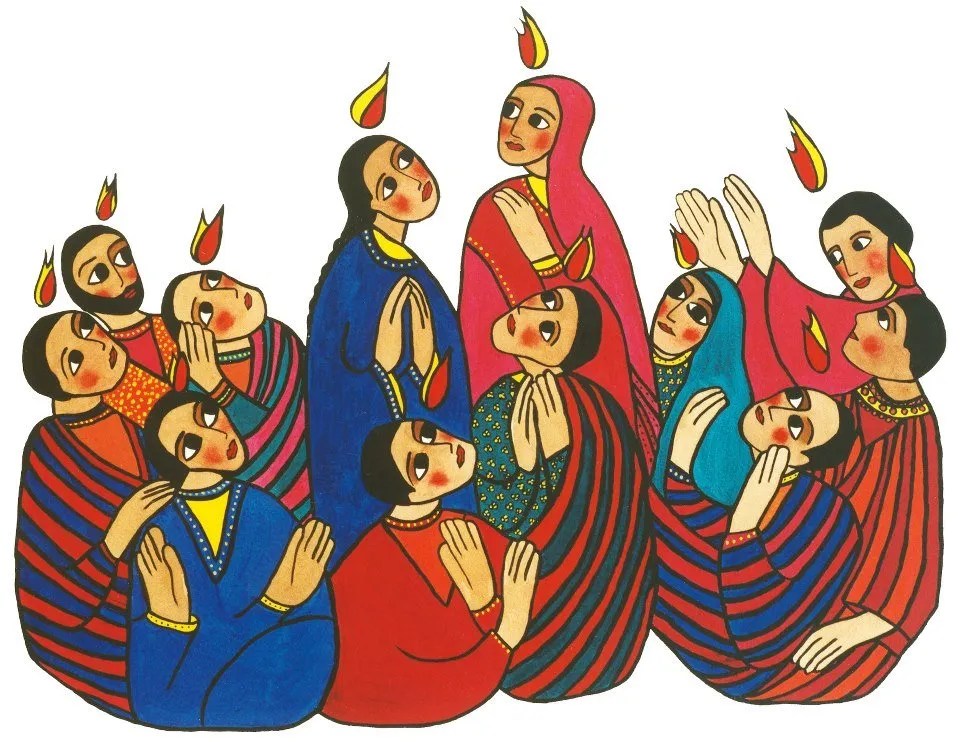
Pentecost Sunday, 1 Corinthians 12:3b-13 and Acts 2:1-21 through a queer, liberationist lens
Key points:
- Throughout scripture and culminating in Pentecost, God’s breath pervades all creation and lavishes gifts upon all persons — yet also demonstrates what liberation theologians call a “preferential option for the poor,” often selecting society’s shamed and shunned to speak God’s good news to the world.
- Too often, we dismiss God-given wisdom and leadership as it manifests in the oppressed; we must resist the hierarchy of gifts humans construct and learn to recognize Spirit wherever She moves.
- For instance, many dismiss the powerful Spirit-movement of Pentecost; they aren’t prepared to see God among Galilean hicks, so they don’t. But there is Spirit-movement there, which lesbian theologian Kittredge Cherry envisions as an erotic, ecstatic, polyamorous marriage between Holy Spirit and human spirits (passage below).
- At Pentecost, it’s people who know society’s in-between spaces, the not-quite-belonging-anywhere that many bi- or multicultural people experience — Jews who were immigrants or visitors from outside Judea. Spirit speaks to them in their own heart languages! We too are called to practice linguistic hospitality and the radical belonging and centering of marginalized voices, vocations, movements.
God’s Spirit: both prodigal and particular
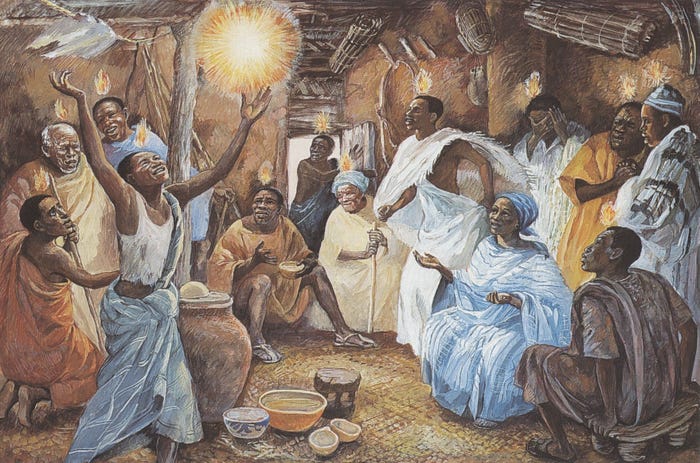
Happy Pentecost! This Sunday’s readings show us a Spirit who blows across all creation, blazes into the bustling heart of community life, and bestows Xir manifold gifts prodigally yet particularly — prodigal as in almost “wastefully” generous, an overflowing abundance of blessing lavished over all created things; and particular in that Xe is intentional about which gifts each individual receives, often with what liberation theologians call a “preferential option” for strangers and outcasts.
There’s Psalm 104, wherein God’s Spirit, or breath, is what animates all things — then Numbers 11:24-30, in which Spirit rests upon a select group in a particular way:
“I’ll take some of the spirit that is on you and place it on them. Then they will carry the burden of the people with you so that you won’t bear it alone.” So Moses…assembled seventy men from the people’s elders and placed them around the tent. …When the spirit rested on them, they prophesied, but only this once.
Two men had remained in the camp, one named Eldad and the second named Medad, and the spirit rested on them. They were among those registered, but they hadn’t gone out to the tent, so they prophesied in the camp. – vv. 24-26
Along with the recognition that we all need support and that decision-making power must be shared, what I love about this passage is how God’s Spirit does what She always does — surprises us.
We expect Divinity to remain within the safe confines of the boundaries we devise — in this case, the meeting tent Moses established where he and God carry out important conversations. But God’s breath blows where it will; the Spirit isn’t solely in the tent! Off in the center of things, out among the people, She gifts Eldad and Medad with prophecy too.
It is as 1 Corinthians 12 tells us:
Now there are varieties of gifts but the same Spirit, and there are varieties of services but the same Lord, and there are varieties of activities, but it is the same God who activates all of them in everyone. To each is given the manifestation of the Spirit for the common good.
– 1 Corinthians 12:4-7
Resisting a hierarchy of gifts
All of us carry gifts from the Spirit intended for communal good; it is in using and joining our God-given gifts that we participate in the delivery of God’s Kin-dom here on earth.
Unfortunately, we tend to create a hierarchies out of these spiritual gifts, vocations, and activities: some are put on pedestals, while others are belittled, overlooked, or even cursed as sin.
For instance, we too often fail to recognize disabled persons’ unique gifts — and I don’t mean “they have so much to teach us” in the paternalistic, infantilizing way that is mainstream. I mean that their/our experiences of moving through a society structured to exclude them/us often compels them/us to cultivate wisdom and resourcefulness that could help liberate everyone.1 This is true of every oppressed group that “makes a way out of no way.”2
Some of our God-given gifts are even denounced as curses. Take queer ways of loving and being — ways that defy and demolish normative constrictions, that challenge society to think beyond “the way things are.”
This is why I can’t tolerate the “love the sinner, hate the sin” rhetoric or see it as anything but hate wrapped up in pretend piety — you are calling Divine activity in my life, the bounty of love and holy transformation flowing out from my queer experiences, sin.
I’m not one to throw around words like blasphemy, but Jesus does warn us that insults against the Holy Spirit — which I interpret as divine activity in the world — are unforgivable. Now, Jesus often employed hyperbole to get vital points across, and I don’t think that by “unforgivable” he means “damnable”; even so, we must all take great care not to rush to denounce God’s movement as sin just because it grates against the status quo.
In Acts 2’s Pentecost story, some of those who witness God’s movement in the disciples’ multilingual exclamations of Christ’s liberation don’t declaim it as sin, but do dismiss it as drunken ranting (v. 13).
A queer vision: Pentecost as erotic, ecstatic union
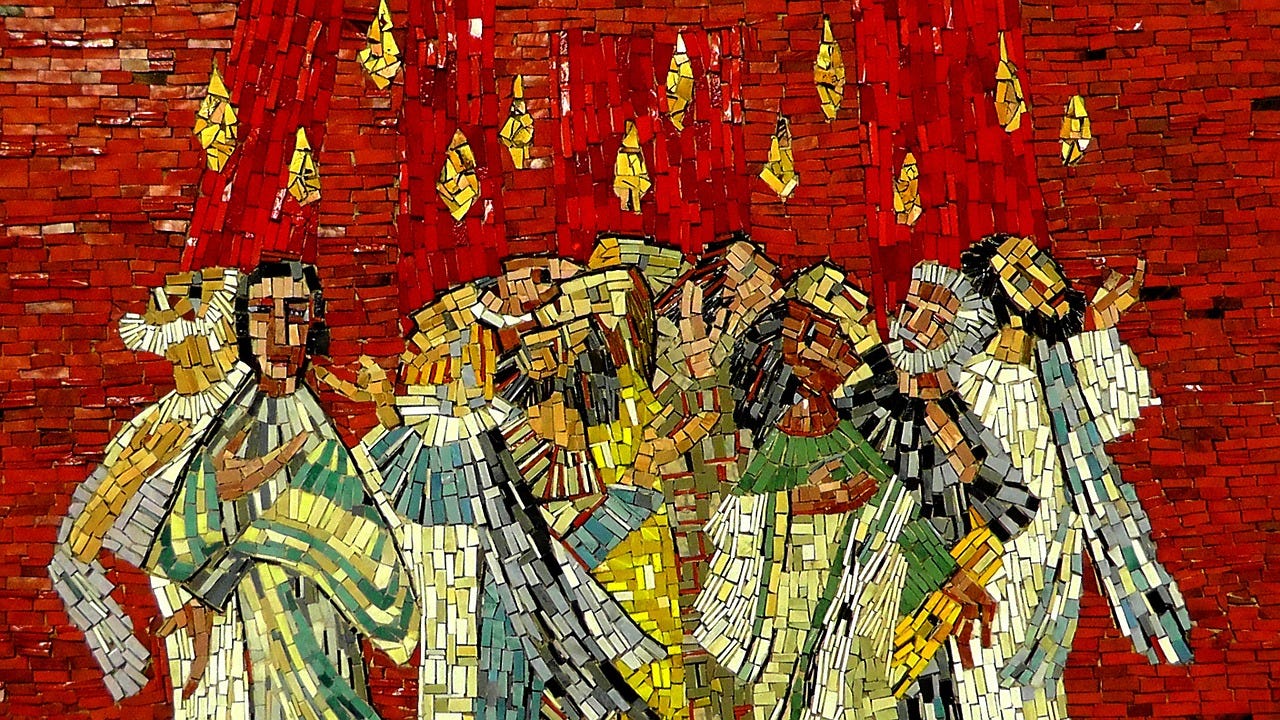
What some dismiss as debauchery was in reality an ecstatic encounter with the divine. Lesbian theologian and QSpirit host Kittredge Cherry envisions Pentecost’s arrival of the Spirit as an orgy-like ecstasy of mystical love-making; Holy Spirit weds human spirit as divinity is distributed through a fiery kiss:
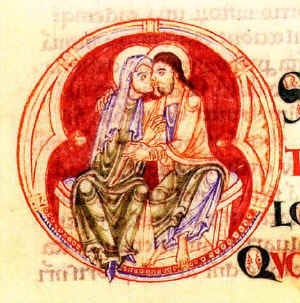
When the Holy Spirit loved me, our contact produced a ripple of energy similar to a heartbeat. She was ringing me like a bell, and the “sound” would roll on forever.
“It is without end, because it is without beginning,” She said. She rang me again, and this time when the edge of her heart crossed mine, the rapture made me lose control and we melted into One. …
We kissed everyone in the room…We licked them with Our flaming tongues. They welcomed Our electric kisses. Each of them inhaled sharply and deeply in preparation for a sigh. We swept into them as breath, passed through each soul’s new doorway and fertilized the sacred chamber within. At the same time, their sparkling souls penetrated my divine heart and swam into a new womblike space that had just unfurled for them. The glorious friction made me feel flushed.
Holy Spirit and human spirit were wedded, catalyzing a chain reaction of power bursts. Every soul in the room ignited in such a way that flames appeared to blaze from each person’s body. They looked around at each other’s auras in astonished admiration.
All that happened on one inhalation. When they exhaled, they could taste how much God loved them as We flowed over their tongues. They let their tongues flutter and writhe in ecstatic abandon. Each one released the tension of the wedding consummation in his or her own unique speaking style. Some of it sounded like gibberish to them as they praised God. Others spoke in exalted words. …
The Holy Spirit and I rode the sound waves of their voices, still actively making love. We granted everyone within listening range the same gift that I had received that morning: the ability to hear pure thought.3
Pentecost’s preferential option for the poor
As the disciples’ spirits merge with the Divine Spirit, their joyful response flows out into Jerusalem. As aforementioned, some dismiss their ecstasy as inebriation.
To them, these students of the executed rabbi Jesus are nothing more than homeless hicks who’ve wandered too far from their backwater region of Galilee. Perhaps they should “go back to where they came from” instead of continuing to disrupt the peace — peace as in “quiet,” in this case; but also as in the Pax Romana, empire’s false peace of enforced order.
Of course many dismiss them, just as we today dismiss the ways God is speaking through those we consider backwards, badly behaved, or unworthy of our time.
But others are drawn to the disciples’ boisterous babble.
“Devout Jews from every nation under heaven”
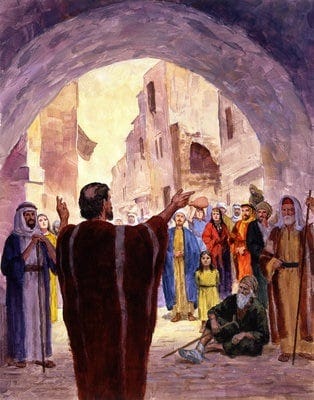
The Jews who stop to listen to what these Spirit-filled vagabonds are actually saying are foreign Jews, coming from nations outside Judea.
Some of them are ethnically Jewish, born in diaspora; others are previously-gentile converts to the Jewish religion.
Some are only visiting Jerusalem on pilgrimage to celebrate Pentecost, the Greek word for the Jewish holiday Shavuot, which celebrates Moses receiving the Ten Commandments. They’ve only left their gentile-majority communities for a short while.
Others have taken up more permanent residence in Jerusalem, where they get to live among fellow Jews — but, with their foreign languages and customs, they still don’t quite fit in.
Overall, these are people of the in-between:
Too Jewish for the gentiles of their homelands; too foreign for the Jews of Jerusalem, they know what it is to not quite belong anywhere.
Here in Jerusalem, these pilgrims and immigrants probably get by with the lingua franca of the Roman Empire, Greek (or, for more official occasions, Latin). They are heartsick for the ease and comfort of their mother tongues, their regional dialects. Strange idioms trip them up; miscommunications abound; jokes and banter are belabored.
As these people of the in-between journey through Jerusalem to the temple for Shavuot, I bet the last thing they expected to hear was their own heart language, breaking through a wall of Greek and Aramaic.
What wonder! What relief! What…on earth are these Galileans; where did they pick up so many languages??
Of course these are the kinds of people who stopped to listen. Judeans accustomed to communicating easily, to hearing their first language everywhere they go, are more likely to react with scorn at the boisterousness of these country bumpkins.
But for those who yearn for a quality conversation in their heart language, it’s good news. They’re disturbed all right — but in a wondrous way. They are ready to have their lives shaken up by proclamations of a Messiah of the in-between — a fringe Jew like themselves, who made time for outcasts like themselves.
…Isn’t it always the people on the outskirts, in the gaps and on the borders of things, who are most ready for revolution?
Many languages, shared liberation
Pentecost is sometimes referred to as a reversal of what happened at Babel — but I don’t think that’s quite right. At Babel, God creates a diversity of language; a reversal of that act would be to reduce human speech to just one language.
But that is not what God does — that’s what Empire does: It bulldozes difference and calls enforced conformity peace.
God speaks to us and hears us in our own language, whatever that language may be, and delights in our diversity! We, in turn, are called to exercise what the philosopher Paul Ricoeur called “linguistic hospitality,” rejoicing in our cultural diversity and enjoying the richness of our variety of language, united in the One who prays for us “with sighs too deep for words” (Romans 8: 26).
At Pentecost, the apostles invite others into their community as they are — sharing much in common, devoted to one passion, but maintaining core differences, like language. Oppressive differences like class are broken down, but the things that make us unique are welcomed.
Speaking as a USAmerican, this posture of humility and hospitality goes against everything we are taught here in the imperial core. I can’t dominate you if I know I have a lot to learn from you. You can’t dehumanize me when you acknowledge the value that I alone can bring to the table.
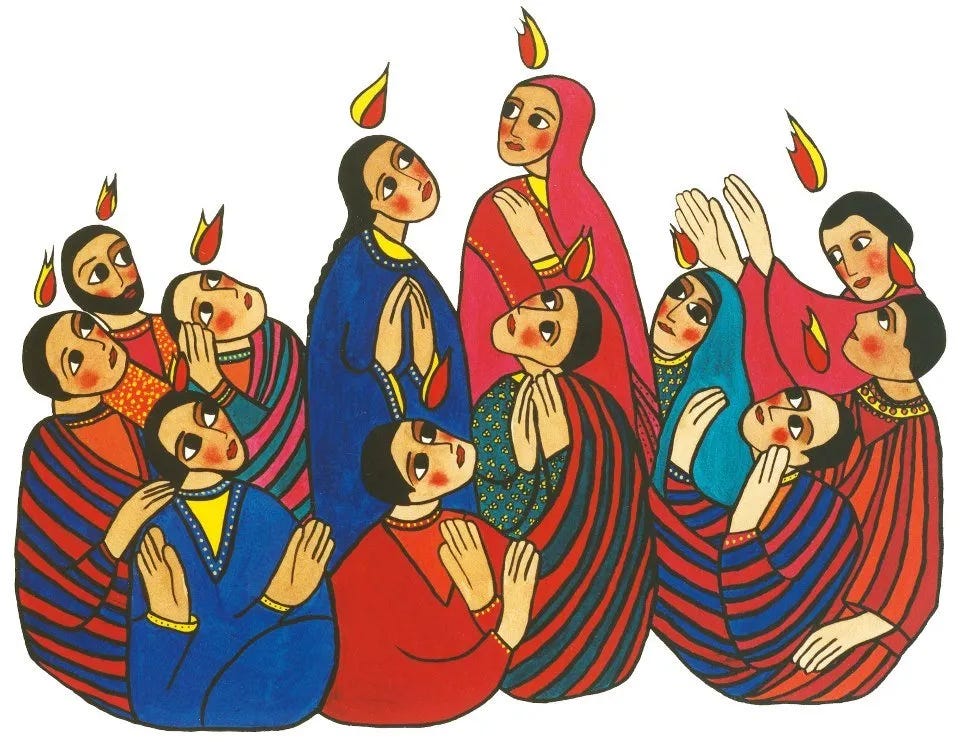
Rejoicing in this expectation-exploding, harmonizing Spirit, let us pray:
Holy Spirit of breath and flame,
howling gale and still small voice,We praise you in your elusiveness,
how you whirl through the world wherever you — not we — will.You dodge every attempt to pin you down,
slipping through our fingers like thin air
when we try to claim control of you —yet at the same time, you pulse through our cells with every heartbeat,
settle deeper into our lungs with every breath.As you, Irresistible Wind, pour over us now,
set our hearts on fire with passion for your justice,
for hospitality and mutuality,
for abundance beyond reckoning.Amen.4
Footnotes
- For more on the unique gifts that disabled persons often bring to the table, see Leah Lakshmi Piepzna Samarasinha’s book The Future Is Disabled — or their article on the topic here, where they declare, “At the core of my work and life is the belief that disabled wisdom is the key to our survival and expansion. Crip genius is what will keep us all alive and bring us home to the just and survivable future we all need. If we have a chance in hell of getting there.” ↩︎
- “Making a way out of no way” is an expression of Black wisdom frequently referenced by Womanists, as in Monica A. Coleman’s book that uses the phrase as its title. ↩︎
- Kittredge Cherry, Jesus in Love: At the Cross, 2018. ↩︎
- Prayer first shared on my website, binarybreakingworship.com. See also this Pentecost call to worship and benediction. ↩︎

