Year A, Fifth Sunday of Easter.
Using a queer lens + addressing anti-Jewish supersessionism.
This Sunday’s readings explore what it means to be followers of the Jesus Way. Is this an exclusive path? Do we supersede the Jewish people as God’s chosen people? (Spoiler: hell no!)
Taking these passages together, we can paint a picture of a Way wherein we dismantle standing structures in favor of building up with living stones, with the rejected stone as the chief cornerstone — creating a Kin-dom home that has room enough for all.
Key points
- The passages from Acts 7 and 1 Peter 2 embody the tension present in so many parts of scripture: They offer gorgeous glimpses into God’s Kin-dom, and they lay the groundwork for later Christian antisemitism.
- I urge preachers and teachers to name the danger in these texts, rather than simply skirt around it. Address these verses so that your audience won’t fill the void of your avoidance with the assumption that “we” agree with this rhetoric.
- At the same time, these two passages can help us explore what it means to be followers of the Jesus Way. We open ourselves to the multitudinous ways God speaks to us through diverse voices. We celebrate the people rejected by the upholders of unjust structures and systems. We commit ourselves to unpacking our biases and learning how to be in solidarity with oppressed peoples, even when we mess up.
- And we remember that, as Jesus promises us in the John 14 passage, God’s home has room enough for us all. Everybody belongs. Everybody feasts.
Acts 7:55-60
Queer meditation
But filled with the Holy Spirit, [Stephen] gazed into heaven and saw the glory of God and Jesus standing at the right hand of God. “Look,” he said, “I see the heavens opened and the Son of Man standing at the right hand of God!” But they covered their ears, and with a loud shout all rushed together against him.
– Acts 7:56-57
How do we respond to divergent interpretations of our shared faith? Are we open to and interested in mutual dialogue, eager to potentially glean new wisdom — or do we cover our ears in horror? Do we let ourselves sit in the discomfort of possibly being wrong (or at least not wholly right) — or shame and shun the “heretic”?
One of my partners grew up in a fundamentalist household in which new ways of understanding God and scripture were received as threats.
Once when he was a teen, he dared to wonder whether every single sentence in the Bible had to exactly reflect God’s will — or whether it might make more sense that human biases entered the text. His father flushed beet red, face twisting as he pointed a shaking finger at his child: “Don’t you dare say that. Don’t you dare blaspheme God under my roof.”
There was rage in his father’s voice — but more than that, there was fear. A real, ferocious terror in what could happen if his child were to rebel against what he believed were God’s truth and will.
Maybe something deep inside him recognized that his faith in a punishing God who despises queerness, deputizes whiteness, and demands perfect obedience was actually quite flimsy — that it was utterly dependent on this understanding of scripture as the literal and inerrant Word of God (with very specific interpretations of said scripture); and that if he were to allow himself to start asking questions, his entire belief system would crumble around him and leave him floundering. And wouldn’t that mean that his whole life had been empty, shameful, wrong? He simply had too much to lose to risk even a shred of doubt or questioning.
…Maybe that’s where his fear came from, maybe not. I think also of the flip-side fear: the terror of growing up being told God hates you, has no options for you but a hollow life or hellfire.
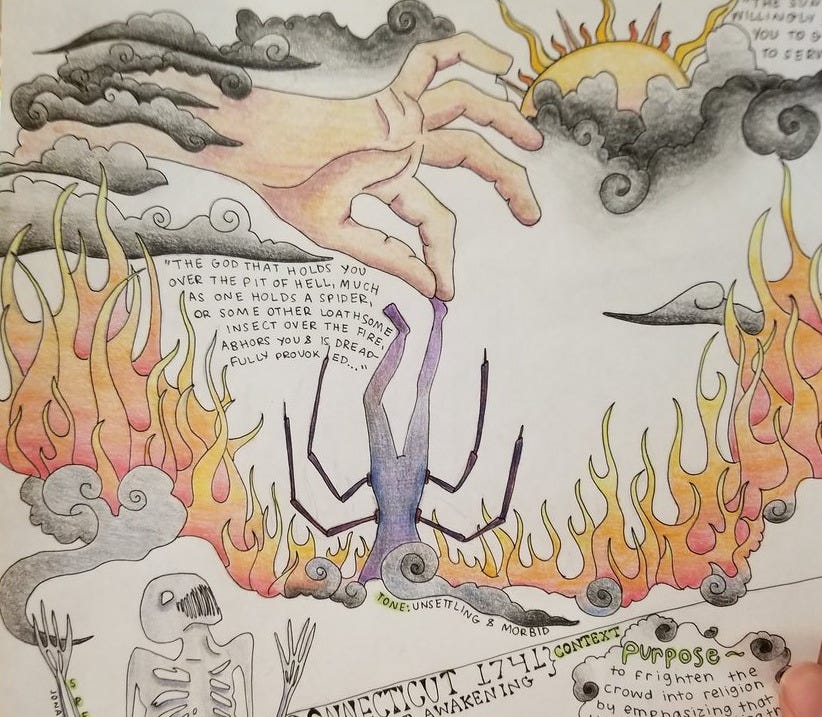
Sometimes the good news of God’s expansive and unconditional love, the holy truth that humanity is intentionally, divinely diverse — how else could we be in the Image of an infinite God? — is received with trepidation rather than relief. Could it be true, or do I just want to believe it’s true to “justify my sin”?1 What happens if I embrace my queerness and it turns out I’m wrong?
We can turn to Thomas Merton and his beloved prayer of unknowing (which matches the John passage we’ll get to later very well):
My Lord God, I have no idea where I am going. I do not see the road ahead of me. I cannot know for certain where it will end.
Nor do I really know myself, and the fact that I think I am following Your will does not mean that I am actually doing so.But I believe that the desire to please You does in fact please You.
And I hope I have that desire in all that I am doing.
I hope that I will never do anything apart from that desire.And I know that, if I do this, You will lead me by the right road,
though I may know nothing about it.Therefore I will trust You always, though I may seem to be lost
and in the shadow of death. I will not fear, for You are ever with me,
and You will never leave me to face my perils alone. Amen.
We can live in fear of new perspectives. Of admitting we were wrong. Of punishment. Of exclusion. Of a scarcity of love and grace.
Or we can place our trust in Divine Wisdom to guide us, in Christ’s mercy to cover us — and take the plunge.
Naming anti-Jewish rhetoric
The above meditation takes the Acts reading as it is laid out for us. But context matters, and Acts 7’s is rather troubling.
So to start with, I urge preachers to provide context for the lectionary passage by summing up the events of Acts 6 as well as Stephen’s speech in Acts 7, especially its closing lines in verses 51-53.
After all, the lectionary passage severs the alleged reason that the Jerusalem Council supposedly stoned Stephen. It’s not just that he’s a Jesus-follower. It’s that he accused them of setting themselves against God’s Spirit (v. 51).
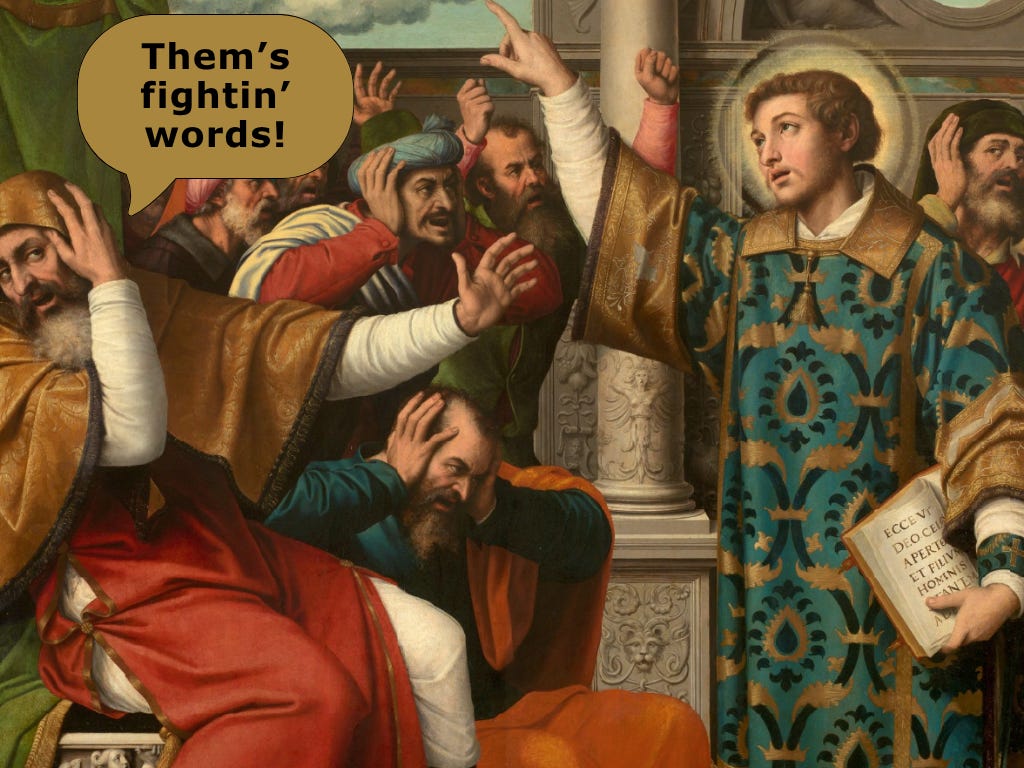
When Stephen adds perceived blasphemy to that accusation, proclaiming Jesus stands at “the right hand of God” — that Jesus is himself divine — it’s enough to spur them to violent action.
…Or is it? Did the stoning of Stephen really take place? And if it did, did it occur exactly as the author of Acts recorded it?
As is so often the case, it’s important to note is the possibility of anti-Jewish polemic in this text — inherent to the text, and/or easily produced by our interpretations of it. I recommend this YouTube lecture on the stoning of Stephen, which draws heavily from Shelly Matthews book Perfect Martyr: The Stoning of Stephen and the Creation of Christian Identity. Starting especially around 25 minutes into the video, a shift is pointed out between more positive depictions of the Jerusalem Jews in the first 6 chapters of Acts, and the vilification of non-Christ-following Jews after the account of Stephen’s martyrdom. From that point on, Jewish people are no longer described as the People of God.
Stephen’s own speech highlights this rhetorical distancing of Jesus-followers from other Jews; he opens his speech by naming “our ancestor Abraham” (v. 2), yet ends with:
“You continuously set yourself against the Holy Spirit, just like your ancestors did. Was there a single prophet your ancestors didn’t harass? …” – Acts 7:51-52a
While Stephen is most likely a Hellenized Jew, e.g. one who speaks Greek and holds a lot of Greek culture and values, he is a born Jew. These are his ancestors too! But here the author writes Stephen as setting up an us and them binary in which Jews with no interest in Jesus are “those people,” stiff-necked and murderous enemies of God Themself.
It’s important to recognize the biases in the NT texts, the context that caused these anti-Jewish polemics. We can recognize that the majority of the NT writers were Jews, that this was for these earliest Christians largely an intra-community conflict, while also naming the harm these texts have done and continue to do. We can experience these scriptures as sites where God’s Word speaks to us, while acknowledging their imperfections as human-written documents. In so doing, we refuse binaries of good and bad, us and them, that don’t leave room for the messiness of human realities.
1 Peter 2:2-10
Continuing to address antisemitism
They stumble because they disobey the word, as they were destined to do. But you are a chosen race, a royal priesthood, a holy nation, God’s own people…
1 Peter 2:8b, 9a
The author of this epistle has such a gorgeous vision of the margins being made central, which I’ll get to in a minute; the tragedy is that he turns that vision into polemic, using his words to sever the Jewish people from their status as “God’s own people” and bestow that title upon Jesus-followers instead.
With passages like these in scripture, it’s no wonder supersessionism — the notion that Christians replace, or supersede, Jews; that our covenant through Christ renders their covenant through Abraham null-and-void — is so prevalent and deeply-rooted in Christianity.
I urge preachers and teachers to name this rhetoric, rather than simply skirt around it. Address these verses so that your audience won’t fill the void of your avoidance with the assumption that “we” agree with the letter writer’s point of view.
Like all of us, the Bible’s authors contained multitudes — their transcendent glimpses into the divine are weighed down by worldly ideologies that say God’s love is a finite resource; that life is a competition; that there can only be one “first,” one “beloved”; that to uplift one group is necessarily to sideline another.
Let’s keep naming that truth as we seek to follow Jesus in ways that bring justice and joy, rather than harm.
And central to the Jesus Way is the declaration that the ones rejected by human structures and systems are the very ones God works in and through! This too is something 1 Peter’s author recognized, as the next section explores.
Queer stones
Come to him, a living stone, though rejected by mortals yet chosen and precious in God’s sight, and like living stones let yourselves be built into a spiritual house…
– 1 Peter 2:4-7
For it stands in scripture:
“See, I am laying in Zion a stone,
a cornerstone chosen and precious,
and whoever believes in him will not be put to shame”
[…and]
“The stone that the builders rejected
has become the very head of the corner.”
This passage is very queer indeed. A stone rejected by the builders becomes the chief cornerstone! The ones who fabricated the structures that enclose us all are not the ones with the final say — God is!
The God of the stranger, Liberator of the oppressed, the One who always chooses to stand outside any dividing line we draw between “us” and “them,” finds that castoff rock and makes it central, indispensable:
[The] members of the body that seem to be weaker are indispensable… God [gives] the greater honor to the inferior member.
– 1 Corinthians 12: 22, 24b
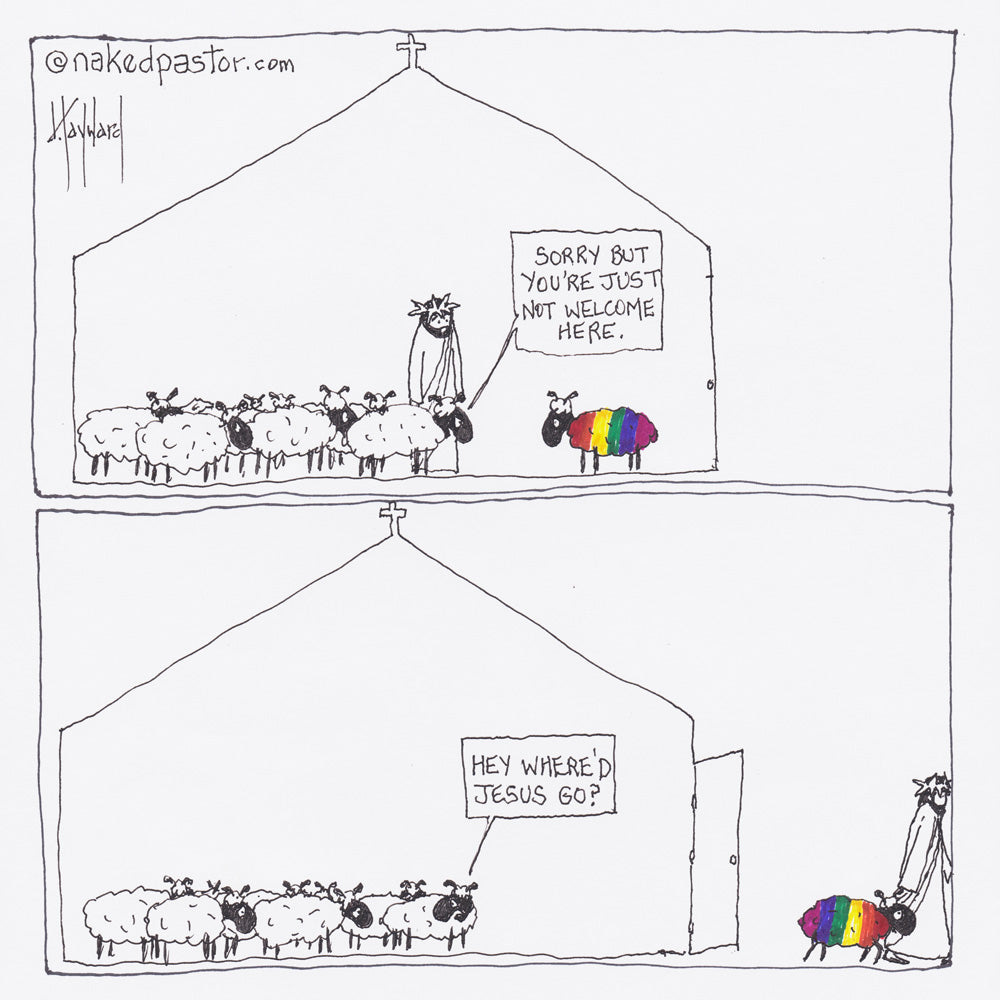
We the shunned and shamed ones, we who are considered to be “no people” (v. 10) — nobodies — become the living stones with which Divinity constructs a new Creation.
We whom dominant cultures despise create our own cultures — queer culture, Black culture, disability culture, and more — where our unique gifts and ways of manifesting God’s love to the world are uplifted.
We are Christ’s hands and feet on earth, helping usher in a Kin-dom in which the last are first, the margins are drawn to the center, and all dividing walls are dismantled, piece by piece.
Babies in Christ: we learn along the way
Like newborn infants, long for the pure, spiritual milk, so that by it you may grow into salvation — if indeed you have tasted that the Lord is good.
1 Peter 2:2
When we taste that God is good, we grow hungry for more. One major way we taste that divine goodness is when we look to the poor for God’s good news and join in liberation movements with the captive and oppressed (see Luke 4:18-19). By becoming co-conspirators with those “living stones” God centers in the building up of Their Kin-dom, we are submerged in Spirit.
Peter doesn’t elaborate on “spiritual milk” in this chapter, but Paul does in his first letter to the Corinthians:
…I could not speak to you as spiritual people but rather as fleshly, as infants in Christ. I fed you with milk, not solid food, for you were not ready for solid food. Even now you are still not ready, for you are still fleshly. For as long as there is jealousy and quarreling among you, are you not fleshly and behaving according to human inclinations?…
– 1 Cor 3:1-3
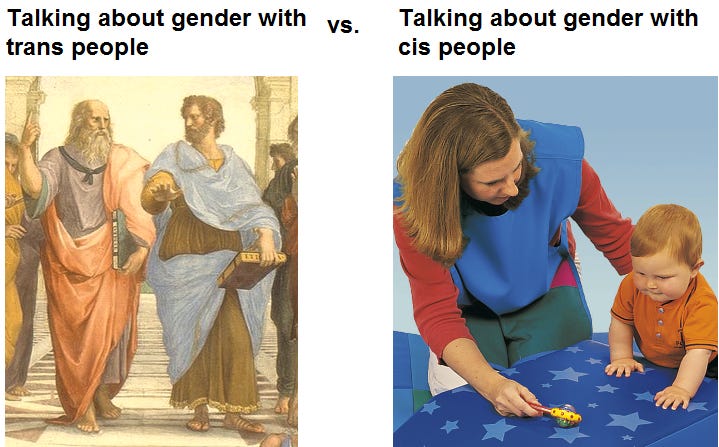
This old-school trans meme identifies a truth about what it’s like to start down the road of solidarity with any oppressed group to which we don’t belong: We are like babies! (But babies with capacity to cause harm.)
As we unpack the presumptions, prejudices, and skewed perspectives we’ve been absorbing since birth, we’re left with big gaps in knowledge. We finally know how little we know.
And as we live into a commitment to true solidarity with the oppressed, we mess up. To step up is to mess up, over and over — and remain committed to making amends and continuing to show up.
Back to John 14
Thomas said to him, “Lord, we do not know where you are going. How can we know the way?” Jesus said to him, “I am the way and the truth and the life.”
– John 14:5-6a
As we devote ourselves to uplifting the stones rejected by the builders and keepers of our unjust systems, as we grow in our purpose as the living stones God uses to build up Their Kin-dom, how do we know we are headed in the right direction? What happens if we get it wrong?
I think again of my partner and his father. The feral fear of fire and brimstone awaiting the ones who believe wrong, let alone do wrong.
But God doesn’t await us with hellfire. God waits to welcome us into Their home with open arms:
“Do not let your hearts be troubled. Believe in God; believe also in me. In my Father’s house there are many dwelling places. If it were not so, would I have told you that I go to prepare a place for you? And if I go and prepare a place for you, I will come again and will take you to myself, so that where I am, there you may be also.”
– John 14:1-3
I hear so much tenderness in Jesus’s voice here. He knows his friends are anxious and uncertain about what the future holds, so he paints them a picture of where their journey is headed: Past the terror and trouble, there is a beautiful home where a place has been prepared for us. For you! for me! — and not just for “us,” but for “them” as well.
Here we find the antidote to the supersessionism in the story of Stephen’s martyrdom and Peter’s first letter. In those two readings, there is an assumption that God can have only one favorite. Only one people. That as the divide between the followers of the Jesus Way and Jews with no interest in Jesus grew, it necessarily required a dethroning of Jews as God’s chosen people so that that title could belong to Christians.
That myth of scarcity sure has been around a while, huh?
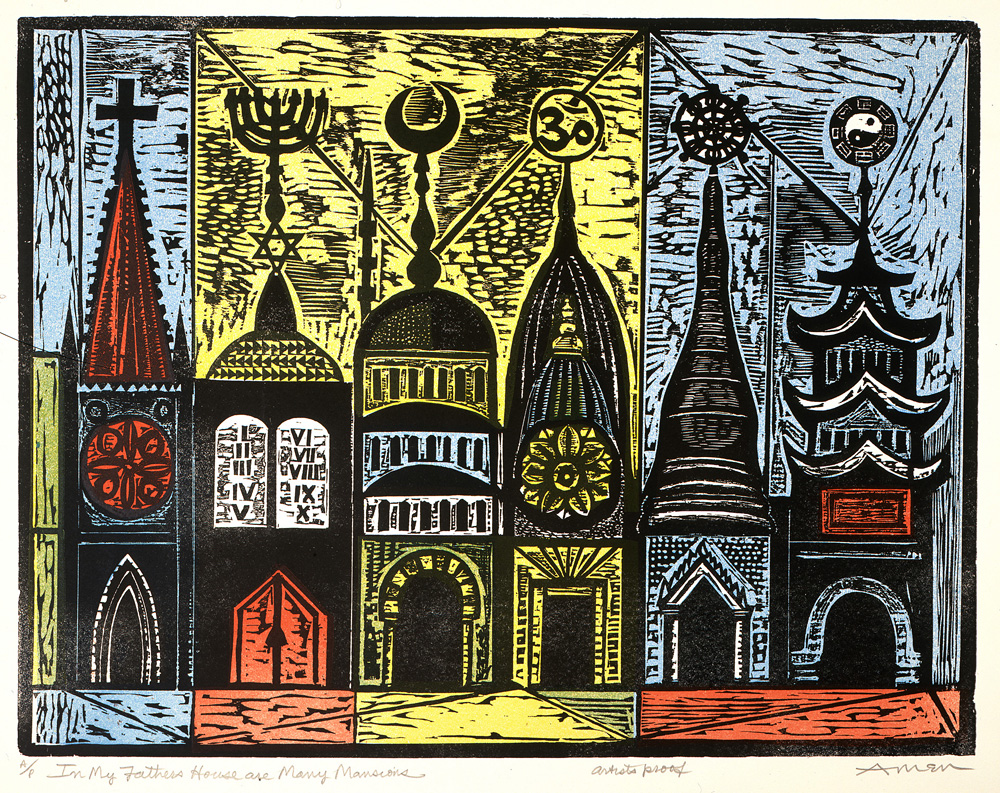
Jesus tells a different story: God’s home has rooms, has room, for everyone. Everyone!
The very nature of God is overflowing love — infinite love, love enough to go around and still spill over. Just like we saw last week, Jesus ushers in life abundant — there is plenty for all.
No one gets scraps — everybody feasts!
Thanks be to God.
- So many of us get told we’re “reading into” the Bible what we want to see there. But there are other ways of understanding our relationship to the Bible! Visit here for my framework on understanding scripture — particularly the last section, “You’re just reading into it.” ↩︎
 Binary-Breaking Worship