Categories
bible study easter LGBT/queer Queer Lectionary Unpacking Antisemitism worship-planning

Liberative lectionary: John 20’s enfleshed, disabled Christ

Year A, Second Sunday of Easter.
John 20:19-31.
Trans & disability theologies; addressing antisemitic implications.

Page contents:

For the Easter Season, I want to offer brief * commentary on each week’s lectionary readings through a liberative lens — largely from my perspective as a trans, disabled Christian scholar, but also drawing from other liberationist traditions. The goal is not to write my own extended essay each week, but to prompt preachers and other worship leaders to incorporate some of these ideas into Sunday worship.

*…I say brief, but John 20:19-31 is my favorite Gospel passage to preach on so this one’s gonna get a little lengthy!

Worship materials

Hymn suggestions:

Liturgy suggestions:

Key point

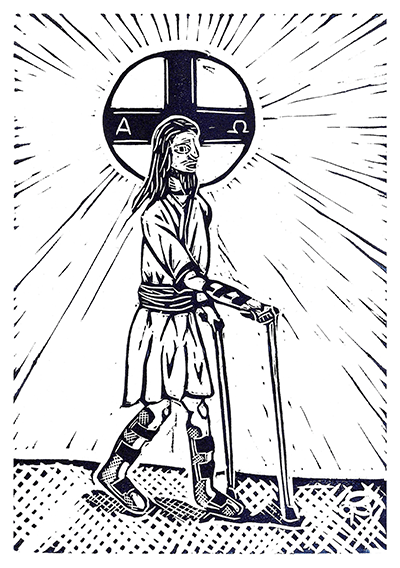
In rising with a physical body that retains its crucifixion wounds, Jesus demonstrated once and for all that our flesh is good, is part of what it means to be in God’s image; and that stigmatized bodies — especially disabled bodies — are not incompatible with divinity, but rather are intimately entwined with divinity.
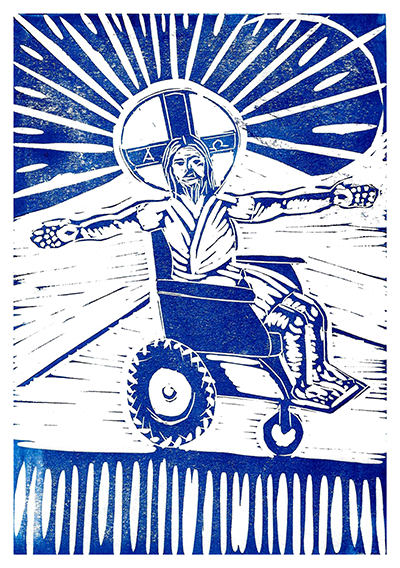
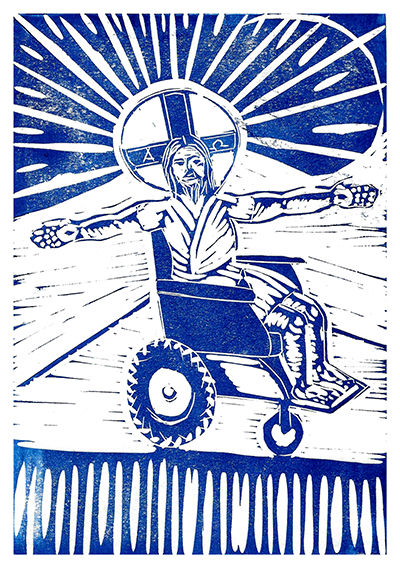
Ink drawing of Jesus rolling down a street in a wheelchair, arms extended outward and a radiant halo behind his head
“Wheelchair Christ” by Rachel Holdforth.
Visit her website for information on this piece and others.

Embodied theology

Presumably Jesus had the power to rise in spirit alone, but instead he keeps his wounded body. Why?

Having entered the material world, Jesus understands the human need for evidence we can experience with our senses. All throughout the Gospel of John, Jesus made use of things people can touch and taste and see – water and bread, vine and branches, baptism and the washing of feet – to embody the less tangible aspects of himself.

Jesus fed and cared for people’s bodies as well as their spirits, because he too is human, he too knows that sometimes we need to reach out and touch the Divine in order to believe. So Jesus holds out his hands, he offers his side, so that Thomas can see, can touch, can then proclaim “My Lord and my God!”

I believe Jesus also kept his body so that he can keep experiencing, with us, all that comes with having a body. He’ll still feel the breeze on his sweaty brow, feel the tug of hunger and the satisfaction of a full stomach, laugh and weep and sing with friends who hug and hold him.

He keeps his body to remind us that physicality is good. He keeps his body for the sake of all who have been told that they should hate their body, should punish it, should avoid its natural pleasures and healthy desires.

If Jesus — who is goodness itself, who is God themself — retains his body, we must conclude that physicality is part of our goodness. We are not spirits trapped in flesh prisons — we are embodied spirits, inspirited bodies.

And if that’s the case, then we cannot avoid learning to love our own bodies and learning to celebrate the amazing diversity of our species with the excuse that it’s all transitory! Our diversity is vital to our humanity. Embodiment is here to stay.

And what about the fact that Jesus not only retained his flesh, but retained the marks of crucifixion upon it?

Disability theology: The resurrected God is disabled
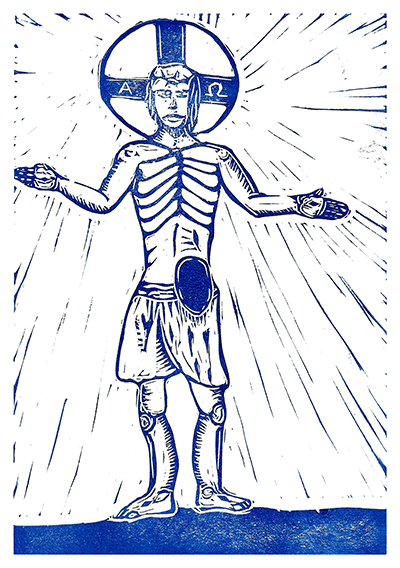
Across the Roman Empire, crucifixion was a shameful death, a criminal’s death. For Jesus’s people, those “hanged on a tree” were cursed by God (Deuteronomy 21:23). And this is how the God incarnate, the Creator of the universe, died!! No wonder Paul describes Christ crucified as a scandal to Jews and foolishness to Gentiles (1 Cor 1:23).

For many Christians, disabled bodyminds are a site of scandal and shame. Drawing on the Gospels’ healing narratives, disabled persons may be accused of not having enough faith if and when efforts to miraculously remove their disabilities fail. When we envision the Kin(g)dom of heaven, do we imagine disabled people front and center? Or do we see disabled bodyminds as signs of a fallen world, things to be eradicated in the world to come?

While both mainstream Christianity and mainstream society view disability as brokenness, many disabled scholars argue that disability is fundamental to the human experience.1 It therefore stands to reason that Jesus, being fully human as well as fully divine, experienced disability.

In her foundational work The Disabled God (1994), Nancy Eiesland describes how through his crucifixion Jesus took on disabling wounds — nail holes that would have impaired his mobility and the use of his hands; a spear in his side that would have caused him chronic pain.

Other authors over the years have joined her in this vision of a disabled Christ. For example, John M. Hull supplements it through the theology of kenosis — how, in the Incarnation, God the all-powerful emptied Themself, in other words disabled Themself, so that “in [Christ] God accepted finitude, the limits of our humanity, our sufferings and our death.”2 I also recently heard someone describe the bruise that would have been left by the cross heavy on Christ’s shoulder as a symbol of invisible disabilities and trauma — the wounds people don’t see.

So ultimately, I believe Jesus kept his wounds for us — for all of us who don’t live into society’s paradigm of the “perfect body.” The glorious body of our God bears wounds, wounds that became for Thomas — and for all of us! — a site of blessing.

What are the implications of a disabled God for our own time and place? Eiesland points out the dissonance that exists in churches that fail to accommodate and accept persons with disability while at the same time accepting “grace through Christ’s broken body” – how is it that we celebrate how Christ’s body became impaired for our sake but judge and cast out the bodies of disabled people in our midst? To worship this God who willingly emptied Themself, who chose to rise from the dead with disabling wounds intact, we must rethink our conceptions of disability and transform our communities into spaces where disabled people fully belong — not just in the pews, but in positions of leadership.
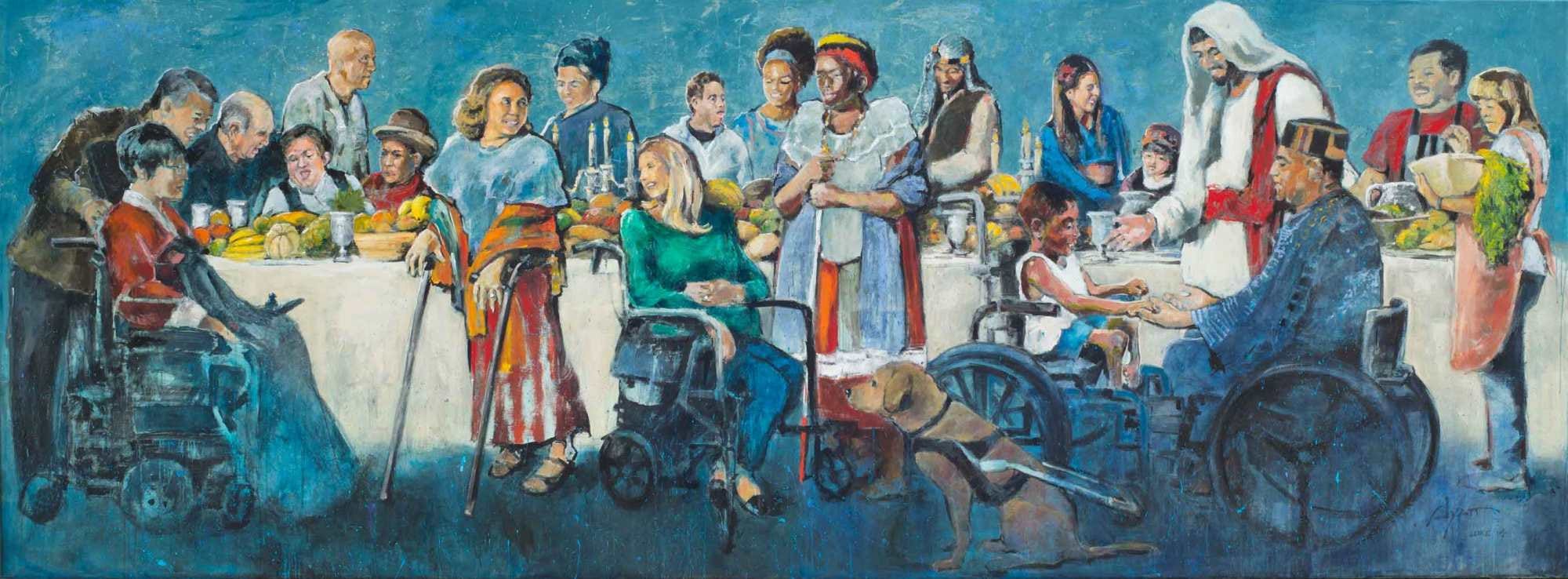
Mural on a blue background and lots of people gathered at a long table with a white tablecloth piled with food. There are persons of many different races and cultures and with various disabilities, including several in wheelchairs or with canes or crutches, several who have down syndrome, one with a service dog, and so on. Jesus stands near the right end of the canvas, conversing with a child of color in a wheelchair and an older Black man in a wheelchair.
“Luke 14 Banquet” by Hyatt More.

Trans theology: Christ embraces stigma

The Christian term for Christ’s crucifixion wounds, stigmata, is the same Greek word from which we get the term stigma. It means “mark,” and it refered to a mark cut or branded into the flesh of a soldier or enslaved personthe visible, painful sign that their bodies were not their own.

Like other oppressed groups, trans people know what it is to be stigmatized in the eyes of society. Our chosen names and pronouns, our choices in clothing and haircuts, the scars of gender affirming surgeries and full-body tranformations via hormone replacement therapy all mark us as worthy targets of shunning, shaming, and violence. Our non-normative bodies become a site of spectacle, where everyone feels entitled to gawk at our bodies, to know every detail of our medical histories. In our efforts to live into our God-given identities, we face obstacles across every sphere of life — from the legal and medical to religious and social — that remind us that many powerful people aim to strip us of agency and ownership over our own bodies.

Yet many of us revel in the very marks of our Otherness, our defiance of the status quo! My top surgery scars make me feel like me; they are visible marks of the wonder of God’s works, of God’s invitation to join in our own co-creation.
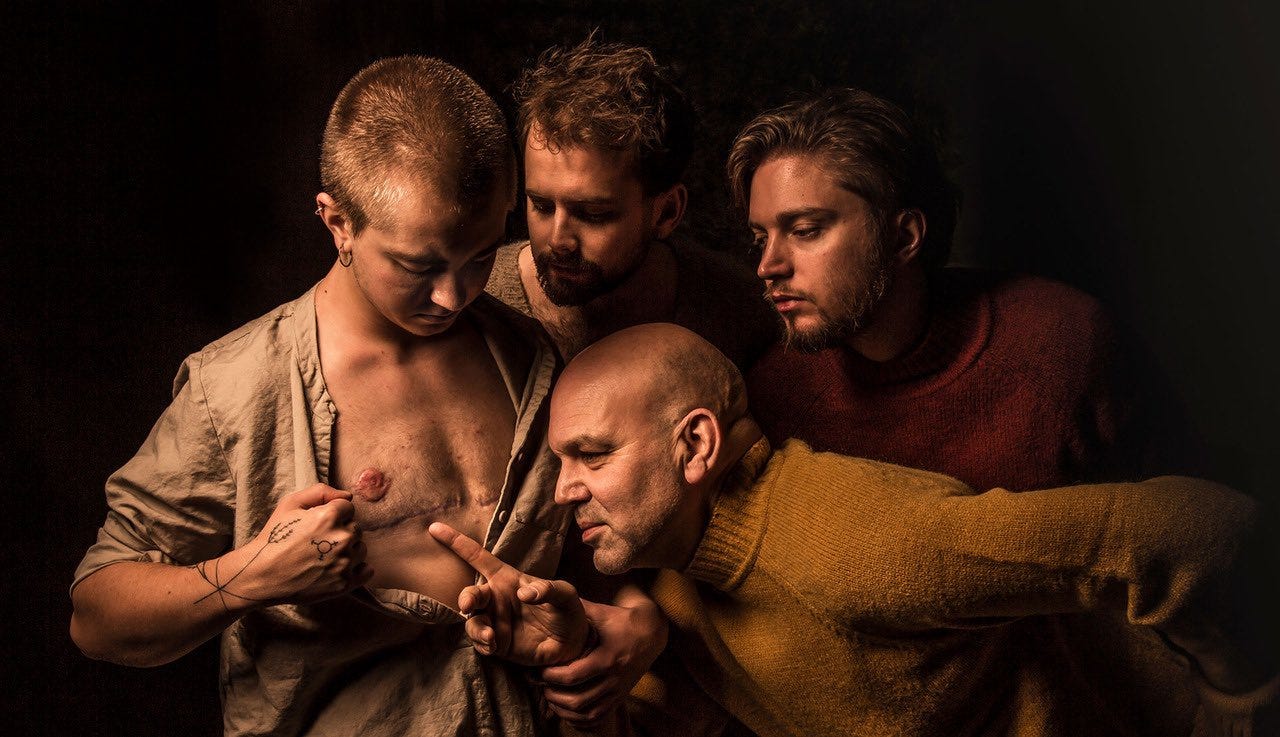
Photograph of four figures staged to imitate Caravaggio's famous painting of Thomas touching Christ's side wound. In this version, the person playing Jesus has top surgery scars, which his three friends marvel at. He is guiding the hand of one friend so that the friend's pointer finger rests just under the scar.
From Swedish photographer Elisabeth Ohlson Wallin’s 2017 exhibit, “id:TRANS.”

Caveats: John 20’s anti-Jewish implications

This lectionary reading opens with a verse that can contribute (and historically has contributed) to anti-Jewish sentiments:

“When it was evening on that day, the first day of the week, and the doors were locked where the disciples were, for fear of the Jews, Jesus came and stood among them and said, ‘Peace be with you.’” – John 20:19

This phrase, “The Jews,” shows up 195 times in the NT — 71 of those times are in John’s Gospel. Frequently, “The Jews” are set up in the text as “the enemies of Jesus, and thus of God.”3 That dynamic has been utilized throughout Christian history to malign and persecute Jewish people, often with accusations of deicide.

Because “the Jews” are only mentioned briefly in this passage, preachers may be tempted to gloss over the potential for antisemitism here: naming it won’t relate to the rest of the sermon; it’ll take too much time! Greg Garrett admits to feeling similarly for many years:

“Looking over a dozen years of preaching on Easter 2, I see that there were years when I skipped straight over the fear of the Jews on the way to doubt or faith or epiphany or commitment or any of the other big spiritual lessons that that particular community seemed to need on that particular second Sunday of Easter.

But in the past few years, anytime we encounter one of these parenthetical statements about “the Jews” in a Gospel reading (particularly in John) I have taken to highlighting them, at the very least, as major sources of Christian antisemitism, and sometimes I have devoted substantial space to correcting bad readings and refuting this prejudice…”4

If you aim to be a good neighbor to our Jewish contemporaries, consider taking the time to name the anti-Jewish readings of John, even if it feels like a “tangent.” (At the very least, you might consider including a footnote in the bulletin / worship handout on the topic.)

Some options for addressing the issue on Sunday

  1. State plainly that “ ‘fear of the Jews’ is a ridiculous and inaccurate statement of why the followers of Jesus are gathered behind locked doors in the Gospel lesson. These men are themselves Jews. All of them. Peter is a Jew. Thomas is a Jew. The risen Jesus, the Anointed One who steps miraculously into their midst, is a Jew…”5
  2. Provide some historical context — that by the time the Gospel of John was being written, there had been a major falling-out between those Jews who confessed Jesus as Lord and those who did not. Many progressive Christians suggest that Jewish Jesus-followers had been “expelled” from synagogues; this is possible, but Jewish NT scholar Amy-Jill Levine notes, “we have no examples of such excommunication from antiquity; to the contrary, Paul is disciplined from within the synagogue system, and centuries later, John Chrysostom complains about church members attending synagogue programs.”6 As with so many things, it’s hard to know exactly what was going on so long ago, and the truth involves nuance. Thus, if you go this route, take care to word things in a way that does not place all the blame for this falling out on the Jews who didn’t follow Jesus. Ultimately, what we know is that this was an intra-community conflict, and whatever tensions there were between Jesus-followers and other Jews can help explain (though not justify) John’s language around “the Jews.”
  3. Consider altering the translation from “the Jews” to “Judaeans,” “the Judaean elite,” or something of that nature. The Greek word typically translated “the Jews” throughout the Gospels is Ioudaios/Ioudaioi. If we alter how we translate the term, it becomes clear that “the Ioudaioi in John were neither today’s ‘Jews’ nor the ancient world’s ‘Jews.’7 When hearing “Judaeans,” worshipers will be less likely to imagine a conflict of Jew vs. Christian; instead, the conflict is between the Galilean disciples — everyday impoverished Jews from a backwater region — and those elites in Judaea/Jerusalem who collaborated with the Roman Empire (e.g. the Sadducees; the Pharisees did not collaborate with Rome).
  4. What other tactics have you taken in addressing anti-Jewish or supersessionist readings of scripture?

Footnotes:

  1. See Rosemarie Garland Thomson’s essay “Becoming Disabled.” See also my introduction to disability basics, which explores disability as a natural part of the human experience and discusses the idea of Disability Culture. ↩︎
  2. John M. Hull, chapter 3 of Disability: The Inclusive Church Resource, 2014. ↩︎
  3. Wes Howard-Brook, “Why We Need to Translate Ioudaioi as “Judeans”, chapter 10 of Jesus Wasn’t Killed by the Jews: Reflections for Christians in Lent, ed. John M. Sweeney, 2020. ↩︎
  4. Greg Garrett, “For Fear of the Jews: Antisemitism in John’s Time and Ours,” chapter 13 of Jesus Wasn’t Killed by the Jews. ↩︎
  5. ibid. ↩︎
  6. Amy-Jill Levine, “If not now, when?”, afterword of Jesus Wasn’t Killed by the Jews. ↩︎
  7. Wes Howard-Brook, “Why We Need to Translate Ioudaioi as “Judeans.” ↩︎
Categories
Affirmation of Faith LGBT/queer Liturgy

Responding to God’s Word: God’s binary-breaking chosen family

Leader:

As one, let us affirm some aspects of
the faith that binds us into one family.

All:

We believe in a God
who made all of us in Their image
and proclaimed every member of Their creation
Good.

We believe that Xe extends a special care towards those
whom the world calls “broken,”
“worthless,” “unclean” —

and that Xe calls us to repent, reform, and rebuild
when we are the ones who call others broken,
when we are the ones who aim to break them.

We believe in a God who gathers
more and still more people into Her own family,
a family that breaks human binaries 
of blood ties and national borders,
demographics and doctrines.

We believe that She extends a special invitation
to all those who find themselves cut off
from their human family:
to the orphans, the eunuchs, the foreigners;
to immigrants, the imprisoned, and the institutionalized,
to members of the disability community, LGBTQA+ community,
and all those whom our societies shuns and shames.

God has this special care for the disowned and disenfranchised
because Xe Xemself knows what it is to be the stranger, 
the one who does not fit, 
whose ways and thoughts are deemed 
incomprehensible, incompatible, or even insane.

Leader: 

As Jewish poet and professor Joy Ladin writes in her book The Soul of the Stranger: Reading God and Torah from a Transgender Perspective,

“…The human rebellions and divine rages of the Book of Numbers make it clear that even after decades of wandering with God in their midst, to the Israelites, God remains a stranger, a deity whose feelings and actions make no sense to them. Perhaps that is why God repeatedly commands the Israelites to accommodate and include ‘the stranger who dwells among you,’ the non-Israelite who embraces the Israelite community as home. For God, the inclusion of those we see as different is not a disruption or a distraction for religious communities; it is an essential religious practice, part of making a place for the ultimate stranger, God.”

We believe that God commands
any community that professes to follow Them
to do Their will
by acknowledging when we have shut out
members of God’s family,
seeking meaningful reconciliation,
and drawing our circles ever wider.

We believe that the Holy Spirit
empowers us in this work 
so that we may join Her in ushering in
the Kingdom of God that Jesus proclaimed:

A Kin-dom without hierarchy,
where all oppressive systems will be broken down
and all live in true kinship with the God who made us.

Amen.


I wrote this piece for a worship service on Mark 3:20-35, the famous “house divided” passage. The sermon and service theme was this:

Jesus redefines family in a way that defies any human-created definition of superiority, and in that definition, Jesus renounces the behaviors from within the community that threaten the people he gathers.

Categories
Affirmation of Faith Call to worship Charge and Benediction Confession and Pardon easter Holy Days Invitation to the table LGBT/queer Liturgy Opening prayer Prayer after Communion Prayers of the People

Acts 8 & John 15 Liturgy: eunuchs, intersex & trans persons, & all outcasts welcome in God’s expansive love

Call to Worship

Beloved community, let us draw the circle wide!
And draw it wider still.

Each of us is here because something draws us to the Divine
as expressed in the Person of Jesus.
We come to explore what it is that draws us here,
in community with neighbors who can teach us 
what it is that draws them here.

We come with questions, struggles, doubts.
We come with unique perspectives that enrich the whole community.

We come in vast diversity of mind, body, being,
to live into a unity that does not quell our differences, but celebrates them.

We come to abide in the love of Jesus,
and to learn to bear good fruit that lasts.

Come, let us join in worship of the God of love
Who teaches us what true love is.

OPENING PRAYER

O God whose love sustains us, restores us, abides in us,
Send your mischievous Spirit whirling through our midst
in the many different spaces from which we gather.

Let Her galvanize our hearts
so that our worship will empower us for the work
into which you invite us:

For you do not call us servants,
nor does your power rely on dominance;
But instead you call us friends, co-laborers whose joys and sorrows
you know as deeply as if they were your own.

Loving God, Living God,
you guide us into true love, into true life
that consists of enough for all humans, all creatures,
and that will restore all relationships
between neighbors, enemies, strangers
and with you, our Friend.

Amen.


Confession and Pardon

CALL TO RECONCILIATION

Our sin, individual and collective, is almost too much to bear. 
It would be easier not to face it — but to pretend it is not there is to let it fester. 

So let us face it together. 

PRAYER OF CONFESSION 

Jesus asks only this of us: 
that we love one another just as he loves us — 
a love without conditions, a love that liberates!

But again and again, we choose hate, or fear, or control
not only with those we call enemies
but even with our family, our friends.

The love of God is a love that acts,
a love that bears fruit that lasts,
but we continue to think of love in terms of simple words,
saying “love” with our mouths 
but acting in ways that harm,
or failing to act at all.

God’s Spirit bursts through all walls we build
to separate “us” from “them” — 
but we build them back, unsure of what we’d be
without an “Other” on whom to project our insecurities,
on whom to blame our misfortunes 
or the consequences of our own crimes.

Created for abundance, 
we live as hostages of scarcity.
We steal from our neighbors
and hoard whatever resources, whatever power 
we can get our hands on.

_____

Siblings in the One who lived, died, and rose for us,
even when we fail to abide in God’s love,
still, still God abides in us — 
chooses to call us friend,
chooses to lift us up.

Thus we are redeemed — 
not through any effort of our own 
but simply through love
deeper and truer than we can imagine.

Empowered by this remarkable gift of grace,
Let us share Christ’s love and peace with one another.

The peace of Christ be with you. And also with you. 


Affirmation of Faith

Even while celebrating our diversity of thought
and making room for questions and new interpretations,
there are some beliefs that we who join ourselves to the church
have committed ourselves to holding in common.

As one, let us affirm that shared faith:

We believe in the God from whom all life flows,
who created all that is — seen and unseen,
physical and spiritual — 
and declared all of it Good.

Her blessing comes before 
and follows after 
any curse — 

for every instant that
our existence is sustained
attests to Her unfailing love
in which we move, and live, and have our being. 

We believe in the irresistible Spirit
who pervades the world 
and abides with whomever Xe choses
with no regard for the boxes and boundaries 
that humankind constructs.

To the dismay of worldly powers,
this Spirit bestows special care upon the most reviled and despised,
those deemed weak and worthless in human eyes.

Among this number are the eunuchs of scripture
who hail from various cultures and faiths,
who knew both enslavement and status,
whose binary-breaking existence disturbs human norms
but delights the Spirit of Upturned Expectations — 

from the eunuchs who helped Esther navigate a fearful situation
to Ashpenaz, who loved the prophet Daniel tenderly;
and from Ebed-Melech, who saved the prophet Jeremiah;
to the eunuch who encountered Philip
with graciousness and eagerness to learn.

We believe in the Word Made Flesh
whose love for those eunuchs and all whom this world Others
is so strong that, upon entering embodied life,
Jesus identified himself as a “eunuch for the Kin-dom.”

In Jesus, God knows intimately what it is
to be marginalized, misunderstood,
and subjected to bodily mistreatment.

We believe that, after his life among us 
and his rising from death on a Roman cross,
Jesus restored us into right relationship 
with the One who made us, sustains us,
and whose Spirit guides us still
in the work of ushering in God’s Kin-dom.

Amen.


Prayers of the People / Pastoral Prayer

Sisters, siblings, and brothers in Christ,
though already God has gathered us together
to abide as one in Their unfailing love,
still, still so many of us feel cut off, outcast, unloved.

So let us pray:

For those who have been cut off from their communities 
because of who they love, who they are, or what they believe,
we pray that God’s unconditional love will guide them
into chosen families who cherish them as they are.

For those who feel cut off and discarded by societies
that shove people aside when age, illness, or disability 
keeps them from fulfilling impossible standards of productivity,
we pray for loved ones that honor their inherent worth,
and for more just laws to protect them from abuse and neglect 
and enable their full participation in our communities.

For those who feel cut off from their cultures:
For refugees forced to flee their homelands, 
immigrants who leave places and people they love behind,
Indigenous peoples and others whose traditions 
are attacked and targeted for extinction,
we pray for strength and courage to resist assimilation,
for solidarity and resources that empower them
to preserve and revitalize their cultures.

For those who feel cut off from the global community
as they cry out for support — 
particularly for the people of India and Brazil
as COVID19 ravages their nations;
and for the people of Colombia
who are under attack from their own government;
we pray for a global outcry, compassion, and action on their behalf.

O God who gathers the outcasts
and gives them places of honor,
hear and respond to every prayer 
we lift up to you aloud or in the quiet of our hearts.

We give you thanks for your faithful love:
guide us to abide in that love
so that we may learn to love our fellow human beings
and all your good Creation
with the same love you first extended to us.

Amen.


Invitation to the Offering

Only when we all come together, 
only when each person is appreciated
for the different gifts and perspectives they bring
is the Body of Christ whole.

So let us offer whatever we have — 
time, skills, resources — 
to the God from whom we receive all things
for the furthering of Her Kin(g)dom
where all needs are met at Her expansive table.


Invitation to Christ’s Table

If you ask, “Does anything prevent me from this communion table? Would anyone tell me I am not welcome here?” this is Christ’s reply:

“Nothing and no one can keep you from God’s table, from God’s community, from God’s love. Let no one tell you otherwise.”

Friends, come to the feast! You are not only welcome; you are needed and appreciated. 


Prayer after Communion

Words cannot express
the wonder of the Spirit’s gathering power,
the miracle of Christ’s life nourishing us across time and space.

May we who have been fed
enact our gratitude out in the world
by joining the Spirit in Her holy work
of breaking down the boundaries that divide
and building up communities that restore.


Charge and Benediction

Friends in Christ,

In worshipping the God who loves us,
we have been reminded of the goodness of our diversity
joining together in one Body.

Gratitude is our response: 
Gratitude for the God who chose us, who abides in us,
and who goes out with us now
to bring love, justice, and peace into a hungry world.

So let us go, glorifying God with our lives!


I wrote this liturgy for an Easter season service centered around Acts 8:26-40’s story of Philip and the Ethiopian eunuch, also tying in John 15:9-17’s instructions to love one another as Jesus loved us. You can view the worship service here.

You can read my sermon transcript here. In the sermon, I discuss the importance of reading scripture together and interpret Philip through an autistic lens and the eunuch through a trans lens.