“The thief comes only to steal and kill and destroy. I came that they may have life and have it abundantly.”
John 10:10
If I had to pick a favorite single Bible verse that isn’t part of one of my favorite passages, John 10:10 would probably be it. In many ways it encapsulates Jesus’s ministry and purpose — what he is for, and what he is against. In other words, it names what Christ’s salvation actually is — what we’re saved from, and what we’re freed for.
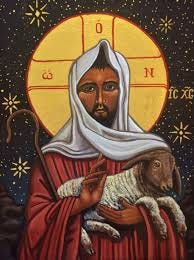
Jesus is for life abundant — or, as the CEB translates it, “life to the fullest.” The Greek adverb he uses is περισσός (perissos), which has an intensity to it, a vehemence, a sense of excess. One might also translate it “excessively” or “overflowingly.” Because it has that prefix peri, one source1 suggests you could even translate it “all-around.”
However you translate it, it’s clear that Jesus’s liberation is all-encompassing, is holistic, floods every area of our lives, individual and communal. We aren’t freed just to survive, but truly and fully live.
Queer abundance — liberated for
As a queer person, this truth set me free to pursue the things I needed to live fully.
It’s possible I could have eeked out a shell of a life constrained to my assigned gender, in a body I felt utterly severed from rather than experiencing my body as me. (It’s also very possible I couldn’t have survived that way; one of the violent fruits of nonacceptance and restricting trans people’s access to affirming healthcare is suicide.) However, I could not have lived life to the full that way. I would not have experienced Christ’s salvation holistically. I wouldn’t be open to the divine presence in my body, mind, psyche, and relationships with other people and all living things.
Embracing my trans self, daring to fall in love with someone of my assigned sex, discovering the power of queer community — these are some of the things Jesus liberated me for; these are the things that have brought me into life that overflows outward, joyously spilling out into my connections with everyone and everything.
Liberated from
In this example from my own life, we also see what kinds of things Jesus liberates us from — the thieves that break in to steal our joy and destroy our peace, who attempt to rob us even of our inherent dignity as creatures made in the divine image.
Any person or group that preaches Jesus’s salvation only as something we’ll experience in some abstract heaven, that denies the divinity in flesh and dirt and the everyday mess and miracle that is embodied life, is one of these thieves who threaten to destroy us.
Those who seem to hold nothing but contempt for this life, to hate this world — who seek to control other bodies and minds as well as the created earth, to constrain sexuality, to bring shame and fear and starvation of body and spirit — work against the abundant life Jesus came to bring. Even and especially when they do so in Christ’s name.
“Us” and “them”
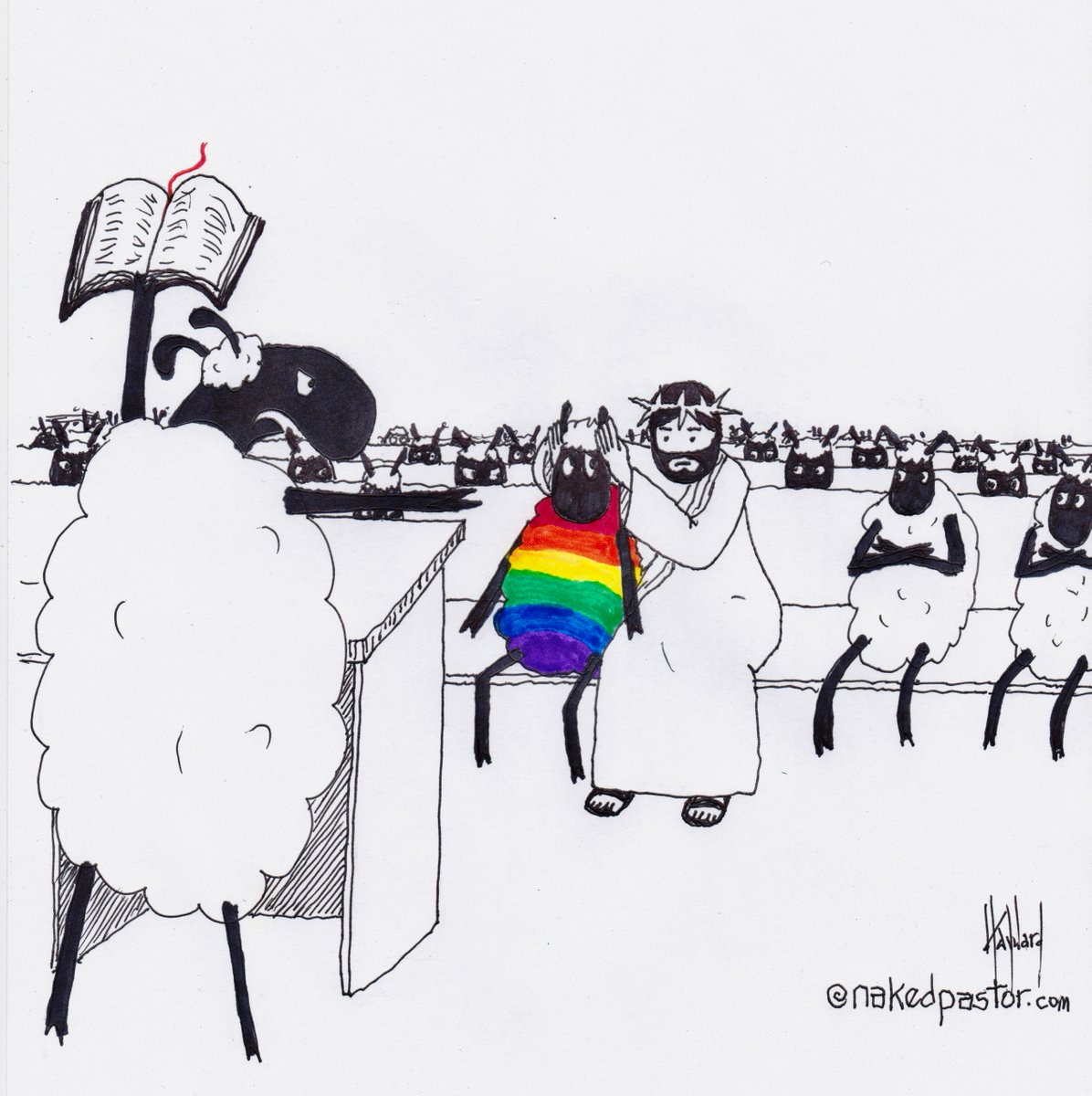
I’ve been saying “we” and “they” in too vague a way — who are “we,” the sheep whom Jesus the gate protects and guides into flourishing?
Whether the Gospel writer meant Jews, or early Christians, or something else when writing about Jesus’s “flock,” the verses leading up to verse 10 make it clear that the evangelist doesn’t mean all humanity; it’s a limited group. So did Jesus come to bring abundant life, life to the full, to his followers alone?
If we continue reading beyond the lectionary passage, the question of who gets included in this overflowing abundance expands exceedingly:
“I have other sheep that don’t belong to this sheep pen. I must lead them too. They will listen to my voice and there will be one flock, with one shepherd.” – John 10:16
In her book Holy Envy: Finding God in the Faith of Others, Barbara Brown Taylor refers to this passage to explore salvation beyond Christianity. God’s liberation, the abundant life that we as Christians believe Jesus came to bring into the world, is for all people.
At the same time, Taylor warns us against disrespecting our non-Christian neighbors when naming this not-Christian-exclusive, universal liberation:
“Once my holy envy led me to ask more of my tradition than the narrative of exclusive salvation and everlasting triumph, I began to search for counternnarratives that sounded more like Jesus to me. In particular, I looked for stories that supported Christian engagement with religious strangers — not as potential converts but as agents of the God who transcends religion and never met a stranger. …
In Judaism they are called ‘righteous gentiles.’ I do not know what they are called in Christianity, but Jesus receives them more than once, whether they come from Samaria, Syrophoenicia, Canaan, or Rome. …
If it is easy for Christians to overlook the ‘otherness’ of these religious strangers, then I think that is because we assume that once they enter our story they never leave it. In gratitude for their blessing, we baptize them as anonymous Christians. We make them one of us. A few do join us, but this is not the norm…”
Rather than declaring John 10 is evidence of “anonymous Christians” — Karl Rahner’s idea that non-Christians who sincerely seek to live ethical lives are essentially living as Christians and thus included in Christ’s salvation2 — perhaps we can focus less on the hypothetical details of Jesus’s gate and shepherd analogies and more on its overarching sense of radical inclusion and belonging.
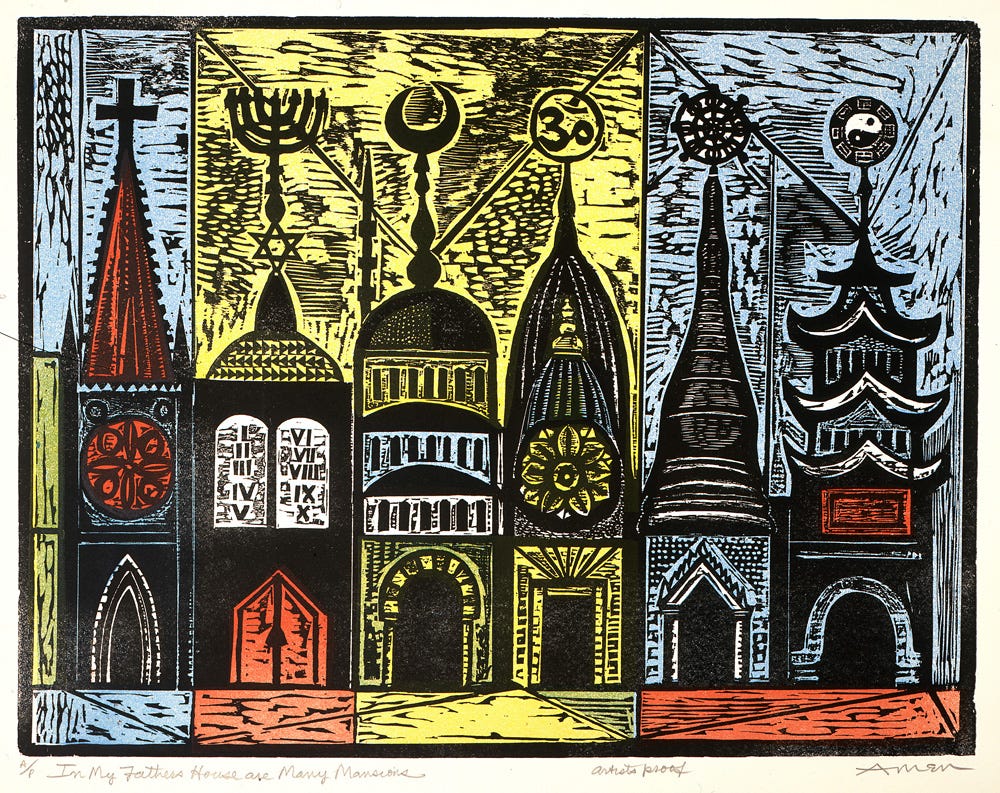
As Taylor explains, Jesus does not elaborate on these many sheep of other flocks, but we can imagine a “God of many sheeps, many folds, many favorites, many mansions.” With this good news, we are challenged to engage respectfully with people of all religions and values, and work towards their abundant life as fervently as our own.
And that leads us to the anarchy and mutual aid of Acts 2:42-47!
I know that for many, the term anarchy evokes visions of Heath Ledger’s Joker who “just wants to watch the world burn.” But the anarchists I hang out with are deeply committed to the world’s flourishing, believing that true equity and justice can only be achieved by removing all hierarchy.
An anarchic community has no central leaders. Decisions are made communally. Resources are shared equally. A core component to anarchy is a complete leveling of class, the systems by which the few wield power over the many. There’s no bigger threat to Empire. To white supremacy. To capitalism.
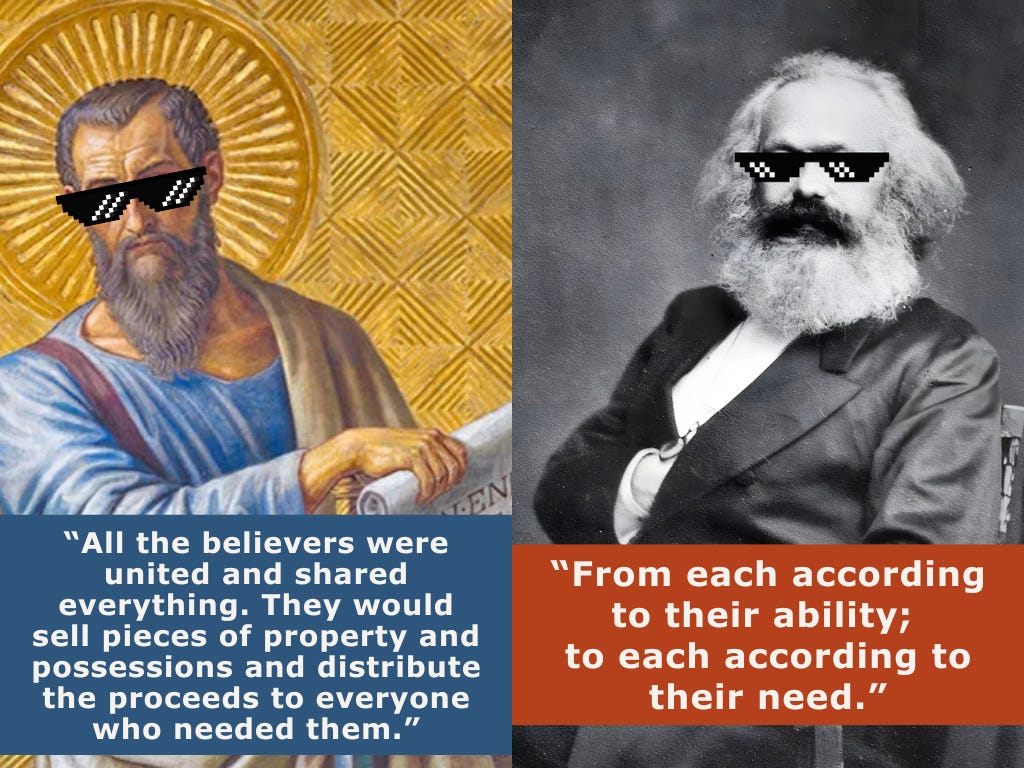
In Acts and various Pauline epistles, we see an effort to dismantle hierarchies, reflecting Mary’s Luke 1 proclamation that God lifts up the lowly and casts down the powerful, fills up the hungry and sends the rich away empty.
Here in Acts 2, the rich Jesus-followers liquidate their wealth and distribute it among the poor Jesus-followers, effectively making themselves one of the poor. What a radical act of faith and commitment to true equity!
The mutual living, or koinonia, of this community reminds me of one disabled activist’s care webs.
In texts like Care Work: Dreaming Disability Justice, Leah Lakshmi Piepzna Samarasinha describes webs of care that they have participated in among other disabled queer and trans BIPOC — i.e., people who are failed by the government and institutions, by school and church and even family, and who therefore know deep in their bones that only “We keep us safe.” Because disabled persons often need to figure out mutual aid in order to literally survive, Piepzna Samarasinha explains, the disability community has much to teach everybody about how to live into mutual care.
The first such care web Piepzna Samarasinha helped form came together when “three disabled queer Asian femmes” were prepping to travel to a conference and going through the “very common disability experience” of “having your freak-out about how badly the whole thing will fuck up your body.” They decided that instead of choosing “between handling our access needs on our own or crossing our fingers that the conference and the airlines would come through to take care of us,” they would “experiment in coming together and caring for each other,” with powerful results:
We didn’t just survive the conference—we made powerful community. Committed to leaving no one behind, we rolled through the conference in a big, slow group of wheelchair users, cane users, and slow-moving people…People got out of the way. Instead of going out to inaccessible party sites, we chose to stay in, and ate and shared about our disabled lives. For some of us, it was our first time doing that. People cried, flirted, and fell in love.
…It was just four days, but people went home to their communities transformed.
We were no longer willing to accept isolation, or a tiny bit of access, or being surrounded by white disabled folks as the only kind of disability community we could access, or being forgotten. …We came back less willing to accept ableism from conferences and community spaces, because we knew it could be different—and if CCA could happen in someplace with scarce physical resources like Detroit, it could happen anywhere. Being part of that wild pack of slowness, talking tentatively about our disabled lives in ways we’d never said out loud before, changed everybody’s lives.
Of course, these care webs are never perfect. Piepzna Samarasinha describes how many fall apart due to unresolved harm, disagreements, or other interpersonal conflict. But they’ve never seen that as a reason to give up on the concept altogether:
“[T]he struggles we hit weren’t failures or signs of how inadequate we were but incredibly valuable learnings. …[O]ur struggle to figure these questions out is at the heart of our movement work. CCA [a disbanded care web] is another worthy, imperfect model in my body’s archive, one I build on as I build care in my life now.”

We can say the same for the earliest communities that sought to live by Jesus’s example, in and through and as Christ’s body.
The early Church did not live out Acts 2’s vision perfectly.
“First of all, when you meet together as a church, I hear that there are divisions among you, and I partly believe it. 19 It’s necessary that there are groups among you, to make it clear who is genuine. 20 So when you get together in one place, it isn’t to eat the Lord’s meal. 21 Each of you goes ahead and eats a private meal. One person goes hungry while another is drunk.” – 1 Corinthians 11:18-21
Eavesdropping on Paul’s first letter to the Corinthians, we learn that the Corinthian community of Christ-followers is not living the way Acts 2 claims the Jerusalem community was living. Instead of unity, they form cliques. Instead of divvying up resources, some eat richly while others go hungry.
None of us manages to live into our own values all the time. Paul is as human as the rest of us in that matter:
At some points, Paul seems to possess a transcendent glimpse of a Kin-dom that demolishes the systems that pit one ethnicity above another, that enslave some and empower others to dominate, and that situate men over women and all other “non-men.3
At other points, Paul (if Paul is indeed the author of these passages) clearly retains the biases he’s spent a lifetime absorbing. Take Ephesians 5 and 6, where Paul instructs wives to obey their husbands (5:22) and enslaved people to obey their masters (6:5). He does so while acknowledging that God does not classify people by status (6:9), seeming not to notice the cognitive dissonance in therefore reinforcing these hierarchies of sex and class.
Paul, if you believe that God’s Kin-dom is one in which these human hierarchies are no more, live into that now! For God’s Kin-dom isn’t just a far-away dream; it’s here, and we are the midwives tasked with delivering it.Paul, as you tell us, don’t conform to worldly systems and structures — be transformed by the renewing of your mind, constantly reassessing your presumptions and beliefs through the lens of Christ’s words and actions.
Decolonizing one’s mind is a lifelong effort.
Just when we think we’ve unpacked all the biases we’ve been absorbing from birth, we mess up again, cause harm. Thus it is essential to keep paying attention, to keep listening to those whom unjust systems place under us — so that we might partake in both the daily work of lifting up the oppressed and casting down the powerful, and the big-picture struggle to completely dismantle the systems that created poor and rich, oppressed and oppressor, powerful and disempowered.
In essence, let us always strive to be Christ’s hands and feet on earth, living in ways that bring life — full, abundant life that spills over into all things! — to ourselves, to each other, and even to those we think of as “other.”
- https://biblehub.com/greek/622.htm. I’m not a fan of HELPS Word-studies in general, or the Discovery Bible that produces them, but I did find this “all-around” translation option intriguing. ↩︎
- Admittedly, this explanation of “anonymous Christians” is oversimplified and Rahner himself would probably have a bone to pick about how I’ve summed up his concept. Go read his own writing for more depth. ↩︎
- “There is neither Jew nor Greek; there is neither slave nor free; nor is there male and female, for you are all one in Christ Jesus.” – Galatians 3:28 ↩︎

