Categories
advent bible study Holy Days Multifaith Other search markers Unpacking Antisemitism

Addressing Advent Anti-Judaism

During the season of Advent, Christians traditionally read Luke’s and Matthew’s Nativity stories alongside the book of Isaiah. It makes sense to do so, as Matthew himself makes the connection:

22 Now all of this took place so that what the Lord had spoken through the prophet would be fulfilled:

23 Look! A virgin will become pregnant and give birth to a son,
        And they will call him, Emmanuel. (Matthew 1:22-23)

– Matt 1:22-23, referencing Isaiah 7:14

But when we read Isaiah only in service to our Christian story, we do harm to our Jewish neighbors with whom we share these scriptures. To utilize the Hebrew Bible (= “Old Testament,” the Jewish Bible) solely as a promise fulfilled through Christ is to suggest that these scriptures are incomplete without and dependent upon Jesus — and therefore that Jews’ interpretation of their own Bible is incorrect and irrelevant.

So how do we simultaneously honor our Advent traditions, draw from Isaiah’s wisdom, and respect the vibrant, living faith of our Jewish neighbors?

Dr. Tyler Mayfield provides some excellent options in his 2020 book Unto Us a Son Is Born: Isaiah, Advent, and Our Jewish Neighbors.

The purpose of this post is to share some of the wisdom from Mayfield’s work, and to urge pastors, teachers, and others who help shape the Advent experience for their communities to check out the entire text for even more invaluable commentary.

A photo of Tyler Mayfield, a white man with short graying hair and short gray-brown beard smiling in the woods. To his right is the cover of his book

Contents of Unto Us a Child Is Born:

  • An introduction that, well, introduces the issues with current Christian uses of Isaiah and suggests a bifocal framework as remedy
  • Chapter 1: Using Our Near Vision During Advent
  • Chapter 2: Using Our Far Vision to Love Our Jewish Neighbors
  • The remainder of the chapters delve into each of the Isaiah passages offered by the Revised Common Lectionary for the Advent season.

This post will survey key points from the intro and first two chapters, and close with actionable ways to incorporate Mayfield’s message into Sunday worship and classes. Preachers and teachers will find it immensely helpful to read the rest of the book’s chapters as lesson/sermon preparation for each week of Advent.

The Bifocal Lens

Image of one side of a pair of bifocals, with the smaller, near lens fused in the larger, far lens. A line connects the larger lens to "Far Vision: Openness to our religious neighbors; paying attention to ways we may cause harm." A line drawn from the near lens leads to "Near Vision: Our sense of identity; e.g. worship rituals, cherished hymns"

In order to maintain our Christian traditions without monopolizing the Hebrew Bible, Mayfield recommends a bifocal view:

  • Our near vision focuses on our worship practices and liturgical celebrations, grounding us in our living religious tradition;
  • Our far view pays attention to the ways those practices affect those not in our communities and “compels us to critique and reject some aspects of this tradition, those that are hurtful, inaccurate, and derogatory toward our religious neighbors” (intro).

Using Isaiah and other Jewish scriptures responsibly during worship is not merely a scholarly endeavor; as Mayfield reminds us, reading and interpreting the Bible is a matter of ethics:

[…L]iturgy and ethics are not easily separated. In her excellent and provocative book on racism and sexism in Christian ethics, Traci West notes, “The rituals of Sunday worship enable Christians to publicly rehearse what it means to uphold the moral values they are supposed to bring to every aspect of their lives, from their attitudes about public policy to their intimate relations.” …We want our worship to spur us to live out our ethical claims. (Introduction)

Using Mayfield’s bifocal lens, we can ethically navigate “the tension between identity within a particular faith tradition and openness to the faith traditions of others.”

So what are some of the ways that traditional Advent worship can lead us to do harm to our Jewish neighbors?

Supersessionism

Supersessionism, also called replacement theology, claims that Christianity has replaced or supplanted Judaism; that our covenant through Christ cancels out Jews’ covenant through Abraham and Moses (hence the labeling of the two parts of the Christian Bible as the Old and New Testaments, from the Latin word for covenant).
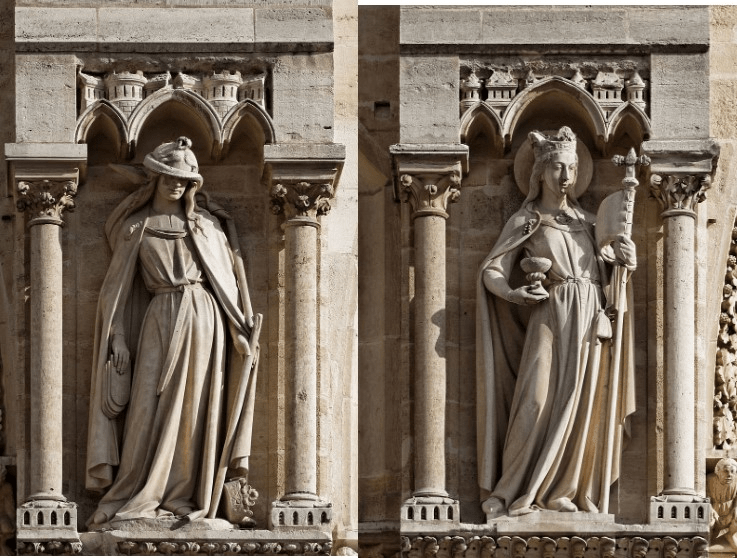
Synagoga et Ecclasia, two statues on the Notre Dame cathedral representing the Jewish and Christian faiths. This juxtaposition of crowned Church standing strong next to the Synagogue who is “blind to Jesus,” the ten commandments almost falling from her hand, is unfortunately depicted in numerous artworks of Medieval Europe.

Mayfield brings in Susannah Heschel’s description of supersessionism as a “theological colonization of Judaism“; she defines it as:

“The appropriation by the New Testament and the early church of Judaism’s central theological teachings, including messiah, eschatology, apocalypticism, election, and Israel, as well as its scriptures, its prophets, and even its God, while denying the continued validity of those teachings and texts within Judaism as an independent path to salvation.” (Heschel, The Aryan Jesus, 2008)

The seeds that the early church planted have born violent fruit across the centuries. This attitude of judgment and/or pity has led both to ideological violence — “render[ing] Jews invisible or irrelevant or as incomplete Christians” (intro) — and immense physical violence through to the segregation, scapegoating, forced conversions, expelling, and flat-out murder of the Jewish people across multiple continents.1

Medieval painting of figures gathered around a fire on which a book is burning. One person presses a poker onto it, while another person holds up a book to throw it into the fire. There are piles of books around this figure
Detail from Pedro Berruguete’s “Saint Dominic and the Albigensians” (1490s), depicting a Medieval “trial by fire” in which potentially heretical texts were determined to be “false” if they burned.

There are multiple instances of the Talmud — the central text of rabbinical Judaism alongside the Jewish Bible — being likewise gathered and burned across Medieval Europe due to the anti-Jewish belief that the Talmud was the primary obstacle keeping Jews from converting to Christianity. In 1242, for instance, King Louis IX of France ordered the burning of “24 cartloads” — something like 12,000 volumes — of priceless, scribe-written copies of the Talmud. This event devastated France’s Jewish community, which had been one of the seats of Jewish scholarship. Louis also followed up the book burning with a decree to expel all Jews from France: violence against Jewish scripture goes hand-in-hand with violence against Jewish bodies.

All this to say, the views we shape through worship and elsewhere truly do have real-world implications.

Mayfield argues that it is possible — indeed, necessary — to share scriptures respectfully. After all, he says, Judaism and Christianity are siblings.

While Christianity is often envisioned as the “shoot” growing from the dead stump of Jesse in Isaiah 11:1, a child who has improved upon the parent, in reality Judaism and Christianity are more like two branches extending from the same tree. They “grew out of the same milieu,” developing from the religion depicted in the Hebrew Bible during the chaotic era of that first century CE:

While early Jesus followers were formulating an identity distinct from Christ’s Jewish origins, Rome’s 70 CE destruction of the Second Temple spurred on new iterations of Jews’ own religion; following the Pharisees,2 they recentered faith around local life rather than the temple. In this way, the two religions are around the same age, growing from the same foundations! We are sibling religions; and we are neighbors. The problem is that we Christians have frequently behaved as very poor neighbors indeed.

Why Jewish “Neighbors”?

In Isaiah, Advent, and Our Christian Neighbors, Mayfield has opted for the term neighbor to describe the Christian relationship to Jews in the present day. Why? For one thing, love of neighbor is a central tenet of both Jewish and Christian tradition, originating in Leviticus 19:18 and emphasized by Jesus in Mark 12:31 and Matthew 22:39. Reading scripture through the ethic of love thy neighbor, we must ask, “If a particular reading of Scripture leads us to think badly of Jews, then is this reading Christian?” (chapter 2).

Furthermore, Mayfield continues,

I also use the concept of neighbor because neighbors do not always agree. In fact, they sometimes disagree and have to take seriously one another’s perceptions, feelings, and opinions. Being neighborly is being attentive and listening well to the concerns of others. It is realizing that your actions affect those around you. Christians act neighborly when they take seriously Jewish critiques of Christianity and Christian teachings, just as Jews act neighborly when they offer these critiques. (Chapter 2)

In reconsidering how we read and teach scripture, we can imagine that scripture is the fence we share with our Jewish neighbors, even while we dwell in different “geographies.” But when we accept supersessionist theology, we deny Jews their side of the fence; we colonize it.

Let’s look at how supersessionism manifests specifically in the ways we use Isaiah during Advent.

Resisting a Christian Isaiah

Mayfield describes how, over the past two millennia, Christians have disconnected Isaiah from his ancient Jewish context and Christianized him, even going so far as to call this eighth-century BCE prophet’s book the “fifth Gospel” alongside Mark, Matthew, Luke, and John (intro).
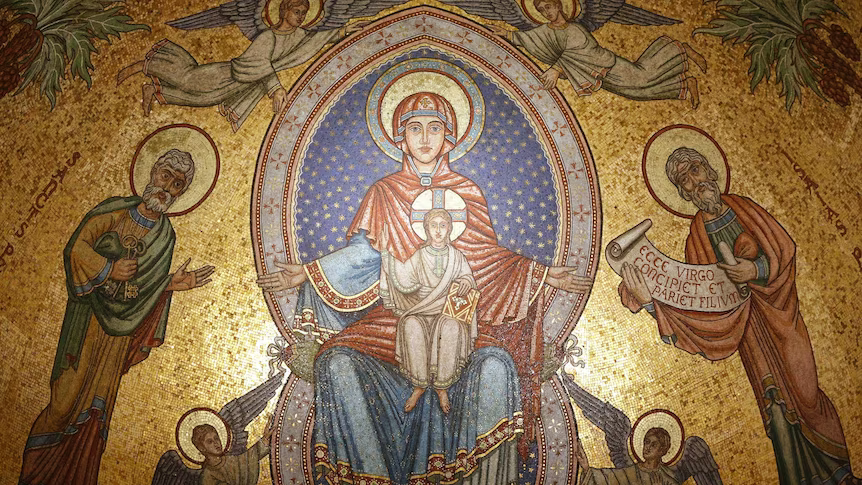
ID; ancient mural of Mary on a throne with a young Jesus in her lap. To her right is Peter holding a key. To her left is Isaiah holding a scroll on which the Latin for "Behold, a virgin will conceive and birth a son" is written
The Virgin Mary and Jesus, flanked by Isaiah (right) and Peter (left).

In lifting Isaiah from his seat among Jeremiah, Amos, and all the Hebrew Bible’s prophets, we sever him from his original ancient Jewish audience and deny his relevance to our Jewish neighbors today.

We hear Isaiah (and Handel in his Messiah) proclaim: “For unto us a child is born; unto us a son is given” (Isaiah 9:6) and everything in our tradition preps us to assume that the “us” in question is us Christians; that this child must be Jesus!

In our presumption that Isaiah’s prophecies are all about Jesus, we render this prophet irrelevant to our Jewish neighbors, denying the validity of their interpretations of this biblical book. But if we dig into the historical context, we can broaden our ways of understanding these texts and thus learn how to better share these scriptures.

A Christ-exclusive interpretation of Isaiah misunderstands what biblical prophets did.

We hear the word “prophecy” and think of foreseeing the future, often the distant future. But the prophets of the Bible, from Joel to John the Baptist, were largely focused on their own here-and-now:

The prophets of ancient Israel (and ancient Mesopotamia) did not see their sole activity as foretelling. They were also “forthtellers,” speaking to the religious and political issues of their day with courage and strength. As mediators between God and the people, prophets delivered messages, oracles, and visions to audiences that included kings and commoners. They interpreted the past, analyzed the present, and spoke of the future but were undoubtedly more concerned with events of the present than events several hundred years in the making. …

[T]he notion of prophecy as foretelling renders the prophet’s words irrelevant to, and uninspired for, the first hearers and readers of these messages. (Chapter 1)

There’s another historical issue with reading Isaiah’s prophecies as exclusively about Jesus as his people’s anticipated Messiah:

At the time of Isaiah in the 700s BCE, the concept of the eschatological Messiah had not yet been developed!

While the Hebrew Bible does describe figures like David and Cyrus as anointed ones (which is what the Hebrew word mashiach, “messiah,” means), the concept of The Messiah who would usher in an age of justice and peace was most likely a later development of Second Temple Judaism (516 BCE – 70 CE).

We only see The Messiah in Isaiah’s descriptions of a “Wonderful Counselor…Prince of Peace” (Isaiah 9:6b) and a just judge on whom God’s spirit rests (Isaiah 11:1-10) because of our own bias: “We think we know what we will find before we look” (chapter 1).

Learning about a passage’s original context helps us interpret the text more faithfully as we seek its relevance today. What is more, we can and should consider its multiple historical contexts, the whole breadth of what it has meant for different groups in different eras:

Texts in Isaiah have an entire history of interpretation, which includes the “originating” context in ancient Israel, their reuse and interpretation in Second Temple Judaism perhaps, their Christian context in which some Isaiah texts became christological, the Jewish context in which some texts became messianic, and then later Christian context, that is, when these texts were attached to Advent.

The book of Isaiah was composed by ancient Israelites over several centuries, from the eighth to the fifth centuries BCE. These authors wrote for their ancient Israelite audiences with no comprehension of later events such as the life of Jesus and the growth of Christianity. Thus, the book of Isaiah does not predict the birth of Jesus. (Chapter 1)

Recognizing the long history of a piece of scripture helps reduce our sense of ownership over the text; we realize that its messages are not for Christians alone, but for faithful Jews and Christians (and Muslims, to an extent) across the millennia and today. This recognition is vital for unpacking biases and beliefs we often don’t even realize we carry deep in our psyches — and that some of the tools we use reinforce.

A Complicit Lectionary?

A key concern Mayfield explores throughout Unto Us a Child Is Born is how the lectionaries we use can guide us towards supersessionist readings during Advent. He focuses on the Revised Common Lectionary (RCL) because of its popularity: Denominations ranging from the UCC to the Roman Catholic Church make use of it; overall, a huge portion of all sorts of Christians (largely in Canada and the USA) use it. 

Mayfield explains that for each Sunday, the ecumenical team that created the RCL selected the Gospel reading first, and then selected an “Old Testament” text (plus a psalm & Acts/epistles/Revelation passage) to complement that Gospel reading.

The theological ramifications of always prioritizing the Gospel in this way include an unbalanced dialogue: If we imagine the readings in conversation with each other, the Gospel always gets to choose the topic; the “Old Testament” only ever gets to respond.

Actionable Ways to Be Good Neighbors

After learning about Advent’s supersessionist pitfalls, you might be tempted simply to drop Isaiah in an effort to avoid the issue entirely. But Mayfield argues that that is a mistake:

We need Isaiah to celebrate Advent. The book’s treasures are too marvelous to set aside as ancient history or consign to another liturgical season. As we begin the liturgical year, we need to hear of swords beaten into plowshares and of barren lands blooming. …To use only the Gospel readings during Advent limits our theological reflections while also insinuating that only those four biblical books are worthy of public reading and proclamation. (Chapter 1)

Instead of ditching Isaiah, Mayfield offers practical suggestions for using the prophet responsibly:

First, we can open readings of Isaiah in church with an explicit statement: “Today we hear words from a book held sacred by both Jews and Christians.” As Mayfield explains, “This simple and accurate statement…compels us to recognize our religious neighbors even as we worship” (chapter 2).

Going further, a preacher can remind congregants that “As Christians, we understand Isaiah through our histories and theologies, but Jews do not read Isaiah this way.”

(My own thought: A pastor can even take time in an Advent sermon to acknowledge some of the history of misusing Jewish scriptures / debunking common presumptions about Isaiah’s role in the Nativity story. A Sunday School teacher has even more space to explore that history and context, and to invite attendees to imagine how Isaiah speaks to us today.)

Beyond simple statements and one-time mentions, Mayfield urges us to commit to always interpreting scriptures through a paradigm of “do no harm” — to “share as good neighbors.”

A key part of this paradigm is an intentional shift from “a more linear approach to the narrative of Scripture (in which we read the biblical books as a progression both in time and in theological depth) to a more back-and-forth conversational approach (in which we allow various texts to speak to one another).” This conversational framework creates space for the Bible’s many voices and refuses to let “New Testament” voices dominate.
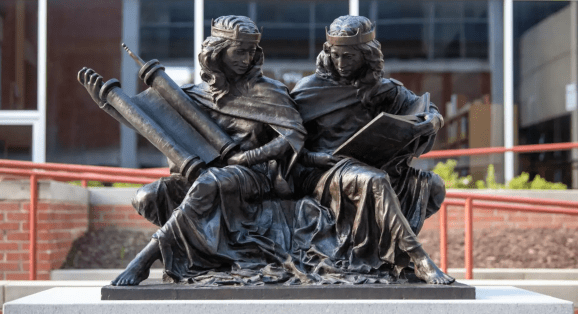
An outdoor statue of two women sitting side by side. Both are robed and crowned. One holds a large torah scroll; the other an open Bible. They are smiling and looking at one another's texts.
A new representation of Synagoga et Ecclasia, mutually crowned and learning from each other. Statue by Joshua Koffman for St. Joseph’s University, commissioned in honor of the 50th Anniversary of the Roman Catholic Church’s 1965 Nostra Aetate declaration, which repudiated past anti-Jewish doctrine and actions and called for more respectful relations.

Here’s a longer excerpt from Mayfield describing how to put this paradigm into practice while remaining true to ourselves:

So, how do we, as Christians, continue to affirm one of our central claims of Jesus as the Messiah while also allowing space for the dismissal of that claim? Perhaps we are helped by returning to the tension between identity and openness.

Christians maintain strong identities in the claim of Jesus as the Christ while also remaining open to other visions of the messianic kingdom, thus realizing that the full realm of God has not come. It is vital to our identity to claim Jesus as the Messiah, and we are also open to other formulations of messiah.

One meaningful way forward along this challenging path is not to claim too much: to be careful, considerate, and humble with our messianic notions. For example, instead of holding to a messianic or christological reading of Isaiah as the only valid notion, Christians could admit openly and explicitly that these texts provide some of the necessary elements that will constitute notions of messiahship in first-century Judaism, notions Jesus and his biographers took up and used. However, these texts do not point immediately to Jesus; there is just not a straight line — historically or theologically — between Point A, Isaiah, and Point B, Jesus.

This sort of admission presents real possibilities for neighborly engagement since it ties the Christian claim about Jesus more closely to sacred texts that are used only by Christians. It does not predetermine the meaning of Isaiah for all traditions, but it allows Jews and Christians to interpret Isaiah’s prophecies based on their respective traditions, with neither tradition holding ultimate authority over the biblical text. …We could go even further to say that the Jewish reading is an important and necessary one from which Christians could learn. (Chapter 2)

More Benefits of Interpreting Responsibly!

Ultimately, a paradigm of respect and mutual conversation bears rich fruit not only in our relationship to our Jewish neighbors, but to our own faith. Letting Hebrew Bible texts stand on their own merit opens us to how a given passage speaks to us here and now, rather than limiting its prophecies to a closed loop of prophecy-fulfilled-in-Christ. Mayfield quotes Ellen Davis’ comment that

“We like to keep the frame of reference for prophecy within the ‘safe’ confines of the Bible, by reading prophecy solely as illuminating what has already happened—the birth, life, and death of Jesus Christ—and not allowing it to meddle much in the current lives of Christians” [and Jews!]. (Chapter 1)

We are not called to play it safe; we are called to let scripture breathe, and to welcome in God’s mischievous spirit! Making room for many interpretations, for multiple messages from Isaiah for different times and contexts, liberates scripture to speak to us in new, challenging, relevant ways today.

Doing so also helps us live into the tension of Advent’s dual theological themes: Incarnation and eschatology. As Mayfield notes,

These two foci do not naturally cohere. The emotions invoked by Advent call us to “prepare joyfully for the first coming of the incarnate Lord and to prepare penitently for the second coming and God’s impending judgment.”3 Joy and penitence. …We are pulled in different emotional directions. (Chapter 1)

Churches tend to lean towards the joy — but we can’t ditch the solemnity, can’t “alleviate the tension,” without robbing ourselves of “the incredible richness and grace that result from the annual eschatological collision in the weeks before Christmas.”4

As someone who centers my ministry around breaking binaries, reveling in the in-betweens where God does Their best work, I appreciate this insistence on the “both/and” of penitence and joy — as well as of Isaiah and Matthew/Mark, and of a prophetic message for Isaiah’s time, and Jesus’s time, and for us and our Jewish neighbors today.

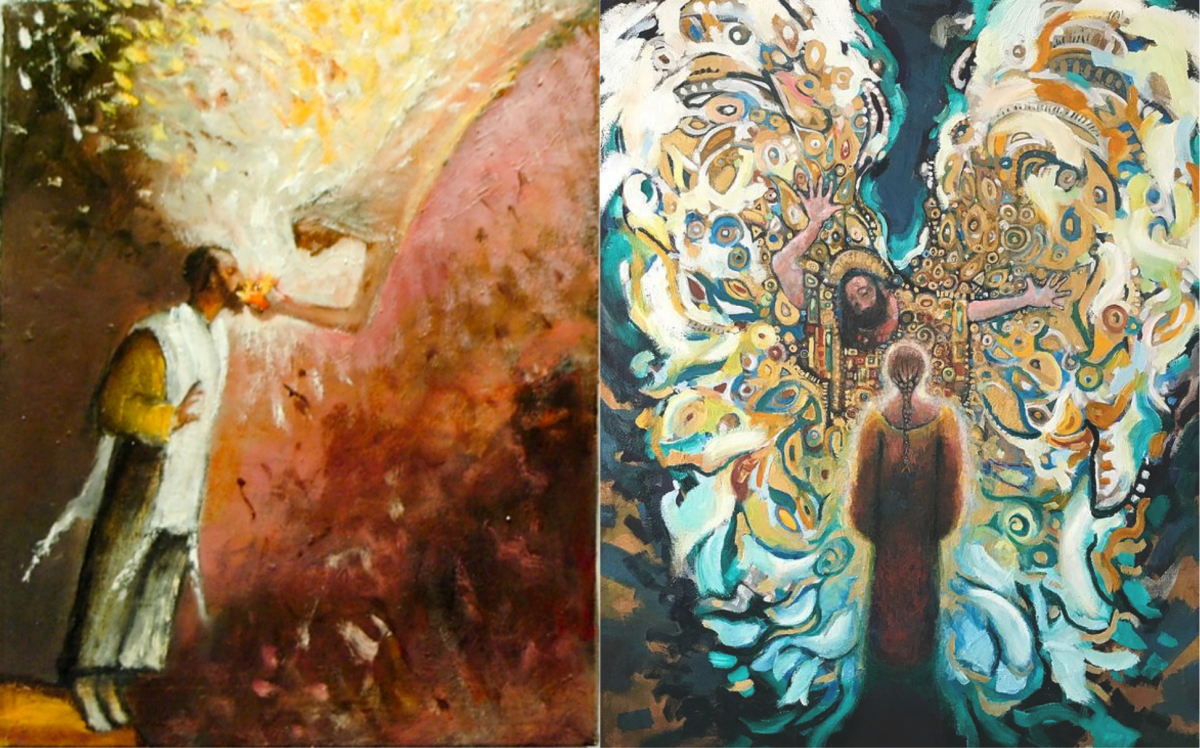
Two contemporary paintings side by side. The first is of Isaiah receiving a burning coal to his lips by an angel. The second is the angel appearing before Mary.
“Isaiah” by Richard McBee; “The Annunciation” by Daniel Bonnell

Closing

In Advent, past, present, and future queerly coalesce:

“We have hope in what the incarnation brings to our world each day, even as we hope for the setting right of things with the culmination of history.” (Chapter 1)

Though the details certainly differ, we can thus proclaim that “even though the Messiah has come, we wait with Jews for the ‘complete realization of the messianic age'” and that in this interim time, “it is the mission of the Church, as also that of the Jewish people, to proclaim and to work to prepare the world for the full flowering of God’s Reign, which is, but is ‘not yet’”5 (chapter 2).

This Advent claim “takes the unique identity of Christians seriously as ones who have seen in Jesus our Messiah yet remain open to the fullness of that claim in the future” (chapter 2).

It is possible to shape Advent into a season wherein we don’t perpetuate harm against our Jewish neighbors, but rather grow in our respect for and mutual relationship with them. The remainder of Unto Us a Child Is Born: Isaiah, Advent, and Our Christian Neighbors is overflowing with more knowledge and advice that further enables this aim. I highly recommend checking it out. If you need help obtaining a copy, hit me up.

Have a blessed, pensive, and joyful Advent.


  1. For a thorough history of antisemitism, and how to be in solidarity both with Jews and Palestinians, I highly recommend Safety through Solidarity: A Radical Guide to Fighting Antisemitism. ↩︎
  2. Pharisees were cool, y’all; go learn from the fabulous Rabbi Danya Ruttenberg about what Pharisees believed, how Jesus may have been a Pharisee himself, and the context around the Gospel writers’ negative depictions of them ↩︎
  3. Mayfield’s quoting Gail R. O’Day, “Back to the Future: The Eschatological Vision of Advent” (2008) ↩︎
  4. Mayfield’s quoting J. Neil Alexander, Waiting for the Coming (1993) ↩︎
  5. Mayfield is quoting Mary Boys, Has God Only One Blessing? (2000) ↩︎
Categories
advent Christmas Holy Days LGBT/queer Liturgy Other search markers

Advent/Christmas Resources

Greetings, it’s been a while and Advent is soon upon us!

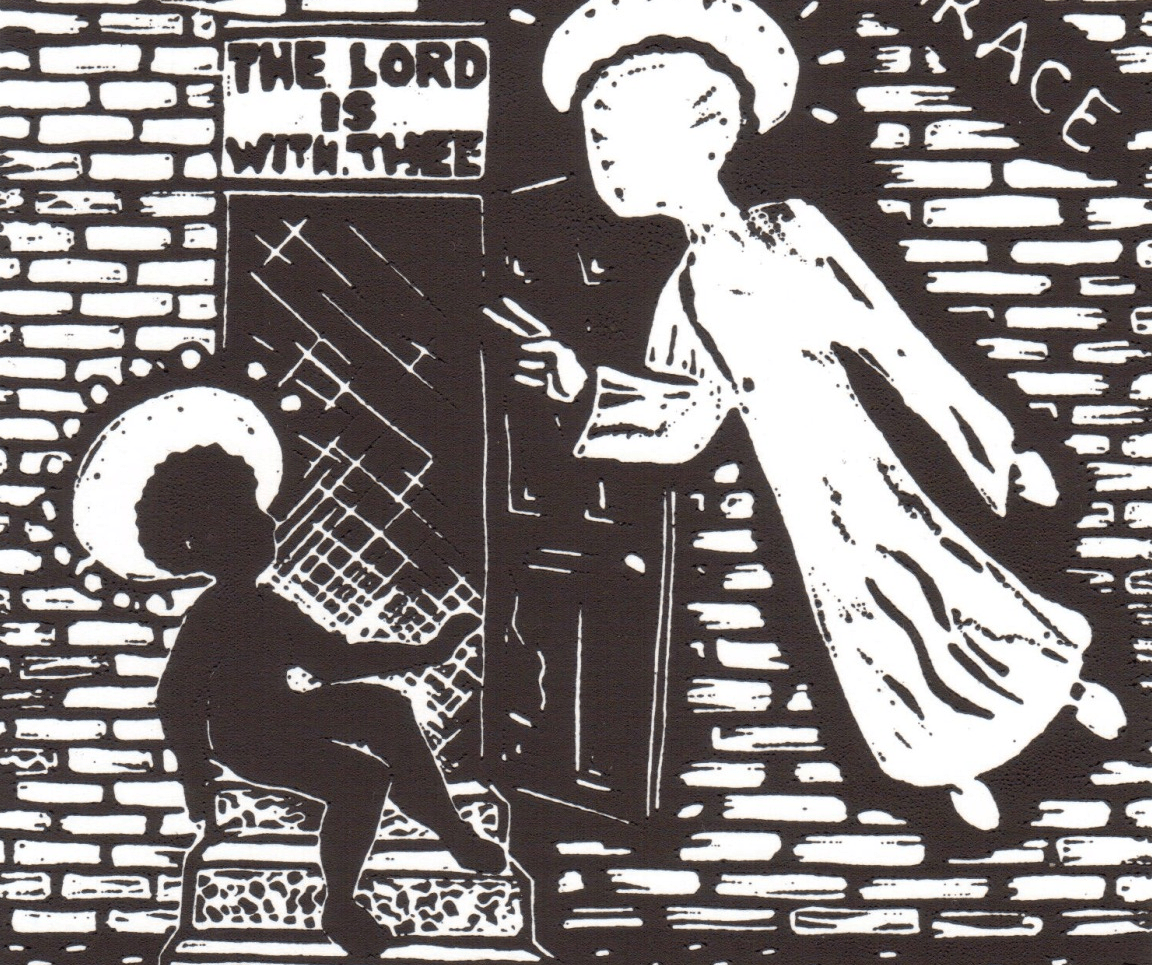
Black and white linocut of an angel appearing to Mary, who is depicted only in sillhouette but who as an afro hairstyle. She sits on a stoop outside a brick wall. Text above and below reads out the first part of the Hail Mary prayer: Hail Mary, full of grace, the Lord is with thee. Blessed art thou among women and blessed is the fruit of thy womb Jesus.
Annunciation, 2015” by Ben Wildflower

In Advent, God’s Spirit comes in dreams,
daring us to conceive of impossible things:
that wolf and lamb
might live in harmony;
that the world’s despised
might rise to greatest glory;
that war-torn wastes might bloom
and grow good fruit.
– my writing in Call to Worship 59.1

Then on to Christmas, when we celebrate how (to paraphrase Saint Athanasius) the divine became human so that humans might become divine.

At Christmas, Creation sings a new song;
God’s prophets proclaim good news:
The Word of God
has put on flesh
so that we may put on divinity.
Through Jesus, our newborn brother,
we are adopted into God’s chosen family.

– my writing in Call to Worship 59.1

In preparation for this holy time of the year, I want to share several resources created for Advent / Christmas 2025 that I had the honor of being part of.

First is More Light Presbyterians’ Advent devotional!

This resource offers a ~100 word devotion for every day of Advent. They will be posted daily on MLP’s Instagram and Facebook pages. It’ll also be published all at once in MLP’s monthly newsletter for December; sign up to receive it here.

Next, there’s Unbound’s Trans Advent/Christmas devotional!

Along with an Advent calendar that lists a trans organization or trans activist for each day of the season, Unbound’s devotional provides a reflection by a trans author for every Sunday & special day of Advent & Christmas. It’s a fantastic resource for communities or individuals who are hoping to queer up this season.

Click this readmore for a snippet of my reflection on the second Sunday of Christmas.

In the beginning, God spoke the Word; and God was the Word; and God was the breath that pushed that Word out into the void to spark life.

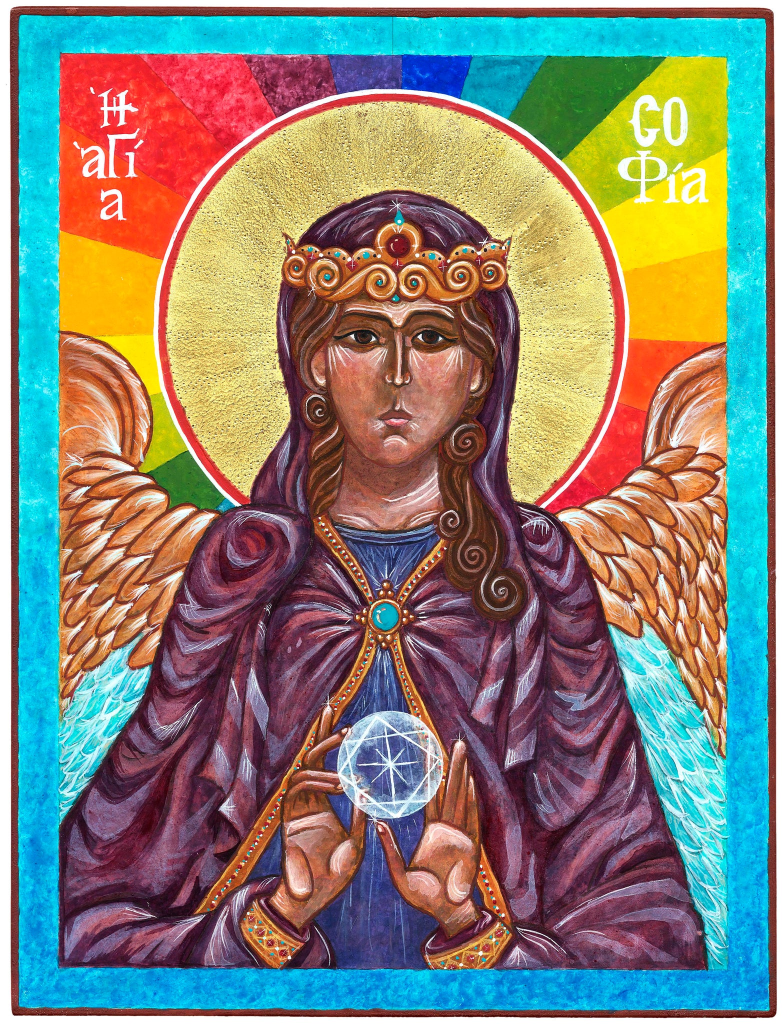
In the beginning was Wisdom, flowing forth from God’s mouth to unfurl Herself across the earth, seeking out those who’d welcome Her peculiar gifts.

Starting with Paul, who identified Christ as “the wisdom of God” (1 Cor 1:24), Christians have traditionally connected the Hebrew scriptures’ personified Wisdom — often called Sophia, the Greek word for wisdom — with Jesus. Yet while the Word took on a human body whose features led those present at Their birth to declare, “It’s a boy!”, Wisdom is described — and speaks of Herself — in feminine terms.

Sophia, Woman Wisdom, assigned male at birth! Now that’s a trans story if I ever heard one. […]

And yet…I still default to thinking of Jesus as male. Why, when many of us have expanded our language for God beyond exclusively masculine terms, does it still feel strange — even inappropriate — to speak of the Person of God who is Jesus as she or they?

…It’s the physical body, isn’t it? In many ways, Jesus is as constrained by his (/her/their/zir…) assigned gender as the rest of us.

From birth, we are bombarded by messages telling us that our flesh is our gender — that, as feminist philosopher Simone de Beauvoir put it, “biology is destiny.” From the moment the Word put on flesh, that flesh (or our assumptions about it, because the Gospels don’t actually tell us much about Jesus’s physical appearance beyond what we can deduce from his circumcision in Luke 2) sealed Their fate: Creator God can exist beyond human labels, and the Spirit is, well, Spirit; but God the Son is a human man.

But trans folk know deep in our bones that biology is not destiny. Trans wisdom cuts through the bonds of the binary’s imposed futures, freeing all of us to imagine new possibilities…and, sometimes, to remember old ones. [… read the full thing here]

Also check out Advent & Christmas liturgy in Call to Worship!

I wrote liturgy based on the Common Revised Lectionary for every Sunday and holy day of Advent 2025 and Christmas 2025/2026.

This liturgy is in many ways more “subtly queer” than Unbound’s devotional, as I wrote it to fit a broader range of contexts and church communities. However, I was delighted by the authorial freedom Call to Worship gave me; along with sticking to inclusive language for people (e.g. saying “siblings” instead of “brothers and sisters”), I was able to employ expansive language and pronouns for God! I also incorporate a lot of liberationist theology, from Ada María Isasi-Díaz’s concept of the Kin-dom of God to prayers emphasizing the goodness of embodied life.

To access all the Advent and Christmas material, you may need to subscribe to Call to Worship. If you are unable to do so, email me at queerlychristian36@gmail.com and I’ll get the material to you.

In the meantime, click this readmore for a sampling.

Fantastically scandalous God,
in being born into human life
you burst through the rigid binary between
worshiper and deity, Creator and creation.
Inspire us to proclaim your astonishing news
wherever we go — not only with words,
but through actions of justice and love.
Push us to prophecy
against hoarding and exploitation;
Empower us to rise up
with oppressed peoples everywhere;
Illuminate our path
as we tend to your poisoned planet,
so that all Creation may feel your embrace through us —
your hands, your feet, your body here on earth. Amen.

TWIBAR’s annual Christmas episode

Every Christmas, The Word in Black and Red podcast puts out an episode featuring the short reflections of largely Christian leftists; I’m one of them! Keep an eye out for the episode on the podcast feed.

digital art of a young Latino couple outside a convenient store in the rain; José is using a payphone while Maria, in a hoodie and visibly pregnant, sits on a toy horse
José y María by Everett Patterson

Other resources

I’m not part of these, but I always recommend the following resources:

  • Enfleshed – spiritual nourishment for collective liberation
  • A Sanctified Art – especially the illustrations they offer for Advent and for Christmas
  • I can’t recommend Cole Arthur Riley’s writings enough; check her out @blackliturgies on Instagram, Facebook, etc.

What about you? What are your favorite liberationist resources for Advent and Christmas?

Categories
advent bible study Holy Days My poetry Queer Lectionary Reflections for worship services

Christ is barred from Bethlehem

A voice cries out in the wilderness,
“Prepare the way of the Lord! Make straight his paths.”

How do we do that in the present day?
We break down walls that block his family’s way.

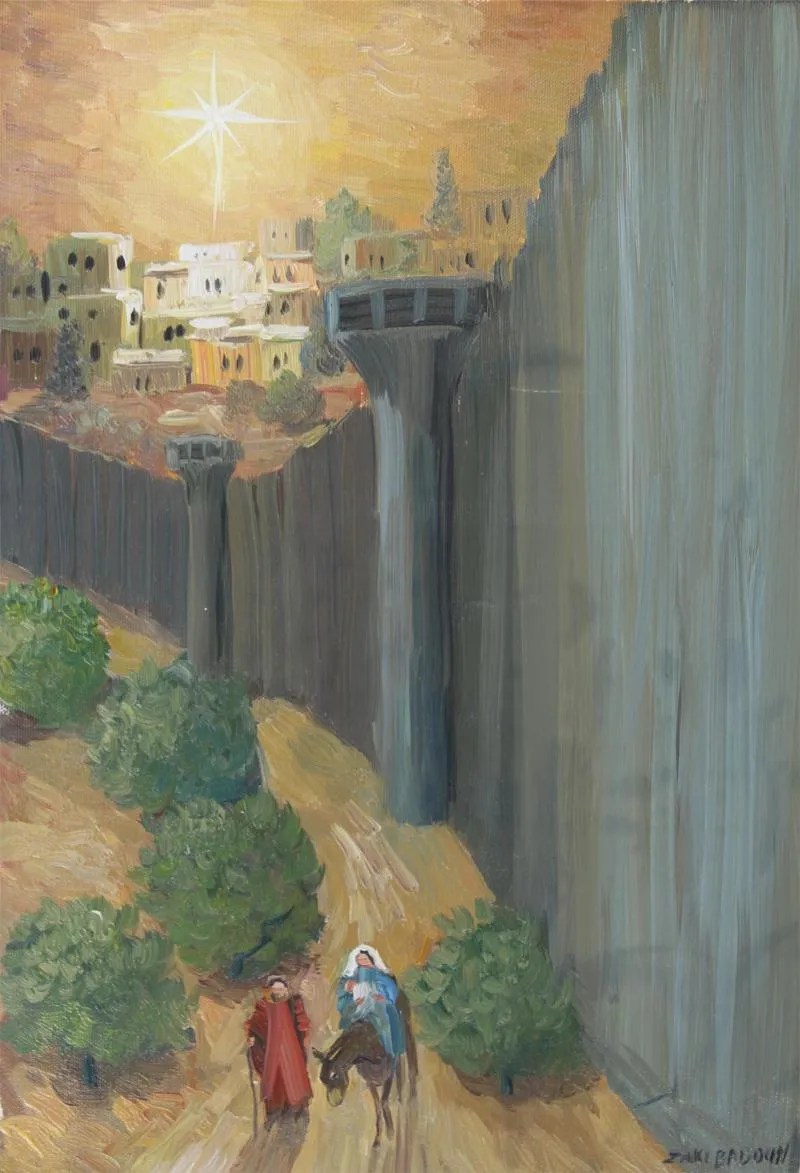
As Mary and Joseph draw near Bethlehem
a fence looms over them, some eight yards high

and soldiers watch from towers as they trudge
not straight into the city, but around
to find the checkpoint — where they’re turned away:
“We’re only letting tourists in today.”

So Mary groans outside the barrier
no place to lay her newborn’s bloodied head

and John the Baptist paints in green and red
across that cold wall’s surface — shepherds, lo! —
“Merry Christmas world
from Bethlehem Ghetto”


You are welcome to make use of the above poem or below reflection in worship, in classrooms, on social media, etc. Please credit Avery Arden of binarybreakingworship.com.

_____

In a 2014 article, Medhi Hasan wonders how Mary and Joseph’s trip from Nazareth to Bethlehem would go in the modern day:

“How would that carpenter and his pregnant wife have circumnavigated the Kafka­esque network of Israeli settlements, roadblocks and closed military zones in the occupied West Bank? Would Mary have had to experience labor or childbirth at a checkpoint, as one in 10 pregnant Palestinian women did between 2000 and 2007 – resulting in the death of at least 35 newborn babies, according to the Lancet?

‘If Jesus were to come this year, Bethlehem would be closed,’ declared Father Ibrahim Shomali, a Catholic priest of the city’s Beit Jala parish, in December 2011. ‘Mary and Joseph would have needed Israeli permission – or to have been tourists.’ “

Meanwhile, a Reddit post claims they’d have to get through fifteen checkpoints on their journey. Chances are, they wouldn’t make it through — just get harassed and interrogated for their trouble.

As I reflect on these statements, I ponder also the opening of Mark’s Gospel. This text, which is read in many churches during the Advent season, recalls the prophetic cry of Isaiah 40:

A voice is crying out:
“Clear the Lord’s way in the desert!
    Make a level highway in the wilderness for our God!
Every valley will be raised up,
    and every mountain and hill will be flattened.
    Uneven ground will become level,
    and rough terrain a valley plain.
The Lord’s glory will appear,
    and all humanity will see it together;
    the Lord’s mouth has commanded it.”

What does such a prophetic leveling — a flattening of land so that all people, including children, elderly and pregnant persons, and people with mobility impairments can easily travel — look like today?

I envision the 440 miles of separation wall crumbling into the earth. Watchtowers topple. Barbed wire melts away. Snipers’ guns morph into ploughshares; bombs explode oh-so-gently into fertilizer to feed burned olive groves.

No more are humans caged in the world’s largest open-air prison. No more are children dragged away in the night to be tortured and tried as terrorists.

The land is free. The people are free. God’s liberating Spirit moves unhindered; God’s holy land becomes, as promised, a “house of prayer for all peoples” (Isaiah 56:7).

Thanks be to God. May we be moved to help make it so.

  • A person wearing a keffiyeh secures tear gas canisters to a tree, with normal Christmas ornaments visible on trees behind him
  • A person secures tear gas canisters to a tree with Christmas lights on it

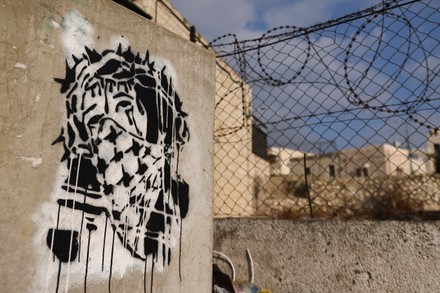
Gallery images: a remake of a famous 1936 “Visit Palestine” poster to show the Holy Family and the separation wall; photos of Palestinians decorating a tree in Bethlehem with tear gas canisters in 2015, as well as a close-up of a canister showing it’s USA-made; and more photos from the separation wall, including the icon “Our Lady of the Wall,” where nuns and pilgrims pray rosaries to dismantle the wall.

Categories
advent Holy Days Hymns Other search markers Unpacking Antisemitism

“O Come Emmanuel” revised for Palestine’s plight

This Advent, some progressive Christians have discussed whether to table one of our religion’s most ancient hymns: “O Come, O Come Emmanuel.” When we sing of God coming to “ransom captive Israel,”
will our congregations recognize we don’t mean the modern Israeli nation?

Honestly, a conversation around this song is long past due (and many have had it over the decades). The truth is, it’s always been laden with supersessionist implications. Depicting the Jewish people as living “in lonely exile here / Until the son of God appear” perpetuates the idea that Jews’ relationship with God is incomplete because they “didn’t accept” Jesus as their Messiah.

How do we resist both antisemitism and Zionism, while seeking to maintain a connection to Christians who came before us? One option may be to reimagine the songs we cherish so that, instead of perpetuating deep-seated hate and Christian supremacy, they challenge us towards joining God in solidarity with the world’s oppressed.

In that spirit, below is my reworking of “O Come Emmanuel” to center the plight of Palestinians (and that removes, I hope, the supersessionism — let me know if I missed any). May our worship songs plant in us a deep desire for justice, and spark our action towards a future where all peoples, all religions live in mutual relationship and respect.

Please feel free to use and share around — just credit Avery Arden of binarybreakingworship.com.

__

O come, o come compassionate Divine,
And ransom captive Palestine
That mourns with tears that will not be soothed
Till empires fall and nations’ hearts are moved.

Rejoice! Rejoice! God’s justice is at hand
To liberate the people and the land.


O come, o bright and ever-burning star;
Bring Gaza comfort from afar!
Dispel from her the shadow of death
That murders dignity and chokes out breath.

Rejoice! Rejoice! God’s justice is at hand
To liberate the people and the land.


O come, o Wisdom from on high,
Take up the outcast’s cause, the captive’s cry.
Guide us to build your kingdom on earth
Where all faiths flourish, and the last are first.

Rejoice! Rejoice! God’s justice is at hand
To liberate the people and the land.


O come, o King of Peace and Justice, break
All weapons down, and from them ploughshares make.
Let all tears dry, all peoples respond:
“We are each other’s magnitude and bond.”

Rejoice! Rejoice! God’s justice is at hand
To liberate the people and the land.

Categories
advent Holy Days My poetry

Poem: Advent in (another) genocide

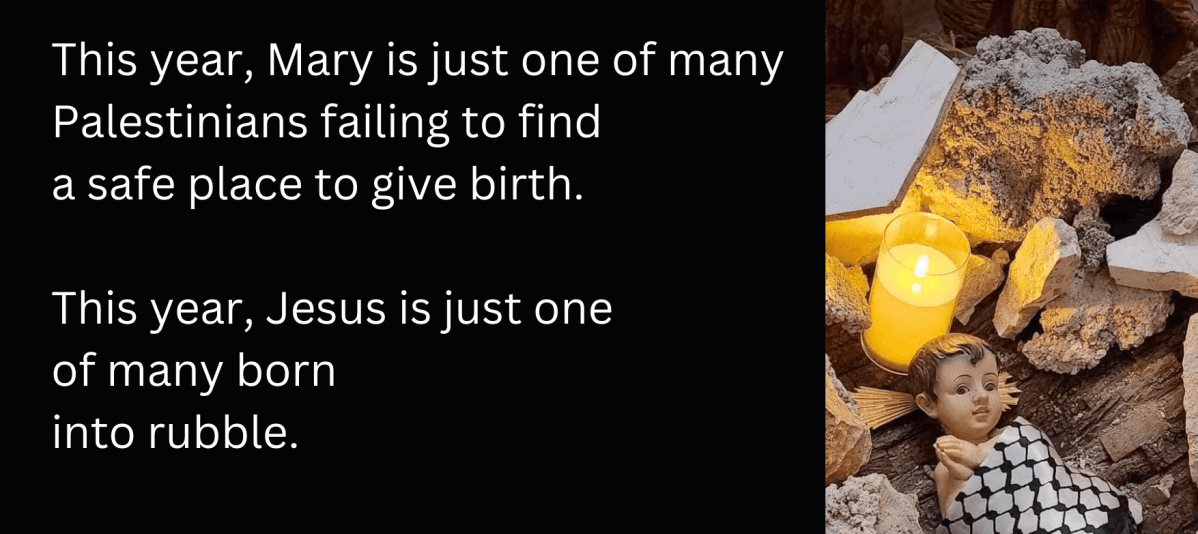
This poem came to me after learning that Christian leaders in the Holy Land have asked churches not to organize any “unnecessarily festive” activities, in solidarity with Gaza; as well as seeing the Nativity scene set among rubble in the Lutheran Church of Bethlehem this year.

Find resources on what’s happening in Palestine and how to help below the poem.

Please feel free to share around; credit to Avery Arden (they/them) with a link to binarybreakingworship.com.


This year, Mary is just one of many
Palestinians failing to find
a safe place to give birth.

This year, Jesus is just one
of countless born
into rubble.

This year, the newborn Christ

dies 

his little body bombed
and tossed aside
into the growing pile.

This time, Jesus never makes it to adulthood —
doesn’t even make it the eight days to circumcision.
He doesn’t die a grown man
making a conscious choice
to defy Empire armed with naught but dreams

of a world where all the nations live as one
where last are first 
and all wars done —

No. This year, his newborn life is threat enough —
his family’s mere existence is rebellion enough  —
to warrant eradication.

Actually, it was then, too, two thousand years ago
— for Empire always fears the ones it grinds
beneath its millstone — back then, though
Christ’s parents found safe passage into Egypt —

now, snipers shoot them as they try
to leave the hospital that scarce had room
for one more woman’s labor cries.

Stigmata are
that much more
chilling between
an infant’s eyes.

And now, as then, some may blame Jesus’s death
on his own Jewish people — but
resist this lie! Now, as then,
the crime is Empire’s

with Western Christians at the helm

and those who would cast stones, look first
for your own nation’s name etched on the bombs
and tear gas canisters!

And, God,
if there is any hope at all
to wrestle from the rubble

as churches all across the Holy Land
close their doors to Christmas joy this year —
a holy choice to mourn with those who mourn
as Christ’s homeland is made a massive grave —

it’s this: there are still children left to save.

It’s this: not every olive branch has burned.

It’s this: the sacred promise of a God
who dies whenever Empire’s outcasts die —
that those cast down 

will rise.

Palestine, Palestine! I swear we will not cease
to shout your name until, at last, your streets
sing with your children’s laughter, loud and free.

– Avery Arden


Notes on this poem

I am writing this note after revising some middle portions of this poem, and coming away still unhappy with the results.

As a Christian who believes that God expresses a solidarity with the oppressed so strong and intimate that They are literally one with every oppressed person, I cannot help but recognize Christ within the people being killed and expelled from their homes in Gaza right now. Christ is there among them, and that means he is among their dead as well as their displaced.

As the Rev. Munther Isaac of the Evangelical Lutheran Church in Bethlehem on the West Bank preached in October,

“God suffers with the people of this land, sharing the same fate with us. …God is under the rubble in Gaza. He is with the frightened and the refugees. He is in the operating room. This is our consolation. He walks with us through the valley of the shadow of death. …”

For Christians like Rev. Isaac, Christ’s intimate identification with those the world calls least, those whom Empire threatens to eradicate, is central to any sense of comfort they may have in the face of so much devastation. It’s also central to my own faith and personal understanding of the Divine.

Yet in this context, because modern-day Israel is a Jewish state, exploring that Divine solidarity comes with a great risk of perpetuating the long, harmful history of antisemitic blood libel and accusations of deicide. How do we affirm God’s presence with those suffering in Palestine without (implicitly or explicitly) adding to the poisonous lie that “the Jews killed Jesus”?

In wrestling with this complexity, I tried to write this poem to uplift both Jesus’s Jewishness and his solidarity with Palestinians. Jesus was born into a Jewish family, his entire worldview was shaped by his Jewishness, and he shared in his people’s suffering under the Roman Empire. His solidarity with Palestinians of various faiths suffering today does not erase that Jewishness. Nor does it mean that Jewish persons don’t “belong” in the region — only that modern Israel’s occupation of Palestine is in no way necessary for Jews to live and thrive there, or anywhere else in the world.

I also aimed to point out (sacrificing poetic flow to do so, lol) that Israel is by no means acting alone in this attack on Gaza or their decades-long occupation of Palestine. There is a much larger Empire at work, with my own country, the United States, as one of the nations at the helm. Israel is entangled in that imperial mess, and directly backed and funded by those forces — not because of what politicians claim, that we have to back Israel or else we’re antisemitic, but because Israel is our strategic foothold in the so-called Middle East. How do we name our complicity as our tax dollars are funneled into violence across the world, and act to end that violence?

Ultimately, I don’t know that this poem is a successful one. I don’t know if it avoids perpetuating harm. If nothing else, I hope it sparks conversation about resisting antisemitism as much as we resist Zionism.


Palestine Resources

HISTORY

CURRENT EVENTS

DREAMING OF A BETTER FUTURE

WAYS TO HELP

  • Urge your University/School/Organization to put out a statement denouncing Israel
  • Organize a Protest/Participate in a local one
  • While calling your reps, tell them that as a voter, you’re unwilling to support them in the upcoming election unless they urge the White House to take a stand against Israel and stop funding them
  • Share art/writing/films around Palestinian culture (see this tumblr post for Palestinian media to watch; I also recommend Oriented (2015) for an un-pinkwashed queer Palestinian story)
  • If you’re part of a union, ask them what they’re doing to urge their industry leaders to take a stand against Israel + pressure the White House OR urge them to start a strike/walkout/etc if they’re not doing anything already
  • Talk with your friends IRL about Palestine; keep spreading information on social media — don’t let talk of Palestine die down!
  • See if your city/state council has put out a statement in support of Gazans. If not, try to push them to do so.
Categories
advent Catholic vibes Holy Days My poetry Other search markers Reflections for worship services

Nativity Beads: a poem & an essay exploring alternative interpretations of the Luke 2 story

Nativity Beads

pendant.

we think we know the story
of how you birthed our God into our midst
— but this
is not quite accurate:

the tale of your time in Bethlehem
is overlaid by two millennia
of retellings —
tradition lining up beside tradition and

when my mind becomes
a tangled mess
trying to divine
which ones Really Happened

you come.

you calm.

you guide me from

my need to know one truth
into the sacred splendor
of a whole string of stories —

each one a bead
pregnant with its little piece of Truth,
a little link between me and
your Son and you.

___

first decade.

“it’s not so bad,” Joseph says hopefully
as he helps you settle down onto the straw.

the cave walls cut the chill;
the goat who ambles close to sniff you stinks but
oh, she’s warm.

you think of births you’ve overheard
at home — the neighbor women rushing in
to help. you expected the same for yourself

but, ah well, what has been expected
about this pregnancy?

___

second.

Joseph hovers, fervent but unsure
how to help.

“if i could take your pain upon myself…”

but there is no pain!
conceived as you were
free from Eve’s bane,

as you give birth
to heaven on earth
all you know is
bliss, bliss, bliss.

___

third.

Joseph is gone.
you can picture his desperate dash
from door to bolted door
off in the town

as you lie alone
on old straw — and, God! the baby crowns

with no one to help — so you reach down
into the mess of your own blood and

yours are the first hands to wrap around
the Son of God, red and slick and — oh sacred sound!  — screaming.

___

fourth.

Joseph is gone, but near — you know he waits
pacing and praying just outside the door.

in his place — women’s faces, smiling and soothing,
letting you squeeze their hands as hard as you need

or bustling about to heed Midwife’s decrees.

the guest room was too small to hold this congregation
so you were helped into the central room
to birth the Son of God right in the heart
of this small peasant home.

the poor know how to serve one of their own.

___

fifth.

you close your eyes as agony subsides
between contractions. see yourself as one bead
upon a long strong string stretching centuries —

you are one

with Jochebed biting down to mute her moaning,
Rebekah grateful for an end to her rough pregnancy,
with Hannah, Ruth, Bathsheba, Hagar, Rahab, Leah, Eve,
and millions more unnamed. you share their groaning,
their labor, their relief, their ecstasy.

your baby crowns; the women round burst out in Glory be!


This poem was written by Avery Arden and belongs to them. If you want to use it in a worship service or elsewhere, let Avery know! You can reach them at queerlychristian36@gmail.com.


Essay

My Advent devotions this year include praying a daily rosary. Meanwhile, I’ve been fixating upon a certain reading of Luke 2’s “no room at the inn” passage that suggests Mary gave birth not in a stable, but someone’s home (more on that in a bit). As I meditated on various iterations of the Nativity tale while moving through my rosary, this poem was conceived.

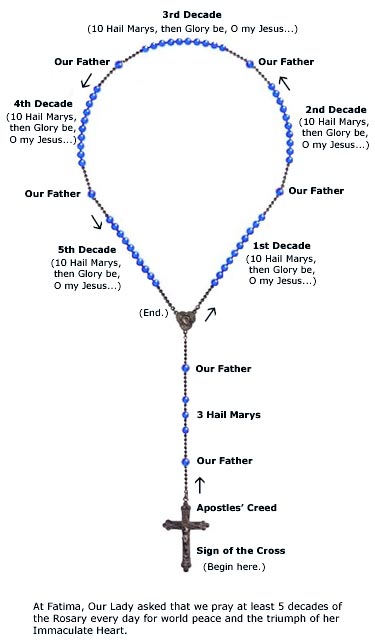
This poem is structured after a rosary. For my non-Catholic friends out there who may not be familiar, a rosary is a long string of prayer beads with a crucifix or other cross hanging down from five decades, or clusters of ten beads each. Here’s a diagram (from this site):

id: diagram of a Catholic rosary with blue beads. A crucifix dangles from the bottom of a string with five beads on it, which is connected to a longer string that connects like a necklace; this longer string has five clusters of ten beads each, and every cluster has one bead between. The diagram labels different beads with their assigned prayers; for instance, each cluster is labeled as one of five decades, with 10 Hail Marys, a Glory Be, and an O my Jesus prayer. The beads between each decade are labeled “Our Father.”

You start at the crucifix and pray along the “pendant,” the strand that hangs down with five beads; then you make your way around the five decades. For me, the rosary offers a way to embody my prayer and to enter into a meditative state as I move from bead to bead and repeat the prayers. As an autistic person, having a tactile point into which to pour all my energy, one point of sensory input to overshadow all the others, is a powerful way to put aside all else and hone in on Divinity.

Pondering one story each decade is a traditional way to pray the rosary — the recommended ones are explained on this site; but for the past week or so, I’ve been imagining the Nativity over and over, a little differently each decade.

Versions whose events contradict each other — a painless Mary versus a groaning Mary; Mary alone or Mary with midwives; Mary dismissed to the outskirts or settled in the heart of a Bethlehemite home — all found their place, side-by-side, along that line of beads. As I took time with each story, the sense of contradiction as conflict faded away.

Little truths rose to the surface of each version, something to savor, a fresh facet of the story of God entering into human life. I can’t know which one was “most historically accurate,” but I could contemplate what each version says about God’s movement in Mary’s life and ours — what good news each version proclaims into our world.

So what is some of that good news? I’ll touch upon the various visions visited by each “decade” of the poem.

The first decade is self-explanatory, I think — it sets up the version we encounter in Christmas pageants, nativity sets, the Charlie Brown Christmas special… In this version, “no room in the inn” means that whatever lodgings a visitor to Bethlehem could usually expect were all full up. Though no Gospel mentions an innkeeper at all, we can all picture that figure well enough; he’s been woven into being by the dramatizations of generations. Whether heartless or apologetic, he can’t provide a bed for a pregnant girl and her husband; but look, there’s the stable, with plenty of straw and a little space among the livestock.

I have long cherished this narrative through a liberationist lens — that God chose to enter the world at the margins of the margins emphasizes Their intimate identification with the most oppressed and erased of our world! Humanity did not make room for the God who so loved the world They squeezed Their infinity into finite, vulnerable flesh; just as our human systems fail to make room for the survival and thriving of so many persons.

The second decade incorporates a bit of Roman Catholic doctrine that states that Mary felt no labor pain — since Catholicism holds that she was born miraculously free from original sin, she was likewise free from the consequences of that sin (see Genesis 3:16, where God informs Eve that her labor will be painful). Though raised Catholic, I didn’t learn about this tidbit of Mariology till late high school. I remember feeling…oddly betrayed? A facet of Mary’s relatability, her humanness, felt stripped away; her pedestal of larger-than-life perfection seemed to stretch a little higher. But this past week, I’ve taken the time to imagine a painless labor for her, and even if it’s not the story that speaks to me loudest, I have found some richness in it.

The third decade imagines Mary alone, following after Eastern Orthodox tradition. I pondered the significance of this version of events — why place Mary by herself as she births God on earth? Does her isolation foreshadow the sense of desolation her Son would feel decades later, on the cross?

What arose most strongly in me as I envisioned this version was a sense of joy and rightness — that Mary’s would be the first hands to touch the Divine she’d carried within her for nine months; that hers would be the first eyes to take in Word made flesh.

The fourth and fifth decades move away from the Nativity versions that have enjoyed the most traction and expansion over the centuries. We do away with barns and innkeepers, and bring some new characters to the stage: midwives!

Bringing midwives into the nativities I imagined as I prayed brought me deep joy. Midwives show up in various places throughout scripture — God Herself is depicted in the role of midwife in places like Psalm 22:11 (see this article for more on midwives in the Jewish Bible). Meanwhile, the most famous human midwives are probably the named, heroic women Shiphrah and Puah of Exodus 1, who protect the newborns of enslaved Hebrew women from Pharaoh. The role such women played was a life-bringing one, and imagining the relief and comfort a skilled midwife would bring teenage Mary filled me with gratitude for whoever this unmentioned woman may have been.

In “The Accommodations of Joseph and Mary in Bethlehem,” Stephen C. Carlson explains, “Childbirth was the riskiest moment in the entire pregnancy during antiquity, potentially lethal for both the mother and child. Whenever possible, women about to give birth relied on the help of relatives, friends, and midwives in and around town” (pp. 340-341). I love imagining Mary encircled by so much support as she labored to birth the God of the universe.

Carlson and other scholars suggest that it was the presence of all these Bethlehemite women at Jesus’ birth that necessitated a lot of space for the event. This brings us at last to that famous line from Luke that notes a lack of room…in the inn? or somewhere else?

I promised I’d return to readings of Luke 2:7 that argue Jesus was born not in a stable, but a house — so here we go!

At first glance, Luke 2:7 seems fairly straightforward. Since we’re talking about tradition here, I’ll offer the KJV’s version:

"And she brought forth her firstborn son, and wrapped him in swaddling clothes, and laid him in a manger; because there was no room for them in the inn." 

However, digging into the Greek of the text and into the socio-cultural context of the story uncovers some complications.

It turns out that the Greek word that most traditionally gets translated as “inn” here has a broader meaning than that. The word is kataluma (κατάλυμα), and it’s only used two other times in the Gospels (or the NT as a whole): in Luke’s and Matthew’s accounts of how Jesus’s disciples found a room for the meal that we now call the Last Supper. Here’s Luke’s account (22:10-12; NRSV translation this time; with the translation of kataluma bolded):

“Listen,” he [Jesus] said to them, “when you have entered the city, a man carrying a jar of water will meet you; follow him into the house he enters and say to the owner of the house, ‘The teacher asks you, “Where is the guest room, where I may eat the Passover with my disciples?”’ He will show you a large room upstairs, already furnished. Make preparations for us there.”

(Side note: if you want to read about that person with a jar of water through a trans lens, check out the section of my webpage over here titled “A Simple Jar of Water.” It’s fun stuff! but not related to the discussion of kataluma.)

How can one Greek word mean both “inn” and “guest room”? The noun kataluma is tied to the verb kataluó (καταλύω) — kata + luó = “to loosen thoroughly.” When journeying with pack animals, you’d only “thoroughly loosen” their straps and packs when stopping for a long rest. Thus the verb came to mean “to take up lodging;” and the related noun, the kataluma of both Luke 2:7 and 22:10, came to stand for those lodgings — whether that was some natural shelter like a cave; a tent; an inn; or a guest room in someone’s house.

Meanwhile, there is another Greek word that means “inn” specifically — and the author of Luke uses that word in his version of the Good Samaritan story, when the Samaritan brings the man mugged and left for dead to a pandocheion (πανδοχεῖον).

So if Luke’s one other use of kataluma (22:11) refers to a guest room in a private home; and the one time he wants to specifcally refer to an inn (10:34) he uses a different Greek word…why do the vast majority of English translations of Luke 2:7 state that there is no room for Mary’s labor “in the inn” rather than “in the guest room”? (Or, to avoid making a claim in either direction, why don’t more translations apply a broader phrase like “there was no room in the lodging place”?)

To reiterate, it’s certainly possible that kataluma refers to an inn when used in Luke 2:7 — but it’s not the only possibility, or even necessarily the most likely one.

If Luke 2:7 is saying that there is no room in Bethlehem’s inn, then the classic stable setting (or a cave, as in the second century Protoevangelium of James) makes sense. However, some scholars contest

  1. whether Bethlehem, being so small, would even have had an inn, with the duty of taking in strangers passing through instead falling upon individual families; and
  2. whether Joseph and his wife would have stayed in such an inn, even if it did exist.

The reason Joseph and Mary are journeying to Bethlehem is for a Roman census, for which “all go to their own towns to be registered” (Luke 2:3). In “An Improbable Inn,” Andy Mickelson explains that Roman censuses typically required people to register not in their ancestral town, but wherever they owned property; thus one might conjecture that Joseph “had traveled to Nazareth previously to seek work or (more likely) to retrieve his fiancée Mary and bring her back to his native Bethlehem” (p. 14).

Mickelson cautions that there are some complications in the Luke text that curtail certainty in what exactly happened (visit page 15 of his article to read more about that); but

"regardless of whether Joseph’s family home was in Bethlehem or whether it was just his ancestral home, Joseph’s ties to the village are key in determining how the κατάλυμα of 2:7 should be understood. If Joseph truly was a native son of Bethlehem, then he almost certainly would have stayed with close family members. Bruce Malina remarks that Joseph 'would have been obligated to stay with family, not in a commercial inn.' He also points out that 'if close family was not available, mention of Joseph’s lineage would have resulted in immediate village recognition that he belonged and space would have been made available.' Thus, even if Joseph was only linked to Bethlehem through lineage, that lineage would have been enough to earn him the hospitality of a distant relative. Arguments that the homes of Bethlehem would have been filled to capacity due to the census disregard the simple fact that Roman registrations took place over a period, not a single day. Regardless, an added measure of hospitality could certainly have been expected due to Mary’s pregnancy."

In placing the Nativity in a barn, stable, or cave, we run the risk of disregarding how central hospitality was to the people of Jesus’s time and place.

When I imagine the people of Bethlehem failing to find proper accommodations for the pregnant Mary and her husband Joseph, I can’t help but think of another city destroyed nearly two thousand years before Jesus’s birth — Sodom, which invoked God’s wrath by replacing hospitality to strangers like Lot with attempted violence against them (see Genesis 19). The people of Bethlehem may have been poor and oppressed, but hospitality was their way of sharing what they had and practicing their devotion to the God who instructed them to care for the stranger (e.g. Exodus 23:9; Deuteronomy 10:19; Leviticus 19:34).

Hospitality was a vital virtue not only for the Jewish people, but for various other groups in this time and place. In scripture, we find a gentile widow sharing what she believes is the last of her resources with a stranger, the prophet Elijah (1 Kings 17). Under the epithet Xenios, the Greek God Zeus embodied the moral obligation to provide strangers with hospitality. Likewise, the Romans viewed hospitality as the divine right of any guest, and the divine duty of any host. I imagine that members of any of these cultures would have expected divine wrath to follow the failure of a whole village consigning a pregnant traveler to a lonely stable!

No matter how poor, crowded, or busy Bethlehem was, I have come to doubt the presumption that not one of its residents took pity on Mary and Joseph and welcomed them in.

So let’s say we accept that Jesus wasn’t born in a stable, but someone’s house — likely the home of Joseph’s relatives. In that case, there’s still one more bit of cultural context we need to make sense of this “new” version of the story:

No matter how we translate kataluma, Luke 2:7 says that Mary laid Jesus in a manger — why the heck would there be a manger, a feeding trough for livestock, inside a house?

It turns out that mangers were totally something you’d find inside first-century Judean village houses: rather than having a separate building for their livestock, families would keep their animals outside in the courtyard during the day, and bring them inside their own homes at night. The same room in which the majority of human work and life took place during the daytime became the sleeping quarters for livestock, complete with feeding troughs:

"Typically, the main room was divided into two sections at different elevations separated by about a meter. The animals were housed in the lower section, the people slept in the upper section, and mangers were located between them." (Carlson, p. 341)

Levant homes had followed this practical arrangement since the Iron Age: one space for livestock and humans kept the animals safe from theft; plus all that body heat kept everyone warm in colder months (Mickelson, p. 17).

id: Here’s a diagram from Kenneth Bailey’s book The Bible through Middle Eastern Eyes depicting a “typical village home in Palestine with attached guest room. The diagram is a rectangular shape; the largest room is labeled the family living room and has two ovals labeled “mangers” to the side, next to a smaller segment labeled “stable.” To the right of the family living room is a “guest room,” or kataluma.

To wrap up our exegetical exploration, let’s tie all this — the manger, the midwifes, the word kataluma — together…

starting with a return to Luke 2:7:

"And she gave birth to her firstborn son and wrapped him in bands of cloth, and laid him in a manger, because there was no room for them in the kataluma."

In this “new” reading, Mary is surrounded by village women headed by a midwife as she gives birth. And she is not alone in a stable on the outskirts of town, but in a peasant home — and not in a guest room or little side room of that home (because that kataluma is either full of other guests or simply too small for all the women), but right in the house’s central space.

As Mickelson summarizes,

"Luke records Mary as placing Jesus in a manger because there was no space for them in the κατάλυμα. There are two plausible reasons for this. First, the guest room might have been taken by other guests, requiring Joseph and Mary to stay somewhere else in the house. While the traditional image of Bethlehem teeming with visitors for the registration is an exaggeration, it is likely that if Joseph had come for the event, others (even members of his family) may have returned as well, and the guest room may have been occupied by someone else.

The other possibility is that there was not sufficient space in the κατάλυμα to accommodate Jesus’s delivery. Childbirth in antiquity was a dangerous procedure for both mother and child, and it is likely that Mary would have been assisted by a midwife as well as the women of the house. The κατάλυμα of the Last Supper was noted for being large, but these guest rooms likely varied in size. If the room in which Mary and Joseph were staying was small, Mary would have relocated to the main room of the house, where there would have been plenty of space for the other women to help with her delivery." (p. 17)

Mickelson moves on to explain why all this matters — which I bet you’ve been wondering if you’ve read this far (or even just skimmed to this point).

If the traditional placement of the Nativity in a stable on Bethlehem’s outskirts emphasizes God’s entrance into the most marginal space possible, what does placing Jesus’s birth in the heart of a peasant home emphasize?

Mickelson argues this setting also fits the theme of Jesus’s intimate identification with the marginalized and oppressed, as it solidifies the everydayness of his arrival:

"This reading of Luke’s infancy narrative makes the story of Jesus’s birth even less unusual than the traditional reading of the story. Being rejected from an inn and being forced to give birth amid animals gives Jesus a humble yet noteworthy beginning: Jesus is born in desperate and memorable circumstances.

But placing Jesus’s delivery in the main room of a Bethlehemite home gives him a birth narrative similar to probably thousands of Jewish babies. Nothing about the circumstances is extraordinary: being swaddled was a common experience for infants, and the most that can be inferred by being placed in a manger is that the home may have been crowded and there was nothing else approximating a crib available. 

In short, Luke portrays Jesus entering the world in a rather unremarkable way." (p. 18)

Thus this “new” reading of the Nativity story is packed with richness for the liberationist reader! As a TL;DR to close this essay, I’ll summarize some of that richness now.

  • In any reading of the Nativity — whether it takes place on Bethlehem’s outskirts or in its heart — Jesus is born to nobodies in a nowhere town. His parents are brown Palestinian Jews living in subjugation to an Empire; they are impoverished; and they are dependent on the hospitality of others who share their poverty and oppression.
  • Though the narratives surrounding the actual birth scene in Luke’s Gospel — replete with angelic messages and praise-songs from priests and shepherds, a teen girl and an old widow — make the importance of Jesus’s arrival clear, for the actual moment of birth, Jesus is just one infant of thousands born in a typical peasant house. He really is just one of the poor, one of the common folk. He makes the margins the center.
  • Do we do a disservice to the poor whom liberationist theologies are supposed to center when we claim that the people of Bethlehem — from the innkeeper of our pageants to whatever relatives Joseph may have had there — fail to provide a pregnant teenager and her husband with better accommodations than a barn or cave?

    A reading that imagines village women supporting Mary through her labor; that imagines the main room of a house given over for her use, is a reading that celebrates the generosity and hospitality often demonstrated by poor and oppressed persons.

    From birth and beyond, Jesus relied upon the solidarity and generosity of his fellow poor.
  • Any possibility of an antisemitic reading of the Nativity story (that “the Jews” rejected Jesus from his very birth by refusing his parents space in their inns or homes — I’m not saying most people do interpret traditional Nativity stories in this way, but the possibility is there) are also avoided with this reading, where Jewish Bethlehemites assist in his birth.
  • This reading also speaks to how Jesus makes room for himself amid our mundane mess!

    Jesus does not wait for us in some remote corner, so that we can go to him when we decide we’re ready, on our terms; he bursts into our bustling, the everyday chaos of an average peasant home. God compels us to make space for the Divine in the center of our lives, ready or not!

Whether or not you are on board with this “new” version of the Nativity story, I hope that, if nothing else, my poem and this essay open you up to the possibilities of scripture — the richness that can come from daring to reimagine stories we think we know by heart. The more familiar a story, the less likely we are to consider new ways of reading it; but just look what is born when we step away from the familiar to explore what lies beyond, even if only for a moment!

What else? Which Nativity stories speak to you?


Resources / Places to Learn More:

  • This Guardian article, which sums the information up pretty succinctly
  • Stephen C. Carlson’s scholarly article that goes more in depth, and argues that kataluma has a generic sense of “place to stay” that fits a variety of readings
  • Andy Mickelson’s scholarly article that likewise goes in depth, including a look at extra-biblical Greek sources that also use kataluma; and that makes some arguments about the significance of one’s interpretation of kataluma to the broader Lukan narrative.
  • My friend Laura discusses the idea of the Nativity taking place in a peasant home’s central room in the context of disability theology in their podcast episode here. They parallel Jesus’s birth story with the story of Zaccheus, where Jesus invites himself over to the tax collector’s home (“I must dine with you!”) — in both stories, Jesus announces his reliance on others for shelter and sustenance, unabashed.
Categories
advent Holy Days Liturgy Multifaith My poetry Reflections for worship services

intertwined inceptions:

written upon realizing that the first days
of Chanukah and Advent coincided this year

Happy Chanukah to those who celebrate it, and blessed Advent to those who observe it! Constructive criticism on this poem is invited and appreciated — particularly from any Jewish folks who take the time to point out any accidental misrepresentations of your holiday.

Image description below; or you can read the poem in its original format outside of screenshots in this google doc.

If you are interested in using this piece in a worship service or elsewhere, email me at queerlychristian36@gmail.com.


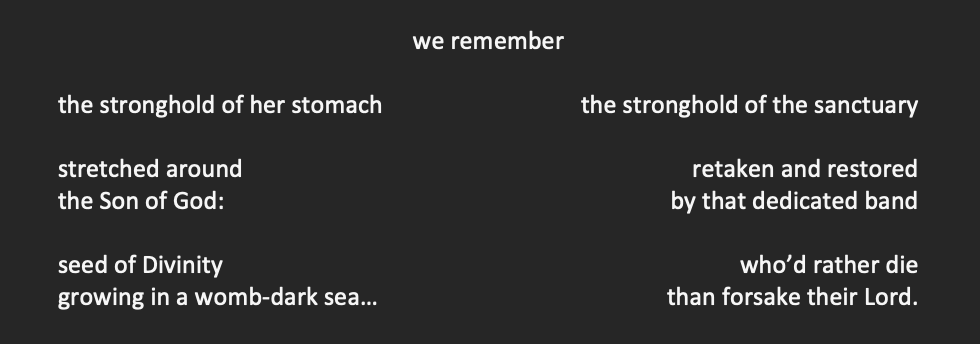
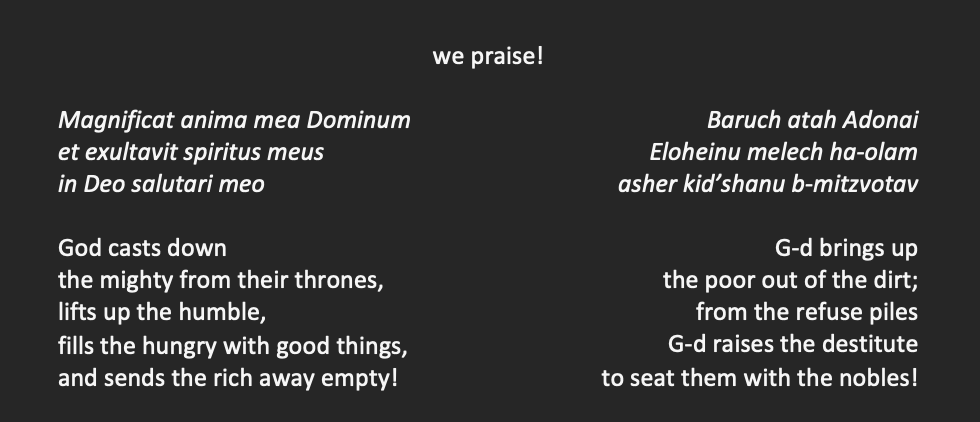
Images show the text of a poem titled “intertwined inceptions: written upon realizing that the first days of Chanukkah and Advent coincided this year.”

The poem’s format places lines about Advent to the left, and lines about Hanukkah to the right, with lines about both in the center. This is difficult to transliterate in a screen-reader friendly way, so I’ll put an “A” before each Advent bit, an “H” before each Hanukkah bit, and a “B” for shared lines.

A:
four tall tapers
ring round a fifth
on their bed of pine branches

H:
eight tall tapers
proudly flank the ninth
along their branching arms

B:
and one candle
lights another

A:
upon an altar draped
in royal purple.

H:
where passersby may glimpse
through windowpanes.

B:
we marvel at

A:
the Word made Flesh —
the miracle of Yes:

“I, Most High sovereign, will become
the lowest, weakest, poorest one!”

“I’ll bear my own Creator in my womb
— with joy, let it be done!”

H:
“a great miracle happened here” —
the miracle of
Enough:

a mighty army brought to shame
by one small hammer in God’s name

and a pittance of oil stretched
across eight days’ flames…

B:
we remember

A:
the stronghold of her stomach

stretched around
the Son of God:

seed of Divinity
growing in a womb-dark sea…

H:
the stronghold of the sanctuary
retaken and restored

by that dedicated band who’d rather die
than forsake their Lord.

B:
we praise!

A:
Magnificat anima mea Dominum
et exultavit spiritus meus
in Deo salutari meo

God casts down
the mighty from their thrones,
lifts up the humble,
fills the hungry with good things,
and sends the rich away empty!

H:
Baruch atah Adonai
Eloheinu melech ha-olam
asher kid’shanu b-mitzvotav

G-d brings up the poor out of the dirt;
from the refuse piles
G-d raises the destitute
to seat them with the nobles!

B:
we await

A:
the Kin-dom of God —
the world made whole!
a table set for all!

H:
tikkun olam —
the righting of the world!
and we must play our role.

B:
we join
we wait
we eat
we praise

H:
and the candlelight

A:
and the candlelight

B:
and the candlelight extends
a hand to shadow —
scoops her up into a flickering dance
across the walls

H:
across the pains

A:
across our upturned faces

B:
and singing fills the darkness round and full
and rises to the One who blesses
all

Categories
advent My poetry Reflections for worship services

poem: God’s Revolution

if you are content now
you will be devastated then

for when the world is flipped upside-down
all your riches will go spilling into space.

a voice cries out in the wilderness
cries out: prepare the way! prepare –
for what? for peace? perhaps, eventually

but first a revolution – woe to you
(to us) who sit too comfortably! for soon
all thrones will be upturned, and those who served
as footstools wear the crown!

(o come, Immanuel! come and turn
the whole world upside down!)

if you are satisfied now
you will be inconsolable then

when all that succeeded in filling you up
is razed to the ground to make way for a table

built of once-rejected stones – the ones
too crooked, too jagged, too small,
too broken to ever be chosen before.

…will those of you (of us) accustomed to
places of honor at the table
accept the humbler seats
when those once trampled underfoot
are seated at its head?


If you this piece it in your own service, please credit it to Avery Arden and link to binarybreakingworship.com. I also invite you to email me at queerlychristian36@gmail.com to let me know you’re using it!

This is a revised version of a poem included in my published volume The Kin(g)dom in the Rubble. 

About this poem: Many of the Bible’s prophets speak of the End of Days and God’s in-coming Kin(g)dom as a fearsome time indeed for any of us who are comfortable with the status quo. In this poem I follow in their footsteps, and hope to remind myself that even though I belong to several oppressed communities, as a white middle-class US citizen there is much indeed I will “lose” when God transforms the world. Will I be ready? Will I be able to let go of my comfortable seat and embrace the revolution?

For more on these ideas, see this sermon I preached in 2018: “When the Good News Feels Like Bad News” on Amos 7 and Mark 6. Here are a few excerpts from that sermon:

“But it turns out that always being accepted, always being liked, is not what following Jesus, what sharing God’s news for the world, is all about. Because sometimes, sharing God’s news for the world comes as bad news for the people who have to hear it, ourselves included. And no one likes the bearer of bad news. …”

“There’s no denying the similarities between our society and the one God called Amos to prophesy against: we too have gross income inequality, the mistreatment of immigrants, refugees, and other vulnerable people, the worship of money at the expense of the marginalized…

Our fancy homes and all we have in them, our malls and factories, all razed to the ground to make way for a system that does not exploit the poor?

In theory, sure, I like the idea of no one being exploited…but does it have to mean I must sacrifice some of my favorite luxuries? Must there be chaos, must there be destruction of the old, to bring in this new world of justice?

When we are at the top of the social ladder, when we are the ones benefiting from other people’s suffering, God’s good news about the world flipping upside down sounds a lot like bad news.”

Categories
advent Holy Days Liturgy Reflections for worship services

God’s vastness, fearsome and comforting

When I sit with God in quiet moments, I feel
so small. Sometimes, this is a beautiful thing:
I become a little child in the lap of their mother,
I become a baby chick under the soft, warm wings of their mother hen;
I feel safe, and comforted, and loved.

But other times God’s vastness in the face of my own littleness
becomes overwhelming: then I am an ant
under God’s magnifying glass, I am one atom in the face
of the ever-expanding universe that is God

and I become discouraged. Surely no gift I could bring to the table
is big enough for this God to even notice, is big enough to make any impact
on God’s vision for the health and wholeness of this world!…

so why bother? Why even try? Who am I
to talk to God or about God,
to lead church events, to participate in worship services,
to go to a rally for immigrant rights? What change can I or any of us make?

…Then I remember
that God became little Themself,
as little
as any of us ever was.

The impossible hugeness of God
folded itself down into a microscopic embryo,
was nourished by an umbilical cord, was born as a fragile infant,
dependent
on the love and protection of impoverished human parents.

In this season of Advent looking forward to Christmas, let us pray together
to the almighty God who became small, vulnerable, one of us:

Jesus of the manger,

When we grow discouraged at our own littleness
in the face of the work that needs to be done,
in the face of God’s greatness,
Remind us that you know our smallness, and delight in it! —
that each and every one of us does have gifts to offer to you
and to our fellow living beings, gifts that matter,
gifts that make a difference.

Remind us of your parents,
a poor young couple shut out from the inn,
who made use of what they had to care for you,
for God in their midst.

Remind us of how you adored
the little ones among us:
the children who were meant to be seen and not heard
but to whom you said, “Come to me!”

And in the remembering of your love for the littlest ones,
the poorest ones, the scorned ones,
may we be inspired to use our gifts
for the betterment of your world, to do
small things with great love, to keep hope burning bright
for the coming of your Kin(g)dom, where the small are lifted up.

Amen.


If you want to make this a call to the passing of the peace,
you can add:

Friends, now that we have recognized that our littleness
is not something to be lamented
but embraced, we can share the peace of the One who became small to live and love among us.
The peace of the infant Jesus be with you.

And also with you.


About this piece:
I wrote this for a Advent worship service some years ago; it was our pageant day, when the children enact the nativity and we sing songs of how the divine Word became human flesh, how the great became small so that the small might become great, how each of us has a gift to offer God.

I was also channeling something I’d learned from classmates in a seminary class where we’d been discussing Psalm 139, that Psalm where the speaker wonders at how there is no place they can go that God is not there, knowing their every move:

To me, this has always been a very comforting and indeed awe-some thing to marvel at! But for one classmate, it was a thing of terror – she said it made her feel trapped in past times when she’d been desperate to escape the image of God that had been forced on her, a God who is judgmental and cruel, ready to pounce on her and damn her for any little slip-up.

She reminded me that God’s bigness can be a terrifying thing, even while it is a comfort when we meet God as a child meets a loving parent. I wanted to hold up her fears as legitimate in this piece, while hopefully softening and soothing them.

Categories
advent Catholic vibes Reflections for worship services

Advent: a time to embrace the Divine in us

“Dust, remember, thou art Splendor!”
– Sister Macrina Wiederkehr in A Tree Full of Angels

If Lent is a time to admit to our Dust –
the death that awaits us, the sin that permeates our cells,
our littleness and our frailness and our need –

perhaps Advent can be a time to embrace our Splendor:
our intimate connection to Divinity
who gave birth to us,
who calls us Good and calls us to be better,
who is the breath within our lungs and the warmth in dancing bodies.

Divinity embraces mortality;
God entered our world and fused the physical with the Divine
so inextricably that we can declare
that every cell of us pulses with Splendor, despite the infection of sin.

Now is the time to be a womb for Splendor,
nourishing it within ourselves.

Now is the time to prepare for the labor:
the teenage girl birthing God into the world.
God birthing a new world around us,
inviting us to serve as Her midwives.


About this piece: I first wrote this in Advent 2019 for Instagram.

If you’re interested in more on Sister Macrina’s concept of “splendor,” here’s the longer passage from which the pull quote was taken:

This brings me to the heart of this book, which is trusting the God who speaks to us in our experiences at every moment. No one ever gave me permission to trust my own experiences as prayerful and holy. It was something I stumbled upon, like a treasure hidden in a field. …In recent years, I seem to hear God say, ‘Put your books away. Be with me. Trust your experience. There are no experts in prayer, only people who have been faithful to the ache.’

…Why shouldn’t our experiences be filled with God? Who do we think it is who is breathing in us? Where do we think this ache has come from? And has it ever crossed our minds that God, too, has a deep yearning for us? …You are the dwelling place for the Source of All Life. You are an offspring of the One who said, ‘I Am who Am.’ If the One who gave you birth lives within you, surely you can find some resources there in your sacred Center. An expert lives within you. An expert breathes out you. Your life is entwined with the God who gave you birth. Frail dust, remember, you are splendor!”