To the ones who bear witness to the church’s flaws and failings, and still believe in everything that Church could be — and work to make that holy vision real though the labor is long, and tough, and often thankless —
Let us offer thanks, remembering the unlikely blessings our subversive Savior likes to lavish on those the world least expects.
Blessed are you who make a way out of no way: who pioneer a path for those of God’s children who’ve been told they don’t belong in the pews, in the pulpit, or in holy bonds of marriage.
Blessed are you when you come in bold and disruptive, flipping the tables that make no room for you; And blessed when you work behind the scenes, change rippling out from constant conversation —
For we we need both: the Spirit of roaring flame, and gentle rain.
Blessed are you when your voice shakes and you speak out anyway.
Blessed are you in patience, persistence, and grace; Blessed also are you in frustration and righteous rage
For the psalmist joins you in crying, “God, how long?”
Blessed are you who endure judgment and scrutiny from people who are meant to be neighbors in the Body of Christ
For the peacemaker’s crown, the friendship of God is yours.
Blessed are you when you tire, and burn out, and wrestle with despair
For rest is your right, and others will take up your fight as long as you need.
And when ignorant tongues defame you, when they twist your words and accuse you of being the divisive one, when they try to shut you up and drive you out
Blessed, blessed are you!
For you belong to an unbroken line of prophets stretching back to the cross and forward to a feast laid out for all.
Yes! Blessed are you when “blessed” is the last thing you feel — you who fight the good fight even when it seems hopeless, even when you lose, again and again, even if you will not be around when the drought on justice ends and the fruits of your labor bloom into life at last
For future generations will remember you with pride.
For no matter how it looks right now, your efforts are never in vain.
For you are part of what makes Church worth fighting for, and what you sowed in sweat and tears, tomorrow’s children reap rejoicing.
Blessed are you, for yours is the kin-dom you are helping to build, one brave truth at a time.
Please feel free to make use of this piece in worship or Sunday school, in ceremony or across social media. Just credit it to Avery Arden of binarybreakingworship.com — and I invite you to email me at queerlychristian36@gmail.com to let me know you’re using it!
About this piece:
The past few days have been rough ones for queer Presbyterians and those who love us. The 226th General Assembly of the Presbyterian Church (USA) kicked off with the Olympia Overture, which sought to add sexuality & gender identity to a portion of our Book of Order that lists classes protected from discrimination; as well as to make it so candidates for ordination must be asked about their ability and commitment to uphold the “principles of participation, representation, and non-discrimination” found in that other part of the Book of Order.
Both parts of the overture ended up getting approved, but only after much discourse before the GA even began, and more debate before the committee. It was…really hard to watch (so hard that I didn’t watch most of it myself — but friends watching kept me informed of what was happening).
It was a reminder that there are people in my own denomination who, whether they would word it this way or not, don’t want to see me and my queer kin as fully human — to recognize us as called by God, as colleagues, as part of Christ’s movement in the world.
Also, part B only passed after the language was amended to take out the word “non-discrimination” — apparently the implication that a candidate might be discriminating against someone is Not Nice. I’m reminded how many of us — myself included as a white person — have it instilled in us from birth that it’s more important to be nice, and to avoid discomfort, than it is to call out harm.
But also, as many queer Presbyterians took their turn speaking — each granted just two minutes to make the case for their belonging, their right to have colleagues who recognize their equality in our church — I felt pride swell up deep in my soul. We are put through so much! We are scrutinized, we are shamed, we are accused of “causing division” just because we call it out — yet we remain faithful. We believe in God’s promise of justice rolling down, of a kin-dom where the last are first and the dignity and worth of all is recognized.
They can’t drive us out. We will stay, and we will persist in loving them back into their own humanity.
This prayer is for all the people across the decades, even centuries, who have fought in loud ways or quiet, in the spotlight or behind the scenes, to have their dignity recognized. For Black folk and queer folk, for women and immigrants and disabled persons, and for so many more, across all the different communities of faith.
We are Church. We are making the Church be what it was always meant to be. Blessed indeed are we.
This year the lectionary gives us Mark’s account of the Resurrection, with its fearful cliffhanger ending — an empty tomb, but Jesus’s body missing. And isn’t that unresolved note fitting?
In the face of so much suffering across the world, it feels right to be compelled to sit — even on this most jubilant of days — with the poor and disenfranchised in their continued suffering.
Mark’s account:
Just days before, the women closest to Jesus witnessed him slowly suffocate to death on a Roman cross. Now, now trudge to his tomb to anoint his corpse — and find the stone rolled away, his body gone. A strange figure inside tells them that Jesus is has risen, and will reunite with them in Galilee.
They respond not with joy, but trembling ekstasis — a sense of being beside yourself, taken out of your own mind with shock. They flee.
The women keep what they’ve seen and heard to themselves — because their beloved friend outliving execution is just too good to be true. When does fortune ever favor those who languish under Empire’s shadow?
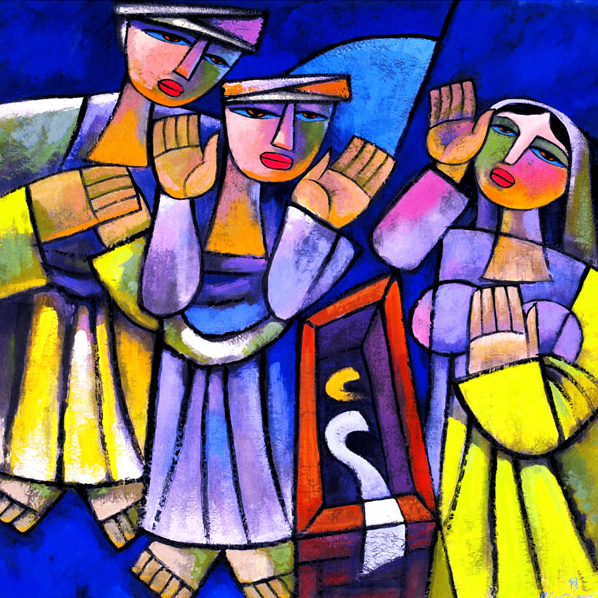
“The Empty Tomb” by He Qi.
Love wins, yet hate still holds us captive.
I’m grateful that Mark’s resurrection story is the one many of us are hearing in church this year. His version emphasizes the “already but not yet” experience of God’s liberation of which theologians write: Christians believe that in Christ’s incarnation — his life, death, and resurrection — all of humanity, all of Creation is already redeemed… and yet, we still experience suffering. The Kin(g)dom is already incoming, but not yet fully manifested.
Like Mark’s Gospel with its Easter joy overshadowed by ongoing fear, Trans Day of Visibility is fraught with the tension of, on the one hand, needing to be seen, to be known, to move society from awareness into acceptance into celebration; and, on the other hand, grappling with the increased violence and bigotry that a larger spotlight brings.
The trans community intimately understands the intermingling of life and death, joy and pain.
When we manage to roll back the stones on our tombs of silence and shame, self-loathing and social death, and stride boldly into new, transforming and transformative life — into trans joy! — death still stalks us.
We are blessedly, audaciously free — and we are in constant danger. There are many who would shove us back into our tombs.
And of course, the trans community is by no means alone in experiencing the not-yet-ness of God’s Kin(g)dom.
Empire’s violence continues to overshadow God’s liberation.
The women who came to tend to their beloved dead initially experienced the loss of his body as one more indignity heaped upon them by Empire. Was his torture, their terror, not enough, that even their grief must be trampled upon, his corpse stolen away from them?
The people of Gaza are undergoing such horrors now. Indignity is heaped on indignity as they are bombed, assaulted, terrorized, starved, mocked. They are not given a moment’s rest to tend to their dead. They are not permitted to celebrate Easter’s joy as they deserve. They are forced to break their Ramadan fasts with little more than grass.
A photo of a Palestinian family’s meal, taken in Gaza.
Those of us who reside in the imperial core — as I do as a white Christian in the United States — must not look away from the violence our leaders are funding, enabling, justifying.
We must not celebrate God’s all-encompassing redemption withoutalso bearing witness to the ways that liberation is not yet experienced by so many across the world.
This Easter, I pray for a free Palestine. I pray for an end to Western Empire, the severing of all its toxic tendrils holding the whole earth in a death grip.
I pray that faith communities will commit and recommit themselves to helping roll the stones of hate and fear away — and to eroding those stones into nothing, so they cannot be used to crush us once we’ve stepped into new life.
I pray for joy so vibrant it washes fear away, disintegrates all hatred into awe.
In the meantime, I pray for the energy and courage to bear witness to suffering; for the wisdom for each of us to discern our part in easing pain; for God’s Spirit to reveal Xirself to and among the world’s despised, over and over — till God’s Kin(g)dom comes in full at last.
I said, “Mourn for me; I’m ruined! I’m a man with unclean lips, and I live among a people with unclean lips. Yet I’ve seen the king, the Lord of heavenly forces!”
Then one of the winged creatures flew to me, holding a glowing coal that ze had taken from the altar with tongs. Ze touched my mouth and said, “See, this has touched your lips. Your guilt has departed, and your sin is removed.”
Did the glowing coal leave a mark? A smear of dark? A bright burn?
Reading this text on Ash Wednesday, I can’t help but connect Isaiah’s coal and our ashy crosses:
He confesses himself unclean — admits his limits, where he and his people have failed.
We profess ourselves dust — acknowledge our limits, the finite time we have here and now, and how often we’ve failed to cherish that time.
In the confession, we open ourselves to blessing. Accepting our limits, we fall into God’s limitless love.
Why these physical, ritual actions — coal to the lips, ashes to the brow — to mark these limits and the blessings they yield?
God knows, respects, loves our existence as embodied spirits, inspirited bodies. She pairs spiritual gifts with tangible signs to help us experience Her truths with our whole selves.
A glowing coal — dead plants packed deep, transformed over eons, unburied at last and set alight — touches truth-telling lips to set them free.
Ashes of palm branches once waved in worship, burned down to begin the cycle anew, mark us as individually finite, but gathered into an infinite love.
Take time to prayerfully consider your own limits. What blessings, what liberation can you imagine flowing from our individual finitude? How can you connect your limited time and gifts to a greater whole, in small ways with great love?
About Daily Ripple!
I am delighted to have joined the creative team at Daily Ripple — starting with posts this week, including what you just read!
If you want to incorporate queer-affirming, justice-oriented snippets of biblical reflection written by a diverse range of Christians into your everyday life, Daily Ripple is a lovely option. It’s free, and every weekday, subscribers receive a short reflection, ending with a question meant to guide you towards action.
I’ve been writing the daily posts for this week, incorporating queer and autistic theology into readings of Psalm 119, Mark 4, and Isaiah 6. Check them all out at the Daily Ripple.
A voice cries out in the wilderness, “Prepare the way of the Lord! Make straight his paths.”
How do we do that in the present day? We break down walls that block his family’s way.
As Mary and Joseph draw near Bethlehem a fence looms over them, some eight yards high
and soldiers watch from towers as they trudge not straight into the city, but around to find the checkpoint — where they’re turned away: “We’re only letting tourists in today.”
So Mary groans outside the barrier no place to lay her newborn’s bloodied head
and John the Baptist paints in green and red across that cold wall’s surface — shepherds, lo! — “Merry Christmas world from Bethlehem Ghetto”
You are welcome to make use of the above poem or below reflection in worship, in classrooms, on social media, etc. Please credit Avery Arden of binarybreakingworship.com.
_____
In a 2014 article, Medhi Hasan wonders how Mary and Joseph’s trip from Nazareth to Bethlehem would go in the modern day:
“How would that carpenter and his pregnant wife have circumnavigated the Kafkaesque network of Israeli settlements, roadblocks and closed military zones in the occupied West Bank? Would Mary have had to experience labor or childbirth at a checkpoint, as one in 10 pregnant Palestinian women did between 2000 and 2007 – resulting in the death of at least 35 newborn babies, according to the Lancet?
‘If Jesus were to come this year, Bethlehem would be closed,’ declared Father Ibrahim Shomali, a Catholic priest of the city’s Beit Jala parish, in December 2011. ‘Mary and Joseph would have needed Israeli permission – or to have been tourists.’ “
Meanwhile, a Reddit post claims they’d have to get through fifteen checkpoints on their journey. Chances are, they wouldn’t make it through — just get harassed and interrogated for their trouble.
As I reflect on these statements, I ponder also the opening of Mark’s Gospel. This text, which is read in many churches during the Advent season, recalls the prophetic cry of Isaiah 40:
A voice is crying out: “Clear the Lord’s way in the desert! Make a level highway in the wilderness for our God! Every valley will be raised up, and every mountain and hill will be flattened. Uneven ground will become level, and rough terrain a valley plain. The Lord’s glory will appear, and all humanity will see it together; the Lord’s mouth has commanded it.”
What does such a prophetic leveling — a flattening of land so that all people, including children, elderly and pregnant persons, and people with mobility impairments can easily travel — look like today?
I envision the 440 miles of separation wall crumbling into the earth. Watchtowers topple. Barbed wire melts away. Snipers’ guns morph into ploughshares; bombs explode oh-so-gently into fertilizer to feed burned olive groves.
The land is free. The people are free. God’s liberating Spirit moves unhindered; God’s holy land becomes, as promised, a “house of prayer for all peoples” (Isaiah 56:7).
Thanks be to God. May we be moved to help make it so.
A spent tear gas grenade shell casing lies on the ground near Aida Refugee Camp following clashes between Palestinian youth and Israeli forces, Bethlehem, West Bank, November 29, 2013. The grenade cartridge, made by the U.S. company Combined Tactical Systems (CTS) contains labeling in English including full contact information and the company’s U.S. address in Jamestown, Pennsylvania.
Mandatory Credit: Photo by Beata Zawrzel/NurPhoto/Shutterstock (13691022a)
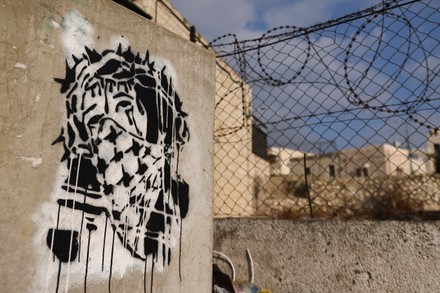
A graffiti of Jesus Christ wearing arafat scarf is seen near the Israeli separation West Bank Wall in Bethlehem, Palestine on December 28, 2022.
Street Art And Banksy Hotel In Bethlehem, Palestine – 28 Dec 2022
How can one Being also be three Persons? The math doesn’t seem to add up! Some spend years attempting to articulate this theology in a way that doesn’t fall into “heresy”; others give up with a laugh and accept it as a Mystery. Ultimately, the God of the Universe is ineffable, beyond our understanding — yet we are called to seek ever deeper relationship with God, and promised that if we seek, we will find.
When people decry queer identities as nonexistent, overly complicated, or paradoxical, I can’t help but think of our impossibly Three-in-One God. I think also about my own gender journey: how I struggled as a child to name what I was feeling because I had no language to describe it; how once I discovered others had words for what I was experiencing, I delighted in every one I could uncover; and how, ultimately, even my favorite words I’ve found to describe myself fall short.
Words like trans, nonbinary, and genderqueer certainly help others understand and relate to me better, but I’ve learned to be okay with the fact that they might never fully know me, just as I may never fully know them — or at least that the deepest understanding is beyond words. Turns out that the children of a Mysterious God are micro-mysteries in ourselves!
What I’m left with is this: if we worship a Triune God, why do we try to squeeze the humans made in that Infinite, Ineffable Being’s image into two narrow boxes? And if we celebrate how, in the Incarnation and Resurrection, Divinity burst through the binaries between Creator & Creation, Life & Death, surely the binary between male and female is not so insurmountable!
Together, let us pray:
Holy God, whose very existence is relationship, we marvel at your mystery. Protect this day and always those of your children who, like you, defy easy definition and resist restrictive categories. Teach us to recognize your wisdom and holiness shining within them, for only together in all our diversity do we reflect your image. Amen.
A reflection that draws from John 20 and Isaiah 56. Happy Easter, all.
As Mary Magdalene sits alone in the predawn stillness, she weeps — but her tears are not only grief: they are tears of frustration. Tears with questions. Tears that demand something of Divinity.
Mary is not passive in her weeping: she is wrestling the divine.
Rev. Dr. Rachel Wrenn of the First Reading podcast calls what Mary is experiencing “exasperated hope.” She parallels Mary in the garden to God of Isaiah 65, who is “ready to be sought out” by Her people who “sit inside tombs, and spend the night in secret places” (vv. 1, 4a). Magdalene reverses the image of Divinity waiting exasperatedly for humanity — now the human awaits the Divine.
God of Isaiah 65 says, ‘I said, “Here I am, here I am,” to a nation that did not call on my name.’
Magdalene too is saying, “Here I am,” to a God who WILL call her name, soon — but not yet.
First, she must endure the excruciating in-between space.
And she endures that space alone. Peter and the Beloved Disciple enter it for a moment, as first light tentatively touches the tomb’s rolled-back stone.
They sprint into it — that pregnant space between question and answer, death and rebirth — past Mary weeping without a word to her.
They enter the empty tomb and they see the burial cloths that God has stripped off and left behind. They see and the beloved, at least, “believes” (John 20:8). Believes that Jesus is risen — does he also believe that Jesus will return? That they will all see Jesus again, and soon?
If he does, his action is not to hunker down with Mary into the waiting space. He and Peter “return to where they were staying” (v. 10).
They cannot bear the waiting space. Most of us can’t. Who would choose to settle down in hospital halls with figures hunched and haggard, to wait with them for whatever news there may be?
Most of us wouldn’t. Magdalene might.
We can’t skip past the waiting, though. So Mary waits — waits for whatever will come, whenever it comes — and as she waits, she weeps. Her tears are not despair — they are lament.
In This Here Flesh, Cole Arthur Riley describes the power and purpose of lament:
“Lament is not anti-hope. It’s not even a stepping-stone to hope. Lament itself is a form of hope. It’s an innate awareness that what is should not be. As if something is written on our hearts that tells us exactly what we are meant for, and whenever confronted with something contrary to this, we experience a crumbling. And in the rubble, we say, God, you promised.”
Mary believes in the promises of her teacher, his proclamations of a world turned on its head, a new creation born where the poor are lifted from the ashes.
Her hope in that world has crumbled, but she doesn’t abandon the rubble: she settles into it. Makes her home there to wait and see what rises from the ruins.
Mary is crying, “God, you promised!” And she in turn promises God, “here I am — whenever you come, you will find me. I’m not going anywhere.”
In her describing of lament, Cole continues, “Our hope can be only as deep as our lament is. And our lament as deep as our hope.” Mary’s lament is long, because her hope is deep.
Mary Magdalene does not sit in the garden in despair. Her lament expects response — demands it. Like God of Isaiah 56, she is waiting to be sought — waiting for her call to be met with response…and it will be! Her God WILL call her name — “Mary!” — and she will know the joy of lament answered, of hope fulfilled.
Magdalene is actively waiting for what she KNOWS will come. And she’s not going anywhere till it does.
Thank God for those who wrestle blessing out of pain; who brave the liminal lament and don’t let go.
Mary, your waiting is not in vain. Joy comes with the morning. Hallelujah!
we are more comfortable when you are tucked into your designated corner — but you were never one to stay put where you’re told.
from birth, you have been bold about breaking right into the thick of things —
pinpointing the pulse of human happenings and blaring through with news of God’s Kin-dom, come.
…
into the cliffsides outside Bethlehem we have constructed with our word and song
a nonexistent edifice — some banished barn along your hometown’s outskirts where you can be born
where no one has to hear your mother’s groans; where Joseph midwives her, untrained, alone.
meanwhile, your wet head crests from a nest of straw built in the home’s hot heart.
your mother gasps and grasps the hand of some old woman she just met tight enough to knit them into kin.
just one wall over, rising from within the side room filled with other guests who’ve come to Bethlehem for Caesar’s census, prayers are sung to secure your safe delivery.
…
we like it better when you wait for us in remote places we can journey to when we are ready.
we like the tale of shepherds, rich men too who visit you forewarned what to expect by angels or by astral signs
— but you burst into our bustling
compel us to make room in the chaos of the everyday —
you will not sit and wait till we’ve tidied up the mundane mess we never seem to get to dealing with.
you’ll write your own invitation into our homes —
you’ll let yourself inside draw up a chair at our tables and preside.
the night is here the hour is now
though we’ve got half-baked plots and chores undone —
ready or not here you come.
About this Poem:
I wrote this piece for episode 52 of my Blessed Are the Binary Breakers podcast: “Revisiting Nativity — Was Jesus born in a barn or house, and why does it matter?” which you can find wherever you get podcasts; or on this website, along with an ep transcript.
In the episode, I discuss how the Greek of Luke 2:7 might not say Jesus was born in a stable after all — that rather than any inns being full, the text tells us Mary gave birth in the main room of a peasant home (likely belonging to Joseph’s family), “because there was no room in the guest room.”
In the episode, Laura first talks about the story of Zaccheus that takes place way later in Jesus’ life, and in Luke’s Gospel: in Luke chapter 19, Jesus calls to a tax collector, who would have been spurned by the Jewish people as a collaborator with the Roman Empire, “Zaccheus, come down at once — I must stay in your home today.” That’s right, Jesus invites himself over to this guy’s house! In doing so, we see how Jesus doesn’t wait for us to invite him into our world; he bursts on in of his own accord.
Laura parallels that story with the reading of the Nativity story that sets it in a peasant home in the heart of Bethlehem — our traditions put Jesus on the outskirts, alone in a barn; but Jesus makes himself comfortable right in the midst of a crowded house. This concept inspired me to write the poem you just read.
we think we know the story of how you birthed our God into our midst — but this is not quite accurate:
the tale of your time in Bethlehem is overlaid by two millennia of retellings — tradition lining up beside tradition and
when my mind becomes a tangled mess trying to divine which ones Really Happened
you come.
you calm.
you guide me from
my need to know one truth into the sacred splendor of a whole string of stories —
each one a bead pregnant with its little piece of Truth, a little link between me and your Son and you.
___
first decade.
“it’s not so bad,” Joseph says hopefully as he helps you settle down onto the straw.
the cave walls cut the chill; the goat who ambles close to sniff you stinks but oh, she’s warm.
you think of births you’ve overheard at home — the neighbor women rushing in to help. you expected the same for yourself
but, ah well, what has been expected about this pregnancy?
___
second.
Joseph hovers, fervent but unsure how to help.
“if i could take your pain upon myself…”
but there is no pain! conceived as you were free from Eve’s bane,
as you give birth to heaven on earth all you know is bliss, bliss, bliss.
___
third.
Joseph is gone. you can picture his desperate dash from door to bolted door off in the town
as you lie alone on old straw — and, God! the baby crowns
with no one to help — so you reach down into the mess of your own blood and
yours are the first hands to wrap around the Son of God, red and slick and — ohsacred sound! — screaming.
___
fourth.
Joseph is gone, but near — you know he waits pacing and praying just outside the door.
in his place — women’s faces, smiling and soothing, letting you squeeze their hands as hard as you need
or bustling about to heed Midwife’s decrees.
the guest room was too small to hold this congregation so you were helped into the central room to birth the Son of God right in the heart of this small peasant home.
the poor know how to serve one of their own.
___
fifth.
you close your eyes as agony subsides between contractions. see yourself as one bead upon a long strong string stretching centuries —
you are one
with Jochebed biting down to mute her moaning, Rebekah grateful for an end to her rough pregnancy, with Hannah, Ruth, Bathsheba, Hagar, Rahab, Leah, Eve, and millions more unnamed. you share their groaning, their labor, their relief, their ecstasy.
your baby crowns; the women round burst out in Glory be!
This poem was written by Avery Arden and belongs to them. If you want to use it in a worship service or elsewhere, let Avery know! You can reach them at queerlychristian36@gmail.com.
Essay
My Advent devotions this year include praying a daily rosary. Meanwhile, I’ve been fixating upon a certain reading of Luke 2’s “no room at the inn” passage that suggests Mary gave birth not in a stable, but someone’s home (more on that in a bit). As I meditated on various iterations of the Nativity tale while moving through my rosary, this poem was conceived.
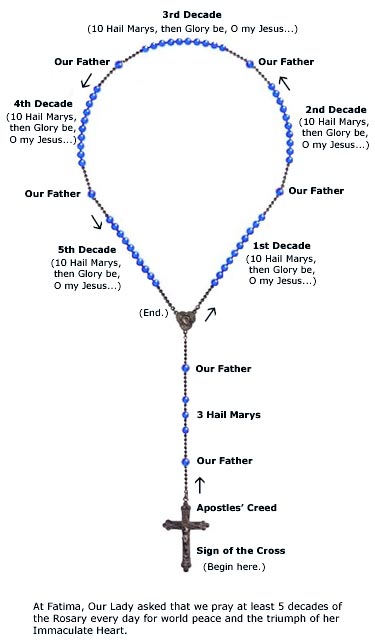
This poem is structured after a rosary. For my non-Catholic friends out there who may not be familiar, a rosary is a long string of prayer beads with a crucifix or other cross hanging down from five decades, or clusters of ten beads each. Here’s a diagram (from this site):
id: diagram of a Catholic rosary with blue beads. A crucifix dangles from the bottom of a string with five beads on it, which is connected to a longer string that connects like a necklace; this longer string has five clusters of ten beads each, and every cluster has one bead between. The diagram labels different beads with their assigned prayers; for instance, each cluster is labeled as one of five decades, with 10 Hail Marys, a Glory Be, and an O my Jesus prayer. The beads between each decade are labeled “Our Father.”
You start at the crucifix and pray along the “pendant,” the strand that hangs down with five beads; then you make your way around the five decades. For me, the rosary offers a way to embody my prayer and to enter into a meditative state as I move from bead to bead and repeat the prayers. As an autistic person, having a tactile point into which to pour all my energy, one point of sensory input to overshadow all the others, is a powerful way to put aside all else and hone in on Divinity.
Pondering one story each decade is a traditional way to pray the rosary — the recommended ones are explained on this site; but for the past week or so, I’ve been imagining the Nativity over and over, a little differently each decade.
Versions whose events contradict each other — a painless Mary versus a groaning Mary; Mary alone or Mary with midwives; Mary dismissed to the outskirts or settled in the heart of a Bethlehemite home — all found their place, side-by-side, along that line of beads. As I took time with each story, the sense of contradiction as conflict faded away.
Little truths rose to the surface of each version, something to savor, a fresh facet of the story of God entering into human life. I can’t know which one was “most historically accurate,” but I could contemplate what each version says about God’s movement in Mary’s life and ours — what good news each version proclaims into our world.
So what is some of that good news? I’ll touch upon the various visions visited by each “decade” of the poem.
The first decade is self-explanatory, I think — it sets up the version we encounter in Christmas pageants, nativity sets, the Charlie Brown Christmas special… In this version, “no room in the inn” means that whatever lodgings a visitor to Bethlehem could usually expect were all full up. Though no Gospel mentions an innkeeper at all, we can all picture that figure well enough; he’s been woven into being by the dramatizations of generations. Whether heartless or apologetic, he can’t provide a bed for a pregnant girl and her husband; but look, there’s the stable, with plenty of straw and a little space among the livestock.
I have long cherished this narrative through a liberationist lens — that God chose to enter the world at the margins of the margins emphasizes Their intimate identification with the most oppressed and erased of our world! Humanity did not make room for the God who so loved the world They squeezed Their infinity into finite, vulnerable flesh; just as our human systems fail to make room for the survival and thriving of so many persons.
The second decade incorporates a bit of Roman Catholic doctrine that states that Mary felt no labor pain — since Catholicism holds that she was born miraculously free from original sin, she was likewise free from the consequences of that sin (see Genesis 3:16, where God informs Eve that her labor will be painful). Though raised Catholic, I didn’t learn about this tidbit of Mariology till late high school. I remember feeling…oddly betrayed? A facet of Mary’s relatability, her humanness, felt stripped away; her pedestal of larger-than-life perfection seemed to stretch a little higher. But this past week, I’ve taken the time to imagine a painless labor for her, and even if it’s not the story that speaks to me loudest, I have found some richness in it.
The third decade imagines Mary alone, following after Eastern Orthodox tradition. I pondered the significance of this version of events — why place Mary by herself as she births God on earth? Does her isolation foreshadow the sense of desolation her Son would feel decades later, on the cross?
What arose most strongly in me as I envisioned this version was a sense of joy and rightness — that Mary’s would be the first hands to touch the Divine she’d carried within her for nine months; that hers would be the first eyes to take in Word made flesh.
The fourth and fifth decadesmove away from the Nativity versions that have enjoyed the most traction and expansion over the centuries. We do away with barns and innkeepers, and bring some new characters to the stage: midwives!
Bringing midwives into the nativities I imagined as I prayed brought me deep joy. Midwives show up in various places throughout scripture — God Herself is depicted in the role of midwife in places like Psalm 22:11 (see this article for more on midwives in the Jewish Bible). Meanwhile, the most famous human midwives are probably the named, heroic women Shiphrah and Puah of Exodus 1, who protect the newborns of enslaved Hebrew women from Pharaoh. The role such women played was a life-bringing one, and imagining the relief and comfort a skilled midwife would bring teenage Mary filled me with gratitude for whoever this unmentioned woman may have been.
In “The Accommodations of Joseph and Mary in Bethlehem,” Stephen C. Carlson explains, “Childbirth was the riskiest moment in the entire pregnancy during antiquity, potentially lethal for both the mother and child. Whenever possible, women about to give birth relied on the help of relatives, friends, and midwives in and around town” (pp. 340-341). I love imagining Mary encircled by so much support as she labored to birth the God of the universe.
Carlson and other scholars suggest that it was the presence of all these Bethlehemite women at Jesus’ birth that necessitated a lot of space for the event. This brings us at last to that famous line from Luke that notes a lack of room…in the inn? or somewhere else?
I promised I’d return to readings of Luke 2:7 that argue Jesus was born not in a stable, but a house — so here we go!
At first glance, Luke 2:7 seems fairly straightforward. Since we’re talking about tradition here, I’ll offer the KJV’s version:
"And she brought forth her firstborn son, and wrapped him in swaddling clothes, and laid him in a manger; because there was no room for them in the inn."
However, digging into the Greek of the text and into the socio-cultural context of the story uncovers some complications.
It turns out that the Greek word that most traditionally gets translated as “inn” here has a broader meaning than that. The word is kataluma (κατάλυμα), and it’s only used two other times in the Gospels (or the NT as a whole): in Luke’s and Matthew’s accounts of how Jesus’s disciples found a room for the meal that we now call the Last Supper. Here’s Luke’s account (22:10-12; NRSV translation this time; with the translation of kataluma bolded):
“Listen,” he [Jesus] said to them, “when you have entered the city, a man carrying a jar of water will meet you; follow him into the house he enters and say to the owner of the house, ‘The teacher asks you, “Where is the guest room, where I may eat the Passover with my disciples?”’ He will show you a large room upstairs, already furnished. Make preparations for us there.”
How can one Greek word mean both “inn” and “guest room”? The noun kataluma is tied to the verb kataluó (καταλύω) — kata + luó = “to loosen thoroughly.” When journeying with pack animals, you’d only “thoroughly loosen” their straps and packs when stopping for a long rest. Thus the verb came to mean “to take up lodging;” and the related noun, the kataluma of both Luke 2:7 and 22:10, came to stand for those lodgings — whether that was some natural shelter like a cave; a tent; an inn; or a guest room in someone’s house.
So if Luke’s one other use of kataluma (22:11) refers to a guest room in a private home; and the one time he wants to specifcally refer to an inn (10:34) he uses a different Greek word…why do the vast majority of English translations of Luke 2:7 state that there is no room for Mary’s labor “in the inn” rather than “in the guest room”? (Or, to avoid making a claim in either direction, why don’t more translations apply a broader phrase like “there was no room in the lodging place”?)
To reiterate, it’s certainly possible that kataluma refers to an inn when used in Luke 2:7 — but it’s not the only possibility, or even necessarily the most likely one.
If Luke 2:7 is saying that there is no room in Bethlehem’s inn, then the classic stable setting (or a cave, as in the second century Protoevangelium of James) makes sense. However, some scholars contest
whether Bethlehem, being so small, would even have had an inn, with the duty of taking in strangers passing through instead falling upon individual families; and
whether Joseph and his wife would have stayed in such an inn, even if it did exist.
The reason Joseph and Mary are journeying to Bethlehem is for a Roman census, for which “all go to their own towns to be registered” (Luke 2:3). In “An Improbable Inn,” Andy Mickelson explains that Roman censuses typically required people to register not in their ancestral town, but wherever they owned property; thus one might conjecture that Joseph “had traveled to Nazareth previously to seek work or (more likely) to retrieve his fiancée Mary and bring her back to his native Bethlehem” (p. 14).
Mickelson cautions that there are some complications in the Luke text that curtail certainty in what exactly happened (visit page 15 of his article to read more about that); but
"regardless of whether Joseph’s family home was in Bethlehem or whether it was just his ancestral home, Joseph’s ties to the village are key in determining how the κατάλυμα of 2:7 should be understood. If Joseph truly was a native son of Bethlehem, then he almost certainly would have stayed with close family members. Bruce Malina remarks that Joseph 'would have been obligated to stay with family, not in a commercial inn.' He also points out that 'if close family was not available, mention of Joseph’s lineage would have resulted in immediate village recognition that he belonged and space would have been made available.' Thus, even if Joseph was only linked to Bethlehem through lineage, that lineage would have been enough to earn him the hospitality of a distant relative. Arguments that the homes of Bethlehem would have been filled to capacity due to the census disregard the simple fact that Roman registrations took place over a period, not a single day. Regardless, an added measure of hospitality could certainly have been expected due to Mary’s pregnancy."
In placing the Nativity in a barn, stable, or cave, we run the risk of disregarding how central hospitality was to the people of Jesus’s time and place.
When I imagine the people of Bethlehem failing to find proper accommodations for the pregnant Mary and her husband Joseph, I can’t help but think of another city destroyed nearly two thousand years before Jesus’s birth — Sodom, which invoked God’s wrath by replacing hospitality to strangers like Lot with attempted violence against them (see Genesis 19). The people of Bethlehem may have been poor and oppressed, but hospitality was their way of sharing what they had and practicing their devotion to the God who instructed them to care for the stranger (e.g. Exodus 23:9; Deuteronomy 10:19; Leviticus 19:34).
Hospitality was a vital virtue not only for the Jewish people, but for various other groups in this time and place. In scripture, we find a gentile widow sharing what she believes is the last of her resources with a stranger, the prophet Elijah (1 Kings 17). Under the epithet Xenios, the Greek God Zeus embodied the moral obligation to provide strangers with hospitality. Likewise, the Romans viewed hospitality as the divine right of any guest, and the divine duty of any host. I imagine that members of any of these cultures would have expected divine wrath to follow the failure of a whole village consigning a pregnant traveler to a lonely stable!
No matter how poor, crowded, or busy Bethlehem was, I have come to doubt the presumption that not one of its residents took pity on Mary and Joseph and welcomed them in.
So let’s say we accept that Jesus wasn’t born in a stable, but someone’s house — likely the home of Joseph’s relatives. In that case, there’s still one more bit of cultural context we need to make sense of this “new” version of the story:
No matter how we translate kataluma, Luke 2:7 says that Mary laid Jesus in a manger — why the heck would there be a manger, a feeding trough for livestock, inside a house?
It turns out that mangers were totally something you’d find inside first-century Judean village houses: rather than having a separate building for their livestock, families would keep their animals outside in the courtyard during the day, and bring them inside their own homes at night. The same room in which the majority of human work and life took place during the daytime became the sleeping quarters for livestock, complete with feeding troughs:
"Typically, the main room was divided into two sections at different elevations separated by about a meter. The animals were housed in the lower section, the people slept in the upper section, and mangers were located between them." (Carlson, p. 341)
Levant homes had followed this practical arrangement since the Iron Age: one space for livestock and humans kept the animals safe from theft; plus all that body heat kept everyone warm in colder months (Mickelson, p. 17).
id: Here’s a diagram from Kenneth Bailey’s book The Bible through Middle Eastern Eyes depicting a “typical village home in Palestine with attached guest room. The diagram is a rectangular shape; the largest room is labeled the family living room and has two ovals labeled “mangers” to the side, next to a smaller segment labeled “stable.” To the right of the family living room is a “guest room,” or kataluma.
To wrap up our exegetical exploration, let’s tie all this — the manger, the midwifes, the word kataluma — together…
starting with a return to Luke 2:7:
"And she gave birth to her firstborn son and wrapped him in bands of cloth, and laid him in a manger, because there was no room for them in the kataluma."
In this “new” reading, Mary is surrounded by village women headed by a midwife as she gives birth. And she is not alone in a stable on the outskirts of town, but in a peasant home — and not in a guest room or little side room of that home (because that kataluma is either full of other guests or simply too small for all the women), but right in the house’s central space.
As Mickelson summarizes,
"Luke records Mary as placing Jesus in a manger because there was no space for them in the κατάλυμα. There are two plausible reasons for this. First, the guest room might have been taken by other guests, requiring Joseph and Mary to stay somewhere else in the house. While the traditional image of Bethlehem teeming with visitors for the registration is an exaggeration, it is likely that if Joseph had come for the event, others (even members of his family) may have returned as well, and the guest room may have been occupied by someone else.

The other possibility is that there was not sufficient space in the κατάλυμα to accommodate Jesus’s delivery. Childbirth in antiquity was a dangerous procedure for both mother and child, and it is likely that Mary would have been assisted by a midwife as well as the women of the house. The κατάλυμα of the Last Supper was noted for being large, but these guest rooms likely varied in size. If the room in which Mary and Joseph were staying was small, Mary would have relocated to the main room of the house, where there would have been plenty of space for the other women to help with her delivery." (p. 17)
Mickelson moves on to explain why all this matters — which I bet you’ve been wondering if you’ve read this far (or even just skimmed to this point).
If the traditional placement of the Nativity in a stable on Bethlehem’s outskirts emphasizes God’s entrance into the most marginal space possible, what does placing Jesus’s birth in the heart of a peasant home emphasize?
Mickelson argues this setting also fits the theme of Jesus’s intimate identification with the marginalized and oppressed, as it solidifies the everydayness of his arrival:
"This reading of Luke’s infancy narrative makes the story of Jesus’s birth even less unusual than the traditional reading of the story. Being rejected from an inn and being forced to give birth amid animals gives Jesus a humble yet noteworthy beginning: Jesus is born in desperate and memorable circumstances.

But placing Jesus’s delivery in the main room of a Bethlehemite home gives him a birth narrative similar to probably thousands of Jewish babies. Nothing about the circumstances is extraordinary: being swaddled was a common experience for infants, and the most that can be inferred by being placed in a manger is that the home may have been crowded and there was nothing else approximating a crib available.

In short, Luke portrays Jesus entering the world in a rather unremarkable way." (p. 18)
Thus this “new” reading of the Nativity story is packed with richness for the liberationist reader! As a TL;DR to close this essay, I’ll summarize some of that richness now.
In any reading of the Nativity — whether it takes place on Bethlehem’s outskirts or in its heart — Jesus is born to nobodies in a nowhere town. His parents are brown Palestinian Jews living in subjugation to an Empire; they are impoverished; and they are dependent on the hospitality of others who share their poverty and oppression.
Though the narratives surrounding the actual birth scene in Luke’s Gospel — replete with angelic messages and praise-songs from priests and shepherds, a teen girl and an old widow — make the importance of Jesus’s arrival clear, for the actual moment of birth, Jesus is just one infant of thousands born in a typical peasant house. He really is just one of the poor, one of the common folk. He makes the margins the center.
Do we do a disservice to the poor whom liberationist theologies are supposed to center when we claim that the people of Bethlehem — from the innkeeper of our pageants to whatever relatives Joseph may have had there — fail to provide a pregnant teenager and her husband with better accommodations than a barn or cave?
A reading that imagines village women supporting Mary through her labor; that imagines the main room of a house given over for her use, is a reading that celebrates the generosity and hospitality often demonstrated by poor and oppressed persons.
From birth and beyond, Jesus relied upon the solidarity and generosity of his fellow poor.
Any possibility of an antisemitic reading of the Nativity story (that “the Jews” rejected Jesus from his very birth by refusing his parents space in their inns or homes — I’m not saying most people do interpret traditional Nativity stories in this way, but the possibility is there) are also avoided with this reading, where Jewish Bethlehemites assist in his birth.
This reading also speaks to how Jesus makes room for himself amid our mundane mess!
Jesus does not wait for us in some remote corner, so that we can go to him when we decide we’re ready, on our terms; he bursts into our bustling, the everyday chaos of an average peasant home. God compels us to make space for the Divine in the center of our lives, ready or not!
Whether or not you are on board with this “new” version of the Nativity story, I hope that, if nothing else, my poem and this essay open you up to the possibilities of scripture — the richness that can come from daring to reimagine stories we think we know by heart. The more familiar a story, the less likely we are to consider new ways of reading it; but just look what is born when we step away from the familiar to explore what lies beyond, even if only for a moment!
Stephen C. Carlson’s scholarly article that goes more in depth, and argues that kataluma has a generic sense of “place to stay” that fits a variety of readings
Andy Mickelson’s scholarly article that likewise goes in depth, including a look at extra-biblical Greek sources that also use kataluma; and that makes some arguments about the significance of one’s interpretation of kataluma to the broader Lukan narrative.
My friend Laura discusses the idea of the Nativity taking place in a peasant home’s central room in the context of disability theology in their podcast episode here. They parallel Jesus’s birth story with the story of Zaccheus, where Jesus invites himself over to the tax collector’s home (“I must dine with you!”) — in both stories, Jesus announces his reliance on others for shelter and sustenance, unabashed.
written upon realizing that the first days of Chanukah and Advent coincided this year
Happy Chanukah to those who celebrate it, and blessed Advent to those who observe it! Constructive criticism on this poem is invited and appreciated — particularly from any Jewish folks who take the time to point out any accidental misrepresentations of your holiday.
Image description below; or you can read the poem in its original format outside of screenshots in this google doc.
If you are interested in using this piece in a worship service or elsewhere, email me at queerlychristian36@gmail.com.
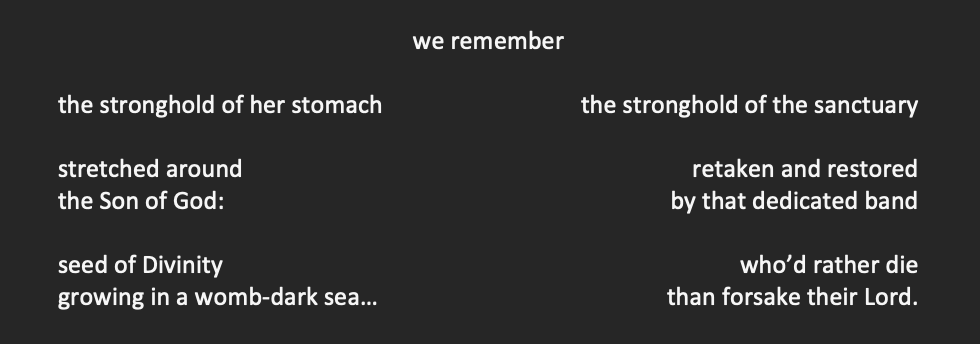
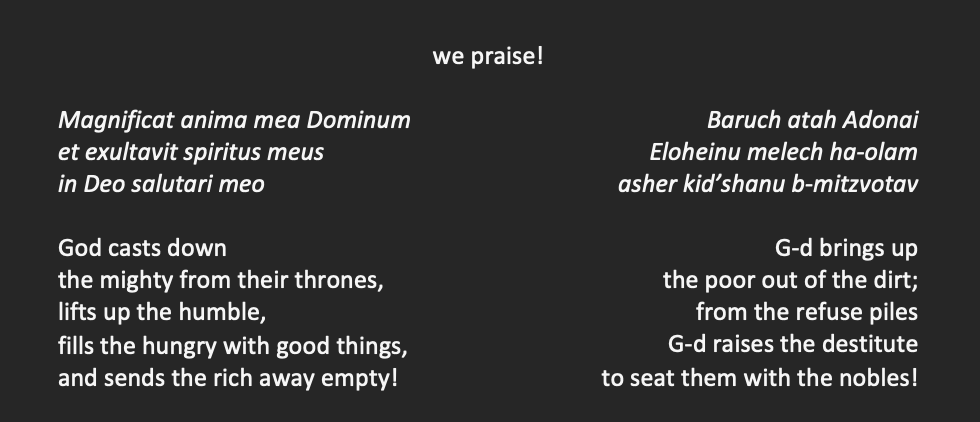
Images show the text of a poem titled “intertwined inceptions: written upon realizing that the first days of Chanukkah and Advent coincided this year.”
The poem’s format places lines about Advent to the left, and lines about Hanukkah to the right, with lines about both in the center. This is difficult to transliterate in a screen-reader friendly way, so I’ll put an “A” before each Advent bit, an “H” before each Hanukkah bit, and a “B” for shared lines.
A: four tall tapers ring round a fifth on their bed of pine branches
H: eight tall tapers proudly flank the ninth along their branching arms
B: and one candle lights another
A: upon an altar draped in royal purple.
H: where passersby may glimpse through windowpanes.
B: we marvel at
A: the Word made Flesh — the miracle of Yes:
“I, Most High sovereign, will become the lowest, weakest, poorest one!”
“I’ll bear my own Creator in my womb — with joy, let it be done!”
H: “a great miracle happened here” — the miracle of Enough:
a mighty army brought to shame by one small hammer in God’s name
and a pittance of oil stretched across eight days’ flames…
B: we remember
A: the stronghold of her stomach
stretched around the Son of God:
seed of Divinity growing in a womb-dark sea…
H: the stronghold of the sanctuary retaken and restored
by that dedicated band who’d rather die than forsake their Lord.
B: we praise!
A: Magnificat anima mea Dominum et exultavit spiritus meus in Deo salutari meo
God casts down the mighty from their thrones, lifts up the humble, fills the hungry with good things, and sends the rich away empty!
There are cocoons of silence, soft merciful darkness enveloping you until you are ready to emerge as something new—
And there are tombs of silence. Darkness gone awry, a heaviness that presses down your lungs, so that your shouts of “I’m alive!” die before they can escape your lips.
My shoulders ache with the ghosts of silences too long carried.
Mom, Dad, you always promised to love me no matter what — but so did my wife’s parents and they nearly threw her out when they found out.
I wanted to believe you really would love me “no matter what” but how could I dare to hope it when you never said a word about gay or trans people, and always changed the channel when two women holding hands came on the screen?
Your silence weighed on me almost as heavy as explicit condemnation would have.
Parents, guardians out there, please tell your children when they are young and only just learning what love is that you will love them even if it turns out the wrong gender was stamped on their birth certificate and no matter who they cut their wedding cake with.
I came out to my parents eventually. Piece by piece I tore through the silence we had built up together and they
have been wonderful. Slowly they wrapped up the name they gave me at my birth and put it away, replaced by a name of my own choosing, a name that really is me.
The pronouns took longer but now when I go home arm in arm with my wife I have no fear of being misgendered by those closest in my life.
And what of myself, the residue of silence that still coats my inner gut?
Sometimes I forget that I am safe now to speak up for other queer folk, that I can say, “no, that joke was not funny it was transphobic” or “so why exactly would you ‘never date a bisexual’?”
My mouth stays shut. And silence wins. Nothing changes. Other times I’m just too tired to correct someone who’s called me ma’am yet again to repeat like a broken record, please use they/them!
and then silence wins. I dodge falling stalactites as my identity caves in around me.
The seductive arms of silence reach out to all of us and we all fall into them sometimes, too tired to resist or too scared of saying the wrong thing to even try.
But the key is to ask yourself: what will you do to ensure that the old wounds etched by silence don’t bleed out indefinitely? what will you do not to cover over the scars or pretend like they never happened but to keep new scars from jagging into existence?
Listen. I know how your heart speeds up when you try to speak up on your own behalf or another’s — my heart does too.
I know the lump that forms in your throat and when you speak anyway,
maybe people will be mad. Maybe you’ll have to fight. Maybe you’ll even lose.
But speak anyway. And if you have to fight, then fight not with swords but with words, not with violence but with love and truth.
If we speak, the scars of silences once carried will map themselves into a vision of a future where no one needs to bury themselves to stay alive.
As for me and my house, we will dig and dig and dig and free the ones whom we have buried with the sin of all the times that we have failed.
We will not disturb those who have chosen to wrap themselves in cocoons of silence for their own protection, but we will speak on their behalf; while they form themselves in safety we will speak, so that when they emerge
the world will greet them not with more tombs to shove them in not with confused stares or snide comments but with open arms and a seat at the feast—
not with isolating silence but with beautiful, life-reviving Song.
This piece was written by Avery Arden and belongs to them. Please do not publish it anywhere, or use it in a service, without permission from the author. Reach out to Avery at queerlychristian36@gmail.com for that permission, or just to chat!
I first wrote this reflection for a National Coming Out Day service at Louisville Presbyterian Theological Seminary in October 2016. The service included reflections from several individuals, each one responding to a different passage from Esther; the passage to which I responded was Esther 8:9-14.
The first version of this piece included my description of how my parents were still working on getting my pronouns right; it was a joy to revise it saying that they now have that down pat! I also got to change “girlfriend” to “wife,” as we got married in 2019.
The concept of “coming out” brings up complex emotions in me. Western culture turns being “out” and “closeted” into a binary; assumes that all of us resonate with those terms; and centers cishet persons in discussion of those terms. Some incomplete thoughts:
It is only in a world where all are assumed cis and straight till proven otherwise that we need to “come out” at all…
My hope is that this reflection honors the many experiences and feelings around the idea of “coming out,” even while focusing on my own personal experiences.















 Binary-Breaking Worship