the in-laws you acquaint yourself with first upon arrival in your husband’s home are in-laws hen and cow.
as other travelers recline upstairs on the best of this household’s cushions, you make do with straw that in-law goat keeps trying to snatch out from under you.
you hardly mind: these relatives are warm. their smell obscures your smell — the sweat and dirt of travel. they don’t pester you with questions you have no energy to answer now.
your husband’s sister — when she finds the time to sit a moment — takes your hand, and beams: “we almost thought he’d never find a wife — that maybe carpentry filled all his dreams” — she winks, and Joseph huffs, but smiles too. “and now, well, look at you!” one motion to your belly, then she’s off to cater to the other guests aloft.
not long from now, you will take center stage — a gush of water like a parted sea crashing back down will call all hands to you. a little niece-in-law will be sent out into the night to call all women to your side… for now, though, you’re content to fall asleep unnoticed by the rest of this household splitting at the seams with family you’ve yet to meet.
the rustling of the hens drifts through your dreams while in your belly, God kicks his new feet.
About this Poem:
I wrote this piece for episode 52 of my Blessed Are the Binary Breakers podcast: “Revisiting Nativity — Was Jesus born in a barn or house, and why does it matter?” which you can find wherever you get podcasts; or on this website, along with an ep transcript.
In the episode, I discuss how the Greek of Luke 2:7 might not say Jesus was born in a stable after all — that rather than any inns being full, the text tells us Mary gave birth in the main room of a peasant home (likely belonging to Joseph’s family), “because there was no room in the guest room.”
we are more comfortable when you are tucked into your designated corner — but you were never one to stay put where you’re told.
from birth, you have been bold about breaking right into the thick of things —
pinpointing the pulse of human happenings and blaring through with news of God’s Kin-dom, come.
…
into the cliffsides outside Bethlehem we have constructed with our word and song
a nonexistent edifice — some banished barn along your hometown’s outskirts where you can be born
where no one has to hear your mother’s groans; where Joseph midwives her, untrained, alone.
meanwhile, your wet head crests from a nest of straw built in the home’s hot heart.
your mother gasps and grasps the hand of some old woman she just met tight enough to knit them into kin.
just one wall over, rising from within the side room filled with other guests who’ve come to Bethlehem for Caesar’s census, prayers are sung to secure your safe delivery.
…
we like it better when you wait for us in remote places we can journey to when we are ready.
we like the tale of shepherds, rich men too who visit you forewarned what to expect by angels or by astral signs
— but you burst into our bustling
compel us to make room in the chaos of the everyday —
you will not sit and wait till we’ve tidied up the mundane mess we never seem to get to dealing with.
you’ll write your own invitation into our homes —
you’ll let yourself inside draw up a chair at our tables and preside.
the night is here the hour is now
though we’ve got half-baked plots and chores undone —
ready or not here you come.
About this Poem:
I wrote this piece for episode 52 of my Blessed Are the Binary Breakers podcast: “Revisiting Nativity — Was Jesus born in a barn or house, and why does it matter?” which you can find wherever you get podcasts; or on this website, along with an ep transcript.
In the episode, I discuss how the Greek of Luke 2:7 might not say Jesus was born in a stable after all — that rather than any inns being full, the text tells us Mary gave birth in the main room of a peasant home (likely belonging to Joseph’s family), “because there was no room in the guest room.”
In the episode, Laura first talks about the story of Zaccheus that takes place way later in Jesus’ life, and in Luke’s Gospel: in Luke chapter 19, Jesus calls to a tax collector, who would have been spurned by the Jewish people as a collaborator with the Roman Empire, “Zaccheus, come down at once — I must stay in your home today.” That’s right, Jesus invites himself over to this guy’s house! In doing so, we see how Jesus doesn’t wait for us to invite him into our world; he bursts on in of his own accord.
Laura parallels that story with the reading of the Nativity story that sets it in a peasant home in the heart of Bethlehem — our traditions put Jesus on the outskirts, alone in a barn; but Jesus makes himself comfortable right in the midst of a crowded house. This concept inspired me to write the poem you just read.
we think we know the story of how you birthed our God into our midst — but this is not quite accurate:
the tale of your time in Bethlehem is overlaid by two millennia of retellings — tradition lining up beside tradition and
when my mind becomes a tangled mess trying to divine which ones Really Happened
you come.
you calm.
you guide me from
my need to know one truth into the sacred splendor of a whole string of stories —
each one a bead pregnant with its little piece of Truth, a little link between me and your Son and you.
___
first decade.
“it’s not so bad,” Joseph says hopefully as he helps you settle down onto the straw.
the cave walls cut the chill; the goat who ambles close to sniff you stinks but oh, she’s warm.
you think of births you’ve overheard at home — the neighbor women rushing in to help. you expected the same for yourself
but, ah well, what has been expected about this pregnancy?
___
second.
Joseph hovers, fervent but unsure how to help.
“if i could take your pain upon myself…”
but there is no pain! conceived as you were free from Eve’s bane,
as you give birth to heaven on earth all you know is bliss, bliss, bliss.
___
third.
Joseph is gone. you can picture his desperate dash from door to bolted door off in the town
as you lie alone on old straw — and, God! the baby crowns
with no one to help — so you reach down into the mess of your own blood and
yours are the first hands to wrap around the Son of God, red and slick and — ohsacred sound! — screaming.
___
fourth.
Joseph is gone, but near — you know he waits pacing and praying just outside the door.
in his place — women’s faces, smiling and soothing, letting you squeeze their hands as hard as you need
or bustling about to heed Midwife’s decrees.
the guest room was too small to hold this congregation so you were helped into the central room to birth the Son of God right in the heart of this small peasant home.
the poor know how to serve one of their own.
___
fifth.
you close your eyes as agony subsides between contractions. see yourself as one bead upon a long strong string stretching centuries —
you are one
with Jochebed biting down to mute her moaning, Rebekah grateful for an end to her rough pregnancy, with Hannah, Ruth, Bathsheba, Hagar, Rahab, Leah, Eve, and millions more unnamed. you share their groaning, their labor, their relief, their ecstasy.
your baby crowns; the women round burst out in Glory be!
This poem was written by Avery Arden and belongs to them. If you want to use it in a worship service or elsewhere, let Avery know! You can reach them at queerlychristian36@gmail.com.
Essay
My Advent devotions this year include praying a daily rosary. Meanwhile, I’ve been fixating upon a certain reading of Luke 2’s “no room at the inn” passage that suggests Mary gave birth not in a stable, but someone’s home (more on that in a bit). As I meditated on various iterations of the Nativity tale while moving through my rosary, this poem was conceived.
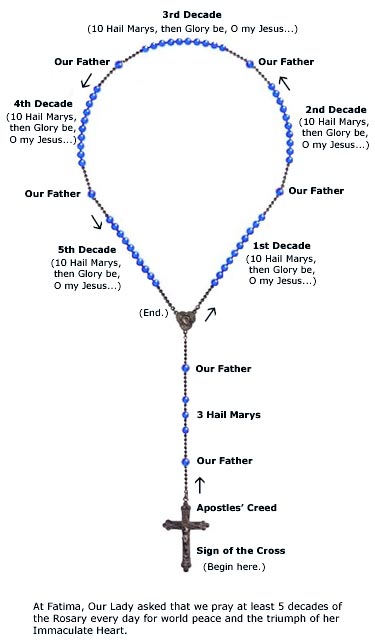
This poem is structured after a rosary. For my non-Catholic friends out there who may not be familiar, a rosary is a long string of prayer beads with a crucifix or other cross hanging down from five decades, or clusters of ten beads each. Here’s a diagram (from this site):
id: diagram of a Catholic rosary with blue beads. A crucifix dangles from the bottom of a string with five beads on it, which is connected to a longer string that connects like a necklace; this longer string has five clusters of ten beads each, and every cluster has one bead between. The diagram labels different beads with their assigned prayers; for instance, each cluster is labeled as one of five decades, with 10 Hail Marys, a Glory Be, and an O my Jesus prayer. The beads between each decade are labeled “Our Father.”
You start at the crucifix and pray along the “pendant,” the strand that hangs down with five beads; then you make your way around the five decades. For me, the rosary offers a way to embody my prayer and to enter into a meditative state as I move from bead to bead and repeat the prayers. As an autistic person, having a tactile point into which to pour all my energy, one point of sensory input to overshadow all the others, is a powerful way to put aside all else and hone in on Divinity.
Pondering one story each decade is a traditional way to pray the rosary — the recommended ones are explained on this site; but for the past week or so, I’ve been imagining the Nativity over and over, a little differently each decade.
Versions whose events contradict each other — a painless Mary versus a groaning Mary; Mary alone or Mary with midwives; Mary dismissed to the outskirts or settled in the heart of a Bethlehemite home — all found their place, side-by-side, along that line of beads. As I took time with each story, the sense of contradiction as conflict faded away.
Little truths rose to the surface of each version, something to savor, a fresh facet of the story of God entering into human life. I can’t know which one was “most historically accurate,” but I could contemplate what each version says about God’s movement in Mary’s life and ours — what good news each version proclaims into our world.
So what is some of that good news? I’ll touch upon the various visions visited by each “decade” of the poem.
The first decade is self-explanatory, I think — it sets up the version we encounter in Christmas pageants, nativity sets, the Charlie Brown Christmas special… In this version, “no room in the inn” means that whatever lodgings a visitor to Bethlehem could usually expect were all full up. Though no Gospel mentions an innkeeper at all, we can all picture that figure well enough; he’s been woven into being by the dramatizations of generations. Whether heartless or apologetic, he can’t provide a bed for a pregnant girl and her husband; but look, there’s the stable, with plenty of straw and a little space among the livestock.
I have long cherished this narrative through a liberationist lens — that God chose to enter the world at the margins of the margins emphasizes Their intimate identification with the most oppressed and erased of our world! Humanity did not make room for the God who so loved the world They squeezed Their infinity into finite, vulnerable flesh; just as our human systems fail to make room for the survival and thriving of so many persons.
The second decade incorporates a bit of Roman Catholic doctrine that states that Mary felt no labor pain — since Catholicism holds that she was born miraculously free from original sin, she was likewise free from the consequences of that sin (see Genesis 3:16, where God informs Eve that her labor will be painful). Though raised Catholic, I didn’t learn about this tidbit of Mariology till late high school. I remember feeling…oddly betrayed? A facet of Mary’s relatability, her humanness, felt stripped away; her pedestal of larger-than-life perfection seemed to stretch a little higher. But this past week, I’ve taken the time to imagine a painless labor for her, and even if it’s not the story that speaks to me loudest, I have found some richness in it.
The third decade imagines Mary alone, following after Eastern Orthodox tradition. I pondered the significance of this version of events — why place Mary by herself as she births God on earth? Does her isolation foreshadow the sense of desolation her Son would feel decades later, on the cross?
What arose most strongly in me as I envisioned this version was a sense of joy and rightness — that Mary’s would be the first hands to touch the Divine she’d carried within her for nine months; that hers would be the first eyes to take in Word made flesh.
The fourth and fifth decadesmove away from the Nativity versions that have enjoyed the most traction and expansion over the centuries. We do away with barns and innkeepers, and bring some new characters to the stage: midwives!
Bringing midwives into the nativities I imagined as I prayed brought me deep joy. Midwives show up in various places throughout scripture — God Herself is depicted in the role of midwife in places like Psalm 22:11 (see this article for more on midwives in the Jewish Bible). Meanwhile, the most famous human midwives are probably the named, heroic women Shiphrah and Puah of Exodus 1, who protect the newborns of enslaved Hebrew women from Pharaoh. The role such women played was a life-bringing one, and imagining the relief and comfort a skilled midwife would bring teenage Mary filled me with gratitude for whoever this unmentioned woman may have been.
In “The Accommodations of Joseph and Mary in Bethlehem,” Stephen C. Carlson explains, “Childbirth was the riskiest moment in the entire pregnancy during antiquity, potentially lethal for both the mother and child. Whenever possible, women about to give birth relied on the help of relatives, friends, and midwives in and around town” (pp. 340-341). I love imagining Mary encircled by so much support as she labored to birth the God of the universe.
Carlson and other scholars suggest that it was the presence of all these Bethlehemite women at Jesus’ birth that necessitated a lot of space for the event. This brings us at last to that famous line from Luke that notes a lack of room…in the inn? or somewhere else?
I promised I’d return to readings of Luke 2:7 that argue Jesus was born not in a stable, but a house — so here we go!
At first glance, Luke 2:7 seems fairly straightforward. Since we’re talking about tradition here, I’ll offer the KJV’s version:
"And she brought forth her firstborn son, and wrapped him in swaddling clothes, and laid him in a manger; because there was no room for them in the inn."
However, digging into the Greek of the text and into the socio-cultural context of the story uncovers some complications.
It turns out that the Greek word that most traditionally gets translated as “inn” here has a broader meaning than that. The word is kataluma (κατάλυμα), and it’s only used two other times in the Gospels (or the NT as a whole): in Luke’s and Matthew’s accounts of how Jesus’s disciples found a room for the meal that we now call the Last Supper. Here’s Luke’s account (22:10-12; NRSV translation this time; with the translation of kataluma bolded):
“Listen,” he [Jesus] said to them, “when you have entered the city, a man carrying a jar of water will meet you; follow him into the house he enters and say to the owner of the house, ‘The teacher asks you, “Where is the guest room, where I may eat the Passover with my disciples?”’ He will show you a large room upstairs, already furnished. Make preparations for us there.”
How can one Greek word mean both “inn” and “guest room”? The noun kataluma is tied to the verb kataluó (καταλύω) — kata + luó = “to loosen thoroughly.” When journeying with pack animals, you’d only “thoroughly loosen” their straps and packs when stopping for a long rest. Thus the verb came to mean “to take up lodging;” and the related noun, the kataluma of both Luke 2:7 and 22:10, came to stand for those lodgings — whether that was some natural shelter like a cave; a tent; an inn; or a guest room in someone’s house.
So if Luke’s one other use of kataluma (22:11) refers to a guest room in a private home; and the one time he wants to specifcally refer to an inn (10:34) he uses a different Greek word…why do the vast majority of English translations of Luke 2:7 state that there is no room for Mary’s labor “in the inn” rather than “in the guest room”? (Or, to avoid making a claim in either direction, why don’t more translations apply a broader phrase like “there was no room in the lodging place”?)
To reiterate, it’s certainly possible that kataluma refers to an inn when used in Luke 2:7 — but it’s not the only possibility, or even necessarily the most likely one.
If Luke 2:7 is saying that there is no room in Bethlehem’s inn, then the classic stable setting (or a cave, as in the second century Protoevangelium of James) makes sense. However, some scholars contest
whether Bethlehem, being so small, would even have had an inn, with the duty of taking in strangers passing through instead falling upon individual families; and
whether Joseph and his wife would have stayed in such an inn, even if it did exist.
The reason Joseph and Mary are journeying to Bethlehem is for a Roman census, for which “all go to their own towns to be registered” (Luke 2:3). In “An Improbable Inn,” Andy Mickelson explains that Roman censuses typically required people to register not in their ancestral town, but wherever they owned property; thus one might conjecture that Joseph “had traveled to Nazareth previously to seek work or (more likely) to retrieve his fiancée Mary and bring her back to his native Bethlehem” (p. 14).
Mickelson cautions that there are some complications in the Luke text that curtail certainty in what exactly happened (visit page 15 of his article to read more about that); but
"regardless of whether Joseph’s family home was in Bethlehem or whether it was just his ancestral home, Joseph’s ties to the village are key in determining how the κατάλυμα of 2:7 should be understood. If Joseph truly was a native son of Bethlehem, then he almost certainly would have stayed with close family members. Bruce Malina remarks that Joseph 'would have been obligated to stay with family, not in a commercial inn.' He also points out that 'if close family was not available, mention of Joseph’s lineage would have resulted in immediate village recognition that he belonged and space would have been made available.' Thus, even if Joseph was only linked to Bethlehem through lineage, that lineage would have been enough to earn him the hospitality of a distant relative. Arguments that the homes of Bethlehem would have been filled to capacity due to the census disregard the simple fact that Roman registrations took place over a period, not a single day. Regardless, an added measure of hospitality could certainly have been expected due to Mary’s pregnancy."
In placing the Nativity in a barn, stable, or cave, we run the risk of disregarding how central hospitality was to the people of Jesus’s time and place.
When I imagine the people of Bethlehem failing to find proper accommodations for the pregnant Mary and her husband Joseph, I can’t help but think of another city destroyed nearly two thousand years before Jesus’s birth — Sodom, which invoked God’s wrath by replacing hospitality to strangers like Lot with attempted violence against them (see Genesis 19). The people of Bethlehem may have been poor and oppressed, but hospitality was their way of sharing what they had and practicing their devotion to the God who instructed them to care for the stranger (e.g. Exodus 23:9; Deuteronomy 10:19; Leviticus 19:34).
Hospitality was a vital virtue not only for the Jewish people, but for various other groups in this time and place. In scripture, we find a gentile widow sharing what she believes is the last of her resources with a stranger, the prophet Elijah (1 Kings 17). Under the epithet Xenios, the Greek God Zeus embodied the moral obligation to provide strangers with hospitality. Likewise, the Romans viewed hospitality as the divine right of any guest, and the divine duty of any host. I imagine that members of any of these cultures would have expected divine wrath to follow the failure of a whole village consigning a pregnant traveler to a lonely stable!
No matter how poor, crowded, or busy Bethlehem was, I have come to doubt the presumption that not one of its residents took pity on Mary and Joseph and welcomed them in.
So let’s say we accept that Jesus wasn’t born in a stable, but someone’s house — likely the home of Joseph’s relatives. In that case, there’s still one more bit of cultural context we need to make sense of this “new” version of the story:
No matter how we translate kataluma, Luke 2:7 says that Mary laid Jesus in a manger — why the heck would there be a manger, a feeding trough for livestock, inside a house?
It turns out that mangers were totally something you’d find inside first-century Judean village houses: rather than having a separate building for their livestock, families would keep their animals outside in the courtyard during the day, and bring them inside their own homes at night. The same room in which the majority of human work and life took place during the daytime became the sleeping quarters for livestock, complete with feeding troughs:
"Typically, the main room was divided into two sections at different elevations separated by about a meter. The animals were housed in the lower section, the people slept in the upper section, and mangers were located between them." (Carlson, p. 341)
Levant homes had followed this practical arrangement since the Iron Age: one space for livestock and humans kept the animals safe from theft; plus all that body heat kept everyone warm in colder months (Mickelson, p. 17).
id: Here’s a diagram from Kenneth Bailey’s book The Bible through Middle Eastern Eyes depicting a “typical village home in Palestine with attached guest room. The diagram is a rectangular shape; the largest room is labeled the family living room and has two ovals labeled “mangers” to the side, next to a smaller segment labeled “stable.” To the right of the family living room is a “guest room,” or kataluma.
To wrap up our exegetical exploration, let’s tie all this — the manger, the midwifes, the word kataluma — together…
starting with a return to Luke 2:7:
"And she gave birth to her firstborn son and wrapped him in bands of cloth, and laid him in a manger, because there was no room for them in the kataluma."
In this “new” reading, Mary is surrounded by village women headed by a midwife as she gives birth. And she is not alone in a stable on the outskirts of town, but in a peasant home — and not in a guest room or little side room of that home (because that kataluma is either full of other guests or simply too small for all the women), but right in the house’s central space.
As Mickelson summarizes,
"Luke records Mary as placing Jesus in a manger because there was no space for them in the κατάλυμα. There are two plausible reasons for this. First, the guest room might have been taken by other guests, requiring Joseph and Mary to stay somewhere else in the house. While the traditional image of Bethlehem teeming with visitors for the registration is an exaggeration, it is likely that if Joseph had come for the event, others (even members of his family) may have returned as well, and the guest room may have been occupied by someone else.

The other possibility is that there was not sufficient space in the κατάλυμα to accommodate Jesus’s delivery. Childbirth in antiquity was a dangerous procedure for both mother and child, and it is likely that Mary would have been assisted by a midwife as well as the women of the house. The κατάλυμα of the Last Supper was noted for being large, but these guest rooms likely varied in size. If the room in which Mary and Joseph were staying was small, Mary would have relocated to the main room of the house, where there would have been plenty of space for the other women to help with her delivery." (p. 17)
Mickelson moves on to explain why all this matters — which I bet you’ve been wondering if you’ve read this far (or even just skimmed to this point).
If the traditional placement of the Nativity in a stable on Bethlehem’s outskirts emphasizes God’s entrance into the most marginal space possible, what does placing Jesus’s birth in the heart of a peasant home emphasize?
Mickelson argues this setting also fits the theme of Jesus’s intimate identification with the marginalized and oppressed, as it solidifies the everydayness of his arrival:
"This reading of Luke’s infancy narrative makes the story of Jesus’s birth even less unusual than the traditional reading of the story. Being rejected from an inn and being forced to give birth amid animals gives Jesus a humble yet noteworthy beginning: Jesus is born in desperate and memorable circumstances.

But placing Jesus’s delivery in the main room of a Bethlehemite home gives him a birth narrative similar to probably thousands of Jewish babies. Nothing about the circumstances is extraordinary: being swaddled was a common experience for infants, and the most that can be inferred by being placed in a manger is that the home may have been crowded and there was nothing else approximating a crib available.

In short, Luke portrays Jesus entering the world in a rather unremarkable way." (p. 18)
Thus this “new” reading of the Nativity story is packed with richness for the liberationist reader! As a TL;DR to close this essay, I’ll summarize some of that richness now.
In any reading of the Nativity — whether it takes place on Bethlehem’s outskirts or in its heart — Jesus is born to nobodies in a nowhere town. His parents are brown Palestinian Jews living in subjugation to an Empire; they are impoverished; and they are dependent on the hospitality of others who share their poverty and oppression.
Though the narratives surrounding the actual birth scene in Luke’s Gospel — replete with angelic messages and praise-songs from priests and shepherds, a teen girl and an old widow — make the importance of Jesus’s arrival clear, for the actual moment of birth, Jesus is just one infant of thousands born in a typical peasant house. He really is just one of the poor, one of the common folk. He makes the margins the center.
Do we do a disservice to the poor whom liberationist theologies are supposed to center when we claim that the people of Bethlehem — from the innkeeper of our pageants to whatever relatives Joseph may have had there — fail to provide a pregnant teenager and her husband with better accommodations than a barn or cave?
A reading that imagines village women supporting Mary through her labor; that imagines the main room of a house given over for her use, is a reading that celebrates the generosity and hospitality often demonstrated by poor and oppressed persons.
From birth and beyond, Jesus relied upon the solidarity and generosity of his fellow poor.
Any possibility of an antisemitic reading of the Nativity story (that “the Jews” rejected Jesus from his very birth by refusing his parents space in their inns or homes — I’m not saying most people do interpret traditional Nativity stories in this way, but the possibility is there) are also avoided with this reading, where Jewish Bethlehemites assist in his birth.
This reading also speaks to how Jesus makes room for himself amid our mundane mess!
Jesus does not wait for us in some remote corner, so that we can go to him when we decide we’re ready, on our terms; he bursts into our bustling, the everyday chaos of an average peasant home. God compels us to make space for the Divine in the center of our lives, ready or not!
Whether or not you are on board with this “new” version of the Nativity story, I hope that, if nothing else, my poem and this essay open you up to the possibilities of scripture — the richness that can come from daring to reimagine stories we think we know by heart. The more familiar a story, the less likely we are to consider new ways of reading it; but just look what is born when we step away from the familiar to explore what lies beyond, even if only for a moment!
Stephen C. Carlson’s scholarly article that goes more in depth, and argues that kataluma has a generic sense of “place to stay” that fits a variety of readings
Andy Mickelson’s scholarly article that likewise goes in depth, including a look at extra-biblical Greek sources that also use kataluma; and that makes some arguments about the significance of one’s interpretation of kataluma to the broader Lukan narrative.
My friend Laura discusses the idea of the Nativity taking place in a peasant home’s central room in the context of disability theology in their podcast episode here. They parallel Jesus’s birth story with the story of Zaccheus, where Jesus invites himself over to the tax collector’s home (“I must dine with you!”) — in both stories, Jesus announces his reliance on others for shelter and sustenance, unabashed.
written upon realizing that the first days of Chanukah and Advent coincided this year
Happy Chanukah to those who celebrate it, and blessed Advent to those who observe it! Constructive criticism on this poem is invited and appreciated — particularly from any Jewish folks who take the time to point out any accidental misrepresentations of your holiday.
Image description below; or you can read the poem in its original format outside of screenshots in this google doc.
If you are interested in using this piece in a worship service or elsewhere, email me at queerlychristian36@gmail.com.
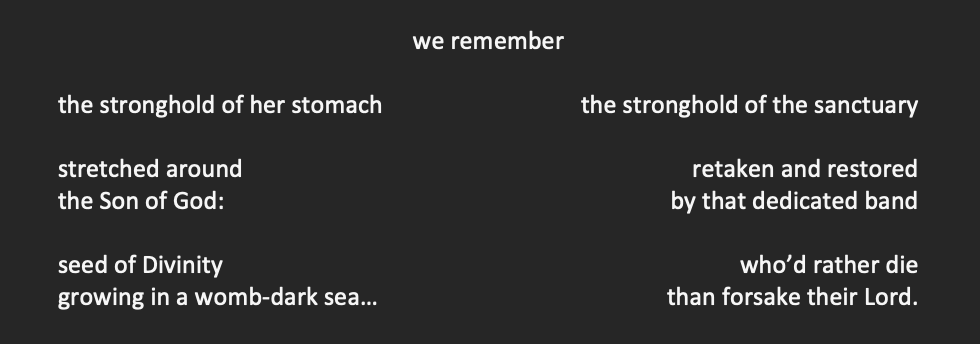
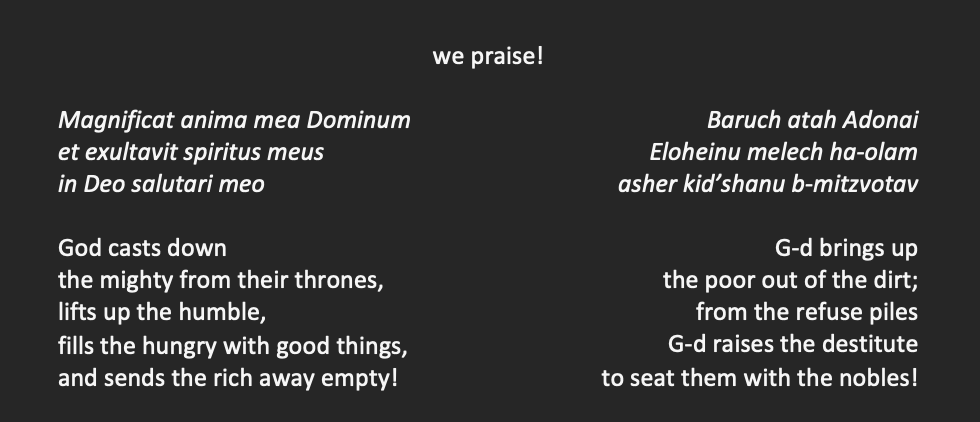
Images show the text of a poem titled “intertwined inceptions: written upon realizing that the first days of Chanukkah and Advent coincided this year.”
The poem’s format places lines about Advent to the left, and lines about Hanukkah to the right, with lines about both in the center. This is difficult to transliterate in a screen-reader friendly way, so I’ll put an “A” before each Advent bit, an “H” before each Hanukkah bit, and a “B” for shared lines.
A: four tall tapers ring round a fifth on their bed of pine branches
H: eight tall tapers proudly flank the ninth along their branching arms
B: and one candle lights another
A: upon an altar draped in royal purple.
H: where passersby may glimpse through windowpanes.
B: we marvel at
A: the Word made Flesh — the miracle of Yes:
“I, Most High sovereign, will become the lowest, weakest, poorest one!”
“I’ll bear my own Creator in my womb — with joy, let it be done!”
H: “a great miracle happened here” — the miracle of Enough:
a mighty army brought to shame by one small hammer in God’s name
and a pittance of oil stretched across eight days’ flames…
B: we remember
A: the stronghold of her stomach
stretched around the Son of God:
seed of Divinity growing in a womb-dark sea…
H: the stronghold of the sanctuary retaken and restored
by that dedicated band who’d rather die than forsake their Lord.
B: we praise!
A: Magnificat anima mea Dominum et exultavit spiritus meus in Deo salutari meo
God casts down the mighty from their thrones, lifts up the humble, fills the hungry with good things, and sends the rich away empty!
If the world tells you that you are unworthy of a seat at the table, that your presence is unwelcome or even unwholesome, know that Jesus extends an invitation to you personally.
This table does not belong to human beings, but to the God who delights in you, Who welcomes you without demanding you be anything but your own beautiful self.
Come, join this joyful feast without fear.
God has set a place just for you.
About this piece:
I wrote this affirmation for my church’s More Light Sunday service, an LGBTQA/queer-focused service. Themes included learning how to love ourselves, our neighbors, and our God; reclaiming scripture from those who have weaponized it; and the power of story.
If you this piece it in your own service, please credit it to Avery Arden — and I invite you to email me at queerlychristian36@gmail.com to let me know you’re using it!
The love of our queer God unites us into one Body — not in spite of, but in celebration of our varied gifts and roles in the story God is telling even now.
As one, let us affirm some of what we believe about the God who is for us when we are in the closet, and when we come out, when we receive our loved ones with rejoicing and when we strive to understand.
We believe in the God who came out to Moses from the midst of unburned branches with a name They had never revealed before —
a name shared with love, shared as an invitation into deeper relationship, deeper understanding of the God Who Is and Who Will Be the steadfast ally of shunned and shackled peoples.
We believe in the God of Joseph, who takes tattered lives and weaves them into wholeness.
When Joseph came out to his brothers as a dress-draped dreamer and faced their violent rejection,
God went with Joseph into slavery, into imprisonment, and out again, guiding his way into flourishing.
But They also stayed with Joseph’s brothers, never ceasing to work on their hard hearts, preparing them for the tearful reunion where they would embrace Joseph’s differences as life-bringing gifts.
We believe in the God of Esther, who protected her from being outed unwillingly in a place hostile to her very being;
and who, when the time came to act, filled her with the courage and power she needed to use what privilege she had to save the more vulnerable members of her people.
We believe in the God of Mary, the teenage girl who faced disgrace by coming out as full of grace, pregnant with divinity —
yet she did so boldly, joyously, recognizing the hand of God in the status quo’s upturning.
We believe in Jesus, whose identity as God’s beloved son and God Themself, as Word made Flesh and Life that died is too complex for human minds to fathom —
yet Jesus yearned to be known, to be understood by those who loved him most! He asked them earnestly, “Who do you say that I am?” but told them not to out him to the world before he was ready to share his truth in his own time — And oh, how he’d shine!
We believe that the God who liberated Lazurus from his tomb, and who overcame death by rising from a tomb of his own,
is the selfsame Spirit who enters into the tombs we build around ourselves or shove our neighbors into;
She looses our bindings and pulls us into Her great Upturning.
Amen.
About this piece:
I wrote this affirmation for my church’s More Light Sunday service, an LGBTQA/queer-focused service. Themes included learning how to love ourselves, our neighbors, and our God; reclaiming scripture from those who have weaponized it; and the power of story.
If you this piece it in your own service, please credit it to Avery Arden — and I invite you to email me at queerlychristian36@gmail.com to let me know you’re using it!
[image: a digital painting of Joseph of Genesis by tomato-bird on tumblr, a figure with light brown skin, brown eyes, and curly dark hair sitting in a field. They have their head propped on one hand as they sit, gazing off into the distance with a sunset or sunrise blushed sky behind them. And from their shoulders extends a gorgeous, flowing cape, rising upward behind them as if caught on the wind so that its colors blend with the blushing sky – ripples of vibrant red and blue, with orange and yellow stars plus a moon and sun scattered along the fabric. / end id]
Gracious God, in this time of worship and wonder, story and song into which you have gathered us,
we marvel at the wondrous diversity of your human creation. Each of us — Black, white, Latine, Asian, Indigenous, and beyond — is an integral part of your magnificent spectrum.
You call us to join in joyous worship, just as we are.
Each of us — Christian, Jewish, Muslim, Hindu, Buddhist, atheist, and beyond — is an integral part of your magnificent spectrum.
You call us into community, just as we are.
Each of us — with our bodies of diverse shapes, sizes, and abilities — is an integral part of your magnificent spectrum.
You call us Good, you call us whole and holy, just as we are.
Each of us — of all sexualities and genders, all these ways of being and loving — is an integral part of your magnificent spectrum.
You call us to share the gifts you gave us, just as we are.
Opening Prayer
Queer God beyond our knowing, we glimpse your vastness in the diversity of your children who together bear your image.
Queer Trinity, both One and Three, your very Being shows us how to be: honoring each person’s uniqueness, and valuing our interconnectedness.
Queer God, On this More Light Sunday, we humbly pray and act for the full affirmation and inclusion of all of our LGBTQ+ siblings.
Amen.
About this piece:
I co-wrote this call to worship, and wrote the opening prayer, for my church’s More Light Sunday service, an LGBTQA/queer-focused service. You could edit the last two lines to take out the reference to More Light Sunday if using it for general worship.
If you use it in your own service, please credit it to Avery Arden — and I invite you to email me at queerlychristian36@gmail.com to let me know you’re using it!
There are cocoons of silence, soft merciful darkness enveloping you until you are ready to emerge as something new—
And there are tombs of silence. Darkness gone awry, a heaviness that presses down your lungs, so that your shouts of “I’m alive!” die before they can escape your lips.
My shoulders ache with the ghosts of silences too long carried.
Mom, Dad, you always promised to love me no matter what — but so did my wife’s parents and they nearly threw her out when they found out.
I wanted to believe you really would love me “no matter what” but how could I dare to hope it when you never said a word about gay or trans people, and always changed the channel when two women holding hands came on the screen?
Your silence weighed on me almost as heavy as explicit condemnation would have.
Parents, guardians out there, please tell your children when they are young and only just learning what love is that you will love them even if it turns out the wrong gender was stamped on their birth certificate and no matter who they cut their wedding cake with.
I came out to my parents eventually. Piece by piece I tore through the silence we had built up together and they
have been wonderful. Slowly they wrapped up the name they gave me at my birth and put it away, replaced by a name of my own choosing, a name that really is me.
The pronouns took longer but now when I go home arm in arm with my wife I have no fear of being misgendered by those closest in my life.
And what of myself, the residue of silence that still coats my inner gut?
Sometimes I forget that I am safe now to speak up for other queer folk, that I can say, “no, that joke was not funny it was transphobic” or “so why exactly would you ‘never date a bisexual’?”
My mouth stays shut. And silence wins. Nothing changes. Other times I’m just too tired to correct someone who’s called me ma’am yet again to repeat like a broken record, please use they/them!
and then silence wins. I dodge falling stalactites as my identity caves in around me.
The seductive arms of silence reach out to all of us and we all fall into them sometimes, too tired to resist or too scared of saying the wrong thing to even try.
But the key is to ask yourself: what will you do to ensure that the old wounds etched by silence don’t bleed out indefinitely? what will you do not to cover over the scars or pretend like they never happened but to keep new scars from jagging into existence?
Listen. I know how your heart speeds up when you try to speak up on your own behalf or another’s — my heart does too.
I know the lump that forms in your throat and when you speak anyway,
maybe people will be mad. Maybe you’ll have to fight. Maybe you’ll even lose.
But speak anyway. And if you have to fight, then fight not with swords but with words, not with violence but with love and truth.
If we speak, the scars of silences once carried will map themselves into a vision of a future where no one needs to bury themselves to stay alive.
As for me and my house, we will dig and dig and dig and free the ones whom we have buried with the sin of all the times that we have failed.
We will not disturb those who have chosen to wrap themselves in cocoons of silence for their own protection, but we will speak on their behalf; while they form themselves in safety we will speak, so that when they emerge
the world will greet them not with more tombs to shove them in not with confused stares or snide comments but with open arms and a seat at the feast—
not with isolating silence but with beautiful, life-reviving Song.
This piece was written by Avery Arden and belongs to them. Please do not publish it anywhere, or use it in a service, without permission from the author. Reach out to Avery at queerlychristian36@gmail.com for that permission, or just to chat!
I first wrote this reflection for a National Coming Out Day service at Louisville Presbyterian Theological Seminary in October 2016. The service included reflections from several individuals, each one responding to a different passage from Esther; the passage to which I responded was Esther 8:9-14.
The first version of this piece included my description of how my parents were still working on getting my pronouns right; it was a joy to revise it saying that they now have that down pat! I also got to change “girlfriend” to “wife,” as we got married in 2019.
The concept of “coming out” brings up complex emotions in me. Western culture turns being “out” and “closeted” into a binary; assumes that all of us resonate with those terms; and centers cishet persons in discussion of those terms. Some incomplete thoughts:
It is only in a world where all are assumed cis and straight till proven otherwise that we need to “come out” at all…
My hope is that this reflection honors the many experiences and feelings around the idea of “coming out,” even while focusing on my own personal experiences.
God sent the prophet Amos to Israel to warn the rich and powerful that the natural consequence of their mistreatment of the vulnerable would be destruction for all.
In many ways, the modern United States is not unlike that ancient nation —
A land of plenty only for the powerful few, while the oppressed go hungry and unheard.
So come, let us confess our failings by hearing some of Amos’s words as if they were proclaimed to us.
Prayer of Confession
“Alas for those who are at ease in Zion, and for those who feel secure… Alas for those who ignore the evil day causing violent rule to draw near: for those who lie on beds of ivory, and lounge on their couches…” (Amos 6:1, 3-4a)
“…They have been led astray by the same lies after which their ancestors walked.” (Amos 2:4)
We cannot bear to hear of the atrocities inflicted past and present by our fellow Christians against Indigenous peoples —
such news shatters our faith in the Church, wracks us with grief and guilt we don’t know what to do with.
We cannot bear to believe all the stories of violence committed by police against Black persons and other persons of color —
such stories shake our trust in our country, leave us wondering where else we could go when our own safety is threatened.
We cannot bear the knowledge that our world is burning due to human greed — don’t we need the gas that poisons our planet to power our cars and homes?
God, when we think we cannot bear these truths, give us the strength to face them — for in avoiding them, we move towards our collective doom.
“I raised up some of your children to be prophets… But you…command the prophets, Saying, ‘You shall not prophesy!’” (Amos 2:11-12)
“[You] hate the one who reprimands in the city gate, abhor the one who speaks the truth.” (Amos 5:10)
We cannot bear the messages of people we have individually harmed, or of communities whose oppression is the price of our own prosperity
because they pierce through our illusions about ourselves as “nice” people, and expose the pretty lie of the American Dream for the nightmare it is, accessible only to the privileged;
they make us feel bad and defensive, and expose the poison festering beneath our “respectable” facades.
God, when we think we cannot bear these truths, urge us all the harder to face them. Do not let us look away!
“They do not know how to do right, says the HOLY ONE…” (3:10)
You alone, O God, can teach us how to do right. Open our hearts. Help us lower our defenses. We will face the harm we have done so that we can move forward.
Assurance of Pardon
God declares, “Let justice roll down like waters, and righteousness like an ever-flowing stream!” (Amos 5:24)
Through the life, death, and resurrection of Jesus, such justice is possible!
God will make all things right, and empowers us to join Them in that task.
I wrote this confession for a service centered around Amos chapter 7, which includes the metaphor of the plumbline, which God has used to measure Israel only to find its very foundation is completely skewed; the whole thing must be leveled and rebuilt.
Israel’s high priest Amaziah cries that “the land cannot bear [Amos’s] words,” and tells Amos to go on back home to Judah, because his prophecies are not welcome in Israel. But in reality, it isn’t the message that Israel “cannot bear,” but the avoidance of that message: because Amaziah rejects this message and the repentance and reform it necessitates, Israel will be invaded and driven into exile by the Neo-Assyrian Empire; by 722 BCE, the Northern Kingdom of Israel will have fallen, leaving her sister nation Judah standing alone.
There are so many truths that we likewise avoid because we believe that we and our communities cannot bear the guilt, grief, and upheaval those truths would bring. But to fail to face those realities and respond with active reform spells doom for us all.
As James Baldwin writes in The Fire Next Time, “Not everything that is faced can be changed. But nothing can be changed until it is faced.”
What realities are the members of your faith community avoiding? How can the community come together to face them together?
_____
In the case of how white Christians can and must face our complicity in antiblack racism, I recommend Good White Racist? by Kerry Connelly as a good starting point. Connelly goes into the neuroscience behind why we react to our words or actions being called out as if such a thing were a life-threatening attack; how we value being “nice” and not making others uncomfortable to seeking justice; and how to move past that hardwiring.
Our God is the Ultimate Other; Xe knows firsthand what it is to be the one who does not fit, whose ways are not “our ways” and whose thoughts are not “our thoughts.”
Thus trusting in Her steadfast solidarity, let us lift up our prayers for all those who know the heart of the stranger.
We pray for Indigenous peoples across the globe who are made Other in their own homelands, their lands stripped from them and genocide attempted against their languages, their cultures, their bodies —
we pray particularly for the First Nations peoples of North America whose long-held, never yet healed wounds were recently reopened with the discovery of the remains Indigenous children who were forced into residential schools, died, and were discarded;
as well as for Palestinians facing persecution and expulsion from the homes of their ancestors with nowhere to go:
O God who saw and saved the enslaved foreigners Hagar and Ishmael, whose descendants would one day found the Islamic faith; hear our prayer.
We pray for immigrants, asylum seekers, refugees and all who find themselves far from all they know and love
only to face contempt and mistreatment, often by the very powers that had a direct hand in the violence they are fleeing:
O God who transformed the migrant Naomi’s bitterness to sweetness; O God who, in the person of Jesus, was yourself a refugee, finding asylum in Egypt as an infant, hear our prayer.
Finally, we pray for all who experience double consciousness in which they feel forced to think always of how the oppressor will respond to their words and actions,
from Black persons to the children of immigrants as well as Asian Americans and other persons of color who are subjected to the stereotype of the “perpetual foreigner”, treated always as alien even in their place of birth:
O God of Moses, who felt stuck somewhere between his adopted Egyptian family and his Hebrew roots, hear our prayer.
Great Breaker of the human Binaries of blood ties and national borders,
gather us into one community — something fresh, something new! — where no one’s needs are denied on the grounds of being too difficult or strange;
where no one is forced to cut off pieces of themselves to fit into a pre-established mold;
where no one is treated like a problem, an afterthought, a disruption but rather every person is protected, cherished, listened to.
It is you, God of the Stranger, on whom we depend to right the wrongs of xenophobia. Teach us to move with you towards justice. Amen.
I wrote this pastoral prayer to accompany the “prayers of the people” session of a worship service on Immigrant Sunday, celebrated in the PCUSA denomination. It could also suit the UCC’s Immigrant Rights Sunday and, I imagine, other such services across denominations.




 Binary-Breaking Worship