Categories
Holy Days Hymns Other search markers

“Holy, Holy, Holy” revised

Scroll lower for credit info, reasons for revision, and downloadable sheet music.

Unaltered lines are in light gray; altered lines are in black.

Holy, holy, holy!
Lord God Almighty
Early in the morning our song shall rise to thee
Holy, holy, holy!

Justice wed to mercy,
God in three persons, blessed Trinity!

Holy, holy, holy!
All the saints adore thee,
Casting down their golden crowns around the glassy sea.
Cherubim and seraphim,
falling down before thee,
Who was and is and evermore shall be.

Holy, holy, holy!
Sacred darkness cloaks thee,
Granting us mere glimpses of thine untold Mystery.
Still, thine image shows thee
in each human body:
Thou art our breath, our love and artistry.

Holy, holy, holy,
Although almighty,
Thou stripped off omnipotence to share our frailty.
Only Thou are holy,
yet thou chose the lowly —
With the despised, there shall thy Spirit be.

Holy, holy, holy!
God of the lowly!
All thy works shall praise thy name
In earth and sky and sea
Holy, holy, holy!

Justice wed to mercy,
God in three persons, blessed Trinity!

Credit Info:

Please feel free to spread this around, to sing it in your own communities, etc.! Just include credit to Avery Arden at binarybreakingworship.com.

If your community does make use of my revised verses, I would love to know about it. If you post a video of it being sung anywhere, I would love to hear it!! You can contact me at queerlychristian36@gmail.com.

And if you have any suggestions for further revision, please do let me know that too. Let us all join together in the endless effort to draw our circles wider!

Reasons for Revision

This hymn by Anglican archbishop Reginald Heber (1783–1826) is a lovely piece of pure adoration of the Triune God. My personal appreciation of it centers on how it spans centuries — published the year Heber died, it’ll be two hundred years old next year! — and traditions:

I grew up singing it in Catholic Mass; I sing it now in a Presbyterian church; and I enjoy queer musician Sufjan Stevens’s cover of it. Heck, even the non-Trinitarian Latter Day Saints/Mormons sing it (altering “God in three persons, blessed Trinity” to “God in His glory, blessed Deity”). Thus when we sing this song we do so together not only with “cherubim and seraphim,” but with a vast cloud of human witnesses.

To better encapsulate the hymn’s expansive nature, and to infuse it with key concepts from liberationist theologies, I have revised parts of it with several goals:

  • To move from an emphasis on God’s “might” to God’s solidarity and abiding Presence.
  • To remove an instance of patriarchal language (“sinful man”).
  • To move from an equation of darkness and sightlessness with sinfulness (“Though the darkness hide thee / though the eye of sinful man thy glory may not see”) into an appreciation for the thick darkness — Hebrew עֲרָפֶל arafel — from which God guided the liberated Hebrews.
  • ^ That stanza on God’s hiddenness is the part of the hymn I changed most — I ended up turning it into two stanzas! Refocusing that hiddenness around Mystery rather than sin, and taking the opportunity that afforded me to explore how the Trinity chooses to relate to humanity in the Imago Dei, in the Incarnation, and through the Holy Spirit.

I am thankful to Dr. Matt Webb for his input on my revisions. If you notice anything more to change up in this hymn, let me know!

Sheet Music

Categories
Confession and Pardon Current Events / Activism Liturgy

Confession of Western Christian complicity in Palestine’s plight

As a church that aims to live into God’s call
to do justice, love kindness, and walk humbly,
we must acknowledge where we’ve fallen short —

particularly when it comes to the horrors
that Palestinians have faced in a Western-backed colonial project
since the British Mandate for Palestine in 1922,
into the Nakba, or great catastrophe of ethnic cleansing in 1948,

and up through the present day,
in these many months of violence escalated to genocidal levels.

If our desire for peace is true,
we will let go of any false peace
built on top of silenced voices and disenfranchised bodies.

We will cease to cry “Peace! Peace!”
at a people that has not known peace for over 100 years.

As one step towards a true peace, let us confess together the ways in which, individually and collectively, through action or inaction,
we have aided and abetted atrocities
against fellow human beings with whom we share God’s image:

We confess our compliant silence
from inside the heart of Empire.

Allowing hopelessness to collapse us into inaction,
we shrug in despair as Western powers fuel our excess
with African, Asian, Latin American, and Arab suffering,
and the stealing and stripping of Indigenous lands
all across the weeping Earth,
including in Palestine.

We confess our complicity as Christians
with our long and ongoing marriage to Empire —

our bloody past of crusades and pogroms,
missionary schools, eugenics, and all kinds of evil
wrapped in a guise of Christian “love” —
that extends into our present.

We confess our ties to Christian Zionism
begun in the nineteenth century British Empire
and continued through our “progressive” theologies of the late 1900s.

We confess the ways we reduce all Jewish people into a monolith
instead of respecting the diversity of perspectives and allegiances therein.
We confess how we treat our Jewish siblings as pawns
in our guilt and savior complexes, our various redemption myths:

We imply our faith supersedes Jews’ own on the one hand,
while on the other, we twist the very real issue of antisemitism
into a weapon to forward our colonial projects and anti-Arab racism.

When nationalism and Christian supremacy
erect murderous walls and stifle the reality
of one Beloved Community of all human beings,
Forgive us, redeemer God. Move us into honesty.

In our complicity, we confess our willful ignorance,
our failure to seek out accurate information —
allowing vital stories to be silenced
or twisted into lies.

We allow ourselves to be lulled by pretty propaganda
lifting up modern Israel as a “promised land” for Holocaust survivors,
for environmental justice and queer inclusion,
because that feels better than the truth:
survivors silenced and kept in poverty;
desert biomes forced into European molds,
ancient olive trees obliterated,
and the searing truth that no place that enables racism and apartheid
can ever be a queer friendly or environmental paradise.

When fear or uncertainty keeps us from speaking up;
When we choose our own comfort over courageous conversations,
Forgive us, redeeming God. Move us into courage.

Finally, we confess a collective failure of imagination.

We have fallen for the lies that this conflict
is too complicated to resolve,
that justice is impossible,
that hope is dead —
instead of listening for Spirit’s wisdom
and noticing God’s inbreaking Kin-dom
in the vision and voice of Palestinians
who have never given up on justice,
on believing in peace,
on believing in a multicultural, interfaith future for the land.

Forgive us, redeemer God.
Move us to seek, center, and celebrate
Palestinian visions of justice and peace.

In repentance and hope,
we pray to the God of both Sarah and Hagar, both Isaac and Ishmael,
Parent of all peoples and protector of the oppressed:

Help us recommit to seeking your Spirit at work among ruins,
to lifting up the voices Empire aims to silence,
to God’s Kin-dom where all peoples, all Creation,

can live together in joy.

__

Friends, our shortcomings are great, but God’s love is greater.

In his invitation to peace
after his execution and resurrection,
Letting go of the betrayals of the past
in order to initiate a faithful future,
Jesus reminds us that it is never too late
for collective wholeness and healing.

Thus reminded and redeemed by the God who crosses every border
and tears down every wall,
we may extend the peace of Christ to one another — 

not an easy peace, not a halfhearted peace,
but a peace built on justice and mutuality —

both here in this space, and across the world.

The peace of Christ be with you…


Please feel free to make use of this piece in worship or Sunday school, in ceremony or across social media. Just credit it to Avery Arden of binarybreakingworhsip.com — and I invite you to email me at queerlychristian36@gmail.com to let me know you’re using it!

You may make small adjustments to fit your own particular context.

About this piece:

We are many months into genocide, and misinformation still abounds; the USA and other Western nations continue to fund Israel’s violence; Palestinians continue to be bombed, starved, imprisoned, defamed.

We cannot lose steam; we must continue to speak up, to educate one another and get active till Palestine is finally free.

My hope is that this Confession can be one piece igniting further conversation and action in faith communities. If your community is not at a place where a confession like this could be shared in worship, make it the subject of a Sunday School lesson or coffee hour conversation instead.

For resources describing the various claims in this piece, see this post.

  • My top recommendation on Palestine & Christianity is Mitri Raheb’s book Decolonizing Palestine; read a summary of it here.
  • For discussions on fighting antisemitism while supporting Palestine, my top rec is Safety through Solidarity by Shane Burley and Ben Lorber.
Categories
Confession and Pardon LGBT/queer Liturgy

Confession of Anti-Trans Violence & Assurance of God’s Grace

Drawing from Luke 4:16-30
and F-1.04 of the Book of Order of the Presbyterian Church (USA)

PRELUDE:

As Presbyterians, we believe in a God who takes up the cause of those whom human societies consider “least.”

In this era of escalating anti-trans rhetoric and legislation, in our own state and beyond, our faith calls us to affirm God’s movement among and through the trans community in particular.

Even as we leave room for some differences in belief, we can agree that there is no place in the life of the Church for discrimination against any person. 

United in this belief, let us confess together the ways in which we continue to fall short in protecting and celebrating the gender diverse members of God’s human family:

CONFESSION

When we refuse to recognize the unique ways
our transgender siblings participate in co-creation
and manifest the Divine Image
of a God far vaster than any rules we devise or boxes we build,

Forgive and transform us, Creator God.
Open us to choose respect over rejection,

conversation over misinformation,
relationship over alienation.

When we look on as oppressive forces hold our trans kin captive —

suffocate their free will, strip them of health and safety,
drive them to desperation and rob them of their very lives —
and we shrug off their plight, assuming it has nothing to do with us;

or else stay silent out of fear for our own security and comfort,

Forgive and transform us, Liberator God. 
Wake us to the life-or-death urgency of this struggle.
Open us to choose action over silence,
to risk much in the name of justice.

When our denomination’s promises
of full participation and representation for all persons and groups
remain unfulfilled —

with many queer candidates still finding their ministry obstructed,
and trans parishioners forced to choose
between staying in hostile spaces
or leaving their spiritual homes to seek belonging elsewhere,

Forgive and transform us, God who favors outcasts.
Open us to see both the possibilities and perils of our institution,
so that we may revise the things that harm
and bolster the things that liberate.

God who hears and joins in our lament,
God who speaks through unexpected prophets,

instill in us a hunger for your justice
that will drive our solidarity and action
until we have become — in fact as well as in faith —

a community of all people
made one in Christ by the power of your Holy Spirit.

PARDON

Friends, we have a long way to go, and much work to do —
but we rejoice now in the assurance that, through Jesus Christ,
we are forgiven and renewed to continue the journey.

Thanks be to God.

PEACE

Assured of God’s mercy, we may be bold in sharing Christ’s peace —
a peace built on justice, a peace that preserves diversity —
with all we meet. 

The peace of Christ be with you.
And also with you…


Please feel free to make use of this piece in worship or Sunday school, in ceremony or across social media. Just credit it to Avery Arden of binarybreakingworhsip.com — and I invite you to email me at queerlychristian36@gmail.com to let me know you’re using it!

You may make small adjustments to fit your own particular context.

About this piece:

I wrote this confession and pardon to be used during morning worship at the PC(USA)’s 226th General Assembly.

I was asked to center its call to acknowledge where we have failed our transgender kin around Luke 4′s account of Jesus reading from Isaiah in his local synagogue — the prophet’s proclamation of good news for the poor, the imprisoned, for disabled persons and all whom Empire oppresses.

When Jesus announces after he reads, “Today, this scripture has been fulfilled,” his audience raves, impressed by this local boy grown up into a wise teacher. It’s only when he continues his commentary to make it clear that gentiles will be receiving the Spirit of God’s liberation as well — for did not Elijah and Elisha minister to gentile widows and lepers? — that the crowd’s praise sours into rage.

What a fitting text to draw from when confronting our own resistance to expanding God’s liberation to those we consider outsiders. God is lavishing Their Spirit on Their queer children, freeing Their trans children from bondage and into ministry — and there are many who refuse to recognize this divine activity.

Just days before this confession was shared in worship, the General Assembly discussed and ultimately approved the Olympia Overture, which seeks to solidify protections for queer members — particularly queer ordination candidates — of our denomination. Though I rejoice that this overture passed, the debates were painful to witness, reminding me that I share this spiritual home with people who deny my humanity, my vocation, or God’s movement through me and those like me — and who balk at naming this denial “discrimination.”

If you’re interested, I wrote another piece — Beatitudes for the prophets who move our churches into truer welcome — in response to those overture debates.

I give thanks to all who courageously spoke up in support of the Olympia Overture; may they find themselves surrounded by support and love after living out such brave vulnerability. And I pray that those who feared or raged against its passing will find themselves broken open, bit by bit or all at once, by the Spirit of Wisdom who guides us all into understanding. Maybe this overture’s passing can be an opportunity for deeper conversations that will draw us all closer. Maybe. If we all are brave, and bold, and ignited by love. If we all commit ourselves to living into F-1.0404‘s call to openness:

"...a new openness to the sovereign activity of God in the Church and in the
world, to a more radical obedience to Christ, and to a more joyous celebration in
worship and work;

a new openness in its own membership, becoming in fact as well as in faith
a community of all people of all ages, races, ethnicities, abilities, genders, and
worldly conditions, made one in Christ by the power of the Spirit, as a visible
sign of the new humanity;

a new openness to see both the possibilities and perils of its institutional
forms in order to ensure the faithfulness and usefulness of these forms to God’s
activity in the world; and

a new openness to God’s continuing reformation of the Church ecumenical,
that it might be more effective in its mission."
Categories
Current Events / Activism LGBT/queer Prayers of the People Reflections for worship services

Beatitudes for the prophets who move our churches into truer welcome

To the ones who bear witness
to the church’s flaws and failings,
and still believe in everything that Church could be —
and work to make that holy vision real
though the labor is long, and tough, and often thankless —

Let us offer thanks,
remembering the unlikely blessings
our subversive Savior likes to lavish
on those the world least expects.

Blessed are you who make a way
out of no way: who pioneer a path
for those of God’s children who’ve been told they don’t belong
in the pews, in the pulpit, or in holy bonds of marriage.

Blessed are you when you come in bold and disruptive,
flipping the tables that make no room for you;
And blessed when you work behind the scenes,
change rippling out from constant conversation —

For we we need both: the Spirit of roaring flame, and gentle rain.

Blessed are you when your voice shakes
and you speak out anyway.

Blessed are you in patience, persistence, and grace;
Blessed also are you in frustration and righteous rage

For the psalmist joins you in crying, “God, how long?”

Blessed are you who endure judgment and scrutiny
from people who are meant to be neighbors in the Body of Christ

For the peacemaker’s crown, the friendship of God is yours.

Blessed are you when you tire,
and burn out, and wrestle with despair

For rest is your right, and others will take up your fight
as long as you need.

And when ignorant tongues defame you,
when they twist your words
and accuse you of being the divisive one,
when they try to shut you up and drive you out

Blessed, blessed are you!

For you belong to an unbroken line of prophets
stretching back to the cross
and forward to a feast laid out for all.

Yes! Blessed are you when “blessed” is the last thing you feel —
you who fight the good fight
even when it seems hopeless,
even when you lose, again and again,
even if you will not be around
when the drought on justice ends
and the fruits of your labor bloom into life at last

For future generations will remember you with pride.

For no matter how it looks right now,
your efforts are never in vain.

For you are part of what makes Church worth fighting for,
and what you sowed in sweat and tears,
tomorrow’s children reap rejoicing.

Blessed are you, for yours is the kin-dom
you are helping to build, one brave truth at a time.


Please feel free to make use of this piece in worship or Sunday school, in ceremony or across social media. Just credit it to Avery Arden of binarybreakingworship.com — and I invite you to email me at queerlychristian36@gmail.com to let me know you’re using it!

About this piece:

The past few days have been rough ones for queer Presbyterians and those who love us. The 226th General Assembly of the Presbyterian Church (USA) kicked off with the Olympia Overture, which sought to add sexuality & gender identity to a portion of our Book of Order that lists classes protected from discrimination; as well as to make it so candidates for ordination must be asked about their ability and commitment to uphold the “principles of participation, representation, and non-discrimination” found in that other part of the Book of Order.

Both parts of the overture ended up getting approved, but only after much discourse before the GA even began, and more debate before the committee. It was…really hard to watch (so hard that I didn’t watch most of it myself — but friends watching kept me informed of what was happening).

It was a reminder that there are people in my own denomination who, whether they would word it this way or not, don’t want to see me and my queer kin as fully human — to recognize us as called by God, as colleagues, as part of Christ’s movement in the world.

Also, part B only passed after the language was amended to take out the word “non-discrimination” — apparently the implication that a candidate might be discriminating against someone is Not Nice. I’m reminded how many of us — myself included as a white person — have it instilled in us from birth that it’s more important to be nice, and to avoid discomfort, than it is to call out harm.

But also, as many queer Presbyterians took their turn speaking — each granted just two minutes to make the case for their belonging, their right to have colleagues who recognize their equality in our church — I felt pride swell up deep in my soul. We are put through so much! We are scrutinized, we are shamed, we are accused of “causing division” just because we call it out — yet we remain faithful. We believe in God’s promise of justice rolling down, of a kin-dom where the last are first and the dignity and worth of all is recognized.

They can’t drive us out. We will stay, and we will persist in loving them back into their own humanity.

This prayer is for all the people across the decades, even centuries, who have fought in loud ways or quiet, in the spotlight or behind the scenes, to have their dignity recognized. For Black folk and queer folk, for women and immigrants and disabled persons, and for so many more, across all the different communities of faith.

We are Church. We are making the Church be what it was always meant to be. Blessed indeed are we.

Categories
bible study Current Events / Activism easter Holy Days LGBT/queer Queer Lectionary Reflections for worship services

Today is Easter Sunday. Today is Trans Day of Visibility. Today is day 176 of genocide.

This year the lectionary gives us Mark’s account of the Resurrection, with its fearful cliffhanger ending — an empty tomb, but Jesus’s body missing. And isn’t that unresolved note fitting?

In the face of so much suffering across the world, it feels right to be compelled to sit — even on this most jubilant of days — with the poor and disenfranchised in their continued suffering.

Mark’s account:

Just days before, the women closest to Jesus witnessed him slowly suffocate to death on a Roman cross. Now, now trudge to his tomb to anoint his corpse — and find the stone rolled away, his body gone. A strange figure inside tells them that Jesus is has risen, and will reunite with them in Galilee.

They respond not with joy, but trembling ekstasis — a sense of being beside yourself, taken out of your own mind with shock. They flee.

The women keep what they’ve seen and heard to themselves — because their beloved friend outliving execution is just too good to be true. When does fortune ever favor those who languish under Empire’s shadow?

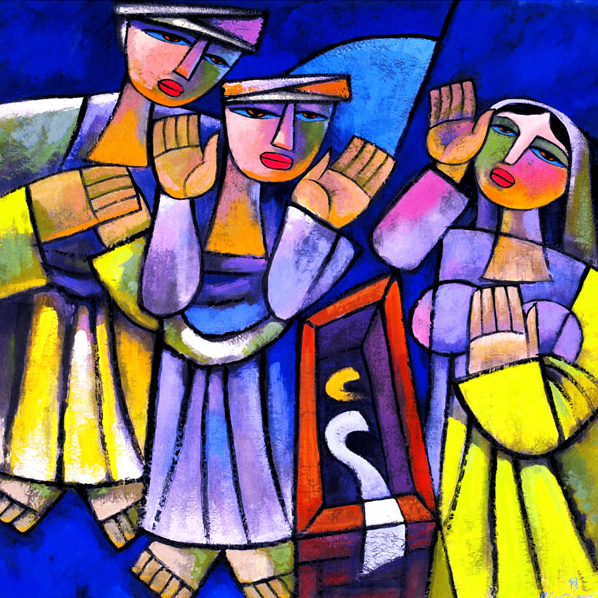
A painting in a style resembling stained glass of three women standing over a coffin, which is empty except for strips of white and yellow linen. The women's hands are raised in confusion and shock.
“The Empty Tomb” by He Qi.

Love wins, yet hate still holds us captive.

I’m grateful that Mark’s resurrection story is the one many of us are hearing in church this year. His version emphasizes the “already but not yet” experience of God’s liberation of which theologians write: Christians believe that in Christ’s incarnation — his life, death, and resurrection — all of humanity, all of Creation is already redeemed… and yet, we still experience suffering. The Kin(g)dom is already incoming, but not yet fully manifested.

Like Mark’s Gospel with its Easter joy overshadowed by ongoing fear, Trans Day of Visibility is fraught with the tension of, on the one hand, needing to be seen, to be known, to move society from awareness into acceptance into celebration; and, on the other hand, grappling with the increased violence and bigotry that a larger spotlight brings.

The trans community intimately understands the intermingling of life and death, joy and pain.

When we manage to roll back the stones on our tombs of silence and shame, self-loathing and social death, and stride boldly into new, transforming and transformative life — into trans joy! — death still stalks us.

We are blessedly, audaciously free — and we are in constant danger. There are many who would shove us back into our tombs.

An art piece structured like a collage featuring an elegant figure wreathed in fire, with text around them reading "& like any goddexx you are scorned & become the fire anyway." The figure is pouring pitchers of water into a pool at their feet; green hills with various flowers stretch up around the pool.
Art by Amir Khadar, based off the poem “litany in which you are still here” by kiki nicole

And of course, the trans community is by no means alone in experiencing the not-yet-ness of God’s Kin(g)dom.

Empire’s violence continues to overshadow God’s liberation.

The women who came to tend to their beloved dead initially experienced the loss of his body as one more indignity heaped upon them by Empire. Was his torture, their terror, not enough, that even their grief must be trampled upon, his corpse stolen away from them?

The people of Gaza are undergoing such horrors now. Indignity is heaped on indignity as they are bombed, assaulted, terrorized, starved, mocked. They are not given a moment’s rest to tend to their dead. They are not permitted to celebrate Easter’s joy as they deserve. They are forced to break their Ramadan fasts with little more than grass.

Photo of a blanket set with bowls of grass soup and slices of lemon
A photo of a Palestinian family’s meal, taken in Gaza.

Those of us who reside in the imperial core — as I do as a white Christian in the United States — must not look away from the violence our leaders are funding, enabling, justifying.

We must not celebrate God’s all-encompassing redemption without also bearing witness to the ways that liberation is not yet experienced by so many across the world.

This Easter, I pray for a free Palestine. I pray for an end to Western Empire, the severing of all its toxic tendrils holding the whole earth in a death grip.

I pray that faith communities will commit and recommit themselves to helping roll the stones of hate and fear away — and to eroding those stones into nothing, so they cannot be used to crush us once we’ve stepped into new life.

I pray for joy so vibrant it washes fear away, disintegrates all hatred into awe.

In the meantime, I pray for the energy and courage to bear witness to suffering; for the wisdom for each of us to discern our part in easing pain; for God’s Spirit to reveal Xirself to and among the world’s despised, over and over — till God’s Kin(g)dom comes in full at last.

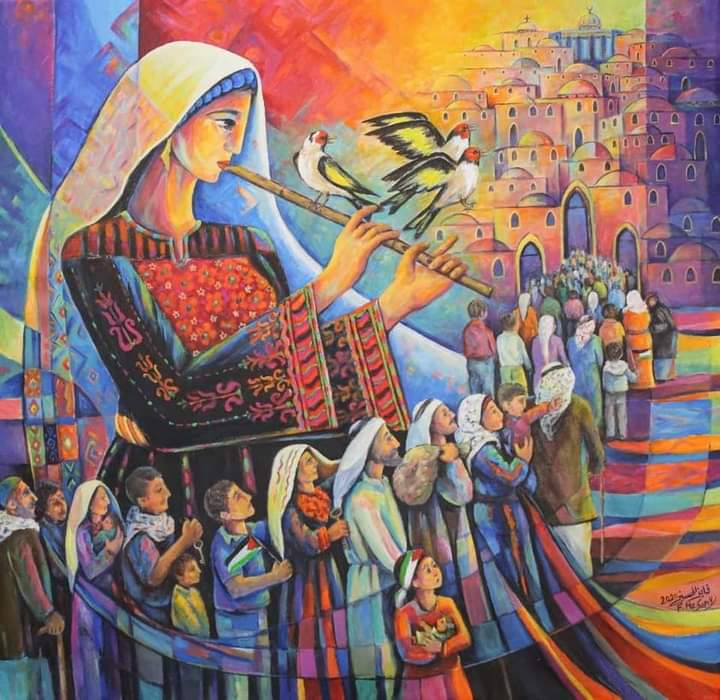
Painting of a woman playing a flute with several birds around her, as below her a line of Palestinians make their way up towards the city of Jerusalem. The colors are warm and bright.
Painting by Palestinian artist Fayez Al-Hasani
Categories
bible study Holy Days lent Reflections for worship services

Ash Wednesday, Isaiah 6, and the blessing in our limitations

Painting by Justin “JUST” Simmons.

The below reflection is cross-posted from Daily Ripple; see the end of this post for more information. Furthermore, if you prefer to listen instead of reading, you can listen to this piece in the latest episode of the Blessed Are the Binary Breakers podcast.

I said, “Mourn for me; I’m ruined! I’m a man with unclean lips, and I live among a people with unclean lips. Yet I’ve seen the king, the Lord of heavenly forces!”

Then one of the winged creatures flew to me, holding a glowing coal that ze had taken from the altar with tongs. Ze touched my mouth and said, “See, this has touched your lips. Your guilt has departed, and your sin is removed.”

Isaiah 6:5-7

Did the glowing coal leave a mark? A smear of dark? A bright burn?

Reading this text on Ash Wednesday, I can’t help but connect Isaiah’s coal and our ashy crosses:

He confesses himself unclean — admits his limits, where he and his people have failed.

We profess ourselves dust — acknowledge our limits, the finite time we have here and now, and how often we’ve failed to cherish that time.

In the confession, we open ourselves to blessing. Accepting our limits, we fall into God’s limitless love.

Why these physical, ritual actions — coal to the lips, ashes to the brow — to mark these limits and the blessings they yield?

God knows, respects, loves our existence as embodied spirits, inspirited bodies. She pairs spiritual gifts with tangible signs to help us experience Her truths with our whole selves.

A glowing coal — dead plants packed deep, transformed over eons, unburied at last and set alight — touches truth-telling lips to set them free.

Ashes of palm branches once waved in worship, burned down to begin the cycle anew, mark us as individually finite, but gathered into an infinite love.

Take time to prayerfully consider your own limits. What blessings, what liberation can you imagine flowing from our individual finitude? How can you connect your limited time and gifts to a greater whole, in small ways with great love?

Photo of a bowl of black ashes, with a small dried palm leaf cross in the middle of the ashes. The bowl sits on a green palm branch.

About Daily Ripple!

I am delighted to have joined the creative team at Daily Ripple — starting with posts this week, including what you just read!

If you want to incorporate queer-affirming, justice-oriented snippets of biblical reflection written by a diverse range of Christians into your everyday life, Daily Ripple is a lovely option. It’s free, and every weekday, subscribers receive a short reflection, ending with a question meant to guide you towards action. 

I’ve been writing the daily posts for this week, incorporating queer and autistic theology into readings of Psalm 119, Mark 4, and Isaiah 6. Check them all out at the Daily Ripple.

Categories
Current Events / Activism My poetry

“What words can do” — A poem for Palestine

Half a world away from me
they are killing a people they claim does not exist
using my taxes, my country’s ghoulish gifts —
our bullets and bone-eating phosphorous,
our bombs, and our blessing to use them ­—

they are killing the doctors to kill all hope of healing
they are killing the journalists to kill all calls for justice

and what can I do? With what can I fight
to end this nightmare I’m complicit in
by birthright?

All I have, it seems to me, are words.

I scrawl them on protest signs,
arrange them into stilted, inept poems,
deposit them into the answering machines
of politicians who persist
in signing over all our souls for oil.

they are killing the old women
with nothing left to their names
but tales of how things were

and, God! they are killing the children
who listen to the tales and spin
them into dreams of how things yet could be

And what, in God’s name, can I do? What
can all the words
winging forth from all the corners of the earth
do?

what dream can rise unscathed from so much ruin?
what song is not drowned out
by the drones’ constant humming?

I pull up a lecture by Refaat Alareer
who believed in the power of a poem

to soar above the rubble
crushing its poet’s corpse.

they are killing the poets
whose words are seeds are kites are embryonic deeds

In the lecture, his voice speaks
to me from beyond the grave, haunted
by that soft electric hum
endemic, it seems, to classrooms all over.

In the lecture, he is saying

there was an Israeli general
for whom one poem by Fadwa Tuqan
packed a punch more potent than the guns
of twenty enemy fighters.

In the lecture, he is pleading:

“Don’t ever say Tuqan was arrested
‘just’ for writing poems”

and how could I, how could I
do anything but promise him, “I won’t!”

when he himself was killed a month ago
“just” for nurturing the poems in others,
“just” for reeling those poems out,
slim and supple as kites, into the world?

what song or verse, what thin prophetic cry
can scale a wall eight meters high?
one built to be buffeted, bombed — and still fly.

In the lecture, he is promising

as long as we can imagine Palestine free,
we can unlock that future reality

from a classroom that is rubble now —
the IDF bombed his university in October.
They say it was an important Hamas site.

Maybe it was

or maybe it was a danger “just” because
its teachers, its students, kept slipping their poems
past checkpoint gates

filling the world with prophecies of freedom
that “just” might make
a battered but persistent people free.

they can kill children women journalists
they can kill doctors dreamers prophets poets
but still (we must believe!) the poem lives on.

So take up your pen, or take up Gaza’s song
and spread the word forth: Palestine lives on.


Please feel free to spread this poem around online or offline. Just credit Avery Arden of binarybreakingworship.com.

You can find me reciting this poem in video format on TikTok here and on Instagram here.

If you’re interested in more poetry for Palestine, check out my podcast episode here.

About this poem:

These last few months, I have been reading a great deal of Palestinian poetry. Poems are my heart’s language, and I have been deeply moved by the long proud history of Palestine’s resistance poets, who have used their art to defy the colonialist lie that there is no Palestinian people or culture. For decades, these poets have been targeted by Israel’s government because the power of their words cannot be denied.

Before he was killed by an Israeli airstrike on December 7, 2023, Professor Refaat Alareer was a professor of creative writing and world literature at the Islamic University of Gaza, where he worked to nurture his people’s creative powers and broadcast Palestinian poetry to the world through efforts like the We Are Not Numbers project.

Many of Alareer’s lectures are available on YouTube; around nine minutes into an introduction to poetry, he discusses how art helps us imagine what we have never experienced so that we can work to make those dreams reality. In it, he speaks to his students:

“We’ve never been to other parts of Palestine because of the Israeli occupation, but we’ve been told so many times by our parents and grandparents, especially our mothers, have been telling us stories about Palestine…the good old days how Palestine was, all nice and beautiful, unoccupied, un-raped… Our homeland turns into a story. In reality we can’t have it, we don’t have it. But it can turn into poems, into poetry, into literature, into stories.

So our homeland turns into a story. We love our homeland because of the story. …And we love the story because it’s about [class joins in] our homeland. And this connection is significant. Israel wants to sever this relationship between Palestinians and land, Palestinians and Jerusalem, and other places and cities. And literature attaches us back, connects us strongly to Palestine,…creating realities, making the impossible sound possible.”

When we look at the weapons the IDF wields, courtesy of imperialist powers like the United States, what are words? Why bother speak up? Alareer assures us that our words do matter. In the same lecture as above, he speaks of the Palestinian resistance poet Fadwa Tuqan (1917-2003), whom Israel arrested. Why, Alareer urges us to consider, would Israel feel so threatened by someone who wields no weapon but a pen?

“…We always fall into this trap of saying, ‘She [Fadwa Tuqan] was arrested for just writing poetry!’ …So we contradict ourselves sometimes; we believe in the power of literature changing lives as a means of resistance, as a means of fighting back, and then at the end of the day, we say, ‘She just wrote a poem!’ We shouldn’t be saying that.

Moshe Dayan, an Israeli general, said that ‘the poems of Fadwa Tuqan were like facing 20 enemy fighters.’ … And the same thing happened to Palestinian poet Dareen Tatour. She wrote poetry celebrating Palestinian struggle, encouraging Palestinians to resist, not to give up, to fight back. She was put under house arrest, she was sent to prison for years.

And therefore, I end here, with a very significant point: Don’t forget that Palestine was first and foremost occupied in Zionist literature and Zionist poetry. …It took them years — over 50 years — of thinking, of planning, all the politics, money and everything else. But literature played one of the most crucial roles here. …Palestine in Zionist Jewish literature was presented to the Jewish people around the world … [as] a land without a people to a people without a land. ‘Palestine flows with milk and honey. There’s no one there, so let’s go.’ … And there were people — there have always been people in Palestine. These are examples of how poetry can be a very significant part of life.”

Professor Refaat Alareer in a 2019 poetry lecture

It turns out that words are working — slowly but surely.

Since October 2023, the journalists and everyday people in Gaza who have been bravely broadcasting their stories to the world, and those across the world who have been spreading those stories, and organizing protests, and refusing to be silent in the face of government powers and heavy propaganda, are having an effect. Israel is concerned about its public image, which our collective words and actions are damaging.

So keep sharing Palestinians’ stories; keep writing; keep contacting your representatives; keep protesting.

We won’t stop till Palestine is free.

Categories
advent bible study Holy Days My poetry Queer Lectionary Reflections for worship services

Christ is barred from Bethlehem

A voice cries out in the wilderness,
“Prepare the way of the Lord! Make straight his paths.”

How do we do that in the present day?
We break down walls that block his family’s way.

As Mary and Joseph draw near Bethlehem
a fence looms over them, some eight yards high

and soldiers watch from towers as they trudge
not straight into the city, but around
to find the checkpoint — where they’re turned away:
“We’re only letting tourists in today.”

So Mary groans outside the barrier
no place to lay her newborn’s bloodied head

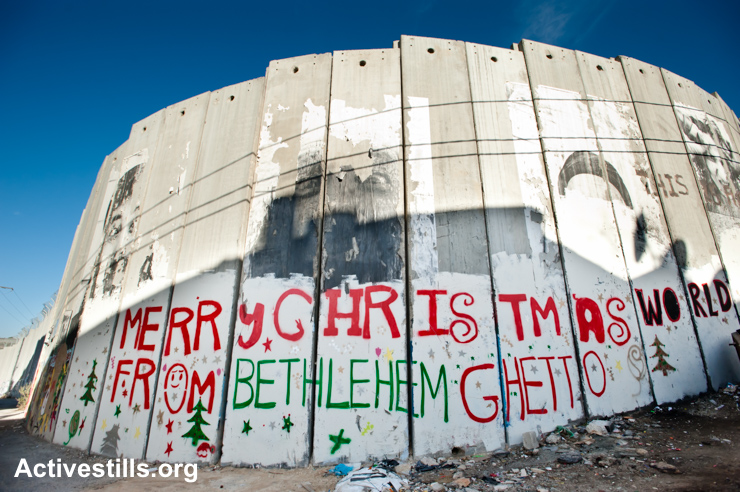
and John the Baptist paints in green and red
across that cold wall’s surface — shepherds, lo! —
“Merry Christmas world
from Bethlehem Ghetto”


You are welcome to make use of the above poem or below reflection in worship, in classrooms, on social media, etc. Please credit Avery Arden of binarybreakingworship.com.

_____

In a 2014 article, Medhi Hasan wonders how Mary and Joseph’s trip from Nazareth to Bethlehem would go in the modern day:

“How would that carpenter and his pregnant wife have circumnavigated the Kafka­esque network of Israeli settlements, roadblocks and closed military zones in the occupied West Bank? Would Mary have had to experience labor or childbirth at a checkpoint, as one in 10 pregnant Palestinian women did between 2000 and 2007 – resulting in the death of at least 35 newborn babies, according to the Lancet?

‘If Jesus were to come this year, Bethlehem would be closed,’ declared Father Ibrahim Shomali, a Catholic priest of the city’s Beit Jala parish, in December 2011. ‘Mary and Joseph would have needed Israeli permission – or to have been tourists.’ “

Meanwhile, a Reddit post claims they’d have to get through fifteen checkpoints on their journey. Chances are, they wouldn’t make it through — just get harassed and interrogated for their trouble.

As I reflect on these statements, I ponder also the opening of Mark’s Gospel. This text, which is read in many churches during the Advent season, recalls the prophetic cry of Isaiah 40:

A voice is crying out:
“Clear the Lord’s way in the desert!
    Make a level highway in the wilderness for our God!
Every valley will be raised up,
    and every mountain and hill will be flattened.
    Uneven ground will become level,
    and rough terrain a valley plain.
The Lord’s glory will appear,
    and all humanity will see it together;
    the Lord’s mouth has commanded it.”

What does such a prophetic leveling — a flattening of land so that all people, including children, elderly and pregnant persons, and people with mobility impairments can easily travel — look like today?

I envision the 440 miles of separation wall crumbling into the earth. Watchtowers topple. Barbed wire melts away. Snipers’ guns morph into ploughshares; bombs explode oh-so-gently into fertilizer to feed burned olive groves.

No more are humans caged in the world’s largest open-air prison. No more are children dragged away in the night to be tortured and tried as terrorists.

The land is free. The people are free. God’s liberating Spirit moves unhindered; God’s holy land becomes, as promised, a “house of prayer for all peoples” (Isaiah 56:7).

Thanks be to God. May we be moved to help make it so.

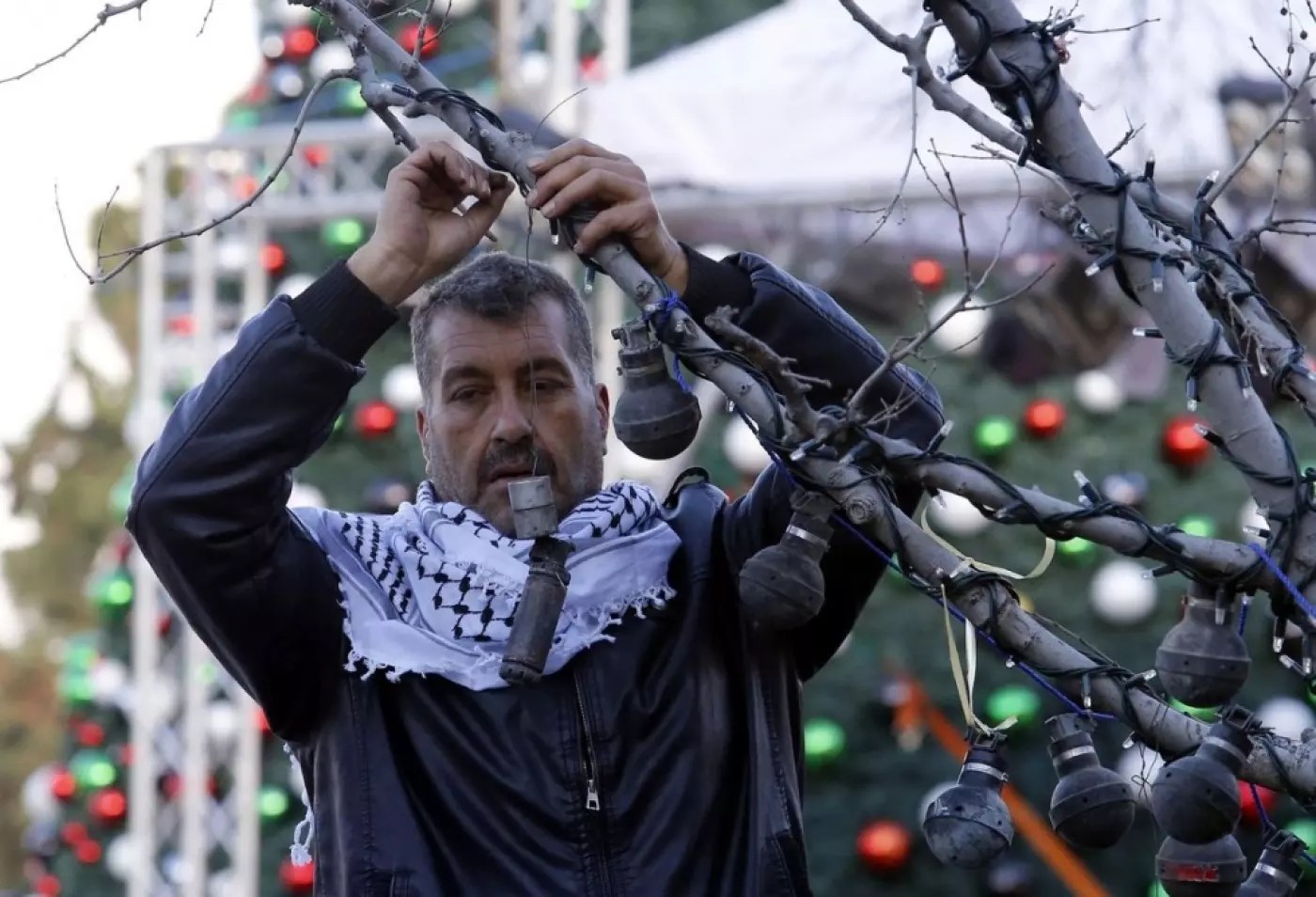
  • A person wearing a keffiyeh secures tear gas canisters to a tree, with normal Christmas ornaments visible on trees behind him
  • A person secures tear gas canisters to a tree with Christmas lights on it

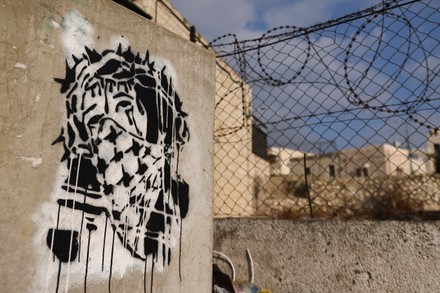
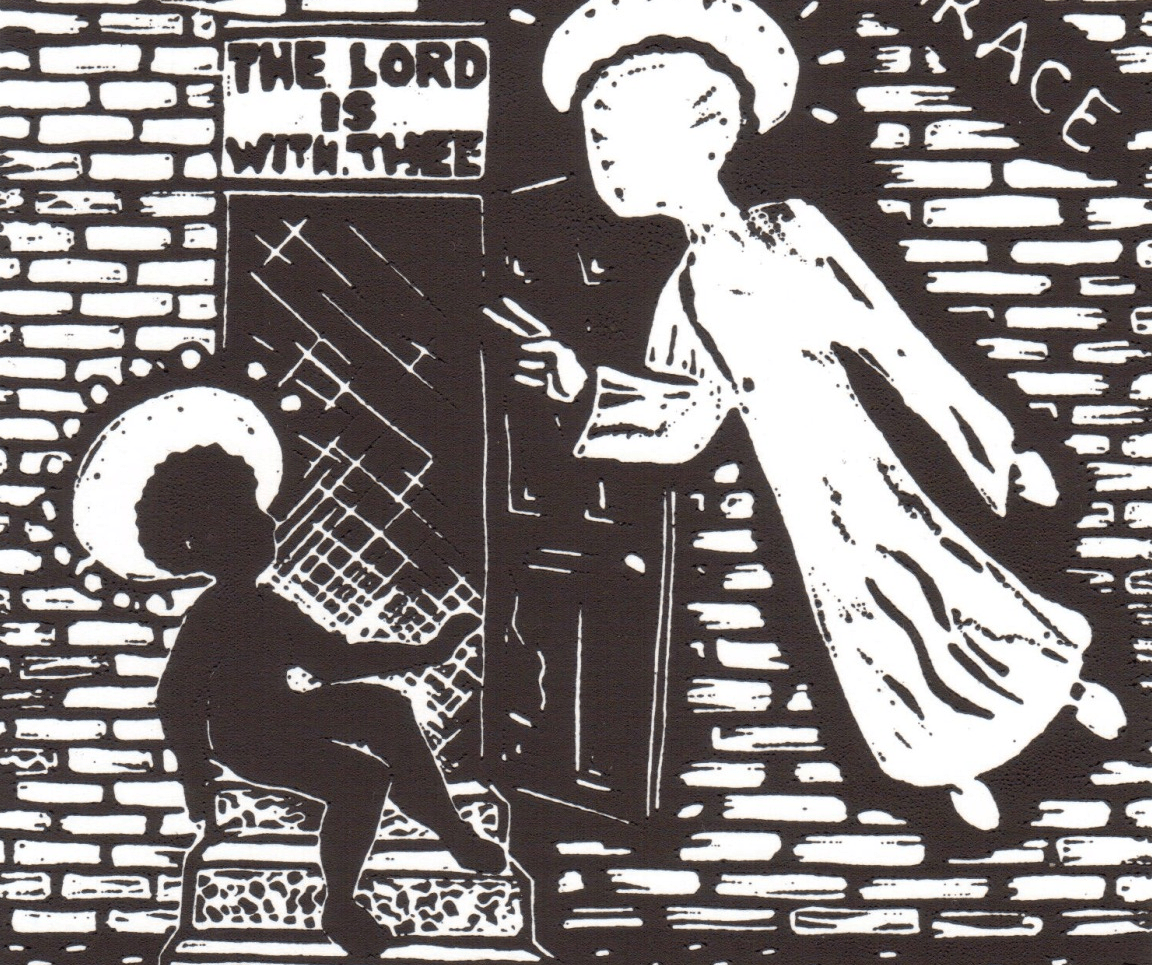
Gallery images: a remake of a famous 1936 “Visit Palestine” poster to show the Holy Family and the separation wall; photos of Palestinians decorating a tree in Bethlehem with tear gas canisters in 2015, as well as a close-up of a canister showing it’s USA-made; and more photos from the separation wall, including the icon “Our Lady of the Wall,” where nuns and pilgrims pray rosaries to dismantle the wall.

Categories
advent Holy Days Hymns Other search markers Unpacking Antisemitism

“O Come Emmanuel” revised for Palestine’s plight

This Advent, some progressive Christians have discussed whether to table one of our religion’s most ancient hymns: “O Come, O Come Emmanuel.” When we sing of God coming to “ransom captive Israel,”
will our congregations recognize we don’t mean the modern Israeli nation?

Honestly, a conversation around this song is long past due (and many have had it over the decades). The truth is, it’s always been laden with supersessionist implications. Depicting the Jewish people as living “in lonely exile here / Until the son of God appear” perpetuates the idea that Jews’ relationship with God is incomplete because they “didn’t accept” Jesus as their Messiah.

How do we resist both antisemitism and Zionism, while seeking to maintain a connection to Christians who came before us? One option may be to reimagine the songs we cherish so that, instead of perpetuating deep-seated hate and Christian supremacy, they challenge us towards joining God in solidarity with the world’s oppressed.

In that spirit, below is my reworking of “O Come Emmanuel” to center the plight of Palestinians (and that removes, I hope, the supersessionism — let me know if I missed any). May our worship songs plant in us a deep desire for justice, and spark our action towards a future where all peoples, all religions live in mutual relationship and respect.

Please feel free to use and share around — just credit Avery Arden of binarybreakingworship.com.

__

O come, o come compassionate Divine,
And ransom captive Palestine
That mourns with tears that will not be soothed
Till empires fall and nations’ hearts are moved.

Rejoice! Rejoice! God’s justice is at hand
To liberate the people and the land.


O come, o bright and ever-burning star;
Bring Gaza comfort from afar!
Dispel from her the shadow of death
That murders dignity and chokes out breath.

Rejoice! Rejoice! God’s justice is at hand
To liberate the people and the land.


O come, o Wisdom from on high,
Take up the outcast’s cause, the captive’s cry.
Guide us to build your kingdom on earth
Where all faiths flourish, and the last are first.

Rejoice! Rejoice! God’s justice is at hand
To liberate the people and the land.


O come, o King of Peace and Justice, break
All weapons down, and from them ploughshares make.
Let all tears dry, all peoples respond:
“We are each other’s magnitude and bond.”

Rejoice! Rejoice! God’s justice is at hand
To liberate the people and the land.

Categories
advent Holy Days My poetry

Poem: Advent in (another) genocide

This poem came to me after learning that Christian leaders in the Holy Land have asked churches not to organize any “unnecessarily festive” activities, in solidarity with Gaza; as well as seeing the Nativity scene set among rubble in the Lutheran Church of Bethlehem this year.

Find resources on what’s happening in Palestine and how to help below the poem.

Please feel free to share around; credit to Avery Arden (they/them) with a link to binarybreakingworship.com.


This year, Mary is just one of many
Palestinians failing to find
a safe place to give birth.

This year, Jesus is just one
of countless born
into rubble.

This year, the newborn Christ

dies 

his little body bombed
and tossed aside
into the growing pile.

This time, Jesus never makes it to adulthood —
doesn’t even make it the eight days to circumcision.
He doesn’t die a grown man
making a conscious choice
to defy Empire armed with naught but dreams

of a world where all the nations live as one
where last are first 
and all wars done —

No. This year, his newborn life is threat enough —
his family’s mere existence is rebellion enough  —
to warrant eradication.

Actually, it was then, too, two thousand years ago
— for Empire always fears the ones it grinds
beneath its millstone — back then, though
Christ’s parents found safe passage into Egypt —

now, snipers shoot them as they try
to leave the hospital that scarce had room
for one more woman’s labor cries.

Stigmata are
that much more
chilling between
an infant’s eyes.

And now, as then, some may blame Jesus’s death
on his own Jewish people — but
resist this lie! Now, as then,
the crime is Empire’s

with Western Christians at the helm

and those who would cast stones, look first
for your own nation’s name etched on the bombs
and tear gas canisters!

And, God,
if there is any hope at all
to wrestle from the rubble

as churches all across the Holy Land
close their doors to Christmas joy this year —
a holy choice to mourn with those who mourn
as Christ’s homeland is made a massive grave —

it’s this: there are still children left to save.

It’s this: not every olive branch has burned.

It’s this: the sacred promise of a God
who dies whenever Empire’s outcasts die —
that those cast down 

will rise.

Palestine, Palestine! I swear we will not cease
to shout your name until, at last, your streets
sing with your children’s laughter, loud and free.

– Avery Arden


Notes on this poem

I am writing this note after revising some middle portions of this poem, and coming away still unhappy with the results.

As a Christian who believes that God expresses a solidarity with the oppressed so strong and intimate that They are literally one with every oppressed person, I cannot help but recognize Christ within the people being killed and expelled from their homes in Gaza right now. Christ is there among them, and that means he is among their dead as well as their displaced.

As the Rev. Munther Isaac of the Evangelical Lutheran Church in Bethlehem on the West Bank preached in October,

“God suffers with the people of this land, sharing the same fate with us. …God is under the rubble in Gaza. He is with the frightened and the refugees. He is in the operating room. This is our consolation. He walks with us through the valley of the shadow of death. …”

For Christians like Rev. Isaac, Christ’s intimate identification with those the world calls least, those whom Empire threatens to eradicate, is central to any sense of comfort they may have in the face of so much devastation. It’s also central to my own faith and personal understanding of the Divine.

Yet in this context, because modern-day Israel is a Jewish state, exploring that Divine solidarity comes with a great risk of perpetuating the long, harmful history of antisemitic blood libel and accusations of deicide. How do we affirm God’s presence with those suffering in Palestine without (implicitly or explicitly) adding to the poisonous lie that “the Jews killed Jesus”?

In wrestling with this complexity, I tried to write this poem to uplift both Jesus’s Jewishness and his solidarity with Palestinians. Jesus was born into a Jewish family, his entire worldview was shaped by his Jewishness, and he shared in his people’s suffering under the Roman Empire. His solidarity with Palestinians of various faiths suffering today does not erase that Jewishness. Nor does it mean that Jewish persons don’t “belong” in the region — only that modern Israel’s occupation of Palestine is in no way necessary for Jews to live and thrive there, or anywhere else in the world.

I also aimed to point out (sacrificing poetic flow to do so, lol) that Israel is by no means acting alone in this attack on Gaza or their decades-long occupation of Palestine. There is a much larger Empire at work, with my own country, the United States, as one of the nations at the helm. Israel is entangled in that imperial mess, and directly backed and funded by those forces — not because of what politicians claim, that we have to back Israel or else we’re antisemitic, but because Israel is our strategic foothold in the so-called Middle East. How do we name our complicity as our tax dollars are funneled into violence across the world, and act to end that violence?

Ultimately, I don’t know that this poem is a successful one. I don’t know if it avoids perpetuating harm. If nothing else, I hope it sparks conversation about resisting antisemitism as much as we resist Zionism.


Palestine Resources

HISTORY

CURRENT EVENTS

DREAMING OF A BETTER FUTURE

WAYS TO HELP

  • Urge your University/School/Organization to put out a statement denouncing Israel
  • Organize a Protest/Participate in a local one
  • While calling your reps, tell them that as a voter, you’re unwilling to support them in the upcoming election unless they urge the White House to take a stand against Israel and stop funding them
  • Share art/writing/films around Palestinian culture (see this tumblr post for Palestinian media to watch; I also recommend Oriented (2015) for an un-pinkwashed queer Palestinian story)
  • If you’re part of a union, ask them what they’re doing to urge their industry leaders to take a stand against Israel + pressure the White House OR urge them to start a strike/walkout/etc if they’re not doing anything already
  • Talk with your friends IRL about Palestine; keep spreading information on social media — don’t let talk of Palestine die down!
  • See if your city/state council has put out a statement in support of Gazans. If not, try to push them to do so.