Categories
bible study Current Events / Activism easter Holy Days LGBT/queer Queer Lectionary Reflections for worship services

Today is Easter Sunday. Today is Trans Day of Visibility. Today is day 176 of genocide.

This year the lectionary gives us Mark’s account of the Resurrection, with its fearful cliffhanger ending — an empty tomb, but Jesus’s body missing. And isn’t that unresolved note fitting?

In the face of so much suffering across the world, it feels right to be compelled to sit — even on this most jubilant of days — with the poor and disenfranchised in their continued suffering.

Mark’s account:

Just days before, the women closest to Jesus witnessed him slowly suffocate to death on a Roman cross. Now, now trudge to his tomb to anoint his corpse — and find the stone rolled away, his body gone. A strange figure inside tells them that Jesus is has risen, and will reunite with them in Galilee.

They respond not with joy, but trembling ekstasis — a sense of being beside yourself, taken out of your own mind with shock. They flee.

The women keep what they’ve seen and heard to themselves — because their beloved friend outliving execution is just too good to be true. When does fortune ever favor those who languish under Empire’s shadow?
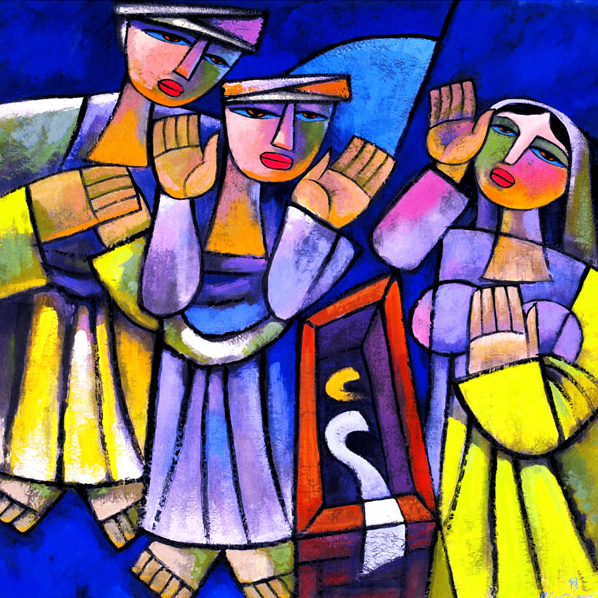
A painting in a style resembling stained glass of three women standing over a coffin, which is empty except for strips of white and yellow linen. The women's hands are raised in confusion and shock.
“The Empty Tomb” by He Qi.

Love wins, yet hate still holds us captive.

I’m grateful that Mark’s resurrection story is the one many of us are hearing in church this year. His version emphasizes the “already but not yet” experience of God’s liberation of which theologians write: Christians believe that in Christ’s incarnation — his life, death, and resurrection — all of humanity, all of Creation is already redeemed… and yet, we still experience suffering. The Kin(g)dom is already incoming, but not yet fully manifested.

Like Mark’s Gospel with its Easter joy overshadowed by ongoing fear, Trans Day of Visibility is fraught with the tension of, on the one hand, needing to be seen, to be known, to move society from awareness into acceptance into celebration; and, on the other hand, grappling with the increased violence and bigotry that a larger spotlight brings.

The trans community intimately understands the intermingling of life and death, joy and pain.

When we manage to roll back the stones on our tombs of silence and shame, self-loathing and social death, and stride boldly into new, transforming and transformative life — into trans joy! — death still stalks us.

We are blessedly, audaciously free — and we are in constant danger. There are many who would shove us back into our tombs.

An art piece structured like a collage featuring an elegant figure wreathed in fire, with text around them reading "& like any goddexx you are scorned & become the fire anyway." The figure is pouring pitchers of water into a pool at their feet; green hills with various flowers stretch up around the pool.
Art by Amir Khadar, based off the poem “litany in which you are still here” by kiki nicole

And of course, the trans community is by no means alone in experiencing the not-yet-ness of God’s Kin(g)dom.

Empire’s violence continues to overshadow God’s liberation.

The women who came to tend to their beloved dead initially experienced the loss of his body as one more indignity heaped upon them by Empire. Was his torture, their terror, not enough, that even their grief must be trampled upon, his corpse stolen away from them?

The people of Gaza are undergoing such horrors now. Indignity is heaped on indignity as they are bombed, assaulted, terrorized, starved, mocked. They are not given a moment’s rest to tend to their dead. They are not permitted to celebrate Easter’s joy as they deserve. They are forced to break their Ramadan fasts with little more than grass.

Photo of a blanket set with bowls of grass soup and slices of lemon
A photo of a Palestinian family’s meal, taken in Gaza.

Those of us who reside in the imperial core — as I do as a white Christian in the United States — must not look away from the violence our leaders are funding, enabling, justifying.

We must not celebrate God’s all-encompassing redemption without also bearing witness to the ways that liberation is not yet experienced by so many across the world.

This Easter, I pray for a free Palestine. I pray for an end to Western Empire, the severing of all its toxic tendrils holding the whole earth in a death grip.

I pray that faith communities will commit and recommit themselves to helping roll the stones of hate and fear away — and to eroding those stones into nothing, so they cannot be used to crush us once we’ve stepped into new life.

I pray for joy so vibrant it washes fear away, disintegrates all hatred into awe.

In the meantime, I pray for the energy and courage to bear witness to suffering; for the wisdom for each of us to discern our part in easing pain; for God’s Spirit to reveal Xirself to and among the world’s despised, over and over — till God’s Kin(g)dom comes in full at last.
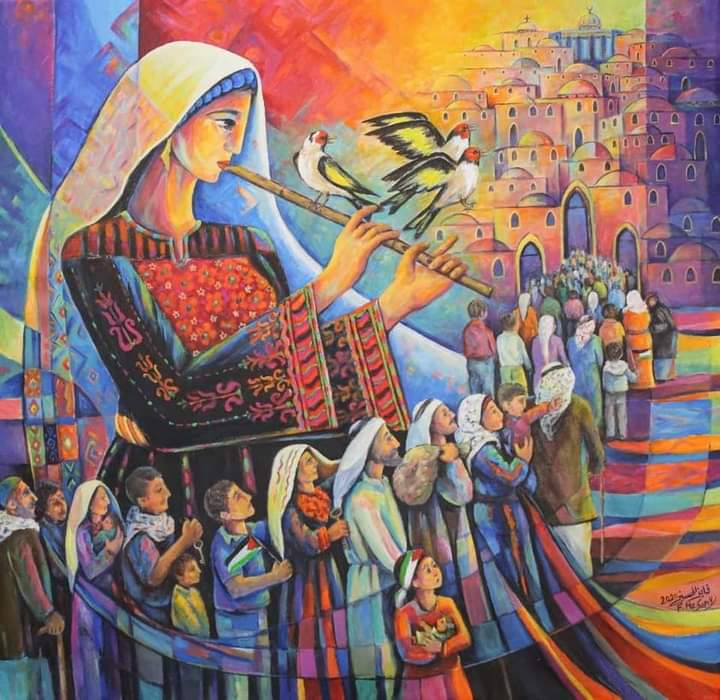
Painting of a woman playing a flute with several birds around her, as below her a line of Palestinians make their way up towards the city of Jerusalem. The colors are warm and bright.
Painting by Palestinian artist Fayez Al-Hasani
Categories
advent Holy Days My poetry

Poem: Advent in (another) genocide

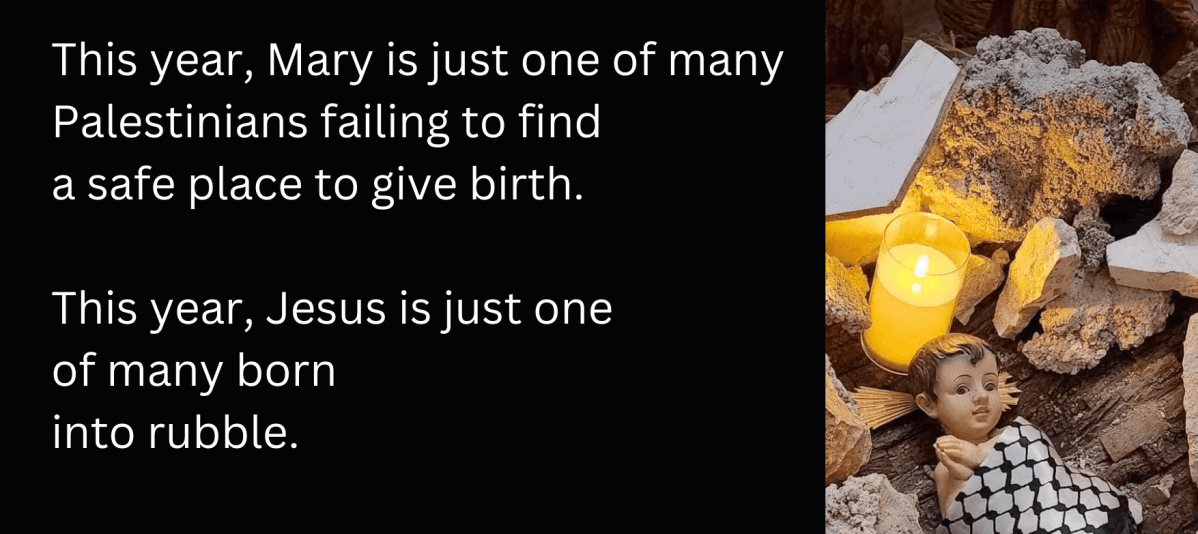
This poem came to me after learning that Christian leaders in the Holy Land have asked churches not to organize any “unnecessarily festive” activities, in solidarity with Gaza; as well as seeing the Nativity scene set among rubble in the Lutheran Church of Bethlehem this year.

Find resources on what’s happening in Palestine and how to help below the poem.

Please feel free to share around; credit to Avery Arden (they/them) with a link to binarybreakingworship.com.


This year, Mary is just one of many
Palestinians failing to find
a safe place to give birth.

This year, Jesus is just one
of countless born
into rubble.

This year, the newborn Christ

dies 

his little body bombed
and tossed aside
into the growing pile.

This time, Jesus never makes it to adulthood —
doesn’t even make it the eight days to circumcision.
He doesn’t die a grown man
making a conscious choice
to defy Empire armed with naught but dreams

of a world where all the nations live as one
where last are first 
and all wars done —

No. This year, his newborn life is threat enough —
his family’s mere existence is rebellion enough  —
to warrant eradication.

Actually, it was then, too, two thousand years ago
— for Empire always fears the ones it grinds
beneath its millstone — back then, though
Christ’s parents found safe passage into Egypt —

now, snipers shoot them as they try
to leave the hospital that scarce had room
for one more woman’s labor cries.

Stigmata are
that much more
chilling between
an infant’s eyes.

And now, as then, some may blame Jesus’s death
on his own Jewish people — but
resist this lie! Now, as then,
the crime is Empire’s

with Western Christians at the helm

and those who would cast stones, look first
for your own nation’s name etched on the bombs
and tear gas canisters!

And, God,
if there is any hope at all
to wrestle from the rubble

as churches all across the Holy Land
close their doors to Christmas joy this year —
a holy choice to mourn with those who mourn
as Christ’s homeland is made a massive grave —

it’s this: there are still children left to save.

It’s this: not every olive branch has burned.

It’s this: the sacred promise of a God
who dies whenever Empire’s outcasts die —
that those cast down 

will rise.

Palestine, Palestine! I swear we will not cease
to shout your name until, at last, your streets
sing with your children’s laughter, loud and free.

– Avery Arden


Notes on this poem

I am writing this note after revising some middle portions of this poem, and coming away still unhappy with the results.

As a Christian who believes that God expresses a solidarity with the oppressed so strong and intimate that They are literally one with every oppressed person, I cannot help but recognize Christ within the people being killed and expelled from their homes in Gaza right now. Christ is there among them, and that means he is among their dead as well as their displaced.

As the Rev. Munther Isaac of the Evangelical Lutheran Church in Bethlehem on the West Bank preached in October,

“God suffers with the people of this land, sharing the same fate with us. …God is under the rubble in Gaza. He is with the frightened and the refugees. He is in the operating room. This is our consolation. He walks with us through the valley of the shadow of death. …”

For Christians like Rev. Isaac, Christ’s intimate identification with those the world calls least, those whom Empire threatens to eradicate, is central to any sense of comfort they may have in the face of so much devastation. It’s also central to my own faith and personal understanding of the Divine.

Yet in this context, because modern-day Israel is a Jewish state, exploring that Divine solidarity comes with a great risk of perpetuating the long, harmful history of antisemitic blood libel and accusations of deicide. How do we affirm God’s presence with those suffering in Palestine without (implicitly or explicitly) adding to the poisonous lie that “the Jews killed Jesus”?

In wrestling with this complexity, I tried to write this poem to uplift both Jesus’s Jewishness and his solidarity with Palestinians. Jesus was born into a Jewish family, his entire worldview was shaped by his Jewishness, and he shared in his people’s suffering under the Roman Empire. His solidarity with Palestinians of various faiths suffering today does not erase that Jewishness. Nor does it mean that Jewish persons don’t “belong” in the region — only that modern Israel’s occupation of Palestine is in no way necessary for Jews to live and thrive there, or anywhere else in the world.

I also aimed to point out (sacrificing poetic flow to do so, lol) that Israel is by no means acting alone in this attack on Gaza or their decades-long occupation of Palestine. There is a much larger Empire at work, with my own country, the United States, as one of the nations at the helm. Israel is entangled in that imperial mess, and directly backed and funded by those forces — not because of what politicians claim, that we have to back Israel or else we’re antisemitic, but because Israel is our strategic foothold in the so-called Middle East. How do we name our complicity as our tax dollars are funneled into violence across the world, and act to end that violence?

Ultimately, I don’t know that this poem is a successful one. I don’t know if it avoids perpetuating harm. If nothing else, I hope it sparks conversation about resisting antisemitism as much as we resist Zionism.


Palestine Resources

HISTORY

CURRENT EVENTS

DREAMING OF A BETTER FUTURE

WAYS TO HELP

  • Urge your University/School/Organization to put out a statement denouncing Israel
  • Organize a Protest/Participate in a local one
  • While calling your reps, tell them that as a voter, you’re unwilling to support them in the upcoming election unless they urge the White House to take a stand against Israel and stop funding them
  • Share art/writing/films around Palestinian culture (see this tumblr post for Palestinian media to watch; I also recommend Oriented (2015) for an un-pinkwashed queer Palestinian story)
  • If you’re part of a union, ask them what they’re doing to urge their industry leaders to take a stand against Israel + pressure the White House OR urge them to start a strike/walkout/etc if they’re not doing anything already
  • Talk with your friends IRL about Palestine; keep spreading information on social media — don’t let talk of Palestine die down!
  • See if your city/state council has put out a statement in support of Gazans. If not, try to push them to do so.