Categories
advent Christmas Holy Days LGBT/queer Liturgy Other search markers

Advent/Christmas Resources

Greetings, it’s been a while and Advent is soon upon us!

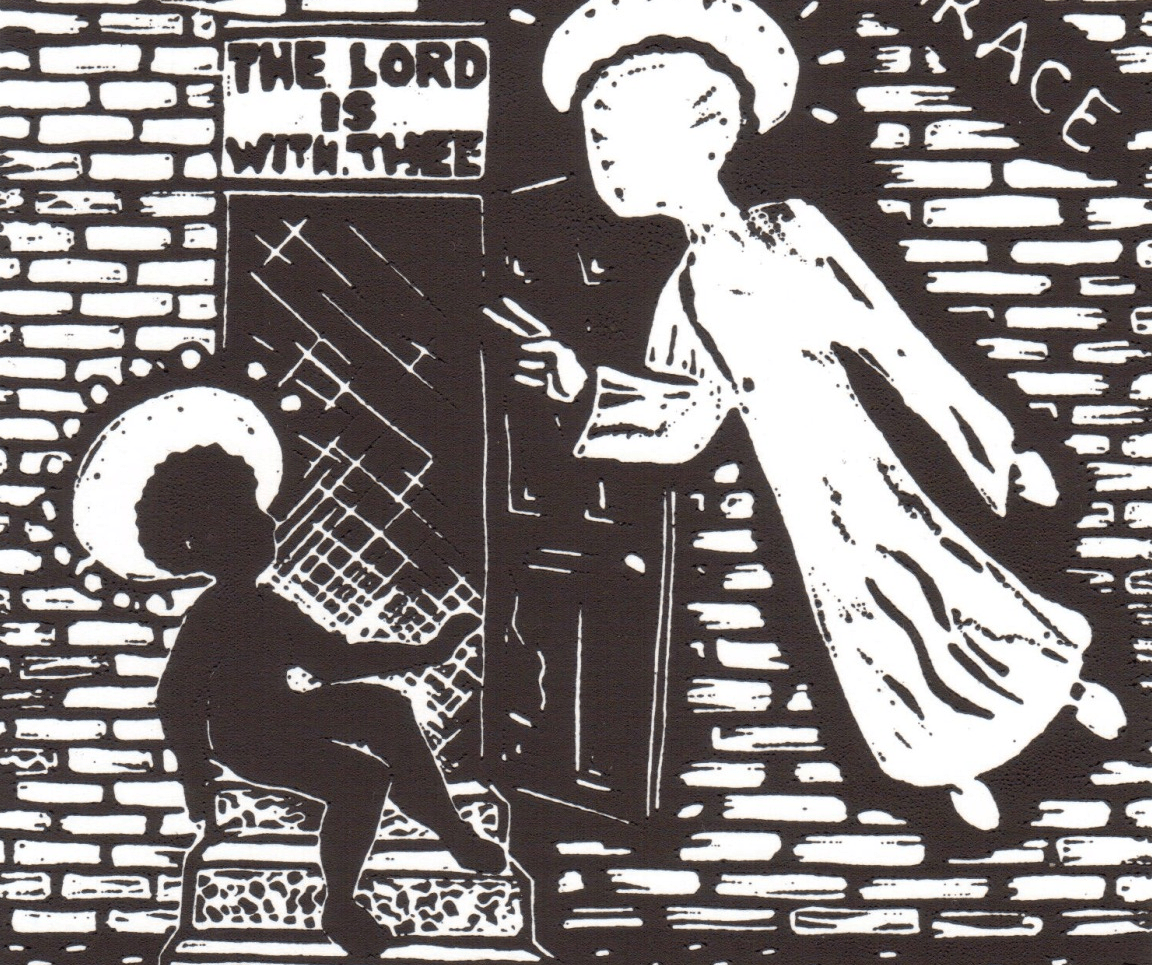
Black and white linocut of an angel appearing to Mary, who is depicted only in sillhouette but who as an afro hairstyle. She sits on a stoop outside a brick wall. Text above and below reads out the first part of the Hail Mary prayer: Hail Mary, full of grace, the Lord is with thee. Blessed art thou among women and blessed is the fruit of thy womb Jesus.
Annunciation, 2015” by Ben Wildflower

In Advent, God’s Spirit comes in dreams,
daring us to conceive of impossible things:
that wolf and lamb
might live in harmony;
that the world’s despised
might rise to greatest glory;
that war-torn wastes might bloom
and grow good fruit.
– my writing in Call to Worship 59.1

Then on to Christmas, when we celebrate how (to paraphrase Saint Athanasius) the divine became human so that humans might become divine.

At Christmas, Creation sings a new song;
God’s prophets proclaim good news:
The Word of God
has put on flesh
so that we may put on divinity.
Through Jesus, our newborn brother,
we are adopted into God’s chosen family.

– my writing in Call to Worship 59.1

In preparation for this holy time of the year, I want to share several resources created for Advent / Christmas 2025 that I had the honor of being part of.

First is More Light Presbyterians’ Advent devotional!

This resource offers a ~100 word devotion for every day of Advent. They will be posted daily on MLP’s Instagram and Facebook pages. It’ll also be published all at once in MLP’s monthly newsletter for December; sign up to receive it here.

Next, there’s Unbound’s Trans Advent/Christmas devotional!

Along with an Advent calendar that lists a trans organization or trans activist for each day of the season, Unbound’s devotional provides a reflection by a trans author for every Sunday & special day of Advent & Christmas. It’s a fantastic resource for communities or individuals who are hoping to queer up this season.

Click this readmore for a snippet of my reflection on the second Sunday of Christmas.

In the beginning, God spoke the Word; and God was the Word; and God was the breath that pushed that Word out into the void to spark life.

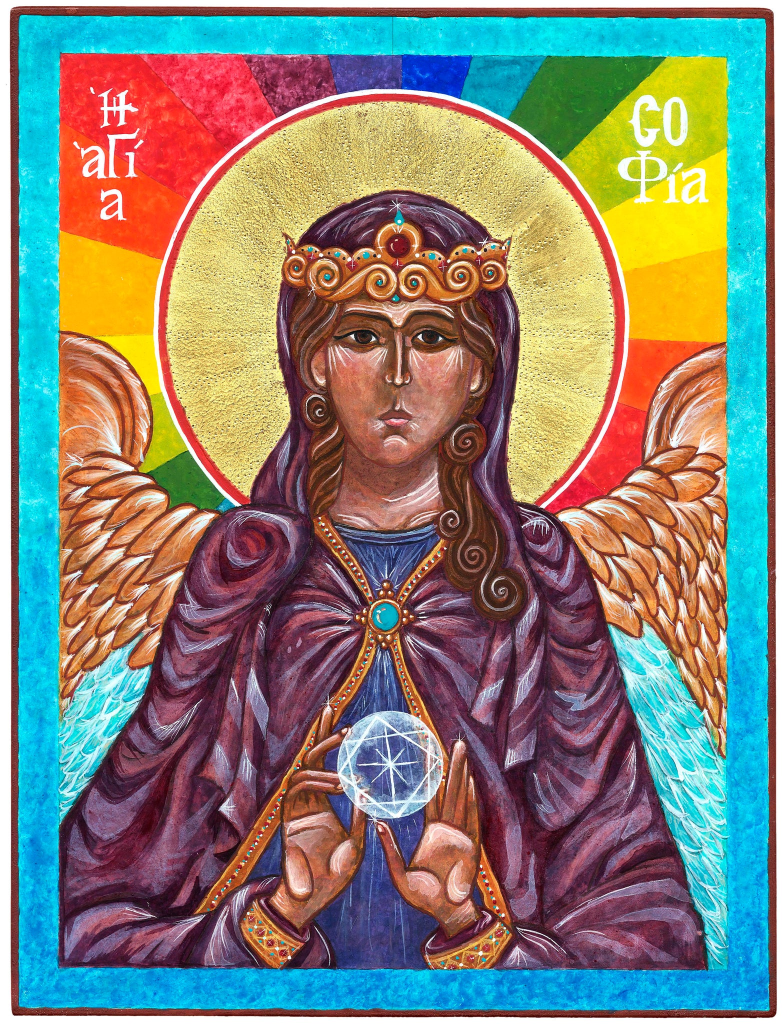
In the beginning was Wisdom, flowing forth from God’s mouth to unfurl Herself across the earth, seeking out those who’d welcome Her peculiar gifts.

Starting with Paul, who identified Christ as “the wisdom of God” (1 Cor 1:24), Christians have traditionally connected the Hebrew scriptures’ personified Wisdom — often called Sophia, the Greek word for wisdom — with Jesus. Yet while the Word took on a human body whose features led those present at Their birth to declare, “It’s a boy!”, Wisdom is described — and speaks of Herself — in feminine terms.

Sophia, Woman Wisdom, assigned male at birth! Now that’s a trans story if I ever heard one. […]

And yet…I still default to thinking of Jesus as male. Why, when many of us have expanded our language for God beyond exclusively masculine terms, does it still feel strange — even inappropriate — to speak of the Person of God who is Jesus as she or they?

…It’s the physical body, isn’t it? In many ways, Jesus is as constrained by his (/her/their/zir…) assigned gender as the rest of us.

From birth, we are bombarded by messages telling us that our flesh is our gender — that, as feminist philosopher Simone de Beauvoir put it, “biology is destiny.” From the moment the Word put on flesh, that flesh (or our assumptions about it, because the Gospels don’t actually tell us much about Jesus’s physical appearance beyond what we can deduce from his circumcision in Luke 2) sealed Their fate: Creator God can exist beyond human labels, and the Spirit is, well, Spirit; but God the Son is a human man.

But trans folk know deep in our bones that biology is not destiny. Trans wisdom cuts through the bonds of the binary’s imposed futures, freeing all of us to imagine new possibilities…and, sometimes, to remember old ones. [… read the full thing here]

Also check out Advent & Christmas liturgy in Call to Worship!

I wrote liturgy based on the Common Revised Lectionary for every Sunday and holy day of Advent 2025 and Christmas 2025/2026.

This liturgy is in many ways more “subtly queer” than Unbound’s devotional, as I wrote it to fit a broader range of contexts and church communities. However, I was delighted by the authorial freedom Call to Worship gave me; along with sticking to inclusive language for people (e.g. saying “siblings” instead of “brothers and sisters”), I was able to employ expansive language and pronouns for God! I also incorporate a lot of liberationist theology, from Ada María Isasi-Díaz’s concept of the Kin-dom of God to prayers emphasizing the goodness of embodied life.

To access all the Advent and Christmas material, you may need to subscribe to Call to Worship. If you are unable to do so, email me at queerlychristian36@gmail.com and I’ll get the material to you.

In the meantime, click this readmore for a sampling.

Fantastically scandalous God,
in being born into human life
you burst through the rigid binary between
worshiper and deity, Creator and creation.
Inspire us to proclaim your astonishing news
wherever we go — not only with words,
but through actions of justice and love.
Push us to prophecy
against hoarding and exploitation;
Empower us to rise up
with oppressed peoples everywhere;
Illuminate our path
as we tend to your poisoned planet,
so that all Creation may feel your embrace through us —
your hands, your feet, your body here on earth. Amen.

TWIBAR’s annual Christmas episode

Every Christmas, The Word in Black and Red podcast puts out an episode featuring the short reflections of largely Christian leftists; I’m one of them! Keep an eye out for the episode on the podcast feed.

digital art of a young Latino couple outside a convenient store in the rain; José is using a payphone while Maria, in a hoodie and visibly pregnant, sits on a toy horse
José y María by Everett Patterson

Other resources

I’m not part of these, but I always recommend the following resources:

  • Enfleshed – spiritual nourishment for collective liberation
  • A Sanctified Art – especially the illustrations they offer for Advent and for Christmas
  • I can’t recommend Cole Arthur Riley’s writings enough; check her out @blackliturgies on Instagram, Facebook, etc.

What about you? What are your favorite liberationist resources for Advent and Christmas?

Categories
advent bible study Holy Days My poetry Queer Lectionary Reflections for worship services

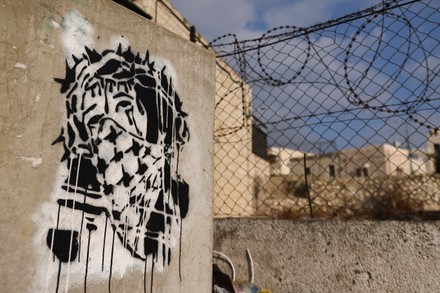
Christ is barred from Bethlehem

A voice cries out in the wilderness,
“Prepare the way of the Lord! Make straight his paths.”

How do we do that in the present day?
We break down walls that block his family’s way.

As Mary and Joseph draw near Bethlehem
a fence looms over them, some eight yards high

and soldiers watch from towers as they trudge
not straight into the city, but around
to find the checkpoint — where they’re turned away:
“We’re only letting tourists in today.”

So Mary groans outside the barrier
no place to lay her newborn’s bloodied head

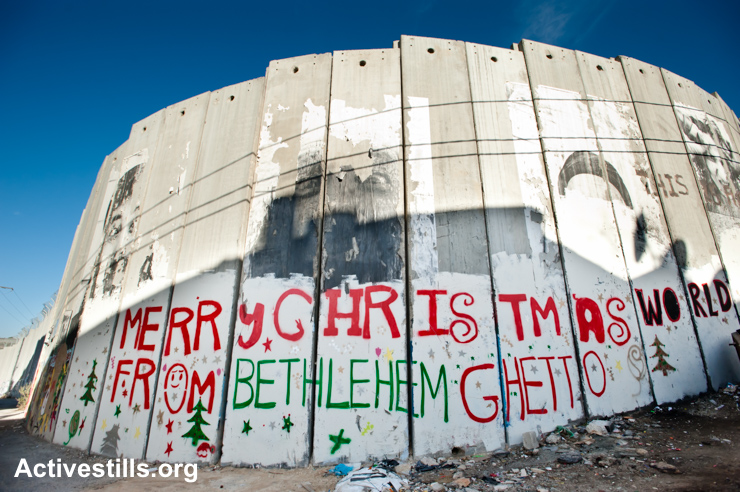
and John the Baptist paints in green and red
across that cold wall’s surface — shepherds, lo! —
“Merry Christmas world
from Bethlehem Ghetto”


You are welcome to make use of the above poem or below reflection in worship, in classrooms, on social media, etc. Please credit Avery Arden of binarybreakingworship.com.

_____

In a 2014 article, Medhi Hasan wonders how Mary and Joseph’s trip from Nazareth to Bethlehem would go in the modern day:

“How would that carpenter and his pregnant wife have circumnavigated the Kafka­esque network of Israeli settlements, roadblocks and closed military zones in the occupied West Bank? Would Mary have had to experience labor or childbirth at a checkpoint, as one in 10 pregnant Palestinian women did between 2000 and 2007 – resulting in the death of at least 35 newborn babies, according to the Lancet?

‘If Jesus were to come this year, Bethlehem would be closed,’ declared Father Ibrahim Shomali, a Catholic priest of the city’s Beit Jala parish, in December 2011. ‘Mary and Joseph would have needed Israeli permission – or to have been tourists.’ “

Meanwhile, a Reddit post claims they’d have to get through fifteen checkpoints on their journey. Chances are, they wouldn’t make it through — just get harassed and interrogated for their trouble.

As I reflect on these statements, I ponder also the opening of Mark’s Gospel. This text, which is read in many churches during the Advent season, recalls the prophetic cry of Isaiah 40:

A voice is crying out:
“Clear the Lord’s way in the desert!
    Make a level highway in the wilderness for our God!
Every valley will be raised up,
    and every mountain and hill will be flattened.
    Uneven ground will become level,
    and rough terrain a valley plain.
The Lord’s glory will appear,
    and all humanity will see it together;
    the Lord’s mouth has commanded it.”

What does such a prophetic leveling — a flattening of land so that all people, including children, elderly and pregnant persons, and people with mobility impairments can easily travel — look like today?

I envision the 440 miles of separation wall crumbling into the earth. Watchtowers topple. Barbed wire melts away. Snipers’ guns morph into ploughshares; bombs explode oh-so-gently into fertilizer to feed burned olive groves.

No more are humans caged in the world’s largest open-air prison. No more are children dragged away in the night to be tortured and tried as terrorists.

The land is free. The people are free. God’s liberating Spirit moves unhindered; God’s holy land becomes, as promised, a “house of prayer for all peoples” (Isaiah 56:7).

Thanks be to God. May we be moved to help make it so.

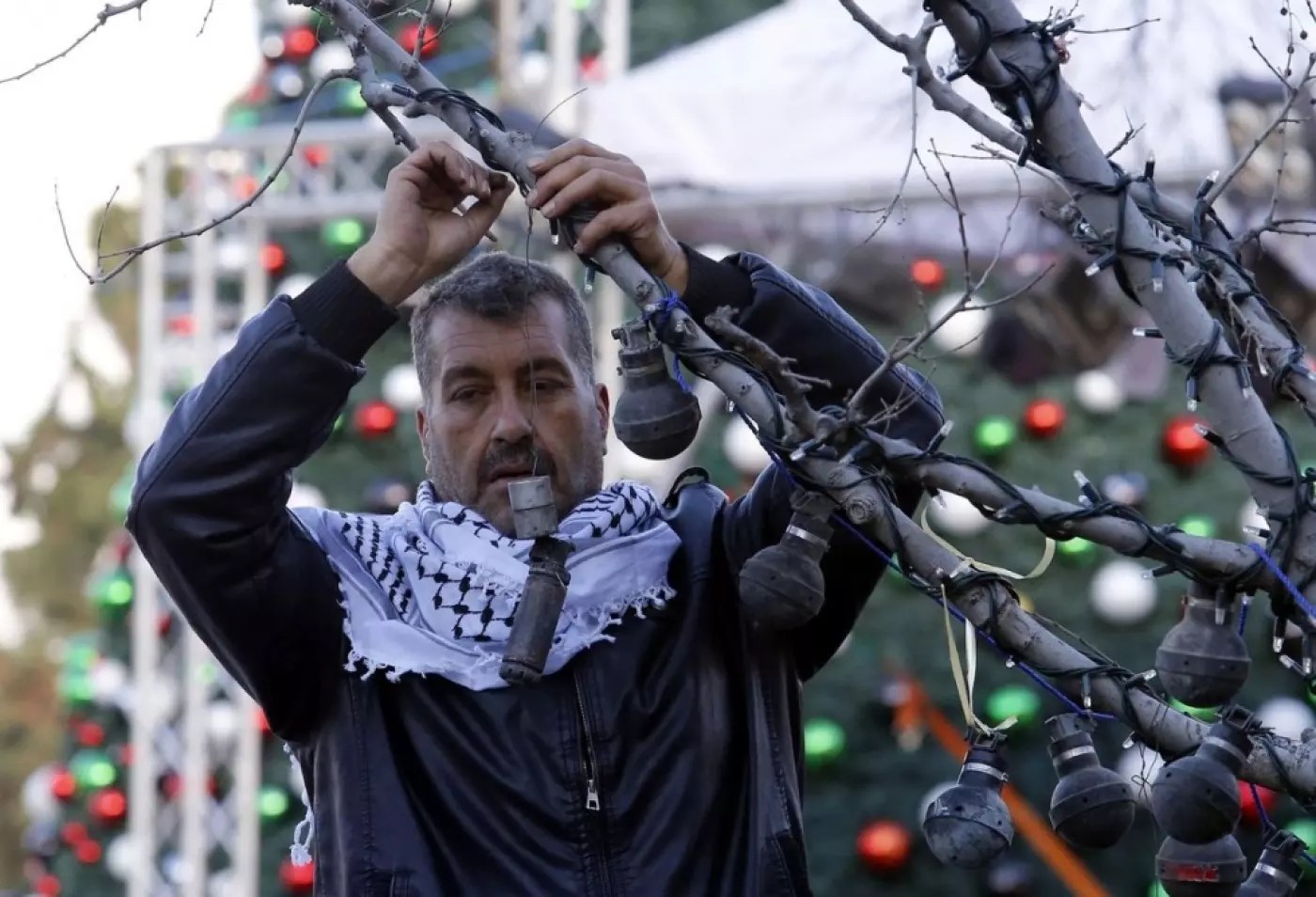
  • A person wearing a keffiyeh secures tear gas canisters to a tree, with normal Christmas ornaments visible on trees behind him
  • A person secures tear gas canisters to a tree with Christmas lights on it

Gallery images: a remake of a famous 1936 “Visit Palestine” poster to show the Holy Family and the separation wall; photos of Palestinians decorating a tree in Bethlehem with tear gas canisters in 2015, as well as a close-up of a canister showing it’s USA-made; and more photos from the separation wall, including the icon “Our Lady of the Wall,” where nuns and pilgrims pray rosaries to dismantle the wall.

Categories
Affirmation of Faith easter Liturgy Other search markers

Affirmation of Faith in the Wounded God who calls us Good

We worship a Mystery, a Being too vast to capture in words,
who reveals Godself to each of us in different ways.

While making room for different understandings,
let us affirm the faith that draws us together:

We believe in the God whose Word birthed the cosmos,

Who shaped human beings from the rich topsoil,
breathed Her own breath into us,
blessed both our earthy bodies and celestial spark,
and declared us Good, very Good!

When evil taught us shame
for those very bodies God had blessed,

God became a seamstress,
tenderly dressing Her children, Adam and Eve —
never dismissing our distress
but giving us what we need
to believe in our inherent dignity again.

This God reminds us at every opportunity
That we are destined for freedom:

God did what it took to liberate Her people
from enslavement in Egypt — and from countless future captors,
human powers who wield control through violence and fear.

The God who walked through Eden put on wheels —
the throne Ezekiel saw rolling through the heavens
to follow Their people into exile, and back again.

And then, this same God settled into flesh: 

For God so loved the world They’d made
that They entered into it Themself,
weaving Godself a human form within a human womb.

From boundless power to an infant in the lap
of his teenage mother, God learned to crawl, to walk,
to speak with human tongue the news They’d been proclaiming
through pillars of flame and cloud, 
through prophets’ cries and in the stillest silence.

In Jesus, God brought restoration to bodies and spirits aching
under the yoke of empire, the shackles of shame —

and then God died. 

But no tomb can restrain Life itself for long:
Christ rose with wounds — reminders of what happens
when we allow violence and fear to reign unchallenged.

This wounded Christ ascended into heaven,
but his Spirit abides with us still —
stirring up our indifference, whispering hope into our despair,
and whisking us up into the hard but holy work
of unrolling a kin-dom accessible to all.

Amen.


About this piece:

If you this piece it in your own service, please credit it to Avery Arden — and I invite you to email me at queerlychristian36@gmail.com to let me know you’re using it!

I wrote this affirmation for a worship service centered around John 20:19-30’s account of Jesus inviting Thomas to touch his wounds.

God created us to be inspirited bodies, embodied spirits — in Genesis 1, God calls not just our spirits but our bodies good — and not just some bodies, but all bodies, disabled bodies included.

Disability theologians have long been inspired by the idea that Jesus’s resurrected body keeps its wounds — wounds that would impair mobility and fine motor skills, that would cause chronic pain.

In rising with a disabled body, Jesus “redeems” disability: he evinces that disability is not brokenness, is not shameful or the result of sin; and he evinces that disability can exist separate from suffering — that suffering is not intrinsic to disability.

The idea of a wounded Christ also connects to Henri Nouwen’s concept of the “wounded healer,” which I recommend looking into if that phrase resonates with you.

The description of God as seamstress restoring a sense of dignity to Adam and Eve is inspired by Cole Arthur Riley’s book This Here Flesh, where she writes:

“On the day the world began to die, God became a seamstress. This is the moment in the Bible that I wish we talked about more often.

When Eve and Adam eat from the tree, and decay and despair begin to creep in, when they learn to hide from their own bodies, when they learn to hide from each other—no one ever told me the story of a God who kneels and makes clothes out of animal skin for them.

I remember many conversations about the doom and consequence imparted by God after humans ate from that tree. I learned of the curses, too, and could maybe even recite them. But no one ever told me of the tenderness of this moment. It makes me question the tone of everything that surrounds it.

In the garden, when shame had replaced Eve’s and Adam’s dignity, God became a seamstress. He took the skin off of his creation to make something that would allow humans to stand in the presence of their maker and one another again.

Isn’t it strange that God didn’t just tell Adam and Eve to come out of hiding and stop being silly, because he’s the one who made them and has seen every part of them? He doesn’t say that in the story, or at least we do not know if he did. But we do know that God went to great lengths to help them stand unashamed. Sometimes you can’t talk someone into believing their dignity. You do what you can to make a person feel unashamed of themselves, and you hope in time they’ll believe in their beauty all on their own.

People say we are unworthy of salvation. I disagree. Perhaps we are very much worth saving. It seems to me that God is making miracles to free us from the shame that haunts us. Maybe the same hand that made garments for a trembling Adam and Eve is doing everything he can that we might come a little closer. I pray his stitches hold. Our liberation begins with the irrevocable belief that we are worthy to be liberated, that we are worthy of a life that does not degrade us but honors our whole selves. When you believe in your dignity, or at least someone else does, it becomes more difficult to remain content with the bondage with which you have become so acquainted. You begin to wonder what you were meant for.

The idea of God on wheels comes primarily from Julia Watts Belser’s article “God on Wheels: Disability and Jewish Feminist Theology.” I highly recommend the whole article (check out the gorgeous art piece that accompanies it, if nothing else), but here’s one excerpt:

“…On the morning of the holiday of Shavuot, Jewish communities around the world chant from the book of Ezekiel, reciting the Israelite prophet’s striking image of God. The prophet speaks of a radiant fire borne on a vast chariot, lifted up by four angelic creatures with fused legs, lustrous wings, and great wheels. …One recent Shavuot, Ezekiel’s vision split open my own imagination. Hearing those words chanted, I felt a jolt of recognition, an intimate familiarity. I thought: God has wheels!

When I think of God on wheels, I think of the delight I take in my own chair. I sense the holy possibility that my own body knows, the way wheels set me free and open up my spirit. I like to think that God inhabits the particular fusions that mark a body in wheels: the way flesh flows into frame, into tire, into air. This is how the Holy moves through me, in the intricate interplay of muscle and spin, the exhilarating physicality of body and wheel, the rare promise of a wide-open space, the unabashed exhilaration of a dance floor, where wing can finally unfurl.

On wheels, I feel the tenor of the path deep in my sinews and sit bones. I come to know the intimate geography of a place: not just broad brushstrokes of terrain, but the minute fluctuations of topography, the way the wheel flows. When I roll, I pay particular attention to the interstices and intersections: the place where concrete seams together uneasily, the buckle of tree roots pushing up against asphalt, the bristle of crumbling brick.

I have come to believe this awareness reflects a quality of divine attention. Perhaps the divine presence moves through this world with a bone-deep knowledge of every crack and fissure. Perhaps God is particularly present at junctions and unexpected meetings, alert to points of encounter where two things come together…”

A similar theology around God on wheels can be found in the perspective of a Christian teen named Becky Tyler, found here. Becky says:

“When I was about 12 years old, I felt God didn’t love me as much as other people because I am in a wheelchair and because I can’t do lots of the things that other people can do. I felt this way because I did not see anyone with a wheelchair in the Bible, and nearly all the disabled people in the Bible get healed by Jesus – so they are not like me.”

She felt alienated by much of what she read in the Bible – until she was given new food for thought.

“My mum showed me a verse from the Book of Daniel (Chapter 7, Verse 9), which basically says God’s throne has wheels, so God has a wheelchair.

“In fact it’s not just any old chair, it’s the best chair in the Bible. It’s God’s throne, and it’s a wheelchair. This made me feel like God understands what it’s like to have a wheelchair and that having a wheelchair is actually very cool, because God has one.”

Categories
Liturgy Prayers of the People

Pastoral Prayer for Immigration Sunday: praying for all who know the heart of the stranger

Our God is the Ultimate Other;
Xe knows firsthand what it is 
to be the one who does not fit,
whose ways are not “our ways”
and whose thoughts are not “our thoughts.”

Thus trusting in Her steadfast solidarity,
let us lift up our prayers for all those 
who know the heart of the stranger.

We pray for Indigenous peoples across the globe
who are made Other in their own homelands,
their lands stripped from them and genocide attempted 
against their languages, their cultures, their bodies —

we pray particularly for the First Nations peoples of North America
whose long-held, never yet healed wounds were recently reopened
with the discovery of the remains Indigenous children 
who were forced into residential schools, died, and were discarded;

as well as for Palestinians facing persecution
and expulsion from the homes of their ancestors
with nowhere to go:

O God who saw and saved
the enslaved foreigners Hagar and Ishmael,
whose descendants would one day found the Islamic faith;
hear our prayer.

We pray for immigrants, asylum seekers, refugees
and all who find themselves far from all they know and love

only to face contempt and mistreatment,
often by the very powers that had a direct hand
in the violence they are fleeing:

O God who transformed the migrant Naomi’s bitterness to sweetness;
O God who, in the person of Jesus,
was yourself a refugee, finding asylum in Egypt as an infant,
hear our prayer.

Finally, we pray 
for all who experience double consciousness
in which they feel forced to think always
of how the oppressor will respond to their words and actions,

from Black persons to the children of immigrants
as well as Asian Americans and other persons of color 
who are subjected to the stereotype of the “perpetual foreigner”,
treated always as alien even in their place of birth:

O God of Moses, who felt stuck somewhere between 
his adopted Egyptian family and his Hebrew roots, 
hear our prayer.

Great Breaker of the human Binaries
of blood ties and national borders,

gather us into one community — something fresh, something new! —
where no one’s needs are denied 
on the grounds of being too difficult or strange;

where no one is forced to cut off pieces of themselves 
to fit into a pre-established mold;

where no one is treated like a problem, an afterthought, a disruption
but rather every person is protected, cherished, listened to.

It is you, God of the Stranger, on whom we depend
to right the wrongs of xenophobia.
Teach us to move with you towards justice.
Amen.


I wrote this pastoral prayer to accompany the “prayers of the people” session of a worship service on Immigrant Sunday, celebrated in the PCUSA denomination. It could also suit the UCC’s Immigrant Rights Sunday and, I imagine, other such services across denominations.

For more on Moses as one torn between identities in a way that relates to the second generation Latine experience, I highly recommend “Moses Speaks Spanglish” by Daniel José Camacho.

For more on God as ultimate other, see Joy Ladin’s text The Soul of the Stranger.

The term “double consciousness” comes from W.E.B. Du Bois’s 1903 text The Souls of Black Folk.

See here for the stereotype of the “perpetual foreigner” defined.

Categories
Affirmation of Faith Call to worship Confession and Pardon Liturgy Opening prayer

Liturgy for a service exploring God’s place in our suffering

Leader:

We gather here and now, 

All:

separated in space
and joined in one Body,

fractured by discord

and united by love,

to worship God,
to open ourselves to God’s voice,
to grow towards God’s will

together.

Come, let us worship God!

Opening Prayer

O high eternal Divinity,
You who are both
Unknowable, Other, utterly Beyond all sense and space —

and Presence itself, 
pervader of all things, 
glimpsable
in every human face,
in the wheeling of the stars
and the miniscule machinations of ants —

Remind us of your vastness.
Make room for our littleness.

Through this time of worship,
stoke in us a burning desire
not for easy answers
but for grace to guide our questioning;
not for light that forces out all shadow
but for the wisdom encountered only
by those who brave the stormy night. 

Amen.


Another prayer (read after reading Psalm 107:1-3, 23-32)

God whom even the seas obey,
All praise belongs to you,
for you journey with us
into troubled waters
and guide us out again.

As we ride the perilous waves together,
Surround us in your Spirit of wisdom and courage —
a whirlwind stronger than the gusts of any storm,
a breath that stills the most agitated soul —
to carry us through.

Amen.


Call to Confession

We have come to worship the Creator
not only of ourselves, but of all peoples,
all creatures, all the cosmos;

Yet we fall into self-centeredness,
becoming so lost in our own hurts, our own desires, our own needs, 
that we fail to look around to see how we might attend
to the hurts and needs of others.

Only in acknowledging our complicity
in the continued wounding of the world
can we join in God’s restoration. 

So let us confess our failings,
first in silent reflection,
and then as one.

Silence

Prayer of Confession

Borrowing from the words of Thomas Merton, we confess together,

Lord God,
We have no idea where we are going.
We do not see the road ahead of us.
We cannot know for certain where it will end.
Nor do we really know ourselves,
and the fact that we think we are following your will
does not mean that we are actually doing so.

When we fool ourselves into certainty
in our own rightness,

Remind us of how limited we are, Infinite God,
how prone to calling evil “good” and good “evil.”

When we favor being right over accepting truth,
cheap grace over the long hard road to justice and reconciliation,

Jolt us from our egotism, self-giving God.
Help us let go of our defensiveness.

When the way seems too hard
and we nearly succumb to despair,

Surround us with support, sweet Trinity;
suffuse us with wisdom and courage.

Returning to the words of Thomas Merton, we rejoice because…

We believe that the desire to please you, o God,
does in fact please you.
And we hope we have that desire in all that we are doing.
We hope that we will never do anything apart from that desire.
And we know that if we do this, you will lead us by the right road,
though we may know nothing about it.

Therefore will we trust you always, 
though we may seem to be lost and in the shadow of death.
We will not fear, for you are ever with us,
and you will never leave us to face our perils alone.

Assurance of Pardon 

In the name of Jesus Christ, we are forgiven!
By the Holy Spirit, we are empowered 
to strive ever deeper into God’s will!

Thanks be to God!

Passing the Peace of Christ

In Jesus Christ, we know God’s forgiveness and peace — 
not an easy peace, nor a halfhearted peace,
but a peace entwined with justice, 
a peace that empowers us to survive all discord.


Affirmation of Faith / Responding to God’s Word

Ours is a God who makes room for our demand for answers,
hears us out and guides us into wisdom
as far as our finite forms can go.

Our God affirms our cries for justice,
for in the cries of the oppressed and despairing
Holy Wisdom cries for justice too.

Rejoicing in God’s welcoming of questions,
let us use poetry as a medium for framing some of our deepest doubts,
with all the messy human emotions that come with them:

my God, you better be ready when i come
and stand before you face to face at last
because you know how many questions i have for you
and you know the very first that will
burst from my lips will be

why?

why did you conceive and birth a world
roiling with so much pain?
why did you make human beings
capable of such atrocities?

why did you make our skin so frail, our stomachs
so prone to hunger and thirst, our minds
so quick to judge and scheme and place ourselves first?

and why, why do you seem to watch passively
as we raze forests into barren dust
as we pour poison into rivers
as we tear flesh from each other’s bodies with our teeth?

…i don’t know, yet. 
but when i think of you
cradled in the arms of a single mother 
with calloused brown hands

and of you
walking miles between towns to bring
healing on tired feet,
your stomach eating itself with hunger, 
your tongue parched

and of you
being nailed to a cross
by hands that have shed their compassion for gain
as you cry out “my God, why! why have you forsaken me!”

…then, i feel a little better.
i still do not understand
but i trust.

we trust because you do not watch us suffer from
some lofty throne high above,

but rather
wherever a child sobs with hunger
a woman aches with grief
a whole community is being trampled into the mud
you are there. 

your face is tear-tracked too. your wrists
and feet and torso bear wounds, too.
so i question, constantly.

and i will demand answers. 
but also, i trust you.

truly, truly
our hope is in you.


These pieces were written for a service centered around Job 38 and Mark 4:35-41, with themes of God’s bigness and God’s co-suffering with us.

Categories
Holy Days lent My poetry Other search markers Reflections for worship services

Crucifixion poem: “your death was nothing special”

your death was
nothing special

it was the death
of uncounted criminals
convicted under Roman law

in fact, two others died with you
on that same hill, on that same day
in that same way: bloody suffocation on a cross

so if you had lived today your death
would have been likewise ordinary
and likewise brutal:

exploded veins in the electric chair
after an unfair trial

or blood gushing out
on a road with a busted street lamp,
an officer’s bullet in your gut,
no trial at all.

Jesus, Jesus
this is why
your death matters.

because it didn’t — not to the ones who killed you,
not to the soldier who thrust a lance in your side
as he had done to so many men
on so many days like this one
not to the men who cast lots for your clothes,
profiting off your pain

your death matters, your death is precious
because it was common, ordinary —
you share the agony
of every tortured spirit who has ever walked this earth

you share every cry
muffled under the boot of one in power.

and so i know that
they with whom you have shared
agony
will also share in your rising.

…i have no words for this.
it is beyond words.
all i have is
thank you.
thank you.

thank you.


This poem was written by Avery Arden and belongs to them. If you use it in a service, please cite me and link back to this website. You can also let me know you used it by emailing me at queerlychristian36@gmail.com.

About this poem:

Womanist theologians and other Black theologians, joined with Latin American liberationist theolgians and many others, have argued that substitutionary atonement deeply harms some of the world’s most oppressed persons — the very persons with whom Jesus most intimately identifies. As Miguel De La Torre explains in Embracing Hopelessness,

“There is nothing salvific about crucifixion. We are not saved through unjust suffering; although the oppressive suffering of the many who offer up their broken bodies as living sacrifices does provide abundant life for the elite few.

…The eleventh-century theologian Anselm of Canterbury would have us believe the purpose of the cross was necessary to satisfy God’s anger, to serve as a substitute for us. Sinful humans could not redeem themselves before an angry God who required blood atonement. Only a sinless God-as-human could complete the process, make restitution, and restore creation.

In other words, in order to satisfy God’s vanity, God’s child must be humiliated, tortured, and brutally killed, rather than the true object of God’s wrath, humans. …The problem with Anselm’s theology of atonement is that it casts God as the ultimate abuser, the ultimate oppressor who finds satisfaction through the domination, humiliation, and pain of God’s child. …”

But as we let go of these beliefs in God’s “need” for a sacrifice to assuage “his” anger, does the cross retain any meaning at all?

The answer is, of course.

Jesus’s death was hideously ordinary — and hence infinitely meaningful. As Richard Rohr said, “God did not die for us. God died with us.”

Through the cross, Jesus exposed the violence that is so commonplace that many of us have become desensitized to it for the evil it is — a key example being antiblack violence that forms a core tenet of white supremacy and is one foundation of the United States. Jesus’s execution is akin to the lynchings, shootings, and executions of countless Black lives in the United States — and, James Cone argues in The Cross and the Lynching Tree,

“Until we can see the cross and the lynching tree together, until we can identify Christ with a “re-crucified” black body hanging from a lynching tree, there can be no genuine understanding of Christian identity in America, and no deliverance from the brutal legacy of slavery and white supremacy.

Through the cross, Jesus showed us that God’s power is not human power — is not control through violence, but rather is compassion, is co-suffering, is interdependence and solidarity and letting go of the need for control. But God’s power is antithetical to white supremacy and other oppressive powers, and so Christianity entangled in Empire will continue to promote the God whose anger demands blood and tortures it out of “His” own son.

Furthermore, the dominating powers of Empire — from first century Rome to today’s America — attempt to strip humanity and dignity from those they deem useless or dangerous. But through the cross, Jesus reaffirmed the humanity and dignity of the world’s most reviled, tortured, and discarded — for what they suffer, God has suffered. This is why Jesus’s arrest and crucifixion still matter, even if they are not the key to salvation. De La Torre’s discussion of the cross continues thus:

For Christians from marginalized communities, the importance of the cross is not its redemptive powers, for all aspects of Christ’s life, death, teachings, and resurrection are redemptive.

The importance of Jesus’s crucifixion is the point when Christ chose solidarity with the world’s marginalized, even unto death. Christ becomes one with the crucified people of his time, as well as with all who are crucified today on the crosses of classism, colonialism, racism, sexism, heterosexism, and religious discrimination. For Christians to die with Christ so they can also live with him means they too must find solidarity with the world’s crucified people.”

We must find solidarity with the world’s crucified people. How will you and your communities do so?

Categories
LGBT/queer My poetry

poem: swords into swingsets

my god they have cornered me
like an animal
and like an animal i want to lash out
i want to sink my teeth into their flesh until they shout and
let. me. go.

but god

when my fist flies forward
to sink into their face

it hits yours instead.

they cornered me, made me a beast
who cannot tell friend from foe
and in my frenzy i struck you
just as you were reaching
for my hand to pull me up

oh, god

sit with me
in this fear, in this fury, in this pain
sit with me until it melts into tears
and i am ready to stand up
to walk out past their leers
their spit their stones

god
help me pull the nails
from my feet, sides, wrists
and i shall use them
to build a house

for all of us
who are trampled into dust

with tender touch we pluck
the nails from each other’s flesh,
the knives from one another’s hearts

and we
will not
hurl them into the ones
who drove them into our skin

no. they will never
be weapons again.

can you smell the flowers blooming round the doorway?
can you hear the laughter ringing through the halls?

i have repurposed the rope
they tried to hang me with
into a swing that children
take turns swinging on.


This poem was written by Avery Arden.

This is a revised version of a poem included in their volume The Kin(g)dom in the Rubble.

It also appears in the anthology There Is Us: Flowers for Ukraine.

About this poem: This piece contemplates how the horrors done to us might be transformed into something life-giving — and in the meantime, God is with us. How do we fight back against our oppressors’ dehumanizing violence? How do we bear good fruit and thrive in a world that would see us quashed?

This poem was inspired by Psalm 73, where the psalmist begs to know why unjust oppressors thrive while the oppressed suffer. So overcome with pain and fear is this psalmist that they risk becoming the animal their oppressors try to dehumanize them into — but God raises them up from that fate. Here are verses 21-23, my translation:

Yes, my heart was warping into a bitter husk,
   my insides were all cut up.
I became brutish, I knew nothing anymore —
   I lashed out, a wild animal, against You.
Yet even so, I am unceasingly with You!
   You hold fast to my right hand!

Categories
Holy Days lent My poetry

poem for Holy Saturday: this moment matters

they wanted – no, they needed
to touch you one last time.

so they trudged the tombward path
with their perfumes and their spices
their strips of cloth to cocoon your body in
for its final transformation back to dust

their shoulders almost broken with grief,
heavy as the cross
that crushed the life from your flesh.

let me fall in step behind them.
let me take my place in that line
of broken hearts bearing a cross of grief together.
let me shoulder my share of the burden

and let me not rush
to the first fingers of dawn, frail and trembling,
reaching past a rolled-back stone
to empty space where your corpse should be –

no. let me linger in the moment when
your corpse still lies there
and anguish fractures the air
into splinters that cut the lungs.

this moment matters:
your brown body
with the breath pressed out
by the inexorable boot of Empire
matters.

and the moment that comes after
cannot ease this one.

it never has, and it never will, for

there are still bodies broken,
breathless, beaten down
by Empire’s brutality or else its apathy.

and you, with us to the last,
still lie among them – you hold them close
and share their final exhalation
be it in a hospital bed, the street, a cell.

so let me not sprint to sunrise
when your body can still be found
nestled with cold bodies in their graves.

blessed be the hands
that carry the spices and perfumes, water and cloth!
blessed, blessed be the throats
worn rough with sobs
yet refusing to be silenced,
broadcasting the crime lest some claim ignorance.

i’ll not dishonor them by racing past
to the future reunion of
form to dust, breath to body, lover to loved
before they’re ready.

keep watch! soak in! be present with them!
this moment is holy.


If you use this piece, please credit it to Avery Arden and link this website. I also invite you to email me at queerlychristian36@gmail.com to let me know how you’re using it!

About this poem:

This was my prayer for Holy Saturday, 2020 – 
in the shadow of pandemic
and from under the enduring boot of state violence and negligence: 
Spirit, help us learn to linger in the shadow of the tomb,
so as not to abandon those who are not ready to look beyond it yet. 

In this poem I lean on the promise of the Brief Statement of Faith:
“in life and in death, we belong to God.” And I draw from Black theologians like James Cone who argue that God is Black, that Jesus Christ is executed again wherever human beings are lynched or tortured. This poem is written in solidarity with the Black Lives Matter movement.

Categories
My poetry

poem: glory to the God who tires

Glory be to the God who tires, rests.

Jesus, you felt the world’s weight across your shoulders
even heavier than the rest of us.

the lepers whom most of us can choose
to let our gaze slide over
ran after you, calling, clinging at your hem:
there was no denying them.

there is never
cessation of need.
the earth is one mouth gaping
hungry, groaning, calling
never filled, never silent, never closed.

yet
you took the time

to row yourself into the sea’s dark belly
and let her cradle you.

you knew the crowds were teeming on either shore,
that they would coalesce upon you,
waves replacing waves as soon as you rowed back —

and there would be time
for them.

for now, you let the croon of wave lapping at boatwood
lull you to sleep.

God, will you be the sea
and i the boat
rocked to sleep in your lap?

slow my breathing
until it matches yours.
still, still.

promise me:
there will be time, there will
be time

 but for now
there is only rest.

rest.


If you use this piece, please credit it to Avery Arden and link this website. I also invite you to email me at queerlychristian36@gmail.com to let me know how you’re using it!

Hear Avery read this poem on YouTube.

About this poem: I wrote this poem while I was serving for a semester as a hospital chaplain – a time in which I was inundated with grief and need, both my own and that of others. It’s inspired by Psalm 131 and stories in the various Gospels where Jesus withdraws from the crowds that seek his healing and wisdom to pray and rest (e.g. Matthew 14:13, Luke 5:16, Mark 4:35-41).

Categories
My poetry

poem: first question

my God, you better be ready when i come
and stand before you face to face at last
because you know how many questions i have for you
and you know the very first that will
burst from my lips will be
why?

why did you conceive and birth a world
roiling with so much pain?
why did you make human beings
capable of such atrocities?

why did you make our skin so frail, our stomachs
so prone to hunger and thirst, our minds
so quick to judge and scheme and place ourselves first?

and why, why do you seem to watch passively
as we raze forests into barren dust
as we pour poison into rivers
as we tear flesh from each other’s bodies with our teeth??

…i don’t know, yet. but when i think of you
cradled in the arms of a single mother with calloused brown hands

and of you
walking miles between towns to bring healing on tired feet,
your stomach eating itself with hunger, your tongue parched

and of you
being nailed to a cross
by hands that have shed their compassion for gain
as you cry out “my God, whywhy have you forsaken me!”

…then, i feel a little better.
i still do not understand
but i trust.

i trust because you do not watch us suffer from
some lofty throne high above 
but rather

wherever a child sobs with hunger
a woman aches with grief
a whole community is being trampled into the mud
you are there. your face is tear-tracked too. your wrists
and feet and torso bear wounds, too.

so i question, constantly.
and i will demand answers. but also, i trust you.

truly, truly
my hope is in you.


Originally published in The Kin-dom in the Rubble. If you use this piece, please credit it to Avery Arden and link this website. I also invite you to email me at queerlychristian36@gmail.com to let me know how you’re using it!

Hear Avery read this poem on YouTube.

About this poem: If we learn nothing else from scripture, it’s that God welcomes our questions and difficult emotions. And a common question with which we all wrestle is the question of why good people suffer while those who do wrong seem to thrive – see Psalm 73, the Book of Job, and this post for more on what theologians term “theodicy,” the place of God in suffering.