A short reflection on this Sunday’s lectionary text, Genesis 21:8-21. Scroll to the end for further resources
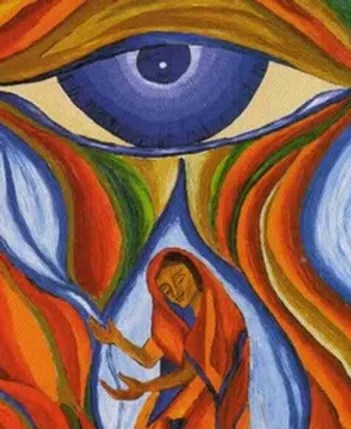
Name changes occur throughout scripture, but there is only one instance in which a human being directly names God!
That person is Hagar — the woman enslaved and then cast off by God’s own chosen people, yet who recognizes God’s solidarity with her in a way that resonates with many marginalized folk, including queer & trans people of faith.
Back in Genesis 16, Hagar is forced to conceive a child with Abraham — her bodily autonomy denied — and then suffers abuse at Sarah’s hand so painful that she prefers almost-certain death in the wilderness. While waiting to die, God comes to her, nourishes her, encourages her with the promise of a better future. For a time, Hagar must return to her oppressors.
This is a hard message, but It may resonate with queer and trans people who make the hard choice to find what safety they can while in the closet, or who choose to remain in relationship with family or faith communities that have caused them harm.
It also isn’t the end of Hagar’s story: when the time is right, God leads her out — as told in this week’s text in Genesis 21.
Sarah continues to abuse Hagar, with Abraham as a passive bystander and enabler. In a society where only one of Abraham’s sons can inherit his wealth and blessing, Sarah sees Hagar’s son Ishmael as a threat to her son Isaac, simply by existing! In our own day and age, this myth of scarcity persists, causing us to hoard resources and compete needlessly.
Sarah cannot stand to see Hagar’s child playing with her own son — as if they were equals! As if a slave boy should be having a moment of fun! She reads something sinister into the play — not unlike how some people today read sinister things into queer play, into drag queens and gender expansive youth.
Having convinced herself that Hagar and her son are a threat, Sarah gets Abraham to cast them out.
But again, God is with the outcast; God comes again to Hagar, who in Genesis 16 had given God the name El Roi — “God sees me.” This God is the god of her oppressors, yet Hagar recognizes that this god is her God as well! This god is a God who sees the suffering of the lowest of society, and responds.
God sees queer and trans people, too. God is our God, too — those who hate us do not have a monopoly on the Divine!
And God walks with us through every struggle, fueling us to fight the good fight and promising blessings to come.
Questions for reflection:
- When have you witnessed God coming to the Hagars in our midst?
- When has your community behaved like Abraham & Sarah, hoarding God’s love as if there were not blessing enough to go around?
- Can you imagine a world in which Sarah, Abraham, and Hagar meet again? What would Hagar need to feel safe to meet with her former abusers? What would Sarah & Abraham need to do to make things right?
Further Reading
Queer-specific resources:
- Article: Out in Scripture‘s commentary for Proper 7 of year A, “Claiming God’s Promise in the Midst of Exile” — connecting Hagar to supportive parents of LGBT children
- Podcast episode: “Hagar and the Caravan” — connecting Hagar’s story to that of Latin American trans women seeking asylum
- Essay: “Intersex Foremother and Forefather” — ancient texts suggesting that Abraham and Sarah were intersex
Other resources:
- Sermon: “No Good Patriarchs: Solidarity with Hagar” — Exploring the messiness of how one person can embody both oppressor & oppressed, and how “good” people buy into unjust systems
- Article: “Jesus and Hagar: the Form of a Slave” — Wil Gafney’s connection between Hagar and Mary the mother of Jesus, through a womanist lens
- Affirmation of Faith: “God of Hagar, Ishmael, Sarah, Abraham — God of oppressor and oppressed“
- Video: Teaching children the story of Hagar, with an interfaith focus
- Essay: connecting Hagar and Ishamel to the Genesis 22 story of Abraham nearly sacrificing Isaac
- Essay: “Hagar and Sarah: Was Reconciliation Ever a Possibility?” — Exploring various writers’ visions of what a meeting between these two women could look like

 Binary-Breaking Worship