Categories
Confession and Pardon LGBT/queer Liturgy

Confession of Anti-Trans Violence & Assurance of God’s Grace

Drawing from Luke 4:16-30
and F-1.04 of the Book of Order of the Presbyterian Church (USA)

PRELUDE:

As Presbyterians, we believe in a God who takes up the cause of those whom human societies consider “least.”

In this era of escalating anti-trans rhetoric and legislation, in our own state and beyond, our faith calls us to affirm God’s movement among and through the trans community in particular.

Even as we leave room for some differences in belief, we can agree that there is no place in the life of the Church for discrimination against any person. 

United in this belief, let us confess together the ways in which we continue to fall short in protecting and celebrating the gender diverse members of God’s human family:

CONFESSION

When we refuse to recognize the unique ways
our transgender siblings participate in co-creation
and manifest the Divine Image
of a God far vaster than any rules we devise or boxes we build,

Forgive and transform us, Creator God.
Open us to choose respect over rejection,

conversation over misinformation,
relationship over alienation.

When we look on as oppressive forces hold our trans kin captive —

suffocate their free will, strip them of health and safety,
drive them to desperation and rob them of their very lives —
and we shrug off their plight, assuming it has nothing to do with us;

or else stay silent out of fear for our own security and comfort,

Forgive and transform us, Liberator God. 
Wake us to the life-or-death urgency of this struggle.
Open us to choose action over silence,
to risk much in the name of justice.

When our denomination’s promises
of full participation and representation for all persons and groups
remain unfulfilled —

with many queer candidates still finding their ministry obstructed,
and trans parishioners forced to choose
between staying in hostile spaces
or leaving their spiritual homes to seek belonging elsewhere,

Forgive and transform us, God who favors outcasts.
Open us to see both the possibilities and perils of our institution,
so that we may revise the things that harm
and bolster the things that liberate.

God who hears and joins in our lament,
God who speaks through unexpected prophets,

instill in us a hunger for your justice
that will drive our solidarity and action
until we have become — in fact as well as in faith —

a community of all people
made one in Christ by the power of your Holy Spirit.

PARDON

Friends, we have a long way to go, and much work to do —
but we rejoice now in the assurance that, through Jesus Christ,
we are forgiven and renewed to continue the journey.

Thanks be to God.

PEACE

Assured of God’s mercy, we may be bold in sharing Christ’s peace —
a peace built on justice, a peace that preserves diversity —
with all we meet. 

The peace of Christ be with you.
And also with you…


Please feel free to make use of this piece in worship or Sunday school, in ceremony or across social media. Just credit it to Avery Arden of binarybreakingworhsip.com — and I invite you to email me at queerlychristian36@gmail.com to let me know you’re using it!

You may make small adjustments to fit your own particular context.

About this piece:

I wrote this confession and pardon to be used during morning worship at the PC(USA)’s 226th General Assembly.

I was asked to center its call to acknowledge where we have failed our transgender kin around Luke 4′s account of Jesus reading from Isaiah in his local synagogue — the prophet’s proclamation of good news for the poor, the imprisoned, for disabled persons and all whom Empire oppresses.

When Jesus announces after he reads, “Today, this scripture has been fulfilled,” his audience raves, impressed by this local boy grown up into a wise teacher. It’s only when he continues his commentary to make it clear that gentiles will be receiving the Spirit of God’s liberation as well — for did not Elijah and Elisha minister to gentile widows and lepers? — that the crowd’s praise sours into rage.

What a fitting text to draw from when confronting our own resistance to expanding God’s liberation to those we consider outsiders. God is lavishing Their Spirit on Their queer children, freeing Their trans children from bondage and into ministry — and there are many who refuse to recognize this divine activity.

Just days before this confession was shared in worship, the General Assembly discussed and ultimately approved the Olympia Overture, which seeks to solidify protections for queer members — particularly queer ordination candidates — of our denomination. Though I rejoice that this overture passed, the debates were painful to witness, reminding me that I share this spiritual home with people who deny my humanity, my vocation, or God’s movement through me and those like me — and who balk at naming this denial “discrimination.”

If you’re interested, I wrote another piece — Beatitudes for the prophets who move our churches into truer welcome — in response to those overture debates.

I give thanks to all who courageously spoke up in support of the Olympia Overture; may they find themselves surrounded by support and love after living out such brave vulnerability. And I pray that those who feared or raged against its passing will find themselves broken open, bit by bit or all at once, by the Spirit of Wisdom who guides us all into understanding. Maybe this overture’s passing can be an opportunity for deeper conversations that will draw us all closer. Maybe. If we all are brave, and bold, and ignited by love. If we all commit ourselves to living into F-1.0404‘s call to openness:

"...a new openness to the sovereign activity of God in the Church and in the
world, to a more radical obedience to Christ, and to a more joyous celebration in
worship and work;

a new openness in its own membership, becoming in fact as well as in faith
a community of all people of all ages, races, ethnicities, abilities, genders, and
worldly conditions, made one in Christ by the power of the Spirit, as a visible
sign of the new humanity;

a new openness to see both the possibilities and perils of its institutional
forms in order to ensure the faithfulness and usefulness of these forms to God’s
activity in the world; and

a new openness to God’s continuing reformation of the Church ecumenical,
that it might be more effective in its mission."
Categories
bible study LGBT/queer Queer Lectionary

Queering Hagar’s Story

A short reflection on this Sunday’s lectionary text, Genesis 21:8-21. Scroll to the end for further resources

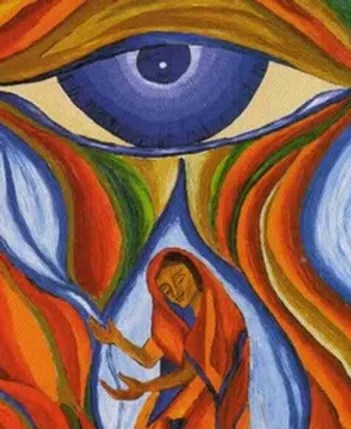
 a painting of a figure like Hagar who is smiling as water pours through her hands; above her is a giant eye.

Name changes occur throughout scripture, but there is only one instance in which a human being directly names God!

That person is Hagar — the woman enslaved and then cast off by God’s own chosen people, yet who recognizes God’s solidarity with her in a way that resonates with many marginalized folk, including queer & trans people of faith.

Back in Genesis 16, Hagar is forced to conceive a child with Abraham — her bodily autonomy denied — and then suffers abuse at Sarah’s hand so painful that she prefers almost-certain death in the wilderness. While waiting to die, God comes to her, nourishes her, encourages her with the promise of a better future. For a time, Hagar must return to her oppressors.

This is a hard message, but It may resonate with queer and trans people who make the hard choice to find what safety they can while in the closet, or who choose to remain in relationship with family or faith communities that have caused them harm.

It also isn’t the end of Hagar’s story: when the time is right, God leads her out — as told in this week’s text in Genesis 21.

Sarah continues to abuse Hagar, with Abraham as a passive bystander and enabler. In a society where only one of Abraham’s sons can inherit his wealth and blessing, Sarah sees Hagar’s son Ishmael as a threat to her son Isaac, simply by existing! In our own day and age, this myth of scarcity persists, causing us to hoard resources and compete needlessly.

Sarah cannot stand to see Hagar’s child playing with her own son — as if they were equals! As if a slave boy should be having a moment of fun! She reads something sinister into the play — not unlike how some people today read sinister things into queer play, into drag queens and gender expansive youth.

Having convinced herself that Hagar and her son are a threat, Sarah gets Abraham to cast them out.

But again, God is with the outcast; God comes again to Hagar, who in Genesis 16 had given God the name El Roi — “God sees me.” This God is the god of her oppressors, yet Hagar recognizes that this god is her God as well! This god is a God who sees the suffering of the lowest of society, and responds.

God sees queer and trans people, too. God is our God, too — those who hate us do not have a monopoly on the Divine!

And God walks with us through every struggle, fueling us to fight the good fight and promising blessings to come.

Questions for reflection:

  • When have you witnessed God coming to the Hagars in our midst?
  • When has your community behaved like Abraham & Sarah, hoarding God’s love as if there were not blessing enough to go around?
  • Can you imagine a world in which Sarah, Abraham, and Hagar meet again? What would Hagar need to feel safe to meet with her former abusers? What would Sarah & Abraham need to do to make things right?

Further Reading

Queer-specific resources:

Other resources:

a painting of two women with curly brown hair and brown skin embracing; the one being held has a blue shawl with “Sarah and Hagar” written in Hebrew on it, while the one embracing her has a bright blue dress. A dove with an olive branch hovers behind them
Sarah and Hagar” by Jewish artist Hilary Sylvester, who says: “Sarah the mother of the Jewish People and Hagar the mother of the Arab people finally find reconciliation through Mashiach.”
Categories
Affirmation of Faith LGBT/queer Liturgy

Affirmation of Faith: Queer God who came out to Moses…& other biblical coming out stories

The love of our queer God
unites us into one Body —
not in spite of, but in celebration of
our varied gifts and roles in
the story God is telling even now.

As one, let us affirm some of what we believe
about the God who is for us
when we are in the closet, and when we come out,
when we receive our loved ones with rejoicing
and when we strive to understand.

We believe in the God who came out to Moses
from the midst of unburned branches
with a name They had never revealed before —

a name shared with love, shared as an invitation
into deeper relationship, deeper understanding
of the God Who Is and Who Will Be
the steadfast ally of shunned and shackled peoples.

We believe in the God of Joseph, 
who takes tattered lives
and weaves them into wholeness.

When Joseph came out to his brothers
as a dress-draped dreamer
and faced their violent rejection,

God went with Joseph into slavery, into imprisonment,
and out again, guiding his way into flourishing.

But They also stayed
with Joseph’s brothers,
never ceasing to work on their hard hearts,
preparing them for the tearful reunion
where they would embrace Joseph’s differences
as life-bringing gifts.

We believe in the God of Esther, 
who protected her from being outed unwillingly
in a place hostile to her very being;

and who, when the time came to act,
filled her with the courage and power she needed
to use what privilege she had
to save the more vulnerable members of her people.

We believe in the God of Mary,
the teenage girl who faced disgrace
by coming out as full of grace

pregnant with divinity —

yet she did so boldly, joyously,
recognizing the hand of God
in the status quo’s upturning.

We believe in Jesus, whose identity 
as God’s beloved son and God Themself,
as Word made Flesh and Life that died
is too complex for human minds to fathom —

yet Jesus yearned to be known,
to be understood by those who loved him most!
He asked them earnestly, “Who do you say that I am?”
but told them not to out him to the world
before he was ready to share his truth in his own time —
And oh, how he’d shine!

We believe that the God
who liberated Lazurus from his tomb,
and who overcame death
by rising from a tomb of his own,

is the selfsame Spirit
who enters into the tombs
we build around ourselves
or shove our neighbors into;

She looses our bindings
and pulls us into Her great Upturning.

Amen.


About this piece:

I wrote this affirmation for my church’s More Light Sunday service, an LGBTQA/queer-focused service. Themes included learning how to love ourselves, our neighbors, and our God; reclaiming scripture from those who have weaponized it; and the power of story.

If you this piece it in your own service, please credit it to Avery Arden — and I invite you to email me at queerlychristian36@gmail.com to let me know you’re using it!

Further Reading

For more on Joseph through a queer & trans lens:

For more on Esther through a queer lens:

For more on Mary through a queer & trans lens:

For more on Jesus through a queer & trans lens:

For more on Lazarus through a queer & trans lens:

[image: a digital painting of Joseph of Genesis by tomato-bird on tumblr, a figure with light brown skin, brown eyes, and curly dark hair sitting in a field. They have their head propped on one hand as they sit, gazing off into the distance with a sunset or sunrise blushed sky behind them. And from their shoulders extends a gorgeous, flowing cape, rising upward behind them as if caught on the wind so that its colors blend with the blushing sky – ripples of vibrant red and blue, with orange and yellow stars plus a moon and sun scattered along the fabric. / end id]

Categories
LGBT/queer My poetry Reflections for worship services

Reflection for Coming Out Day services: Fighting damaging silence, honoring formative silence

There are cocoons
of silence, soft merciful darkness enveloping you 
until you are ready to emerge as something
new—

And there are tombs
of silence. Darkness gone awry,
a heaviness that presses down your lungs,
so that your shouts of “I’m alive!” die
before they can escape your lips.

My shoulders ache with the ghosts of silences too long carried.

Mom, Dad, you always promised
to love me no matter what —
but so did my wife’s parents
and they nearly threw her out
when they found out.

I wanted to believe you really would love me “no matter what”
but how could I dare to hope it
when you never said a word
about gay or trans people,
and always changed the channel when two women
holding hands came on the screen?

Your silence weighed on me
almost as heavy as explicit condemnation would have.

Parents, guardians out there, please
tell your children when they are
young and only just learning what love is
that you will love them even if it turns out 
the wrong gender was stamped on their birth certificate
and no matter who they cut their wedding cake with. 

I came out to my parents eventually.
Piece by piece
I tore through the silence
we had built up together and they

have been wonderful. Slowly
they wrapped up the name
they gave me at my birth and put it away, replaced by
a name of my own choosing, a name that really is me. 

The pronouns took longer
but now when I go home 
arm in arm with my wife
I have no fear of being misgendered 
by those closest in my life.

And what of myself, the residue of silence
that still coats my inner gut?

Sometimes I forget that I am safe now
to speak up for other queer folk,
that I can say, “no, that joke was not funny
it was transphobic” or
“so why exactly would you ‘never date a bisexual’?”

My mouth stays shut. And silence wins. Nothing changes.
Other times I’m just too tired
to correct someone who’s called me ma’am yet again
to repeat like a broken record, please use they/them

and then silence wins.
I dodge falling stalactites as my identity caves in around me.

The seductive arms of silence 
reach out to all of us
and we all fall into them sometimes, too tired to resist
or too scared of saying the wrong thing to even try. 

But the key is to ask yourself: what will you do
to ensure that the old wounds etched by silence
don’t bleed out indefinitely? what will you do
not to cover over the scars or pretend like they never happened
but to keep new scars from jagging into existence?

Listen.
I know how your heart speeds up
when you try to speak up 
on your own behalf or another’s —
my heart does too.

I know the lump that forms in your throat 
and when you speak anyway, 

maybe people will be mad. Maybe you’ll have to fight.
Maybe you’ll even lose.

But speak anyway. And if you have to fight, 
then fight not with swords but with words, not with violence
but with love and truth. 

If we speak, 
the scars of silences once carried
will map themselves into a vision
of a future where no one
needs to bury themselves to stay alive. 

As for me and my house,
we will dig and dig and dig and free
the ones whom we have buried 
with the sin of all the times that we have failed.

We will not disturb those who have chosen
to wrap themselves in cocoons of silence
for their own protection,
but we will speak on their behalf;
while they form themselves in safety 
we will speak, so that when they emerge

the world will greet them not
with more tombs to shove them in
not with confused stares or snide comments
but with open arms
and a seat at the feast—

not with isolating silence
but with beautiful, life-reviving Song.


This piece was written by Avery Arden and belongs to them. Please do not publish it anywhere, or use it in a service, without permission from the author. Reach out to Avery at queerlychristian36@gmail.com for that permission, or just to chat!

I first wrote this reflection for a National Coming Out Day service at Louisville Presbyterian Theological Seminary in October 2016. The service included reflections from several individuals, each one responding to a different passage from Esther; the passage to which I responded was Esther 8:9-14.

I shared this reflection again, revised, for another Coming Out Day service for my friend Ainsley’s online Queer Church (you can watch the service on Facebook live here).

The first version of this piece included my description of how my parents were still working on getting my pronouns right; it was a joy to revise it saying that they now have that down pat! I also got to change “girlfriend” to “wife,” as we got married in 2019.

The concept of “coming out” brings up complex emotions in me. Western culture turns being “out” and “closeted” into a binary; assumes that all of us resonate with those terms; and centers cishet persons in discussion of those terms. Some incomplete thoughts:

My hope is that this reflection honors the many experiences and feelings around the idea of “coming out,” even while focusing on my own personal experiences.

Categories
Hymns LGBT/queer Other search markers

“For Everyone Born” revised to be even more inclusive

“For Everyone Born” by the wonderful Shirley Erena Murray is a well-loved hymn among progressive Christians, for good reason! However, to honor the original song’s spirit of expanding our table ever wider, some revisions were called for. See below my revised lyrics for a discussion on what changes were made and why.

For sheet music, scroll to the very end.

The Lyrics

Note: verses to which no revisions were made are in brackets.

[For everyone born, a place at the table,
for everyone born, clean water and bread,
a shelter, a space, a safe place for growing,
for everyone born, a star overhead.]

[Chorus:]
And God will delight when we are creators
of justice and joy, compassion and peace:
yes, God will delight when we are creators
of justice, justice and joy!

For woman and man, a place at the table —
and all those between, beyond, and besides;
expanding our world, dismantling power,
each valued for what their voice can provide.

[chorus]

For gay, bi, and straight, a place at the table,
Invited to wed, to baptize and preach,
a rainbow of race and gender and color,
for queer, trans, and ace, God’s justice in reach.

[chorus]

[For young and for old, a place at the table,
a voice to be heard, a part in the song,
the hands of a child in hands that are wrinkled,
for young and for old, the right to belong.]

[chorus]

For bodies diverse, a place at the table,
All manner of speech and movement and minds;
Enabled to lead and teach us new language,
For bodies diverse, a church redesigned.

[chorus]

For just and unjust, a place at the table,
a chance to repent, reform, and rebuild,
protecting the wronged, without shame or pressure,
for just and unjust, God’s vision fulfilled.

[chorus]

[For everyone born, a place at the table
to live without fear, and simply to be,
to work, to speak out, to witness and worship,
for everyone born, the right to be free.]

[chorus]

Why Make Revisions?

“For Everyone Born” is a popular and beloved hymn in my sphere of progressive Christianity, and I love it too – except for the parts that don’t feel inclusive or expansive enough. Because of those places, singing this song sometimes feels more hurtful than healing for me and others I know.

The intention of this hymn is a beautiful one: it’s meant to make everyone feel welcome at the table, and to challenge us when we limit who’s welcome at the table. However, its dualistic language leaves out a lot of people!

When I hear “For woman and man,” “For gay and for straight,” sung during worship, my heart shrivels up — I and so many others don’t belong to either of those binary categories.

I am confident that Shirley Erena Murray’s intention was well-meaning, and I am thankful to her for writing a song emphasizing the gifts of diversity. Still, as language for queerness shifts and expands, the language used in our worship songs must shift and expand too.

…And then there’s the ever-controversial “for just and unjust” verse — the wording of which puts the impetus for reconciliation fully on the “abused” in the “abuser, abused” equation, pressuring them to just forgive already, without acknowledging their safety or comfort or right to be hurt, their right to withhold forgiveness. Many churches I know simply leave this verse out to prevent harm.

But I don’t want to leave it out! I want to believe that in God’s Kin(g)dom, injustice will give way to justice; that sometimes, with work on the part of the wrongdoer, ruptured relationships might be repaired. And I want to sing about it! I want to sing a promise into being, a promise that, once sung, must be honored in truth and action: that all who have been hurt can come here for protection; that we will prioritize their safety always.

I first revised the “for gay and for straight” verse simply by tucking lots of other identities into the verse. I know it’s not perfect, and still leaves some out…but hearing my church sing the verse that way was a moment of real healing for me. To have my concerns heard and recommendations acted on, to be acknowledged in that way, explicitly in the song, after so often feeling unheard and left out in faith spaces, was genuinely healing.

Later, I revised the other tricky verses at the request of a seminary professor who wanted a revised version to sing in chapel. Again, I felt such healing and relief at being heard.

Since then, my revised verses have been sung in many different faith communities. Quite a few people have reached out to tell me how much the changes meant to them, which brings me so much joy. I would love for it to continue to spread — and to be further revised, however necessary, as time goes on!

Finally, I’ve now added a verse that centers disability. Disability justice is a great passion of mine, and something that tends to go overlooked even in the most “progressive” faith communities and institutions. (For a list of my recommended resources around disability theology and activism, see here.)


Notes on some of my choices:

If you’d like to see an image of my verses side-by-side with the original verses, just to help you see what changes were made, visit this tumblr post.

In the “for woman and man” verse:

  • “for all those between, beyond, and besides” – there are many persons who are not exclusively “man” or “woman,” myself included; but we don’t all fit into one third box. We aren’t trying to turn a binary into a “trinary” here! I think I myself would fit best into the “beyond” category in this phrasing, while I have lots of friends who would describe themselves as being more “between” woman and man, or something altogether besides that (such as agender, bigender, genderfluid….).
  • I changed “dividing the power” to “dismantling power” to emphasize that we should resist a simple redistribution of oppressive power; rather, we must work to dismantle that power altogether. A somewhat simplified example of this out in the world is when people celebrate women who have made it to high executive positions like CEO of a company that exploits workers and/or harms the environment. That’s not a victory, just because a woman is in charge! We have to get rid of that whole system!

In the dis/ability verse:

  • This verse was the trickiest for me to write. How can one possibly fit a community that makes up at least one in five people on the planet, and that encompasses a massive spectrum of different types of bodyminds, into a scanty four lines?
  • Luckily, a comment from Amanda Udis-Kessler below helped spark my mind in other directions than I’d started! I ended up scrapping the attempt to include naming many specific identities / types of disability, as I believe that was the main problem Shirley Erena Murray ran into with some of her verses: there are just too many to name them all, and naming some while leaving out others will just end up leaving those unnamed feeling excluded.
  • So instead, I named broad categories of action that a great many disabilities may present with “All manner of speech and movement and minds.”
  • With “all manner of speech,” I’m talking about accepting all forms of communication as valid — from verbal communication with ticks, long pauses, stuttered words, Autistic echolalia, and more; to communication beyond verbal speech, such as sign languages and the communication possibilities of AAC.
  • With “movements,” I mean both the way that mobility impaired bodies move — in wheelchairs, on crutches, with walkers, or not at all — and the ways many neurodivergent people move: the rocking and pacing and hand flapping and so much more.
  • With “minds” I of course mean neurodiversity.
  • And with the last two lines, “Enabled to lead and teach us new language, For bodies diverse, a church redesigned,” I focus on disabled persons as agents of divine blessing, with gifts that the Church too often rejects or ignores. How do we completely redesign our spaces and our ways of thinking to ensure that disabled people can even get into our buildings and contribute as fully as any other person? Only by seeking their knowledge out, and re-prioritizing our budgets, and making sure disabled ministers and other leaders have full access.
  • The one thing I wasn’t able to explicitly work in is the concept of the bodymind — that human beings are not so dualistic as we sometimes pretend to be (think of the concept that we “are” a soul and only “have” a body.
  • (If anyone wants to know what the old lyrics were, I’ll paste them here: For sighted and blind, a place at the table, / for hearing and Deaf, all brain types and speech, / accessible space, rethinking our language, / all eager to learn from those who would teach.)

Invitation:

Please feel free to spread this around, to sing it in your own communities, etc.! If your community does make use of my revised verses, I would love to know about it. If you post a video of it being sung anywhere, I would love to hear it!! You can contact me at queerlychristian36@gmail.com.

And if you have any suggestions for further revision, please do let me know that too. Let us all join together in the endless effort to draw our circles wider!

Sheet music: