Categories
bible study Current Events / Activism easter Holy Days LGBT/queer Queer Lectionary Reflections for worship services

Today is Easter Sunday. Today is Trans Day of Visibility. Today is day 176 of genocide.

This year the lectionary gives us Mark’s account of the Resurrection, with its fearful cliffhanger ending — an empty tomb, but Jesus’s body missing. And isn’t that unresolved note fitting?

In the face of so much suffering across the world, it feels right to be compelled to sit — even on this most jubilant of days — with the poor and disenfranchised in their continued suffering.

Mark’s account:

Just days before, the women closest to Jesus witnessed him slowly suffocate to death on a Roman cross. Now, now trudge to his tomb to anoint his corpse — and find the stone rolled away, his body gone. A strange figure inside tells them that Jesus is has risen, and will reunite with them in Galilee.

They respond not with joy, but trembling ekstasis — a sense of being beside yourself, taken out of your own mind with shock. They flee.

The women keep what they’ve seen and heard to themselves — because their beloved friend outliving execution is just too good to be true. When does fortune ever favor those who languish under Empire’s shadow?
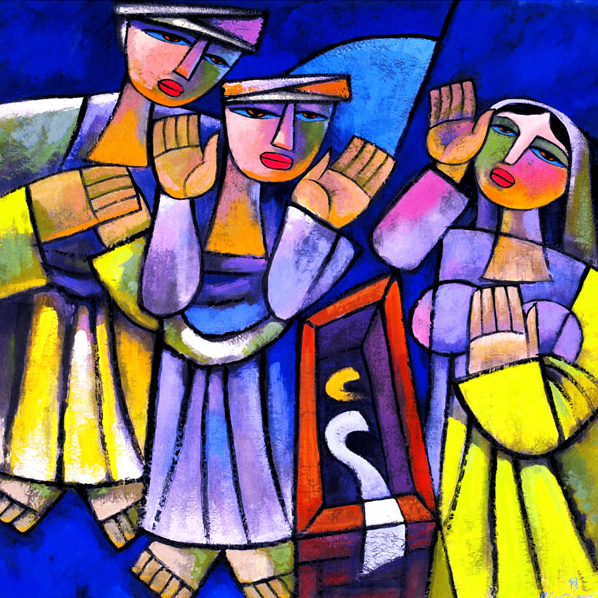
A painting in a style resembling stained glass of three women standing over a coffin, which is empty except for strips of white and yellow linen. The women's hands are raised in confusion and shock.
“The Empty Tomb” by He Qi.

Love wins, yet hate still holds us captive.

I’m grateful that Mark’s resurrection story is the one many of us are hearing in church this year. His version emphasizes the “already but not yet” experience of God’s liberation of which theologians write: Christians believe that in Christ’s incarnation — his life, death, and resurrection — all of humanity, all of Creation is already redeemed… and yet, we still experience suffering. The Kin(g)dom is already incoming, but not yet fully manifested.

Like Mark’s Gospel with its Easter joy overshadowed by ongoing fear, Trans Day of Visibility is fraught with the tension of, on the one hand, needing to be seen, to be known, to move society from awareness into acceptance into celebration; and, on the other hand, grappling with the increased violence and bigotry that a larger spotlight brings.

The trans community intimately understands the intermingling of life and death, joy and pain.

When we manage to roll back the stones on our tombs of silence and shame, self-loathing and social death, and stride boldly into new, transforming and transformative life — into trans joy! — death still stalks us.

We are blessedly, audaciously free — and we are in constant danger. There are many who would shove us back into our tombs.

An art piece structured like a collage featuring an elegant figure wreathed in fire, with text around them reading "& like any goddexx you are scorned & become the fire anyway." The figure is pouring pitchers of water into a pool at their feet; green hills with various flowers stretch up around the pool.
Art by Amir Khadar, based off the poem “litany in which you are still here” by kiki nicole

And of course, the trans community is by no means alone in experiencing the not-yet-ness of God’s Kin(g)dom.

Empire’s violence continues to overshadow God’s liberation.

The women who came to tend to their beloved dead initially experienced the loss of his body as one more indignity heaped upon them by Empire. Was his torture, their terror, not enough, that even their grief must be trampled upon, his corpse stolen away from them?

The people of Gaza are undergoing such horrors now. Indignity is heaped on indignity as they are bombed, assaulted, terrorized, starved, mocked. They are not given a moment’s rest to tend to their dead. They are not permitted to celebrate Easter’s joy as they deserve. They are forced to break their Ramadan fasts with little more than grass.

Photo of a blanket set with bowls of grass soup and slices of lemon
A photo of a Palestinian family’s meal, taken in Gaza.

Those of us who reside in the imperial core — as I do as a white Christian in the United States — must not look away from the violence our leaders are funding, enabling, justifying.

We must not celebrate God’s all-encompassing redemption without also bearing witness to the ways that liberation is not yet experienced by so many across the world.

This Easter, I pray for a free Palestine. I pray for an end to Western Empire, the severing of all its toxic tendrils holding the whole earth in a death grip.

I pray that faith communities will commit and recommit themselves to helping roll the stones of hate and fear away — and to eroding those stones into nothing, so they cannot be used to crush us once we’ve stepped into new life.

I pray for joy so vibrant it washes fear away, disintegrates all hatred into awe.

In the meantime, I pray for the energy and courage to bear witness to suffering; for the wisdom for each of us to discern our part in easing pain; for God’s Spirit to reveal Xirself to and among the world’s despised, over and over — till God’s Kin(g)dom comes in full at last.
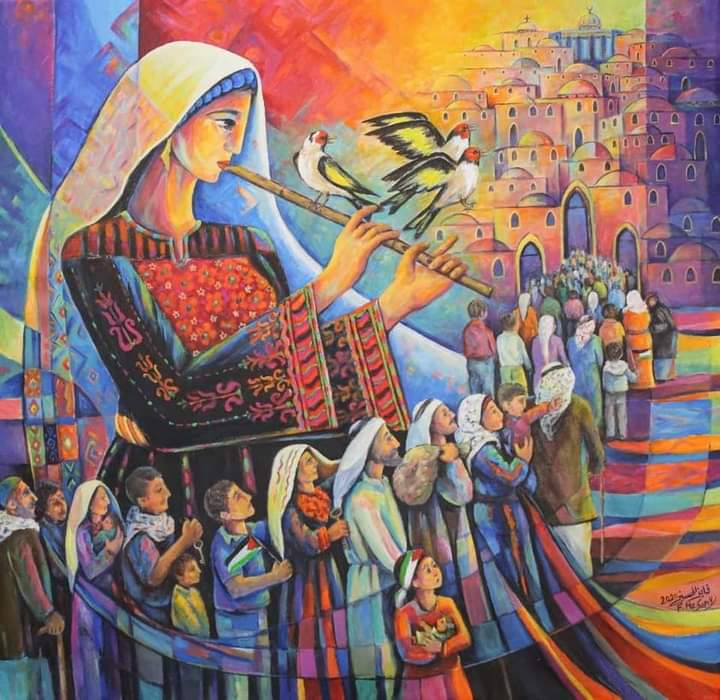
Painting of a woman playing a flute with several birds around her, as below her a line of Palestinians make their way up towards the city of Jerusalem. The colors are warm and bright.
Painting by Palestinian artist Fayez Al-Hasani
Categories
bible study easter Holy Days Reflections for worship services

Waiting with Mary Magdalene — lament that wrestles God

A reflection that draws from John 20 and Isaiah 56. Happy Easter, all.

As Mary Magdalene sits alone in the predawn stillness, she weeps — but her tears are not only grief: they are tears of frustration. Tears with questions. Tears that demand something of Divinity.

Mary is not passive in her weeping: she is wrestling the divine.

Rev. Dr. Rachel Wrenn of the First Reading podcast calls what Mary is experiencing “exasperated hope.” She parallels Mary in the garden to God of Isaiah 65, who is “ready to be sought out” by Her people who “sit inside tombs, and spend the night in secret places” (vv. 1, 4a). Magdalene reverses the image of Divinity waiting exasperatedly for humanity — now the human awaits the Divine.

God of Isaiah 65 says, ‘I said, “Here I am, here I am,” to a nation that did not call on my name.’

Magdalene too is saying, “Here I am,” to a God who WILL call her name, soon — but not yet.

First, she must endure the excruciating in-between space.

And she endures that space alone. Peter and the Beloved Disciple enter it for a moment, as first light tentatively touches the tomb’s rolled-back stone.

They sprint into it — that pregnant space between question and answer, death and rebirth — past Mary weeping without a word to her.

They enter the empty tomb and they see the burial cloths that God has stripped off and left behind. They see and the beloved, at least, “believes” (John 20:8). Believes that Jesus is risen — does he also believe that Jesus will return? That they will all see Jesus again, and soon?

If he does, his action is not to hunker down with Mary into the waiting space. He and Peter “return to where they were staying” (v. 10).

They cannot bear the waiting space. Most of us can’t. Who would choose to settle down in hospital halls with figures hunched and haggard, to wait with them for whatever news there may be?

Most of us wouldn’t. Magdalene might.

We can’t skip past the waiting, though. So Mary waits — waits for whatever will come, whenever it comes — and as she waits, she weeps. Her tears are not despair — they are lament.

In This Here Flesh, Cole Arthur Riley describes the power and purpose of lament:

“Lament is not anti-hope. It’s not even a stepping-stone to hope. Lament itself is a form of hope. It’s an innate awareness that what is should not be. As if something is written on our hearts that tells us exactly what we are meant for, and whenever confronted with something contrary to this, we experience a crumbling. And in the rubble, we say, God, you promised.”

Mary believes in the promises of her teacher, his proclamations of a world turned on its head, a new creation born where the poor are lifted from the ashes.

Her hope in that world has crumbled, but she doesn’t abandon the rubble: she settles into it. Makes her home there to wait and see what rises from the ruins.

Mary is crying, “God, you promised!” And she in turn promises God, “here I am — whenever you come, you will find me. I’m not going anywhere.”

In her describing of lament, Cole continues, “Our hope can be only as deep as our lament is. And our lament as deep as our hope.” Mary’s lament is long, because her hope is deep.

Mary Magdalene does not sit in the garden in despair. Her lament expects response — demands it. Like God of Isaiah 56, she is waiting to be sought — waiting for her call to be met with response…and it will be! Her God WILL call her name — “Mary!” — and she will know the joy of lament answered, of hope fulfilled.

Magdalene is actively waiting for what she KNOWS will come. And she’s not going anywhere till it does.

Thank God for those who wrestle blessing out of pain; who brave the liminal lament and don’t let go.

Mary, your waiting is not in vain. Joy comes with the morning. Hallelujah!


I originally posted this as a twitter thread, which you can see here.

Categories
easter Holy Days Liturgy Prayers of the People

Easter Intercessions: Gratitude for what already is; Dissatisfaction for what is not yet

Dear siblings in the risen Christ,
though we reside in the not-yet world
where God’s Kin(g)dom is still being ushered in,
gratitude still fills my spirit —

for already Jesus has drawn us to himself and holds us close;
already we have the promise that in death as in life, we belong to God;
already the Holy Spirit is at work in solidarity with us.

So I invite you to take this moment with me
to let gratitude grow and glow within you
and lift it up with me to the God Who Lives.

Let us pray:

For this good, good earth
that takes such good care of us
when we take care of it,
we give thanks.

For the helpers,
those who pick up the protest chant, or pick up our to-do lists,
so that we have time to rest and recover;
for these holy helpers, we give thanks.

For the pastors, musicians, church staff, and congregants
who put so much time and energy
into crafting multiple services this week
for the nourishment of our people and for the glory of God,
we give our heartfelt thanks.

For the chances we’ve had to draw together
to serve our neighbors or to study our scriptures;
we give thanks.

For Black Indigenous persons of color, LGBTQA+ persons, and others
who take the hells into which their oppressors throw them
and transform them into Edens —
into refuges for their people
where they can unite, rest from hatred, and create incredible things,
we give thanks.

And finally, for those who find gratitude
hard to muster up right now,
we pray for their courage to reach out to community
for the support they deserve;
and we lift up whatever prayers burn hottest in their hearts.

Oh God Who Lives,
Oh God Who Brings to Life,
Oh God Who Sustains Us evermore with love,

May our gratitude for what already is
beget the energy to act:
Our thanks for Creation moving us to environmental justice;
Our thanks for the helpers moving us to join their ranks;
Our thanks for our church leaders moving us
to participate however we are able.

And may our dissatisfaction with how much is yet broken
fuel our drive to make your Kin(g)dom Come, your will be done —
to demand justice for Black lives,
to demand safety and thriving for trans youth and adults,
to demand resources and respect for
the disability community, for the incarcerated,
for border crossers and Indigenous peoples,
and for all who are most disenfranchised by our society.

Together we lift these prayers
to the God who draws all peoples to Themself.

Amen.