Categories
advent bible study Holy Days Multifaith Other search markers Unpacking Antisemitism

Addressing Advent Anti-Judaism

During the season of Advent, Christians traditionally read Luke’s and Matthew’s Nativity stories alongside the book of Isaiah. It makes sense to do so, as Matthew himself makes the connection:

22 Now all of this took place so that what the Lord had spoken through the prophet would be fulfilled:

23 Look! A virgin will become pregnant and give birth to a son,
        And they will call him, Emmanuel. (Matthew 1:22-23)

– Matt 1:22-23, referencing Isaiah 7:14

But when we read Isaiah only in service to our Christian story, we do harm to our Jewish neighbors with whom we share these scriptures. To utilize the Hebrew Bible (= “Old Testament,” the Jewish Bible) solely as a promise fulfilled through Christ is to suggest that these scriptures are incomplete without and dependent upon Jesus — and therefore that Jews’ interpretation of their own Bible is incorrect and irrelevant.

So how do we simultaneously honor our Advent traditions, draw from Isaiah’s wisdom, and respect the vibrant, living faith of our Jewish neighbors?

Dr. Tyler Mayfield provides some excellent options in his 2020 book Unto Us a Son Is Born: Isaiah, Advent, and Our Jewish Neighbors.

The purpose of this post is to share some of the wisdom from Mayfield’s work, and to urge pastors, teachers, and others who help shape the Advent experience for their communities to check out the entire text for even more invaluable commentary.

A photo of Tyler Mayfield, a white man with short graying hair and short gray-brown beard smiling in the woods. To his right is the cover of his book

Contents of Unto Us a Child Is Born:

  • An introduction that, well, introduces the issues with current Christian uses of Isaiah and suggests a bifocal framework as remedy
  • Chapter 1: Using Our Near Vision During Advent
  • Chapter 2: Using Our Far Vision to Love Our Jewish Neighbors
  • The remainder of the chapters delve into each of the Isaiah passages offered by the Revised Common Lectionary for the Advent season.

This post will survey key points from the intro and first two chapters, and close with actionable ways to incorporate Mayfield’s message into Sunday worship and classes. Preachers and teachers will find it immensely helpful to read the rest of the book’s chapters as lesson/sermon preparation for each week of Advent.

The Bifocal Lens

Image of one side of a pair of bifocals, with the smaller, near lens fused in the larger, far lens. A line connects the larger lens to "Far Vision: Openness to our religious neighbors; paying attention to ways we may cause harm." A line drawn from the near lens leads to "Near Vision: Our sense of identity; e.g. worship rituals, cherished hymns"

In order to maintain our Christian traditions without monopolizing the Hebrew Bible, Mayfield recommends a bifocal view:

  • Our near vision focuses on our worship practices and liturgical celebrations, grounding us in our living religious tradition;
  • Our far view pays attention to the ways those practices affect those not in our communities and “compels us to critique and reject some aspects of this tradition, those that are hurtful, inaccurate, and derogatory toward our religious neighbors” (intro).

Using Isaiah and other Jewish scriptures responsibly during worship is not merely a scholarly endeavor; as Mayfield reminds us, reading and interpreting the Bible is a matter of ethics:

[…L]iturgy and ethics are not easily separated. In her excellent and provocative book on racism and sexism in Christian ethics, Traci West notes, “The rituals of Sunday worship enable Christians to publicly rehearse what it means to uphold the moral values they are supposed to bring to every aspect of their lives, from their attitudes about public policy to their intimate relations.” …We want our worship to spur us to live out our ethical claims. (Introduction)

Using Mayfield’s bifocal lens, we can ethically navigate “the tension between identity within a particular faith tradition and openness to the faith traditions of others.”

So what are some of the ways that traditional Advent worship can lead us to do harm to our Jewish neighbors?

Supersessionism

Supersessionism, also called replacement theology, claims that Christianity has replaced or supplanted Judaism; that our covenant through Christ cancels out Jews’ covenant through Abraham and Moses (hence the labeling of the two parts of the Christian Bible as the Old and New Testaments, from the Latin word for covenant).
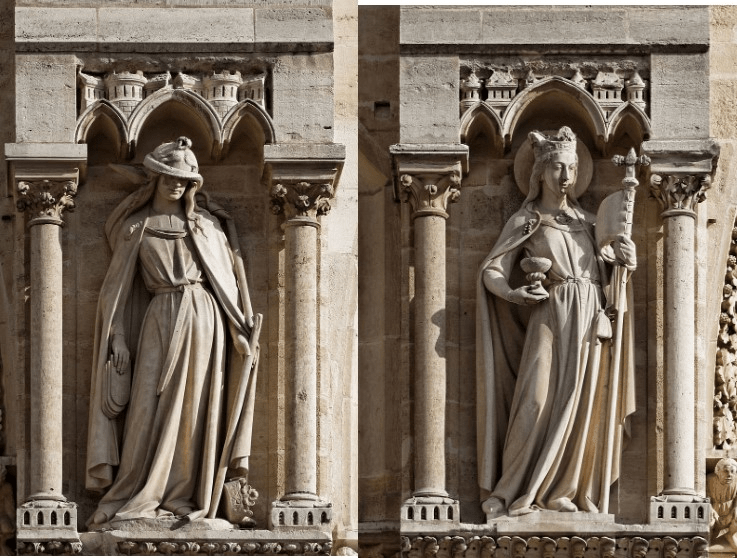
Synagoga et Ecclasia, two statues on the Notre Dame cathedral representing the Jewish and Christian faiths. This juxtaposition of crowned Church standing strong next to the Synagogue who is “blind to Jesus,” the ten commandments almost falling from her hand, is unfortunately depicted in numerous artworks of Medieval Europe.

Mayfield brings in Susannah Heschel’s description of supersessionism as a “theological colonization of Judaism“; she defines it as:

“The appropriation by the New Testament and the early church of Judaism’s central theological teachings, including messiah, eschatology, apocalypticism, election, and Israel, as well as its scriptures, its prophets, and even its God, while denying the continued validity of those teachings and texts within Judaism as an independent path to salvation.” (Heschel, The Aryan Jesus, 2008)

The seeds that the early church planted have born violent fruit across the centuries. This attitude of judgment and/or pity has led both to ideological violence — “render[ing] Jews invisible or irrelevant or as incomplete Christians” (intro) — and immense physical violence through to the segregation, scapegoating, forced conversions, expelling, and flat-out murder of the Jewish people across multiple continents.1

Medieval painting of figures gathered around a fire on which a book is burning. One person presses a poker onto it, while another person holds up a book to throw it into the fire. There are piles of books around this figure
Detail from Pedro Berruguete’s “Saint Dominic and the Albigensians” (1490s), depicting a Medieval “trial by fire” in which potentially heretical texts were determined to be “false” if they burned.

There are multiple instances of the Talmud — the central text of rabbinical Judaism alongside the Jewish Bible — being likewise gathered and burned across Medieval Europe due to the anti-Jewish belief that the Talmud was the primary obstacle keeping Jews from converting to Christianity. In 1242, for instance, King Louis IX of France ordered the burning of “24 cartloads” — something like 12,000 volumes — of priceless, scribe-written copies of the Talmud. This event devastated France’s Jewish community, which had been one of the seats of Jewish scholarship. Louis also followed up the book burning with a decree to expel all Jews from France: violence against Jewish scripture goes hand-in-hand with violence against Jewish bodies.

All this to say, the views we shape through worship and elsewhere truly do have real-world implications.

Mayfield argues that it is possible — indeed, necessary — to share scriptures respectfully. After all, he says, Judaism and Christianity are siblings.

While Christianity is often envisioned as the “shoot” growing from the dead stump of Jesse in Isaiah 11:1, a child who has improved upon the parent, in reality Judaism and Christianity are more like two branches extending from the same tree. They “grew out of the same milieu,” developing from the religion depicted in the Hebrew Bible during the chaotic era of that first century CE:

While early Jesus followers were formulating an identity distinct from Christ’s Jewish origins, Rome’s 70 CE destruction of the Second Temple spurred on new iterations of Jews’ own religion; following the Pharisees,2 they recentered faith around local life rather than the temple. In this way, the two religions are around the same age, growing from the same foundations! We are sibling religions; and we are neighbors. The problem is that we Christians have frequently behaved as very poor neighbors indeed.

Why Jewish “Neighbors”?

In Isaiah, Advent, and Our Christian Neighbors, Mayfield has opted for the term neighbor to describe the Christian relationship to Jews in the present day. Why? For one thing, love of neighbor is a central tenet of both Jewish and Christian tradition, originating in Leviticus 19:18 and emphasized by Jesus in Mark 12:31 and Matthew 22:39. Reading scripture through the ethic of love thy neighbor, we must ask, “If a particular reading of Scripture leads us to think badly of Jews, then is this reading Christian?” (chapter 2).

Furthermore, Mayfield continues,

I also use the concept of neighbor because neighbors do not always agree. In fact, they sometimes disagree and have to take seriously one another’s perceptions, feelings, and opinions. Being neighborly is being attentive and listening well to the concerns of others. It is realizing that your actions affect those around you. Christians act neighborly when they take seriously Jewish critiques of Christianity and Christian teachings, just as Jews act neighborly when they offer these critiques. (Chapter 2)

In reconsidering how we read and teach scripture, we can imagine that scripture is the fence we share with our Jewish neighbors, even while we dwell in different “geographies.” But when we accept supersessionist theology, we deny Jews their side of the fence; we colonize it.

Let’s look at how supersessionism manifests specifically in the ways we use Isaiah during Advent.

Resisting a Christian Isaiah

Mayfield describes how, over the past two millennia, Christians have disconnected Isaiah from his ancient Jewish context and Christianized him, even going so far as to call this eighth-century BCE prophet’s book the “fifth Gospel” alongside Mark, Matthew, Luke, and John (intro).
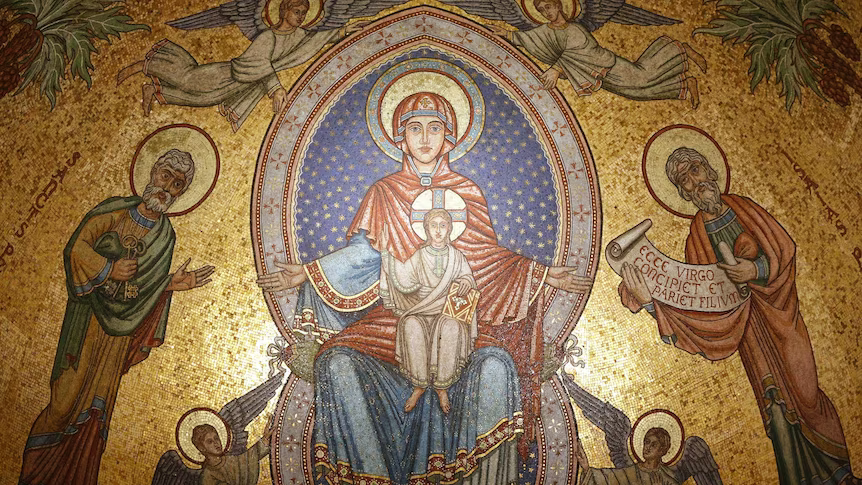
ID; ancient mural of Mary on a throne with a young Jesus in her lap. To her right is Peter holding a key. To her left is Isaiah holding a scroll on which the Latin for "Behold, a virgin will conceive and birth a son" is written
The Virgin Mary and Jesus, flanked by Isaiah (right) and Peter (left).

In lifting Isaiah from his seat among Jeremiah, Amos, and all the Hebrew Bible’s prophets, we sever him from his original ancient Jewish audience and deny his relevance to our Jewish neighbors today.

We hear Isaiah (and Handel in his Messiah) proclaim: “For unto us a child is born; unto us a son is given” (Isaiah 9:6) and everything in our tradition preps us to assume that the “us” in question is us Christians; that this child must be Jesus!

In our presumption that Isaiah’s prophecies are all about Jesus, we render this prophet irrelevant to our Jewish neighbors, denying the validity of their interpretations of this biblical book. But if we dig into the historical context, we can broaden our ways of understanding these texts and thus learn how to better share these scriptures.

A Christ-exclusive interpretation of Isaiah misunderstands what biblical prophets did.

We hear the word “prophecy” and think of foreseeing the future, often the distant future. But the prophets of the Bible, from Joel to John the Baptist, were largely focused on their own here-and-now:

The prophets of ancient Israel (and ancient Mesopotamia) did not see their sole activity as foretelling. They were also “forthtellers,” speaking to the religious and political issues of their day with courage and strength. As mediators between God and the people, prophets delivered messages, oracles, and visions to audiences that included kings and commoners. They interpreted the past, analyzed the present, and spoke of the future but were undoubtedly more concerned with events of the present than events several hundred years in the making. …

[T]he notion of prophecy as foretelling renders the prophet’s words irrelevant to, and uninspired for, the first hearers and readers of these messages. (Chapter 1)

There’s another historical issue with reading Isaiah’s prophecies as exclusively about Jesus as his people’s anticipated Messiah:

At the time of Isaiah in the 700s BCE, the concept of the eschatological Messiah had not yet been developed!

While the Hebrew Bible does describe figures like David and Cyrus as anointed ones (which is what the Hebrew word mashiach, “messiah,” means), the concept of The Messiah who would usher in an age of justice and peace was most likely a later development of Second Temple Judaism (516 BCE – 70 CE).

We only see The Messiah in Isaiah’s descriptions of a “Wonderful Counselor…Prince of Peace” (Isaiah 9:6b) and a just judge on whom God’s spirit rests (Isaiah 11:1-10) because of our own bias: “We think we know what we will find before we look” (chapter 1).

Learning about a passage’s original context helps us interpret the text more faithfully as we seek its relevance today. What is more, we can and should consider its multiple historical contexts, the whole breadth of what it has meant for different groups in different eras:

Texts in Isaiah have an entire history of interpretation, which includes the “originating” context in ancient Israel, their reuse and interpretation in Second Temple Judaism perhaps, their Christian context in which some Isaiah texts became christological, the Jewish context in which some texts became messianic, and then later Christian context, that is, when these texts were attached to Advent.

The book of Isaiah was composed by ancient Israelites over several centuries, from the eighth to the fifth centuries BCE. These authors wrote for their ancient Israelite audiences with no comprehension of later events such as the life of Jesus and the growth of Christianity. Thus, the book of Isaiah does not predict the birth of Jesus. (Chapter 1)

Recognizing the long history of a piece of scripture helps reduce our sense of ownership over the text; we realize that its messages are not for Christians alone, but for faithful Jews and Christians (and Muslims, to an extent) across the millennia and today. This recognition is vital for unpacking biases and beliefs we often don’t even realize we carry deep in our psyches — and that some of the tools we use reinforce.

A Complicit Lectionary?

A key concern Mayfield explores throughout Unto Us a Child Is Born is how the lectionaries we use can guide us towards supersessionist readings during Advent. He focuses on the Revised Common Lectionary (RCL) because of its popularity: Denominations ranging from the UCC to the Roman Catholic Church make use of it; overall, a huge portion of all sorts of Christians (largely in Canada and the USA) use it. 

Mayfield explains that for each Sunday, the ecumenical team that created the RCL selected the Gospel reading first, and then selected an “Old Testament” text (plus a psalm & Acts/epistles/Revelation passage) to complement that Gospel reading.

The theological ramifications of always prioritizing the Gospel in this way include an unbalanced dialogue: If we imagine the readings in conversation with each other, the Gospel always gets to choose the topic; the “Old Testament” only ever gets to respond.

Actionable Ways to Be Good Neighbors

After learning about Advent’s supersessionist pitfalls, you might be tempted simply to drop Isaiah in an effort to avoid the issue entirely. But Mayfield argues that that is a mistake:

We need Isaiah to celebrate Advent. The book’s treasures are too marvelous to set aside as ancient history or consign to another liturgical season. As we begin the liturgical year, we need to hear of swords beaten into plowshares and of barren lands blooming. …To use only the Gospel readings during Advent limits our theological reflections while also insinuating that only those four biblical books are worthy of public reading and proclamation. (Chapter 1)

Instead of ditching Isaiah, Mayfield offers practical suggestions for using the prophet responsibly:

First, we can open readings of Isaiah in church with an explicit statement: “Today we hear words from a book held sacred by both Jews and Christians.” As Mayfield explains, “This simple and accurate statement…compels us to recognize our religious neighbors even as we worship” (chapter 2).

Going further, a preacher can remind congregants that “As Christians, we understand Isaiah through our histories and theologies, but Jews do not read Isaiah this way.”

(My own thought: A pastor can even take time in an Advent sermon to acknowledge some of the history of misusing Jewish scriptures / debunking common presumptions about Isaiah’s role in the Nativity story. A Sunday School teacher has even more space to explore that history and context, and to invite attendees to imagine how Isaiah speaks to us today.)

Beyond simple statements and one-time mentions, Mayfield urges us to commit to always interpreting scriptures through a paradigm of “do no harm” — to “share as good neighbors.”

A key part of this paradigm is an intentional shift from “a more linear approach to the narrative of Scripture (in which we read the biblical books as a progression both in time and in theological depth) to a more back-and-forth conversational approach (in which we allow various texts to speak to one another).” This conversational framework creates space for the Bible’s many voices and refuses to let “New Testament” voices dominate.
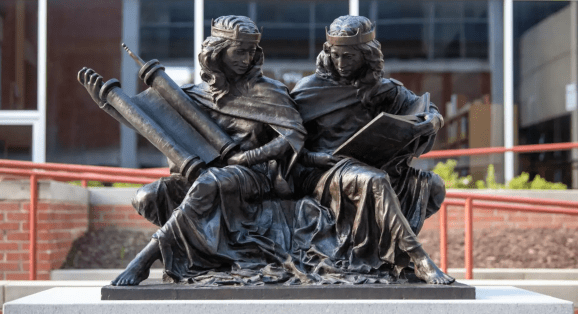
An outdoor statue of two women sitting side by side. Both are robed and crowned. One holds a large torah scroll; the other an open Bible. They are smiling and looking at one another's texts.
A new representation of Synagoga et Ecclasia, mutually crowned and learning from each other. Statue by Joshua Koffman for St. Joseph’s University, commissioned in honor of the 50th Anniversary of the Roman Catholic Church’s 1965 Nostra Aetate declaration, which repudiated past anti-Jewish doctrine and actions and called for more respectful relations.

Here’s a longer excerpt from Mayfield describing how to put this paradigm into practice while remaining true to ourselves:

So, how do we, as Christians, continue to affirm one of our central claims of Jesus as the Messiah while also allowing space for the dismissal of that claim? Perhaps we are helped by returning to the tension between identity and openness.

Christians maintain strong identities in the claim of Jesus as the Christ while also remaining open to other visions of the messianic kingdom, thus realizing that the full realm of God has not come. It is vital to our identity to claim Jesus as the Messiah, and we are also open to other formulations of messiah.

One meaningful way forward along this challenging path is not to claim too much: to be careful, considerate, and humble with our messianic notions. For example, instead of holding to a messianic or christological reading of Isaiah as the only valid notion, Christians could admit openly and explicitly that these texts provide some of the necessary elements that will constitute notions of messiahship in first-century Judaism, notions Jesus and his biographers took up and used. However, these texts do not point immediately to Jesus; there is just not a straight line — historically or theologically — between Point A, Isaiah, and Point B, Jesus.

This sort of admission presents real possibilities for neighborly engagement since it ties the Christian claim about Jesus more closely to sacred texts that are used only by Christians. It does not predetermine the meaning of Isaiah for all traditions, but it allows Jews and Christians to interpret Isaiah’s prophecies based on their respective traditions, with neither tradition holding ultimate authority over the biblical text. …We could go even further to say that the Jewish reading is an important and necessary one from which Christians could learn. (Chapter 2)

More Benefits of Interpreting Responsibly!

Ultimately, a paradigm of respect and mutual conversation bears rich fruit not only in our relationship to our Jewish neighbors, but to our own faith. Letting Hebrew Bible texts stand on their own merit opens us to how a given passage speaks to us here and now, rather than limiting its prophecies to a closed loop of prophecy-fulfilled-in-Christ. Mayfield quotes Ellen Davis’ comment that

“We like to keep the frame of reference for prophecy within the ‘safe’ confines of the Bible, by reading prophecy solely as illuminating what has already happened—the birth, life, and death of Jesus Christ—and not allowing it to meddle much in the current lives of Christians” [and Jews!]. (Chapter 1)

We are not called to play it safe; we are called to let scripture breathe, and to welcome in God’s mischievous spirit! Making room for many interpretations, for multiple messages from Isaiah for different times and contexts, liberates scripture to speak to us in new, challenging, relevant ways today.

Doing so also helps us live into the tension of Advent’s dual theological themes: Incarnation and eschatology. As Mayfield notes,

These two foci do not naturally cohere. The emotions invoked by Advent call us to “prepare joyfully for the first coming of the incarnate Lord and to prepare penitently for the second coming and God’s impending judgment.”3 Joy and penitence. …We are pulled in different emotional directions. (Chapter 1)

Churches tend to lean towards the joy — but we can’t ditch the solemnity, can’t “alleviate the tension,” without robbing ourselves of “the incredible richness and grace that result from the annual eschatological collision in the weeks before Christmas.”4

As someone who centers my ministry around breaking binaries, reveling in the in-betweens where God does Their best work, I appreciate this insistence on the “both/and” of penitence and joy — as well as of Isaiah and Matthew/Mark, and of a prophetic message for Isaiah’s time, and Jesus’s time, and for us and our Jewish neighbors today.

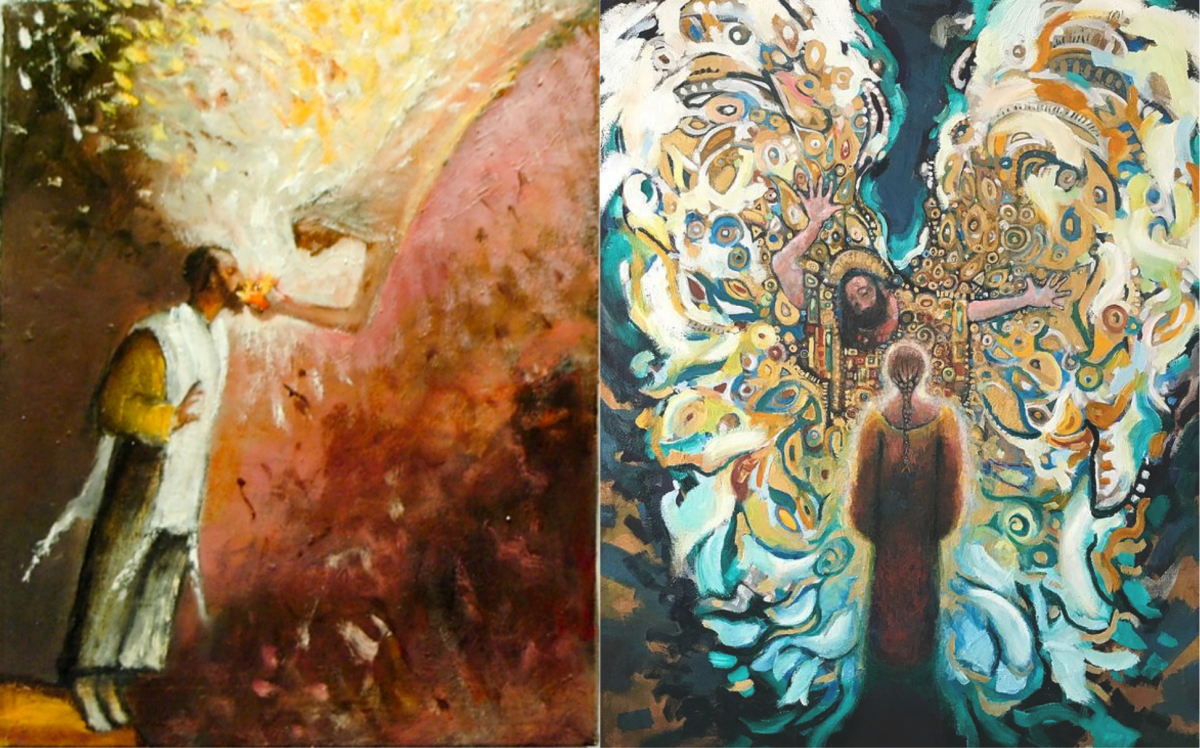
Two contemporary paintings side by side. The first is of Isaiah receiving a burning coal to his lips by an angel. The second is the angel appearing before Mary.
“Isaiah” by Richard McBee; “The Annunciation” by Daniel Bonnell

Closing

In Advent, past, present, and future queerly coalesce:

“We have hope in what the incarnation brings to our world each day, even as we hope for the setting right of things with the culmination of history.” (Chapter 1)

Though the details certainly differ, we can thus proclaim that “even though the Messiah has come, we wait with Jews for the ‘complete realization of the messianic age'” and that in this interim time, “it is the mission of the Church, as also that of the Jewish people, to proclaim and to work to prepare the world for the full flowering of God’s Reign, which is, but is ‘not yet’”5 (chapter 2).

This Advent claim “takes the unique identity of Christians seriously as ones who have seen in Jesus our Messiah yet remain open to the fullness of that claim in the future” (chapter 2).

It is possible to shape Advent into a season wherein we don’t perpetuate harm against our Jewish neighbors, but rather grow in our respect for and mutual relationship with them. The remainder of Unto Us a Child Is Born: Isaiah, Advent, and Our Christian Neighbors is overflowing with more knowledge and advice that further enables this aim. I highly recommend checking it out. If you need help obtaining a copy, hit me up.

Have a blessed, pensive, and joyful Advent.


  1. For a thorough history of antisemitism, and how to be in solidarity both with Jews and Palestinians, I highly recommend Safety through Solidarity: A Radical Guide to Fighting Antisemitism. ↩︎
  2. Pharisees were cool, y’all; go learn from the fabulous Rabbi Danya Ruttenberg about what Pharisees believed, how Jesus may have been a Pharisee himself, and the context around the Gospel writers’ negative depictions of them ↩︎
  3. Mayfield’s quoting Gail R. O’Day, “Back to the Future: The Eschatological Vision of Advent” (2008) ↩︎
  4. Mayfield’s quoting J. Neil Alexander, Waiting for the Coming (1993) ↩︎
  5. Mayfield is quoting Mary Boys, Has God Only One Blessing? (2000) ↩︎
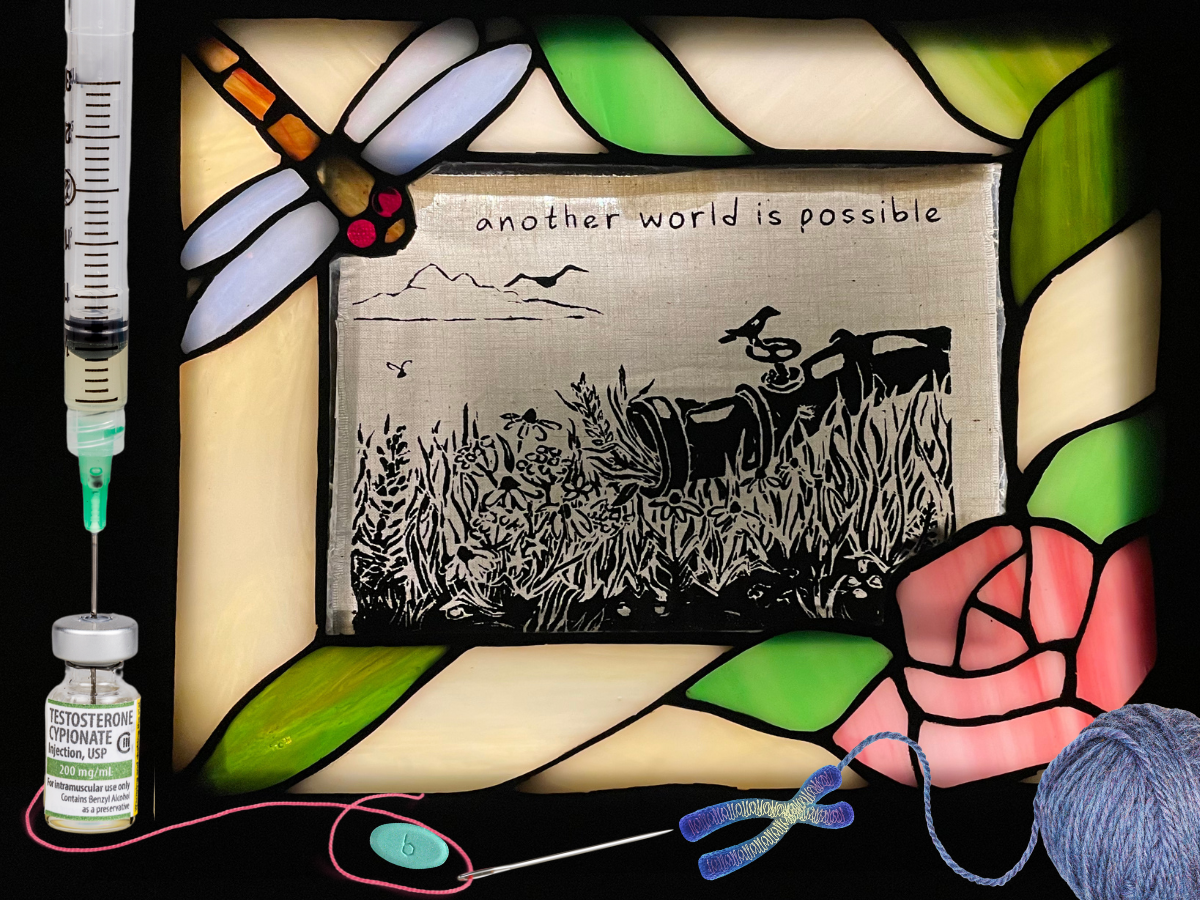
Categories
Current Events / Activism LGBT/queer My poetry Other search markers

A poem on being trans during Trump’s return

The day after the inauguration
I give myself my hormone shot.

Every Tuesday since
I have done so again

in spite

of blowhards’ orders for
two sexes and impermeable borders.

Hrt — dear dermal border crosser — pays no mind 
to the blustering of fools who know nothing

of what it is to sew oneself 
into one’s body with a needle

pierced through thigh muscle; stitches across 
the chest; new names spun by fumbling fingers

into the threads that stretch heartstring to heart-
string. What could they who sever heartstrings know

of the transtemporal tapestry that interweaves
our unnumbered stories, our numberless ways to be?

Even now, they try

to tear our truth out of all legal records,
to blot us out from history and medical texts —

but we suffuse humanity’s warp and weft:
cut us out, mere tatters will be left.

And it may be they’ll pry

our protections and passports, our vials and blue pills
from our still-warm, still-alive, still-trans and intersex hands —

but our tapestry is stronger than their will,
twined tighter than chromosomes, and

we’ll give them hell for every sundered string.
We’ll fight like hell until their bitter end.

For now, it is Tuesday again

and my hand, with its wedding ring
and thickened skin,

is steady as I plunge the needle in.


You are welcome to circulate this poem around, including on social media (please make sure to include image descriptions if you share screenshots) or at any type of gathering. Please credit Avery Arden (they/ze) of binarybreakingworship.com.

I also ask that you keep in mind that this poem is first and foremost a personal piece; I am not attempting to speak to what other trans and/or intersex persons are feeling right now. What is more, I hope it is clear that none of the various things mentioned — hormones, surgery, document changes — are at all necessary to be trans; I only center hrt here because of how it has been a grounding ritual for me these past weeks.

I welcome conversation, and would love to hear about your rituals, your remembrance, your resistance.

(By the way, this post’s title isn’t the poem title; it’s untitled / the first line kinda serves as the title.)

More about the poem:

Since Trump’s intentionally overwhelming first-day flood of executive orders, I’ve been trying to sort my tangled-up feelings:

  • The rage and despair and dread inextricably mixed with love, and defiant dreams of a better world, and deepest pride in the vibrant, rebellious, eternal community of those whose very bodyminds expose Empire’s lie that humanity can be dichotomized.
  • The whiplash of mundanity in times such as these — the way “life as usual” can lure us into passivity if we are not careful; but also the way our everyday rituals and tasks (like my weekly hormone shot) ground us, and can even be little acts of resistance to nourish our larger, communal resistance.
  • The bitterness of all that could have been (and I’m not talking about a Democrat in the White House, upholding the same systems that enable a tyrant like Trump, just with more hand-wringing). The frustration that this is what it takes for more people to wake up to the evils that have festered in and fueled this nation from its conception. The relief that at least now there are more people ready to resist, and urgency to welcome and equip them.
  • The preemptive grief for all we will lose. The determination to lose as few as possible — to pray for the dead and fight like hell for the living.

Before finally managing to get this poem written out, I was able to channel some of that tangle into helping More Light Presbyterians write our statement on Trump’s executive order against gender diversity. Along with concrete actions we can take to support trans and intersex persons right now (see the link for those), one of the parts I wrote was a closing message of love and promise to my trans and intersex kin:

Hateful people want nothing more than to see you feeling hopeless and abandoned—but we promise you, there will always be people in your corner, ready to protect you with our lives. We will not leave you to fight alone, no matter how dire things get. Cling to your community, nurture your spirit however you can, and remember:

Politicians were never going to save us. We keep us safe, trusting in the love and solidarity of the One who created each of us with purpose and delight (Genesis 1:31; Psalm 139:14).

Categories
LGBT/queer Reflections for worship services

A Queer Reflection for Trinity Sunday

There’s something queer about a Triune God. 

A diagram of the Trinity featuring a triangle with each angle labeled The Father, The Son, and the Holy Spirit respectively. In the center of this triangle is the word "God." Connecting lines between each angle read "is not," so that it reads "the father is not the son is not the holy spirit is not the father," while lines that connect each angle to the center read "is" so that you get the message "the father is god, the son is god, the holy spirit is god."

How can one Being also be three Persons? The math doesn’t seem to add up! Some spend years attempting to articulate this theology in a way that doesn’t fall into “heresy”; others give up with a laugh and accept it as a Mystery. Ultimately, the God of the Universe is ineffable, beyond our understanding — yet we are called to seek ever deeper relationship with God, and promised that if we seek, we will find.

When people decry queer identities as nonexistent, overly complicated, or paradoxical, I can’t help but think of our impossibly Three-in-One God. I think also about my own gender journey: how I struggled as a child to name what I was feeling because I had no language to describe it; how once I discovered others had words for what I was experiencing, I delighted in every one I could uncover; and how, ultimately, even my favorite words I’ve found to describe myself fall short. 

Words like trans, nonbinary, and genderqueer certainly help others understand and relate to me better, but I’ve learned to be okay with the fact that they might never fully know me, just as I may never fully know them — or at least that the deepest understanding is beyond words. Turns out that the children of a Mysterious God are micro-mysteries in ourselves!

What I’m left with is this: if we worship a Triune God, why do we try to squeeze the humans made in that Infinite, Ineffable Being’s image into two narrow boxes? And if we celebrate how, in the Incarnation and Resurrection, Divinity burst through the binaries between Creator & Creation, Life & Death, surely the binary between male and female is not so insurmountable!

Together, let us pray:

Holy God, whose very existence is relationship, we marvel at your mystery. Protect this day and always those of your children who, like you, defy easy definition and resist restrictive categories. Teach us to recognize your wisdom and holiness shining within them, for only together in all our diversity do we reflect your image. Amen.

___

Further reading:

Categories
Affirmation of Faith easter Liturgy Other search markers

Affirmation of Faith in the Wounded God who calls us Good

We worship a Mystery, a Being too vast to capture in words,
who reveals Godself to each of us in different ways.

While making room for different understandings,
let us affirm the faith that draws us together:

We believe in the God whose Word birthed the cosmos,

Who shaped human beings from the rich topsoil,
breathed Her own breath into us,
blessed both our earthy bodies and celestial spark,
and declared us Good, very Good!

When evil taught us shame
for those very bodies God had blessed,

God became a seamstress,
tenderly dressing Her children, Adam and Eve —
never dismissing our distress
but giving us what we need
to believe in our inherent dignity again.

This God reminds us at every opportunity
That we are destined for freedom:

God did what it took to liberate Her people
from enslavement in Egypt — and from countless future captors,
human powers who wield control through violence and fear.

The God who walked through Eden put on wheels —
the throne Ezekiel saw rolling through the heavens
to follow Their people into exile, and back again.

And then, this same God settled into flesh: 

For God so loved the world They’d made
that They entered into it Themself,
weaving Godself a human form within a human womb.

From boundless power to an infant in the lap
of his teenage mother, God learned to crawl, to walk,
to speak with human tongue the news They’d been proclaiming
through pillars of flame and cloud, 
through prophets’ cries and in the stillest silence.

In Jesus, God brought restoration to bodies and spirits aching
under the yoke of empire, the shackles of shame —

and then God died. 

But no tomb can restrain Life itself for long:
Christ rose with wounds — reminders of what happens
when we allow violence and fear to reign unchallenged.

This wounded Christ ascended into heaven,
but his Spirit abides with us still —
stirring up our indifference, whispering hope into our despair,
and whisking us up into the hard but holy work
of unrolling a kin-dom accessible to all.

Amen.


About this piece:

If you this piece it in your own service, please credit it to Avery Arden — and I invite you to email me at queerlychristian36@gmail.com to let me know you’re using it!

I wrote this affirmation for a worship service centered around John 20:19-30’s account of Jesus inviting Thomas to touch his wounds.

God created us to be inspirited bodies, embodied spirits — in Genesis 1, God calls not just our spirits but our bodies good — and not just some bodies, but all bodies, disabled bodies included.

Disability theologians have long been inspired by the idea that Jesus’s resurrected body keeps its wounds — wounds that would impair mobility and fine motor skills, that would cause chronic pain.

In rising with a disabled body, Jesus “redeems” disability: he evinces that disability is not brokenness, is not shameful or the result of sin; and he evinces that disability can exist separate from suffering — that suffering is not intrinsic to disability.

The idea of a wounded Christ also connects to Henri Nouwen’s concept of the “wounded healer,” which I recommend looking into if that phrase resonates with you.

The description of God as seamstress restoring a sense of dignity to Adam and Eve is inspired by Cole Arthur Riley’s book This Here Flesh, where she writes:

“On the day the world began to die, God became a seamstress. This is the moment in the Bible that I wish we talked about more often.

When Eve and Adam eat from the tree, and decay and despair begin to creep in, when they learn to hide from their own bodies, when they learn to hide from each other—no one ever told me the story of a God who kneels and makes clothes out of animal skin for them.

I remember many conversations about the doom and consequence imparted by God after humans ate from that tree. I learned of the curses, too, and could maybe even recite them. But no one ever told me of the tenderness of this moment. It makes me question the tone of everything that surrounds it.

In the garden, when shame had replaced Eve’s and Adam’s dignity, God became a seamstress. He took the skin off of his creation to make something that would allow humans to stand in the presence of their maker and one another again.

Isn’t it strange that God didn’t just tell Adam and Eve to come out of hiding and stop being silly, because he’s the one who made them and has seen every part of them? He doesn’t say that in the story, or at least we do not know if he did. But we do know that God went to great lengths to help them stand unashamed. Sometimes you can’t talk someone into believing their dignity. You do what you can to make a person feel unashamed of themselves, and you hope in time they’ll believe in their beauty all on their own.

People say we are unworthy of salvation. I disagree. Perhaps we are very much worth saving. It seems to me that God is making miracles to free us from the shame that haunts us. Maybe the same hand that made garments for a trembling Adam and Eve is doing everything he can that we might come a little closer. I pray his stitches hold. Our liberation begins with the irrevocable belief that we are worthy to be liberated, that we are worthy of a life that does not degrade us but honors our whole selves. When you believe in your dignity, or at least someone else does, it becomes more difficult to remain content with the bondage with which you have become so acquainted. You begin to wonder what you were meant for.

The idea of God on wheels comes primarily from Julia Watts Belser’s article “God on Wheels: Disability and Jewish Feminist Theology.” I highly recommend the whole article (check out the gorgeous art piece that accompanies it, if nothing else), but here’s one excerpt:

“…On the morning of the holiday of Shavuot, Jewish communities around the world chant from the book of Ezekiel, reciting the Israelite prophet’s striking image of God. The prophet speaks of a radiant fire borne on a vast chariot, lifted up by four angelic creatures with fused legs, lustrous wings, and great wheels. …One recent Shavuot, Ezekiel’s vision split open my own imagination. Hearing those words chanted, I felt a jolt of recognition, an intimate familiarity. I thought: God has wheels!

When I think of God on wheels, I think of the delight I take in my own chair. I sense the holy possibility that my own body knows, the way wheels set me free and open up my spirit. I like to think that God inhabits the particular fusions that mark a body in wheels: the way flesh flows into frame, into tire, into air. This is how the Holy moves through me, in the intricate interplay of muscle and spin, the exhilarating physicality of body and wheel, the rare promise of a wide-open space, the unabashed exhilaration of a dance floor, where wing can finally unfurl.

On wheels, I feel the tenor of the path deep in my sinews and sit bones. I come to know the intimate geography of a place: not just broad brushstrokes of terrain, but the minute fluctuations of topography, the way the wheel flows. When I roll, I pay particular attention to the interstices and intersections: the place where concrete seams together uneasily, the buckle of tree roots pushing up against asphalt, the bristle of crumbling brick.

I have come to believe this awareness reflects a quality of divine attention. Perhaps the divine presence moves through this world with a bone-deep knowledge of every crack and fissure. Perhaps God is particularly present at junctions and unexpected meetings, alert to points of encounter where two things come together…”

A similar theology around God on wheels can be found in the perspective of a Christian teen named Becky Tyler, found here. Becky says:

“When I was about 12 years old, I felt God didn’t love me as much as other people because I am in a wheelchair and because I can’t do lots of the things that other people can do. I felt this way because I did not see anyone with a wheelchair in the Bible, and nearly all the disabled people in the Bible get healed by Jesus – so they are not like me.”

She felt alienated by much of what she read in the Bible – until she was given new food for thought.

“My mum showed me a verse from the Book of Daniel (Chapter 7, Verse 9), which basically says God’s throne has wheels, so God has a wheelchair.

“In fact it’s not just any old chair, it’s the best chair in the Bible. It’s God’s throne, and it’s a wheelchair. This made me feel like God understands what it’s like to have a wheelchair and that having a wheelchair is actually very cool, because God has one.”

Categories
Affirmation of Faith LGBT/queer Liturgy

Affirmation of Faith: Queer God who came out to Moses…& other biblical coming out stories

The love of our queer God
unites us into one Body —
not in spite of, but in celebration of
our varied gifts and roles in
the story God is telling even now.

As one, let us affirm some of what we believe
about the God who is for us
when we are in the closet, and when we come out,
when we receive our loved ones with rejoicing
and when we strive to understand.

We believe in the God who came out to Moses
from the midst of unburned branches
with a name They had never revealed before —

a name shared with love, shared as an invitation
into deeper relationship, deeper understanding
of the God Who Is and Who Will Be
the steadfast ally of shunned and shackled peoples.

We believe in the God of Joseph, 
who takes tattered lives
and weaves them into wholeness.

When Joseph came out to his brothers
as a dress-draped dreamer
and faced their violent rejection,

God went with Joseph into slavery, into imprisonment,
and out again, guiding his way into flourishing.

But They also stayed
with Joseph’s brothers,
never ceasing to work on their hard hearts,
preparing them for the tearful reunion
where they would embrace Joseph’s differences
as life-bringing gifts.

We believe in the God of Esther, 
who protected her from being outed unwillingly
in a place hostile to her very being;

and who, when the time came to act,
filled her with the courage and power she needed
to use what privilege she had
to save the more vulnerable members of her people.

We believe in the God of Mary,
the teenage girl who faced disgrace
by coming out as full of grace

pregnant with divinity —

yet she did so boldly, joyously,
recognizing the hand of God
in the status quo’s upturning.

We believe in Jesus, whose identity 
as God’s beloved son and God Themself,
as Word made Flesh and Life that died
is too complex for human minds to fathom —

yet Jesus yearned to be known,
to be understood by those who loved him most!
He asked them earnestly, “Who do you say that I am?”
but told them not to out him to the world
before he was ready to share his truth in his own time —
And oh, how he’d shine!

We believe that the God
who liberated Lazurus from his tomb,
and who overcame death
by rising from a tomb of his own,

is the selfsame Spirit
who enters into the tombs
we build around ourselves
or shove our neighbors into;

She looses our bindings
and pulls us into Her great Upturning.

Amen.


About this piece:

I wrote this affirmation for my church’s More Light Sunday service, an LGBTQA/queer-focused service. Themes included learning how to love ourselves, our neighbors, and our God; reclaiming scripture from those who have weaponized it; and the power of story.

If you this piece it in your own service, please credit it to Avery Arden — and I invite you to email me at queerlychristian36@gmail.com to let me know you’re using it!

Further Reading

For more on Joseph through a queer & trans lens:

For more on Esther through a queer lens:

For more on Mary through a queer & trans lens:

For more on Jesus through a queer & trans lens:

For more on Lazarus through a queer & trans lens:

[image: a digital painting of Joseph of Genesis by tomato-bird on tumblr, a figure with light brown skin, brown eyes, and curly dark hair sitting in a field. They have their head propped on one hand as they sit, gazing off into the distance with a sunset or sunrise blushed sky behind them. And from their shoulders extends a gorgeous, flowing cape, rising upward behind them as if caught on the wind so that its colors blend with the blushing sky – ripples of vibrant red and blue, with orange and yellow stars plus a moon and sun scattered along the fabric. / end id]

Categories
Call to worship LGBT/queer Liturgy Multifaith Opening prayer

Call to Worship & Opening Prayer: Queer God with diverse children

Call to Worship

Gracious God,
in this time of worship and wonder, story and song
into which you have gathered us,

we marvel at the wondrous diversity of your human creation.
Each of us — Black, white, Latine, Asian, Indigenous, and beyond — 
is an integral part of your magnificent spectrum.

You call us to join in joyous worship, just as we are.

Each of us — Christian, Jewish, Muslim, Hindu, Buddhist, atheist, and beyond —
is an integral part of your magnificent spectrum.

You call us into community, just as we are.

Each of us — with our bodies of diverse shapes, sizes, and abilities —
is an integral part of your magnificent spectrum.

You call us Good, you call us whole and holy, just as we are.

Each of us — of all sexualities and genders, all these ways of being and loving —
is an integral part of your magnificent spectrum.

You call us to share the gifts you gave us, just as we are.

Opening Prayer

Queer God beyond our knowing,
we glimpse your vastness in the diversity of your children
who together bear your image.

Queer Trinity, both One and Three,
your very Being shows us how to be:
honoring each person’s uniqueness,
and valuing our interconnectedness. 

Queer God, 
On this More Light Sunday, we humbly pray and act
for the full affirmation and inclusion of all of our LGBTQ+ siblings.

Amen.


About this piece:

I co-wrote this call to worship, and wrote the opening prayer, for my church’s More Light Sunday service, an LGBTQA/queer-focused service. You could edit the last two lines to take out the reference to More Light Sunday if using it for general worship.

If you use it in your own service, please credit it to Avery Arden — and I invite you to email me at queerlychristian36@gmail.com to let me know you’re using it!

Categories
Affirmation of Faith Call to worship Charge and Benediction Confession and Pardon easter Holy Days Invitation to the table LGBT/queer Liturgy Opening prayer Prayer after Communion Prayers of the People

Acts 8 & John 15 Liturgy: eunuchs, intersex & trans persons, & all outcasts welcome in God’s expansive love

Call to Worship

Beloved community, let us draw the circle wide!
And draw it wider still.

Each of us is here because something draws us to the Divine
as expressed in the Person of Jesus.
We come to explore what it is that draws us here,
in community with neighbors who can teach us 
what it is that draws them here.

We come with questions, struggles, doubts.
We come with unique perspectives that enrich the whole community.

We come in vast diversity of mind, body, being,
to live into a unity that does not quell our differences, but celebrates them.

We come to abide in the love of Jesus,
and to learn to bear good fruit that lasts.

Come, let us join in worship of the God of love
Who teaches us what true love is.

OPENING PRAYER

O God whose love sustains us, restores us, abides in us,
Send your mischievous Spirit whirling through our midst
in the many different spaces from which we gather.

Let Her galvanize our hearts
so that our worship will empower us for the work
into which you invite us:

For you do not call us servants,
nor does your power rely on dominance;
But instead you call us friends, co-laborers whose joys and sorrows
you know as deeply as if they were your own.

Loving God, Living God,
you guide us into true love, into true life
that consists of enough for all humans, all creatures,
and that will restore all relationships
between neighbors, enemies, strangers
and with you, our Friend.

Amen.


Confession and Pardon

CALL TO RECONCILIATION

Our sin, individual and collective, is almost too much to bear. 
It would be easier not to face it — but to pretend it is not there is to let it fester. 

So let us face it together. 

PRAYER OF CONFESSION 

Jesus asks only this of us: 
that we love one another just as he loves us — 
a love without conditions, a love that liberates!

But again and again, we choose hate, or fear, or control
not only with those we call enemies
but even with our family, our friends.

The love of God is a love that acts,
a love that bears fruit that lasts,
but we continue to think of love in terms of simple words,
saying “love” with our mouths 
but acting in ways that harm,
or failing to act at all.

God’s Spirit bursts through all walls we build
to separate “us” from “them” — 
but we build them back, unsure of what we’d be
without an “Other” on whom to project our insecurities,
on whom to blame our misfortunes 
or the consequences of our own crimes.

Created for abundance, 
we live as hostages of scarcity.
We steal from our neighbors
and hoard whatever resources, whatever power 
we can get our hands on.

_____

Siblings in the One who lived, died, and rose for us,
even when we fail to abide in God’s love,
still, still God abides in us — 
chooses to call us friend,
chooses to lift us up.

Thus we are redeemed — 
not through any effort of our own 
but simply through love
deeper and truer than we can imagine.

Empowered by this remarkable gift of grace,
Let us share Christ’s love and peace with one another.

The peace of Christ be with you. And also with you. 


Affirmation of Faith

Even while celebrating our diversity of thought
and making room for questions and new interpretations,
there are some beliefs that we who join ourselves to the church
have committed ourselves to holding in common.

As one, let us affirm that shared faith:

We believe in the God from whom all life flows,
who created all that is — seen and unseen,
physical and spiritual — 
and declared all of it Good.

Her blessing comes before 
and follows after 
any curse — 

for every instant that
our existence is sustained
attests to Her unfailing love
in which we move, and live, and have our being. 

We believe in the irresistible Spirit
who pervades the world 
and abides with whomever Xe choses
with no regard for the boxes and boundaries 
that humankind constructs.

To the dismay of worldly powers,
this Spirit bestows special care upon the most reviled and despised,
those deemed weak and worthless in human eyes.

Among this number are the eunuchs of scripture
who hail from various cultures and faiths,
who knew both enslavement and status,
whose binary-breaking existence disturbs human norms
but delights the Spirit of Upturned Expectations — 

from the eunuchs who helped Esther navigate a fearful situation
to Ashpenaz, who loved the prophet Daniel tenderly;
and from Ebed-Melech, who saved the prophet Jeremiah;
to the eunuch who encountered Philip
with graciousness and eagerness to learn.

We believe in the Word Made Flesh
whose love for those eunuchs and all whom this world Others
is so strong that, upon entering embodied life,
Jesus identified himself as a “eunuch for the Kin-dom.”

In Jesus, God knows intimately what it is
to be marginalized, misunderstood,
and subjected to bodily mistreatment.

We believe that, after his life among us 
and his rising from death on a Roman cross,
Jesus restored us into right relationship 
with the One who made us, sustains us,
and whose Spirit guides us still
in the work of ushering in God’s Kin-dom.

Amen.


Prayers of the People / Pastoral Prayer

Sisters, siblings, and brothers in Christ,
though already God has gathered us together
to abide as one in Their unfailing love,
still, still so many of us feel cut off, outcast, unloved.

So let us pray:

For those who have been cut off from their communities 
because of who they love, who they are, or what they believe,
we pray that God’s unconditional love will guide them
into chosen families who cherish them as they are.

For those who feel cut off and discarded by societies
that shove people aside when age, illness, or disability 
keeps them from fulfilling impossible standards of productivity,
we pray for loved ones that honor their inherent worth,
and for more just laws to protect them from abuse and neglect 
and enable their full participation in our communities.

For those who feel cut off from their cultures:
For refugees forced to flee their homelands, 
immigrants who leave places and people they love behind,
Indigenous peoples and others whose traditions 
are attacked and targeted for extinction,
we pray for strength and courage to resist assimilation,
for solidarity and resources that empower them
to preserve and revitalize their cultures.

For those who feel cut off from the global community
as they cry out for support — 
particularly for the people of India and Brazil
as COVID19 ravages their nations;
and for the people of Colombia
who are under attack from their own government;
we pray for a global outcry, compassion, and action on their behalf.

O God who gathers the outcasts
and gives them places of honor,
hear and respond to every prayer 
we lift up to you aloud or in the quiet of our hearts.

We give you thanks for your faithful love:
guide us to abide in that love
so that we may learn to love our fellow human beings
and all your good Creation
with the same love you first extended to us.

Amen.


Invitation to the Offering

Only when we all come together, 
only when each person is appreciated
for the different gifts and perspectives they bring
is the Body of Christ whole.

So let us offer whatever we have — 
time, skills, resources — 
to the God from whom we receive all things
for the furthering of Her Kin(g)dom
where all needs are met at Her expansive table.


Invitation to Christ’s Table

If you ask, “Does anything prevent me from this communion table? Would anyone tell me I am not welcome here?” this is Christ’s reply:

“Nothing and no one can keep you from God’s table, from God’s community, from God’s love. Let no one tell you otherwise.”

Friends, come to the feast! You are not only welcome; you are needed and appreciated. 


Prayer after Communion

Words cannot express
the wonder of the Spirit’s gathering power,
the miracle of Christ’s life nourishing us across time and space.

May we who have been fed
enact our gratitude out in the world
by joining the Spirit in Her holy work
of breaking down the boundaries that divide
and building up communities that restore.


Charge and Benediction

Friends in Christ,

In worshipping the God who loves us,
we have been reminded of the goodness of our diversity
joining together in one Body.

Gratitude is our response: 
Gratitude for the God who chose us, who abides in us,
and who goes out with us now
to bring love, justice, and peace into a hungry world.

So let us go, glorifying God with our lives!


I wrote this liturgy for an Easter season service centered around Acts 8:26-40’s story of Philip and the Ethiopian eunuch, also tying in John 15:9-17’s instructions to love one another as Jesus loved us. You can view the worship service here.

You can read my sermon transcript here. In the sermon, I discuss the importance of reading scripture together and interpret Philip through an autistic lens and the eunuch through a trans lens.

Categories
Affirmation of Faith Call to worship Confession and Pardon easter Holy Days Liturgy Multifaith Opening prayer Reflections for worship services

Liturgy for the Ascension: joining the Cloud of Witnesses

Call to Worship 

Christ is risen! Alleluia!
Alleluia! Christ is risen indeed!

Christ is risen! Alleluia!
Alleluia! Christ is risen indeed!

Christ is risen! Alleluia!
Alleluia! Christ is risen indeed!

Opening Prayer

God in whose image we all are made,
God who pervades all time and space,
when you died and rose again 
you drew all people to yourself.

We in this congregation,
we in this denomination,
we who live in this small point in time
are not the only ones whom you have gathered
to sing your praise and delve into deeper relationship
with neighbor, with stranger, and with you.

As we join as one to worship you today,
open our minds to experience the cloud of witnesses —
the timeless community of all those who dwell in your love, 
past, present, and future,
whose many voices intertwine with our own
to weave one song of praise 
made richer by every added harmony and chord.

And as we worship as one from under many roofs,
in many different lands and languages and ways of life,
send your Spirit to fill us to bursting
both with joyful anticipation of Christ’s return
and an irresistible urge to seek God’s kin(g)dom here and now.

Amen. 

Reading and Praying with the Psalms

Psalm 47:1-2, 5-7 (my translation)

For the choirmaster of the Korahites, a psalm.

All you peoples, clap your hands!
Shout to God with ringing voice.
For LIVING GOD Most High inspires awe, great sovereign over all the earth.

God has ascended with a rallying cry, 
LIVING GOD with a trumpet blast.

Sing to God, sing!
Sing to our sovereign, sing! —
for God is sovereign over all the earth. 
Sing a wise song!

Silence

Prayer

God of all the cosmos,
whose sovereignty brings 
not subjugation, but liberation,

There are as many ways to praise you
as there are creatures on the earth —
ways familiar and dear to us, 
and ways that we think strange.

Some praise you by the name Allah,
faithfully prostrating themselves
when the call to pray sounds five times each day;

Others call you Hashem, and worship you
through torah and ritual passed down over generations
that many have tried but all have failed to stamp out.

Your children worship you 
with prayer wheels and prayer beads, scriptures and songs,
in fasting and feasting, meditation and dancing

and in the worship of simply being —
the bursting of the bud, 
the burrowing of the worm,
the flashing of feathers in flight.

Let us praise you with all that we are,
O God of many names, God both dear and strange.

For wherever we go, whatever we do,
in life and in death we all belong to you.

Amen.


Confession and Pardon

Call to Confession

Our sin, individual and collective, is almost too much to bear. 
It would be easier not to face it — 
but to pretend it is not there is to let it fester. 

So let us face it together —
first with a moment of silent reflection,
and then with voices uplifted as one to God.

Silence

Prayer of Confession

Risen God,

You call us not to look toward the sky,
but into the faces of those who surround us —
to celebrate their many shapes and shades, wrinkles and scars,
the unique insights only they can share;
and to care for their needs as desperately as we care for our own,
according to the example you left us in your own ministry. 

Yet we live as though you abandoned us
when you ascended into heaven –
as though we should wait, dormant, for your return, 
gazing longingly to the sky 
as we dwell on bygone days 
and wish for an uncomplicated future.

When our siblings cry out to us 
from where they’ve been trampled into the mud
by systems like white supremacy, capitalism, and cisheteropatriarchy

we with eyes glued heavenward shrug off their suffering 
with assurances that it is fleeting –
anything to avoid acknowledging our own culpability;
anything to avoid the endless work of active solidarity.

When we fail to balance our hope in your return
with living out your already-present Spirit: forgive us. 

When anxiety or regret holds us back: encourage us.

When apathy or resignation leaves us feeling powerless: empower us.

Amen.

Assurance of Pardon 

My friends in the cloud of witnesses,

God has called us into a transformation 
of our minds, our hearts, our very lives,
and – miracle of miracles! – 
Xe has made that transformation possible!

Through our Creator, Redeemer, Comforter,
we are forgiven and set free
to be God’s people made whole.
Thanks be to the One Who Gives New Life.
Amen.


Responding to God’s Word        

While making room for questions and fresh insight,
and celebrating the diversity of thought
that sets the cloud of witnesses aglow,

there are some beliefs that we in the church
commit ourselves to holding in common.

As one, let us affirm some of that shared faith
while lifting up the wisdom of some of our fellow witnesses.

We believe in one Triune God, Creator of all things.

In that Beginning told in Genesis,
She brooded over watery darkness
and gave birth to Creation in all its remarkable diversity — 
the day and night, and the varied shades
of dawn and dusk between;
the sea and dry land, and the shifting shores
that blur them together;
the plants and all kinds of animals, and life beyond them
— coral and  seaweed and fungi, unicellular organisms…

Each one created by God, who declared all Good.

Finally, God fashioned human beings
— male and female, and intersex –
in Their own divine image,
intending and blessing
our vast diversity of body and mind.

Transgender theologian Dr. Justin Tanis writes,

“In the story of Genesis, even while God was creating apparent opposites, God also created liminal spaces in which the elements of creation overlap and merge. Surely the same could be said about the creation of humanity with people occupying many places between [and beyond] the poles of female and male in a way similar to the rest of creation.”

We believe that in the Person of Jesus
this same God put on flesh
and dwelt among us,
drawing all of us into abundant life –
not only in some far-off time,
but for right here and now.

Rev. Dr. Noel Leo Erskine writes,

“We are admonished to bear the cross now so that we may wear the crown later. We are instructed to sacrifice and do without shoes now so that we may wear shoes when we get to heaven. But Black religion helps us understand that all of God’s children need some shoes now, right here on earth.

Black religion exposed the false eschatology that taught us to postpone liberation for the ‘sweet bye and bye.’ It exposed the fallacy that we have to wait until we get to heaven to have basic human rights such as access to shelter, food, health care, education, and the other essentials of life.

…Eternal life was not relegated to the after-life but was understood as a new quality of life beginning in the here-and-now.”

We believe that Jesus ascended into heaven
But did not leave us alone:

We believe in his Holy, healing, mischief-making Spirit
who sweeps us up into the work of God’s Kin-dom
that is already transforming the world
even while not yet fully ushered in.

In the body and divinity of Jesus,
heaven meets earth –
thanks be to God!

Amen.


I wrote this liturgy for an Ascension Sunday service for May 2021.

Categories
Confession and Pardon Liturgy

Confession and pardon – sins of uniformity, oppression, passivity, self-loathing

God of justice, God of mercy, as one we confess our failings:

Under the guise of seeking unity, we force uniformity
and reject all those who are just too different from us to fit in. 
Convict us. Embolden us. Teach us the long repentance road.

Under the guise of protecting the peace, we enable injustice,
Appeasing the majority while the minoritized are thrown aside.
Convict us. Embolden us. Teach us the long repentance road. 

When our violence manifests in hateful words or striking hands,
In guns leveled against the oppressed and walls erected against the stranger, 
Convict us. Embolden us. Teach us the long repentance road.

When our violence manifests in words swallowed, in hands tied,
Standing by when we should jump in, holding our tongue when we should speak out, 
Convict us. Embolden us. Teach us the long repentance road.

When we do violence to our own spirits
By allowing shame, or self-hate, or resentment to smolder unaddressed,
Convict us. Embolden us. Teach us the long repentance road.


Friends, our remorse is a sign of God’s grace already at work within us.
Assured of God’s mercy, we are free to seek new ways of being together. 

God’s Word forgives and redeems us. God’s Breath revitalizes us for the journey. Empowered by this good news, let us share God’s love with one another.


I wrote this for a virtual service on August 16, 2020 (15A Proper), a service that centered around themes of reconciliation and interdependence. I preached on Genesis 45:1-15, exploring Joseph’s gender nonconformity as a source for the brothers’ violence against Joseph; how Joseph was brought from suffering into thriving and was celebrated for the very gifts that the brothers had hated; and how Joseph as the wronged party got to choose how and when reconciliation would take place.

Meanwhile, I wove that theme of reconciliation into my liturgy alongside our need for community and to draw the circles of our community ever wider, drawing from the alternative reading Isaiah 56:1-8.

To read or watch my sermon, visit here.

Categories
Call to worship Charge and Benediction Confession and Pardon Holy Days Liturgy My poetry Reflections for worship services

Ascension liturgy (Acts 1, Luke 24, Jesus’s wounds)

Call to Worship:

Here we are, gathered in many spaces but in One Body.
Here we are, ready to worship God, ready to be transformed.

Today we remember Jesus’s ascension,
a rising up of human flesh to mingle with the Divine.

We praise the one who died and rose,
who lifts us all – body and spirit – in his outstretched, wounded arms. 

As we join in prayer and song and praise,
may the Holy Spirit fill us to bursting
both with anticipation of Christ’s return
and an irresistible urge to seek God’s kin(g)dom here and now.

Opening Prayer:

Great Creator,
You who crafted the cosmos and cradle it to your heart,
you who will the flourishing of all your creatures
and weave a tapestry of redemption for humanity –
these embodied spirits whom you fashioned in your image –

Teach us to be your hands, working for the liberation and restoration 
of the outcast and those who fear what they do not know,
of the oppressor and the oppressed.

In the name of your Child Jesus,
who rose in body to you
and who sent us the Holy Spirit to be the very heartbeat of the world,
we pray.

Amen.


Confessional Prayer

Risen God,

too often we live as though you abandoned us
when you ascended into heaven –
as though you are not alive and active in the world,
as though we could make up our own morality,
as though we should wait, dormant, for your return, watching the sky instead of being active vessels for your love and restoration.

When we fail to balance our hope in your return
with living out your already-present Spirit: forgive us. 

When anxiety holds us back: encourage us.
When apathy or resignation leaves us feeling powerless: empower us.

Amen.


Reflection

We are the Body of Christ.

Just like Jesus our God,
we are embodied spirits and inspirited bodies –
bodies of many colors, many (dis)abilities and shapes,
many desires and dreams.

When the world tells us our bodies are wrong,
that we are not the right color or size, that we are useless or broken,
that we love the wrong way,

may the vision of our embodied God –
Jesus of the wounded hands and feet,
Jesus of the brown and callused skin,
Jesus of the poor person’s belly
and kind person’s love of food and fellowship –
appear to us.

When we feel swayed to judge
the body of another and what they do with it
may the vision of Jesus’s table, set for
women and eunuchs, tax collectors and poor persons,
practitioners of many faiths, the Roman centurion and his lover,
deaf and blind persons, lepers and those with mental illness,
and ever other stranger and outcast
inspire us to expand our own table. 

When we feel anxious as the first disciples did
that Jesus arose in body, seeming to leave us on earth behind,
may his Spirit enfold us, a reminder that we were not abandoned
but empowered and transformed.

In the body and divinity of Jesus,
heaven meets earth –
thanks be to God!


Benediction 

The Risen One is here among us, here and now.
Jesus calls to us, not to look toward the sky,
but into the faces of those who surround us –

to listen to them; to commune with them;
to live peaceably with them whenever possible
and to disrupt injustice wherever necessary.

May we hear that voice and invitation as we go out into the world,
here and now, together,
to celebrate and cultivate the gifts of the Holy Spirit
whom we find wherever there is life.

Amen.