Categories
advent bible study Holy Days My poetry Queer Lectionary Reflections for worship services

Christ is barred from Bethlehem

A voice cries out in the wilderness,
“Prepare the way of the Lord! Make straight his paths.”

How do we do that in the present day?
We break down walls that block his family’s way.

As Mary and Joseph draw near Bethlehem
a fence looms over them, some eight yards high

and soldiers watch from towers as they trudge
not straight into the city, but around
to find the checkpoint — where they’re turned away:
“We’re only letting tourists in today.”

So Mary groans outside the barrier
no place to lay her newborn’s bloodied head

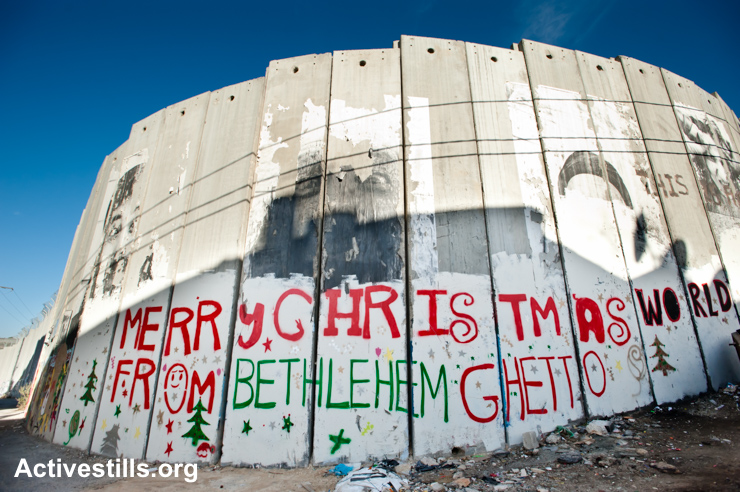
and John the Baptist paints in green and red
across that cold wall’s surface — shepherds, lo! —
“Merry Christmas world
from Bethlehem Ghetto”


You are welcome to make use of the above poem or below reflection in worship, in classrooms, on social media, etc. Please credit Avery Arden of binarybreakingworship.com.

_____

In a 2014 article, Medhi Hasan wonders how Mary and Joseph’s trip from Nazareth to Bethlehem would go in the modern day:

“How would that carpenter and his pregnant wife have circumnavigated the Kafka­esque network of Israeli settlements, roadblocks and closed military zones in the occupied West Bank? Would Mary have had to experience labor or childbirth at a checkpoint, as one in 10 pregnant Palestinian women did between 2000 and 2007 – resulting in the death of at least 35 newborn babies, according to the Lancet?

‘If Jesus were to come this year, Bethlehem would be closed,’ declared Father Ibrahim Shomali, a Catholic priest of the city’s Beit Jala parish, in December 2011. ‘Mary and Joseph would have needed Israeli permission – or to have been tourists.’ “

Meanwhile, a Reddit post claims they’d have to get through fifteen checkpoints on their journey. Chances are, they wouldn’t make it through — just get harassed and interrogated for their trouble.

As I reflect on these statements, I ponder also the opening of Mark’s Gospel. This text, which is read in many churches during the Advent season, recalls the prophetic cry of Isaiah 40:

A voice is crying out:
“Clear the Lord’s way in the desert!
    Make a level highway in the wilderness for our God!
Every valley will be raised up,
    and every mountain and hill will be flattened.
    Uneven ground will become level,
    and rough terrain a valley plain.
The Lord’s glory will appear,
    and all humanity will see it together;
    the Lord’s mouth has commanded it.”

What does such a prophetic leveling — a flattening of land so that all people, including children, elderly and pregnant persons, and people with mobility impairments can easily travel — look like today?

I envision the 440 miles of separation wall crumbling into the earth. Watchtowers topple. Barbed wire melts away. Snipers’ guns morph into ploughshares; bombs explode oh-so-gently into fertilizer to feed burned olive groves.

No more are humans caged in the world’s largest open-air prison. No more are children dragged away in the night to be tortured and tried as terrorists.

The land is free. The people are free. God’s liberating Spirit moves unhindered; God’s holy land becomes, as promised, a “house of prayer for all peoples” (Isaiah 56:7).

Thanks be to God. May we be moved to help make it so.

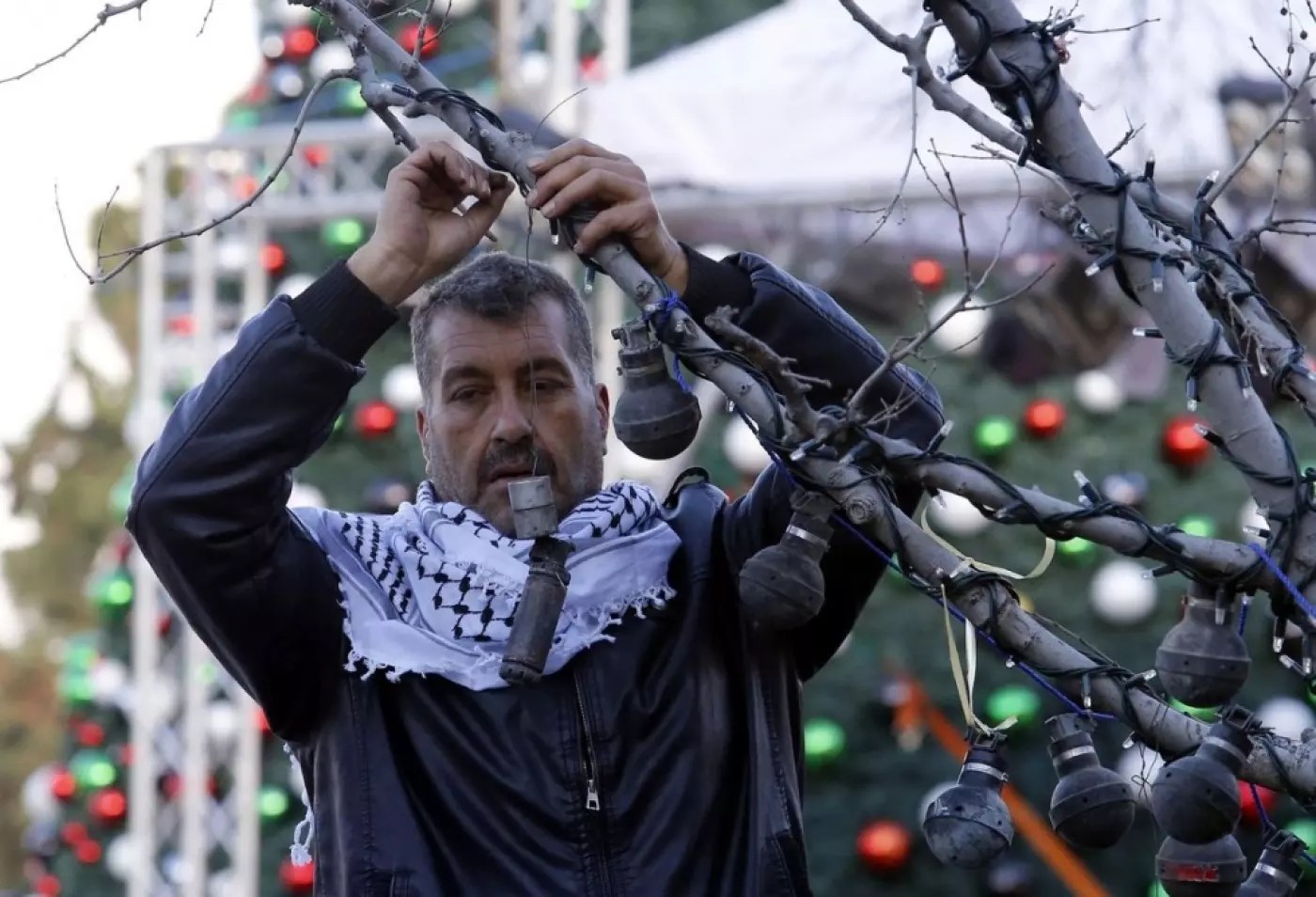
  • A person wearing a keffiyeh secures tear gas canisters to a tree, with normal Christmas ornaments visible on trees behind him
  • A person secures tear gas canisters to a tree with Christmas lights on it

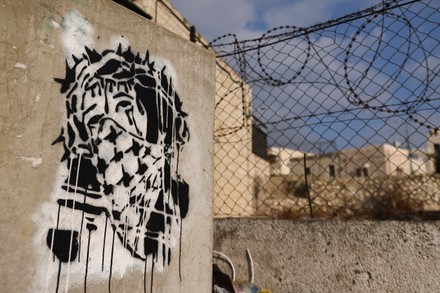
Gallery images: a remake of a famous 1936 “Visit Palestine” poster to show the Holy Family and the separation wall; photos of Palestinians decorating a tree in Bethlehem with tear gas canisters in 2015, as well as a close-up of a canister showing it’s USA-made; and more photos from the separation wall, including the icon “Our Lady of the Wall,” where nuns and pilgrims pray rosaries to dismantle the wall.
Categories
advent Holy Days My poetry

Poem: Advent in (another) genocide

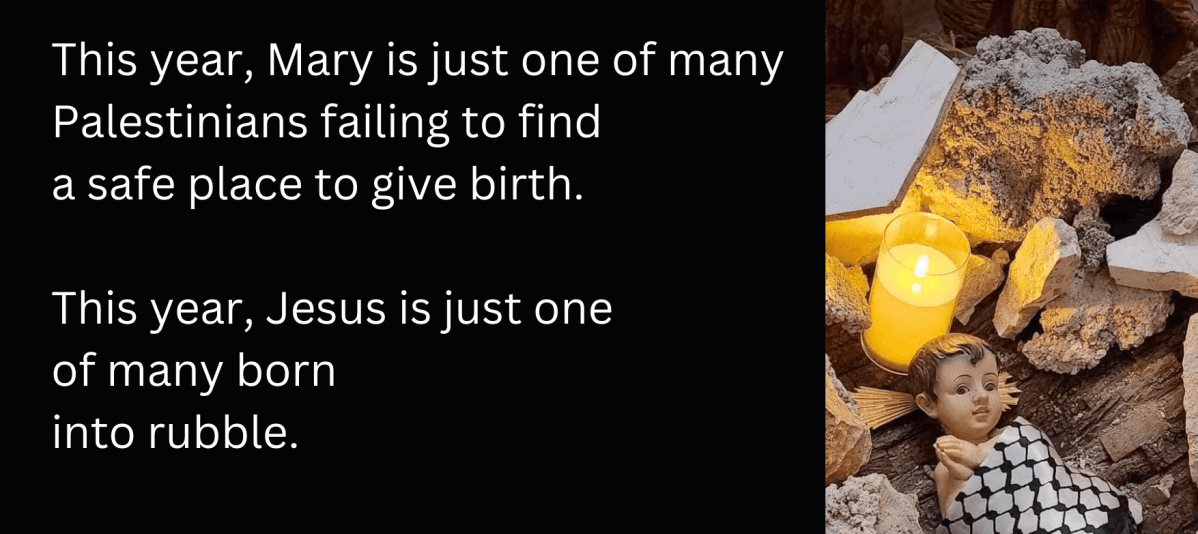
This poem came to me after learning that Christian leaders in the Holy Land have asked churches not to organize any “unnecessarily festive” activities, in solidarity with Gaza; as well as seeing the Nativity scene set among rubble in the Lutheran Church of Bethlehem this year.

Find resources on what’s happening in Palestine and how to help below the poem.

Please feel free to share around; credit to Avery Arden (they/them) with a link to binarybreakingworship.com.


This year, Mary is just one of many
Palestinians failing to find
a safe place to give birth.

This year, Jesus is just one
of countless born
into rubble.

This year, the newborn Christ

dies 

his little body bombed
and tossed aside
into the growing pile.

This time, Jesus never makes it to adulthood —
doesn’t even make it the eight days to circumcision.
He doesn’t die a grown man
making a conscious choice
to defy Empire armed with naught but dreams

of a world where all the nations live as one
where last are first 
and all wars done —

No. This year, his newborn life is threat enough —
his family’s mere existence is rebellion enough  —
to warrant eradication.

Actually, it was then, too, two thousand years ago
— for Empire always fears the ones it grinds
beneath its millstone — back then, though
Christ’s parents found safe passage into Egypt —

now, snipers shoot them as they try
to leave the hospital that scarce had room
for one more woman’s labor cries.

Stigmata are
that much more
chilling between
an infant’s eyes.

And now, as then, some may blame Jesus’s death
on his own Jewish people — but
resist this lie! Now, as then,
the crime is Empire’s

with Western Christians at the helm

and those who would cast stones, look first
for your own nation’s name etched on the bombs
and tear gas canisters!

And, God,
if there is any hope at all
to wrestle from the rubble

as churches all across the Holy Land
close their doors to Christmas joy this year —
a holy choice to mourn with those who mourn
as Christ’s homeland is made a massive grave —

it’s this: there are still children left to save.

It’s this: not every olive branch has burned.

It’s this: the sacred promise of a God
who dies whenever Empire’s outcasts die —
that those cast down 

will rise.

Palestine, Palestine! I swear we will not cease
to shout your name until, at last, your streets
sing with your children’s laughter, loud and free.

– Avery Arden


Notes on this poem

I am writing this note after revising some middle portions of this poem, and coming away still unhappy with the results.

As a Christian who believes that God expresses a solidarity with the oppressed so strong and intimate that They are literally one with every oppressed person, I cannot help but recognize Christ within the people being killed and expelled from their homes in Gaza right now. Christ is there among them, and that means he is among their dead as well as their displaced.

As the Rev. Munther Isaac of the Evangelical Lutheran Church in Bethlehem on the West Bank preached in October,

“God suffers with the people of this land, sharing the same fate with us. …God is under the rubble in Gaza. He is with the frightened and the refugees. He is in the operating room. This is our consolation. He walks with us through the valley of the shadow of death. …”

For Christians like Rev. Isaac, Christ’s intimate identification with those the world calls least, those whom Empire threatens to eradicate, is central to any sense of comfort they may have in the face of so much devastation. It’s also central to my own faith and personal understanding of the Divine.

Yet in this context, because modern-day Israel is a Jewish state, exploring that Divine solidarity comes with a great risk of perpetuating the long, harmful history of antisemitic blood libel and accusations of deicide. How do we affirm God’s presence with those suffering in Palestine without (implicitly or explicitly) adding to the poisonous lie that “the Jews killed Jesus”?

In wrestling with this complexity, I tried to write this poem to uplift both Jesus’s Jewishness and his solidarity with Palestinians. Jesus was born into a Jewish family, his entire worldview was shaped by his Jewishness, and he shared in his people’s suffering under the Roman Empire. His solidarity with Palestinians of various faiths suffering today does not erase that Jewishness. Nor does it mean that Jewish persons don’t “belong” in the region — only that modern Israel’s occupation of Palestine is in no way necessary for Jews to live and thrive there, or anywhere else in the world.

I also aimed to point out (sacrificing poetic flow to do so, lol) that Israel is by no means acting alone in this attack on Gaza or their decades-long occupation of Palestine. There is a much larger Empire at work, with my own country, the United States, as one of the nations at the helm. Israel is entangled in that imperial mess, and directly backed and funded by those forces — not because of what politicians claim, that we have to back Israel or else we’re antisemitic, but because Israel is our strategic foothold in the so-called Middle East. How do we name our complicity as our tax dollars are funneled into violence across the world, and act to end that violence?

Ultimately, I don’t know that this poem is a successful one. I don’t know if it avoids perpetuating harm. If nothing else, I hope it sparks conversation about resisting antisemitism as much as we resist Zionism.


Palestine Resources

HISTORY

CURRENT EVENTS

DREAMING OF A BETTER FUTURE

WAYS TO HELP

  • Urge your University/School/Organization to put out a statement denouncing Israel
  • Organize a Protest/Participate in a local one
  • While calling your reps, tell them that as a voter, you’re unwilling to support them in the upcoming election unless they urge the White House to take a stand against Israel and stop funding them
  • Share art/writing/films around Palestinian culture (see this tumblr post for Palestinian media to watch; I also recommend Oriented (2015) for an un-pinkwashed queer Palestinian story)
  • If you’re part of a union, ask them what they’re doing to urge their industry leaders to take a stand against Israel + pressure the White House OR urge them to start a strike/walkout/etc if they’re not doing anything already
  • Talk with your friends IRL about Palestine; keep spreading information on social media — don’t let talk of Palestine die down!
  • See if your city/state council has put out a statement in support of Gazans. If not, try to push them to do so.
Categories
Christmas communion meditation Holy Days Liturgy Reflections for worship services

Communion Meditation for Christmastide – Jesus of the House of Bread

Two thousand years ago, 

Divinity entered the world in the form of an infant 
born in Bethlehem — a town whose name means “House of Bread”!
He was swaddled by parents poor in the eyes of the world,
but rich in love,
and laid in a manger —

a food trough for cattle!

Thus it is that from the very moment of his birth,
Jesus made known his intention to feed the hungry world
with his very being —
to be bread for empty stomachs
and nourishment for flagging spirits.

His life was a continuation of a Movement that God had begun
long centuries before Jesus:

a Movement that glimmered in the starry sky laid out for Abraham,
that invited Jacob to wrestle faithfully and fervently
until he came away wounded and blessed;

a Movement that carried the enslaved Hebrews out of bondage
and taught them how to live into true freedom;

a Movement kept alive in times of corruption, and empire, and exile
by fearless prophets who would not be silenced
and who looked forward to the liberation of all prisoners, the uplifting of the poor.

It was those prophets’ message that was boldly sung by Mary,
and that she and Joseph, faithful Jewish parents,
taught to the boy Jesus
with the help of their community’s synagogue. 

It is this message, the proclaiming of God’s World-Upturning Movement,
that infuses the bread and cup we share today.

Eat, drink, and let the sharing of this meal unite us across the miles
into one Body of the liberating Christ
who walks and breathes among us even today. 


I wrote these pieces for a virtual service on December 27, 2020 (First Sunday of Christmastide) centered around the story of the Presentation at the Temple as told in Luke 2:22-40.