Categories
advent bible study Holy Days My poetry Queer Lectionary Reflections for worship services

Christ is barred from Bethlehem

A voice cries out in the wilderness,
“Prepare the way of the Lord! Make straight his paths.”

How do we do that in the present day?
We break down walls that block his family’s way.

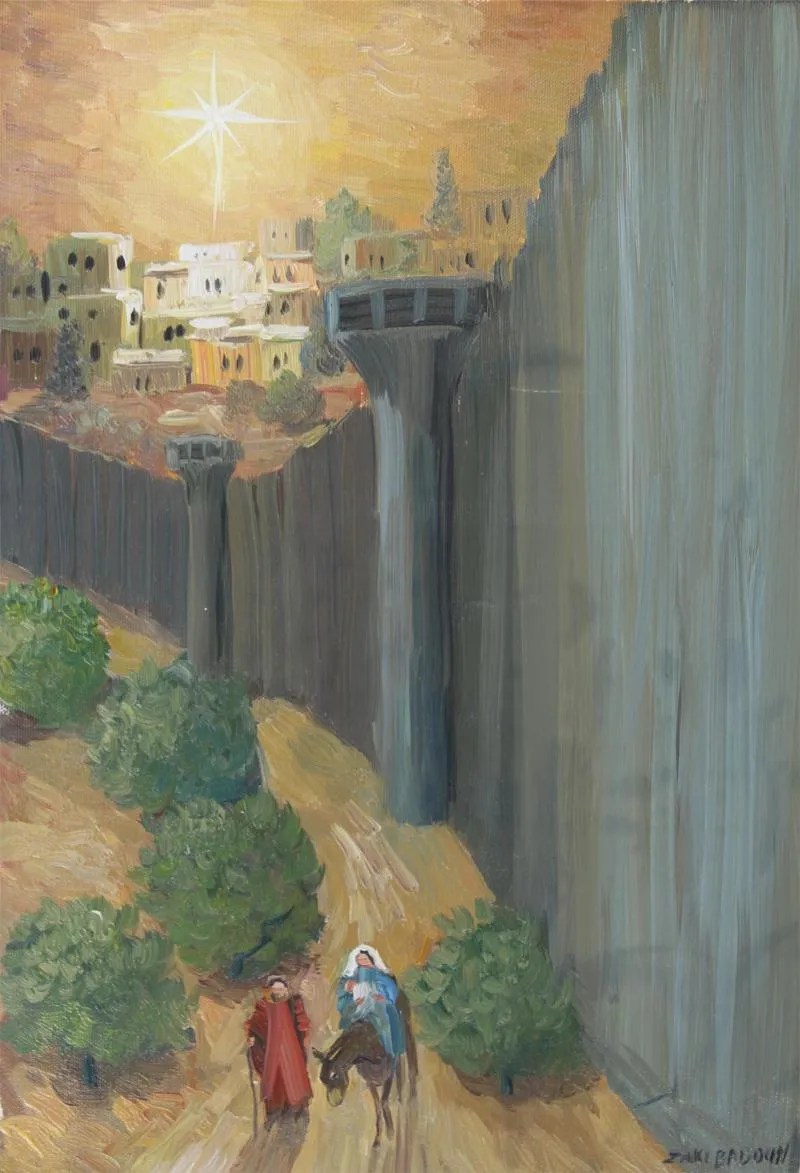
As Mary and Joseph draw near Bethlehem
a fence looms over them, some eight yards high

and soldiers watch from towers as they trudge
not straight into the city, but around
to find the checkpoint — where they’re turned away:
“We’re only letting tourists in today.”

So Mary groans outside the barrier
no place to lay her newborn’s bloodied head

and John the Baptist paints in green and red
across that cold wall’s surface — shepherds, lo! —
“Merry Christmas world
from Bethlehem Ghetto”


You are welcome to make use of the above poem or below reflection in worship, in classrooms, on social media, etc. Please credit Avery Arden of binarybreakingworship.com.

_____

In a 2014 article, Medhi Hasan wonders how Mary and Joseph’s trip from Nazareth to Bethlehem would go in the modern day:

“How would that carpenter and his pregnant wife have circumnavigated the Kafka­esque network of Israeli settlements, roadblocks and closed military zones in the occupied West Bank? Would Mary have had to experience labor or childbirth at a checkpoint, as one in 10 pregnant Palestinian women did between 2000 and 2007 – resulting in the death of at least 35 newborn babies, according to the Lancet?

‘If Jesus were to come this year, Bethlehem would be closed,’ declared Father Ibrahim Shomali, a Catholic priest of the city’s Beit Jala parish, in December 2011. ‘Mary and Joseph would have needed Israeli permission – or to have been tourists.’ “

Meanwhile, a Reddit post claims they’d have to get through fifteen checkpoints on their journey. Chances are, they wouldn’t make it through — just get harassed and interrogated for their trouble.

As I reflect on these statements, I ponder also the opening of Mark’s Gospel. This text, which is read in many churches during the Advent season, recalls the prophetic cry of Isaiah 40:

A voice is crying out:
“Clear the Lord’s way in the desert!
    Make a level highway in the wilderness for our God!
Every valley will be raised up,
    and every mountain and hill will be flattened.
    Uneven ground will become level,
    and rough terrain a valley plain.
The Lord’s glory will appear,
    and all humanity will see it together;
    the Lord’s mouth has commanded it.”

What does such a prophetic leveling — a flattening of land so that all people, including children, elderly and pregnant persons, and people with mobility impairments can easily travel — look like today?

I envision the 440 miles of separation wall crumbling into the earth. Watchtowers topple. Barbed wire melts away. Snipers’ guns morph into ploughshares; bombs explode oh-so-gently into fertilizer to feed burned olive groves.

No more are humans caged in the world’s largest open-air prison. No more are children dragged away in the night to be tortured and tried as terrorists.

The land is free. The people are free. God’s liberating Spirit moves unhindered; God’s holy land becomes, as promised, a “house of prayer for all peoples” (Isaiah 56:7).

Thanks be to God. May we be moved to help make it so.

  • A person wearing a keffiyeh secures tear gas canisters to a tree, with normal Christmas ornaments visible on trees behind him
  • A person secures tear gas canisters to a tree with Christmas lights on it

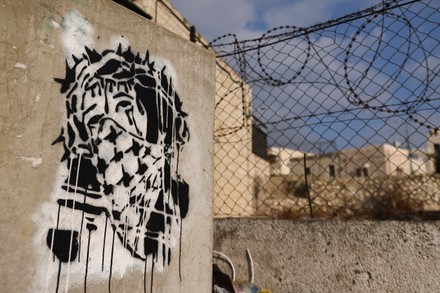
Gallery images: a remake of a famous 1936 “Visit Palestine” poster to show the Holy Family and the separation wall; photos of Palestinians decorating a tree in Bethlehem with tear gas canisters in 2015, as well as a close-up of a canister showing it’s USA-made; and more photos from the separation wall, including the icon “Our Lady of the Wall,” where nuns and pilgrims pray rosaries to dismantle the wall.

Categories
advent Holy Days Hymns Other search markers Unpacking Antisemitism

“O Come Emmanuel” revised for Palestine’s plight

This Advent, some progressive Christians have discussed whether to table one of our religion’s most ancient hymns: “O Come, O Come Emmanuel.” When we sing of God coming to “ransom captive Israel,”
will our congregations recognize we don’t mean the modern Israeli nation?

Honestly, a conversation around this song is long past due (and many have had it over the decades). The truth is, it’s always been laden with supersessionist implications. Depicting the Jewish people as living “in lonely exile here / Until the son of God appear” perpetuates the idea that Jews’ relationship with God is incomplete because they “didn’t accept” Jesus as their Messiah.

How do we resist both antisemitism and Zionism, while seeking to maintain a connection to Christians who came before us? One option may be to reimagine the songs we cherish so that, instead of perpetuating deep-seated hate and Christian supremacy, they challenge us towards joining God in solidarity with the world’s oppressed.

In that spirit, below is my reworking of “O Come Emmanuel” to center the plight of Palestinians (and that removes, I hope, the supersessionism — let me know if I missed any). May our worship songs plant in us a deep desire for justice, and spark our action towards a future where all peoples, all religions live in mutual relationship and respect.

Please feel free to use and share around — just credit Avery Arden of binarybreakingworship.com.

__

O come, o come compassionate Divine,
And ransom captive Palestine
That mourns with tears that will not be soothed
Till empires fall and nations’ hearts are moved.

Rejoice! Rejoice! God’s justice is at hand
To liberate the people and the land.


O come, o bright and ever-burning star;
Bring Gaza comfort from afar!
Dispel from her the shadow of death
That murders dignity and chokes out breath.

Rejoice! Rejoice! God’s justice is at hand
To liberate the people and the land.


O come, o Wisdom from on high,
Take up the outcast’s cause, the captive’s cry.
Guide us to build your kingdom on earth
Where all faiths flourish, and the last are first.

Rejoice! Rejoice! God’s justice is at hand
To liberate the people and the land.


O come, o King of Peace and Justice, break
All weapons down, and from them ploughshares make.
Let all tears dry, all peoples respond:
“We are each other’s magnitude and bond.”

Rejoice! Rejoice! God’s justice is at hand
To liberate the people and the land.

Categories
advent Holy Days My poetry

Poem: Advent in (another) genocide

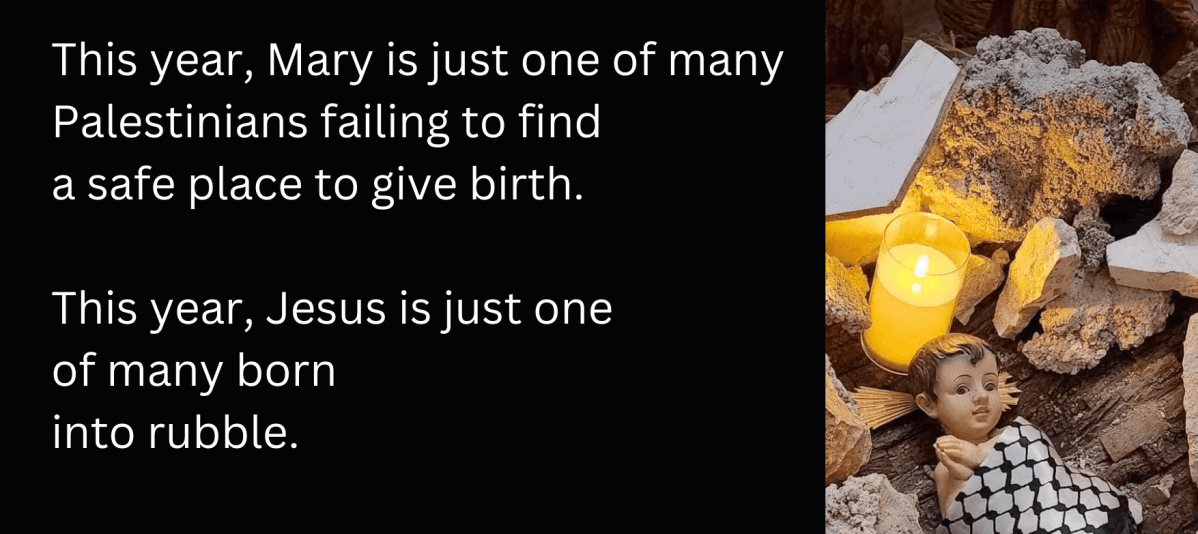
This poem came to me after learning that Christian leaders in the Holy Land have asked churches not to organize any “unnecessarily festive” activities, in solidarity with Gaza; as well as seeing the Nativity scene set among rubble in the Lutheran Church of Bethlehem this year.

Find resources on what’s happening in Palestine and how to help below the poem.

Please feel free to share around; credit to Avery Arden (they/them) with a link to binarybreakingworship.com.


This year, Mary is just one of many
Palestinians failing to find
a safe place to give birth.

This year, Jesus is just one
of countless born
into rubble.

This year, the newborn Christ

dies 

his little body bombed
and tossed aside
into the growing pile.

This time, Jesus never makes it to adulthood —
doesn’t even make it the eight days to circumcision.
He doesn’t die a grown man
making a conscious choice
to defy Empire armed with naught but dreams

of a world where all the nations live as one
where last are first 
and all wars done —

No. This year, his newborn life is threat enough —
his family’s mere existence is rebellion enough  —
to warrant eradication.

Actually, it was then, too, two thousand years ago
— for Empire always fears the ones it grinds
beneath its millstone — back then, though
Christ’s parents found safe passage into Egypt —

now, snipers shoot them as they try
to leave the hospital that scarce had room
for one more woman’s labor cries.

Stigmata are
that much more
chilling between
an infant’s eyes.

And now, as then, some may blame Jesus’s death
on his own Jewish people — but
resist this lie! Now, as then,
the crime is Empire’s

with Western Christians at the helm

and those who would cast stones, look first
for your own nation’s name etched on the bombs
and tear gas canisters!

And, God,
if there is any hope at all
to wrestle from the rubble

as churches all across the Holy Land
close their doors to Christmas joy this year —
a holy choice to mourn with those who mourn
as Christ’s homeland is made a massive grave —

it’s this: there are still children left to save.

It’s this: not every olive branch has burned.

It’s this: the sacred promise of a God
who dies whenever Empire’s outcasts die —
that those cast down 

will rise.

Palestine, Palestine! I swear we will not cease
to shout your name until, at last, your streets
sing with your children’s laughter, loud and free.

– Avery Arden


Notes on this poem

I am writing this note after revising some middle portions of this poem, and coming away still unhappy with the results.

As a Christian who believes that God expresses a solidarity with the oppressed so strong and intimate that They are literally one with every oppressed person, I cannot help but recognize Christ within the people being killed and expelled from their homes in Gaza right now. Christ is there among them, and that means he is among their dead as well as their displaced.

As the Rev. Munther Isaac of the Evangelical Lutheran Church in Bethlehem on the West Bank preached in October,

“God suffers with the people of this land, sharing the same fate with us. …God is under the rubble in Gaza. He is with the frightened and the refugees. He is in the operating room. This is our consolation. He walks with us through the valley of the shadow of death. …”

For Christians like Rev. Isaac, Christ’s intimate identification with those the world calls least, those whom Empire threatens to eradicate, is central to any sense of comfort they may have in the face of so much devastation. It’s also central to my own faith and personal understanding of the Divine.

Yet in this context, because modern-day Israel is a Jewish state, exploring that Divine solidarity comes with a great risk of perpetuating the long, harmful history of antisemitic blood libel and accusations of deicide. How do we affirm God’s presence with those suffering in Palestine without (implicitly or explicitly) adding to the poisonous lie that “the Jews killed Jesus”?

In wrestling with this complexity, I tried to write this poem to uplift both Jesus’s Jewishness and his solidarity with Palestinians. Jesus was born into a Jewish family, his entire worldview was shaped by his Jewishness, and he shared in his people’s suffering under the Roman Empire. His solidarity with Palestinians of various faiths suffering today does not erase that Jewishness. Nor does it mean that Jewish persons don’t “belong” in the region — only that modern Israel’s occupation of Palestine is in no way necessary for Jews to live and thrive there, or anywhere else in the world.

I also aimed to point out (sacrificing poetic flow to do so, lol) that Israel is by no means acting alone in this attack on Gaza or their decades-long occupation of Palestine. There is a much larger Empire at work, with my own country, the United States, as one of the nations at the helm. Israel is entangled in that imperial mess, and directly backed and funded by those forces — not because of what politicians claim, that we have to back Israel or else we’re antisemitic, but because Israel is our strategic foothold in the so-called Middle East. How do we name our complicity as our tax dollars are funneled into violence across the world, and act to end that violence?

Ultimately, I don’t know that this poem is a successful one. I don’t know if it avoids perpetuating harm. If nothing else, I hope it sparks conversation about resisting antisemitism as much as we resist Zionism.


Palestine Resources

HISTORY

CURRENT EVENTS

DREAMING OF A BETTER FUTURE

WAYS TO HELP

  • Urge your University/School/Organization to put out a statement denouncing Israel
  • Organize a Protest/Participate in a local one
  • While calling your reps, tell them that as a voter, you’re unwilling to support them in the upcoming election unless they urge the White House to take a stand against Israel and stop funding them
  • Share art/writing/films around Palestinian culture (see this tumblr post for Palestinian media to watch; I also recommend Oriented (2015) for an un-pinkwashed queer Palestinian story)
  • If you’re part of a union, ask them what they’re doing to urge their industry leaders to take a stand against Israel + pressure the White House OR urge them to start a strike/walkout/etc if they’re not doing anything already
  • Talk with your friends IRL about Palestine; keep spreading information on social media — don’t let talk of Palestine die down!
  • See if your city/state council has put out a statement in support of Gazans. If not, try to push them to do so.
Categories
bible study LGBT/queer Queer Lectionary

Queering Hagar’s Story

A short reflection on this Sunday’s lectionary text, Genesis 21:8-21. Scroll to the end for further resources

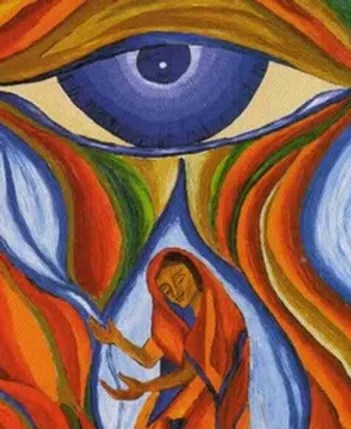
 a painting of a figure like Hagar who is smiling as water pours through her hands; above her is a giant eye.

Name changes occur throughout scripture, but there is only one instance in which a human being directly names God!

That person is Hagar — the woman enslaved and then cast off by God’s own chosen people, yet who recognizes God’s solidarity with her in a way that resonates with many marginalized folk, including queer & trans people of faith.

Back in Genesis 16, Hagar is forced to conceive a child with Abraham — her bodily autonomy denied — and then suffers abuse at Sarah’s hand so painful that she prefers almost-certain death in the wilderness. While waiting to die, God comes to her, nourishes her, encourages her with the promise of a better future. For a time, Hagar must return to her oppressors.

This is a hard message, but It may resonate with queer and trans people who make the hard choice to find what safety they can while in the closet, or who choose to remain in relationship with family or faith communities that have caused them harm.

It also isn’t the end of Hagar’s story: when the time is right, God leads her out — as told in this week’s text in Genesis 21.

Sarah continues to abuse Hagar, with Abraham as a passive bystander and enabler. In a society where only one of Abraham’s sons can inherit his wealth and blessing, Sarah sees Hagar’s son Ishmael as a threat to her son Isaac, simply by existing! In our own day and age, this myth of scarcity persists, causing us to hoard resources and compete needlessly.

Sarah cannot stand to see Hagar’s child playing with her own son — as if they were equals! As if a slave boy should be having a moment of fun! She reads something sinister into the play — not unlike how some people today read sinister things into queer play, into drag queens and gender expansive youth.

Having convinced herself that Hagar and her son are a threat, Sarah gets Abraham to cast them out.

But again, God is with the outcast; God comes again to Hagar, who in Genesis 16 had given God the name El Roi — “God sees me.” This God is the god of her oppressors, yet Hagar recognizes that this god is her God as well! This god is a God who sees the suffering of the lowest of society, and responds.

God sees queer and trans people, too. God is our God, too — those who hate us do not have a monopoly on the Divine!

And God walks with us through every struggle, fueling us to fight the good fight and promising blessings to come.

Questions for reflection:

  • When have you witnessed God coming to the Hagars in our midst?
  • When has your community behaved like Abraham & Sarah, hoarding God’s love as if there were not blessing enough to go around?
  • Can you imagine a world in which Sarah, Abraham, and Hagar meet again? What would Hagar need to feel safe to meet with her former abusers? What would Sarah & Abraham need to do to make things right?

Further Reading

Queer-specific resources:

Other resources:

a painting of two women with curly brown hair and brown skin embracing; the one being held has a blue shawl with “Sarah and Hagar” written in Hebrew on it, while the one embracing her has a bright blue dress. A dove with an olive branch hovers behind them
Sarah and Hagar” by Jewish artist Hilary Sylvester, who says: “Sarah the mother of the Jewish People and Hagar the mother of the Arab people finally find reconciliation through Mashiach.”
Categories
LGBT/queer Reflections for worship services

A Queer Reflection for Trinity Sunday

There’s something queer about a Triune God. 

A diagram of the Trinity featuring a triangle with each angle labeled The Father, The Son, and the Holy Spirit respectively. In the center of this triangle is the word "God." Connecting lines between each angle read "is not," so that it reads "the father is not the son is not the holy spirit is not the father," while lines that connect each angle to the center read "is" so that you get the message "the father is god, the son is god, the holy spirit is god."

How can one Being also be three Persons? The math doesn’t seem to add up! Some spend years attempting to articulate this theology in a way that doesn’t fall into “heresy”; others give up with a laugh and accept it as a Mystery. Ultimately, the God of the Universe is ineffable, beyond our understanding — yet we are called to seek ever deeper relationship with God, and promised that if we seek, we will find.

When people decry queer identities as nonexistent, overly complicated, or paradoxical, I can’t help but think of our impossibly Three-in-One God. I think also about my own gender journey: how I struggled as a child to name what I was feeling because I had no language to describe it; how once I discovered others had words for what I was experiencing, I delighted in every one I could uncover; and how, ultimately, even my favorite words I’ve found to describe myself fall short. 

Words like trans, nonbinary, and genderqueer certainly help others understand and relate to me better, but I’ve learned to be okay with the fact that they might never fully know me, just as I may never fully know them — or at least that the deepest understanding is beyond words. Turns out that the children of a Mysterious God are micro-mysteries in ourselves!

What I’m left with is this: if we worship a Triune God, why do we try to squeeze the humans made in that Infinite, Ineffable Being’s image into two narrow boxes? And if we celebrate how, in the Incarnation and Resurrection, Divinity burst through the binaries between Creator & Creation, Life & Death, surely the binary between male and female is not so insurmountable!

Together, let us pray:

Holy God, whose very existence is relationship, we marvel at your mystery. Protect this day and always those of your children who, like you, defy easy definition and resist restrictive categories. Teach us to recognize your wisdom and holiness shining within them, for only together in all our diversity do we reflect your image. Amen.

___

Further reading:

Categories
Other search markers

Poem: Creation’s littlest sibling

God’s world has spent more time without
us than with us.

We are just the latest twig
on an ancient tree.
We have only just unfurled
our first green leaf.

Our existence depends utterly on the roots
hidden away somewhere far below
that stretch downward just as deep
as their helpmates in the sky —
the towering branches — stretch high.

Without the generosity of these
we would be snatched up by the slightest breeze —

yet of late we envision ourselves to be,
all on our own, an entire tree!
We forget that

God’s world has spent more time without us
than with us —
and that the world was glorifying God

those billions of years
without us, as surely as
it glorifies God with us now.

                     So now,

won’t you come with me
out into the yard where we can catch
a tantalizing hint of cosmos through
the tree limbs swaying high over our heads?

Come out here with me! Let us squint
at whatever scraps of constellations we can glimpse
behind the gauzy garb of light pollution

and as we consider the heavens, let’s also consider:

Are we the crowning glory of the cosmos
to whom the rest of Creation —
from black holes
to bacteria, angels to ants —
 must bow?

Or are we Creation’s littlest sibling —
doted on, but never idolized
by those elder beings who would gladly
           take us by the hand
as we toddle through a world so grand
it sets our heads to spinning
       if only we’d let them?

Listen. These lanky pines have got a secret
to whisper down to us. The dirt beneath our feet
has a message from the fossils packed below it
if only we’d take off our shoes
and let it soak in through our soles.
The lighting bugs and crickets trading gossip 
            back
               and forth
would thrill to have us join the conversation!

Turns out, the creeping beetle, and the grass, and the whole
bustling kingdom of bacteria hard at work within your gut
all, all want to remind you how

                                                        God’s world has spent
more time without us than with us,

                                                             but

they are so glad
                            to have us
             here

so we can join our unique voices to
the praise-song carried on since that first note
God started up Themself
                                          going nigh on
14 billion years ago —
                                        and that will play on
a billion eons hence,

even if we should be —
whether by extinction’s
hand, or evolution’s —
                                          long since gone.

World without end, amen! Play on.


If you use this piece, please credit it to Avery Arden and link this website. I also invite you to email me at queerlychristian36@gmail.com to let me know how you’re using it!

About this poem:

I wrote this after prayerfully reading through Psalm 8, in which the speaker ponders humanity’s place, role, responsibility among the rest of Creation. Are we the crowning achievement? just one of many? Huge in our importance, or infinitesimally small? …Maybe a mix of all of the above?

“When I look upon the heavens, the workings of your fingers —
the moon and the stars that you set firm —
what is humankind that you pay them mind,
human beings, that you tend to them?”

Psalm 8:3-4, my translation

The psalmist concludes that we are somewhere a little below “gods/angels/heavenly beings,” and on earth we are in charge of everything else (/ “have dominion,” a concept repeated from Genesis 1 and that many theologians have debated the meaning of…).

But what do I think? what do you think? — especially now that we have access to far more scientific information about “the heavens,” including its incredible size and age in comparison to our blue dot and the infancy of homo sapiens. …Throw in some existential dread about how long humanity will last, given our current trajectory, and the question grows even more complicated.

Robin Wall Kimmerer’s own exploration of this question in Braiding Sweetgrass: Indigenous Wisdom, Scientific Knowledge, and the Teachings of Plants has been of great help to me. She explains,

“In the Western tradition there is a recognized hierarchy of beings, with, of course, the human being on top—the pinnacle of evolution, the darling of Creation—and the plants at the bottom. But in Native ways of knowing, human people are often referred to as “the younger brothers of Creation.” We say that humans have the least experience with how to live and thus the most to learn—we must look to our teachers among the other species for guidance. Their wisdom is apparent in the way that they live. They teach us by example. They’ve been on the earth far longer than we have been, and have had time to figure things out.”

Robin Wall Kimmerer

Psalm 8 welcomed me into the question, the age-old contemplation of the night sky and the existential awe it inspires; Kimmerer welcomed me into gentle answers.

In the grand scheme of things, we are very, very young. As such, maybe are doted upon! If we are decide to believe we are in any way “in charge” or set over other creatures, we must take great care with how we understand that, lest we fall into idolatry. Let us remember with the psalmist that even though we are beloved by our God, we ourselves are smaller than gods (Psalm 8:5).

Maybe human beings are special in many ways; but we are not gods. The God in whose image we are made delighted in Their cosmos long before we entered it; if we are to follow in Their footsteps, we must tend to Their Creation without possessiveness or domination.

Categories
Affirmation of Faith easter Liturgy Other search markers

Affirmation of Faith in the Wounded God who calls us Good

We worship a Mystery, a Being too vast to capture in words,
who reveals Godself to each of us in different ways.

While making room for different understandings,
let us affirm the faith that draws us together:

We believe in the God whose Word birthed the cosmos,

Who shaped human beings from the rich topsoil,
breathed Her own breath into us,
blessed both our earthy bodies and celestial spark,
and declared us Good, very Good!

When evil taught us shame
for those very bodies God had blessed,

God became a seamstress,
tenderly dressing Her children, Adam and Eve —
never dismissing our distress
but giving us what we need
to believe in our inherent dignity again.

This God reminds us at every opportunity
That we are destined for freedom:

God did what it took to liberate Her people
from enslavement in Egypt — and from countless future captors,
human powers who wield control through violence and fear.

The God who walked through Eden put on wheels —
the throne Ezekiel saw rolling through the heavens
to follow Their people into exile, and back again.

And then, this same God settled into flesh: 

For God so loved the world They’d made
that They entered into it Themself,
weaving Godself a human form within a human womb.

From boundless power to an infant in the lap
of his teenage mother, God learned to crawl, to walk,
to speak with human tongue the news They’d been proclaiming
through pillars of flame and cloud, 
through prophets’ cries and in the stillest silence.

In Jesus, God brought restoration to bodies and spirits aching
under the yoke of empire, the shackles of shame —

and then God died. 

But no tomb can restrain Life itself for long:
Christ rose with wounds — reminders of what happens
when we allow violence and fear to reign unchallenged.

This wounded Christ ascended into heaven,
but his Spirit abides with us still —
stirring up our indifference, whispering hope into our despair,
and whisking us up into the hard but holy work
of unrolling a kin-dom accessible to all.

Amen.


About this piece:

If you this piece it in your own service, please credit it to Avery Arden — and I invite you to email me at queerlychristian36@gmail.com to let me know you’re using it!

I wrote this affirmation for a worship service centered around John 20:19-30’s account of Jesus inviting Thomas to touch his wounds.

God created us to be inspirited bodies, embodied spirits — in Genesis 1, God calls not just our spirits but our bodies good — and not just some bodies, but all bodies, disabled bodies included.

Disability theologians have long been inspired by the idea that Jesus’s resurrected body keeps its wounds — wounds that would impair mobility and fine motor skills, that would cause chronic pain.

In rising with a disabled body, Jesus “redeems” disability: he evinces that disability is not brokenness, is not shameful or the result of sin; and he evinces that disability can exist separate from suffering — that suffering is not intrinsic to disability.

The idea of a wounded Christ also connects to Henri Nouwen’s concept of the “wounded healer,” which I recommend looking into if that phrase resonates with you.

The description of God as seamstress restoring a sense of dignity to Adam and Eve is inspired by Cole Arthur Riley’s book This Here Flesh, where she writes:

“On the day the world began to die, God became a seamstress. This is the moment in the Bible that I wish we talked about more often.

When Eve and Adam eat from the tree, and decay and despair begin to creep in, when they learn to hide from their own bodies, when they learn to hide from each other—no one ever told me the story of a God who kneels and makes clothes out of animal skin for them.

I remember many conversations about the doom and consequence imparted by God after humans ate from that tree. I learned of the curses, too, and could maybe even recite them. But no one ever told me of the tenderness of this moment. It makes me question the tone of everything that surrounds it.

In the garden, when shame had replaced Eve’s and Adam’s dignity, God became a seamstress. He took the skin off of his creation to make something that would allow humans to stand in the presence of their maker and one another again.

Isn’t it strange that God didn’t just tell Adam and Eve to come out of hiding and stop being silly, because he’s the one who made them and has seen every part of them? He doesn’t say that in the story, or at least we do not know if he did. But we do know that God went to great lengths to help them stand unashamed. Sometimes you can’t talk someone into believing their dignity. You do what you can to make a person feel unashamed of themselves, and you hope in time they’ll believe in their beauty all on their own.

People say we are unworthy of salvation. I disagree. Perhaps we are very much worth saving. It seems to me that God is making miracles to free us from the shame that haunts us. Maybe the same hand that made garments for a trembling Adam and Eve is doing everything he can that we might come a little closer. I pray his stitches hold. Our liberation begins with the irrevocable belief that we are worthy to be liberated, that we are worthy of a life that does not degrade us but honors our whole selves. When you believe in your dignity, or at least someone else does, it becomes more difficult to remain content with the bondage with which you have become so acquainted. You begin to wonder what you were meant for.

The idea of God on wheels comes primarily from Julia Watts Belser’s article “God on Wheels: Disability and Jewish Feminist Theology.” I highly recommend the whole article (check out the gorgeous art piece that accompanies it, if nothing else), but here’s one excerpt:

“…On the morning of the holiday of Shavuot, Jewish communities around the world chant from the book of Ezekiel, reciting the Israelite prophet’s striking image of God. The prophet speaks of a radiant fire borne on a vast chariot, lifted up by four angelic creatures with fused legs, lustrous wings, and great wheels. …One recent Shavuot, Ezekiel’s vision split open my own imagination. Hearing those words chanted, I felt a jolt of recognition, an intimate familiarity. I thought: God has wheels!

When I think of God on wheels, I think of the delight I take in my own chair. I sense the holy possibility that my own body knows, the way wheels set me free and open up my spirit. I like to think that God inhabits the particular fusions that mark a body in wheels: the way flesh flows into frame, into tire, into air. This is how the Holy moves through me, in the intricate interplay of muscle and spin, the exhilarating physicality of body and wheel, the rare promise of a wide-open space, the unabashed exhilaration of a dance floor, where wing can finally unfurl.

On wheels, I feel the tenor of the path deep in my sinews and sit bones. I come to know the intimate geography of a place: not just broad brushstrokes of terrain, but the minute fluctuations of topography, the way the wheel flows. When I roll, I pay particular attention to the interstices and intersections: the place where concrete seams together uneasily, the buckle of tree roots pushing up against asphalt, the bristle of crumbling brick.

I have come to believe this awareness reflects a quality of divine attention. Perhaps the divine presence moves through this world with a bone-deep knowledge of every crack and fissure. Perhaps God is particularly present at junctions and unexpected meetings, alert to points of encounter where two things come together…”

A similar theology around God on wheels can be found in the perspective of a Christian teen named Becky Tyler, found here. Becky says:

“When I was about 12 years old, I felt God didn’t love me as much as other people because I am in a wheelchair and because I can’t do lots of the things that other people can do. I felt this way because I did not see anyone with a wheelchair in the Bible, and nearly all the disabled people in the Bible get healed by Jesus – so they are not like me.”

She felt alienated by much of what she read in the Bible – until she was given new food for thought.

“My mum showed me a verse from the Book of Daniel (Chapter 7, Verse 9), which basically says God’s throne has wheels, so God has a wheelchair.

“In fact it’s not just any old chair, it’s the best chair in the Bible. It’s God’s throne, and it’s a wheelchair. This made me feel like God understands what it’s like to have a wheelchair and that having a wheelchair is actually very cool, because God has one.”

Categories
bible study easter Holy Days Reflections for worship services

Waiting with Mary Magdalene — lament that wrestles God

A reflection that draws from John 20 and Isaiah 56. Happy Easter, all.

As Mary Magdalene sits alone in the predawn stillness, she weeps — but her tears are not only grief: they are tears of frustration. Tears with questions. Tears that demand something of Divinity.

Mary is not passive in her weeping: she is wrestling the divine.

Rev. Dr. Rachel Wrenn of the First Reading podcast calls what Mary is experiencing “exasperated hope.” She parallels Mary in the garden to God of Isaiah 65, who is “ready to be sought out” by Her people who “sit inside tombs, and spend the night in secret places” (vv. 1, 4a). Magdalene reverses the image of Divinity waiting exasperatedly for humanity — now the human awaits the Divine.

God of Isaiah 65 says, ‘I said, “Here I am, here I am,” to a nation that did not call on my name.’

Magdalene too is saying, “Here I am,” to a God who WILL call her name, soon — but not yet.

First, she must endure the excruciating in-between space.

And she endures that space alone. Peter and the Beloved Disciple enter it for a moment, as first light tentatively touches the tomb’s rolled-back stone.

They sprint into it — that pregnant space between question and answer, death and rebirth — past Mary weeping without a word to her.

They enter the empty tomb and they see the burial cloths that God has stripped off and left behind. They see and the beloved, at least, “believes” (John 20:8). Believes that Jesus is risen — does he also believe that Jesus will return? That they will all see Jesus again, and soon?

If he does, his action is not to hunker down with Mary into the waiting space. He and Peter “return to where they were staying” (v. 10).

They cannot bear the waiting space. Most of us can’t. Who would choose to settle down in hospital halls with figures hunched and haggard, to wait with them for whatever news there may be?

Most of us wouldn’t. Magdalene might.

We can’t skip past the waiting, though. So Mary waits — waits for whatever will come, whenever it comes — and as she waits, she weeps. Her tears are not despair — they are lament.

In This Here Flesh, Cole Arthur Riley describes the power and purpose of lament:

“Lament is not anti-hope. It’s not even a stepping-stone to hope. Lament itself is a form of hope. It’s an innate awareness that what is should not be. As if something is written on our hearts that tells us exactly what we are meant for, and whenever confronted with something contrary to this, we experience a crumbling. And in the rubble, we say, God, you promised.”

Mary believes in the promises of her teacher, his proclamations of a world turned on its head, a new creation born where the poor are lifted from the ashes.

Her hope in that world has crumbled, but she doesn’t abandon the rubble: she settles into it. Makes her home there to wait and see what rises from the ruins.

Mary is crying, “God, you promised!” And she in turn promises God, “here I am — whenever you come, you will find me. I’m not going anywhere.”

In her describing of lament, Cole continues, “Our hope can be only as deep as our lament is. And our lament as deep as our hope.” Mary’s lament is long, because her hope is deep.

Mary Magdalene does not sit in the garden in despair. Her lament expects response — demands it. Like God of Isaiah 56, she is waiting to be sought — waiting for her call to be met with response…and it will be! Her God WILL call her name — “Mary!” — and she will know the joy of lament answered, of hope fulfilled.

Magdalene is actively waiting for what she KNOWS will come. And she’s not going anywhere till it does.

Thank God for those who wrestle blessing out of pain; who brave the liminal lament and don’t let go.

Mary, your waiting is not in vain. Joy comes with the morning. Hallelujah!


I originally posted this as a twitter thread, which you can see here.

Categories
bible study Holy Days lent Other search markers Unpacking Antisemitism

Jesus Flipping Tables: Unpacking antisemitic readings of the “Temple Cleansing”

Lent is one time of year we talk about Jesus marching into the Court of Gentiles, sitting down and braiding a whip, and proceeding to wreak havoc upon money-changers’ tables and sacrificial animal cages.

It’s a weird, fascinating, fun story (that you can read in Matthew 21, Mark 11, Luke 19, and John 2)! Progressive & leftist Christians like myself have a particular love for it, pointing to this story as evidence that sometimes our “meek and mild” Jesus used violence to combat injustice. If you hang around progressive Christian spaces online, I bet you’ve seen this meme more than once:

A portrait of Jesus wielding a whip in the teple, with tables overturned and people on the floor looking confused or afraid, with text overlaid that reads "If anyone ever asks you What Would Jesus Do? Remind him that flipping over tables and chasing people with a whip is within the realm of possibility"
Image description in alt text.

He did indeed break out a whip, according to the Gospels! But why? What exactly was Jesus’s purpose for causing a ruckus in the Temple?

A common progressive interpretation of the story is exemplified by this Tweet by ELCA pastor Eric Clapp:

"Just a reminder that the only time Jesus flipped tables is when religious people put a bustling economy over the well-being of their neighbor."
ID in alt text. Click here for the original Tweet.

Hey, I’m all for a reminder that God calls us to care for human beings over economic gain — and that religious leaders often find ourselves in prime positions to make some money ourselves. But before embracing this interpretation, we need to pause and consider what assumptions about Temple goings-on are present within it. For starters, this reading assumes:

  • that the selling of animals for sacrifice right on the Temple premises was inappropriate and even unjust;
  • that Temple leaders did so in order to line their own pockets;
  • and that they charged exploitative prices to the detriment of the poor.

So what’s the problem here?

Well, according to Jewish scholar of the New Testament Amy-Jill Levine, these assumptions about Temple corruption have no historical backing to them. As this post will get to in a bit, both within the Gospel narratives and in extra-biblical sources, we don’t have any reason to believe that money changers were cheating anybody in the Temple, or that Jesus was protesting such a thing!

Even worse, such readings easily lead into antisemitism that impacts our Jewish neighbors even to this day. For example, I can easily imagine the above list of explicit assumptions yielding various implicit ones:

  • that Jewish leaders were greedy & money-obsessed — hmm, doesn’t that sound uncomfortably like an antisemitic stereotype that’s pervaded centuries?
  • that one of Jesus’s priorities in his ministry was to shut down the Temple system and institute a brand new religion that would replace the “legalism” and hypocrisy of Judaism with a “law of love” — a foundational concept of supersessionism, or the idea that Christianity supersedes (replaces) Judaism; click here for information on the pervasiveness of supersessionist views in our churches today & why such views actively harm our contemporary Jewish neighbors.
  • (And if you don’t think this Bible story promotes supersessionism, pause and ponder why we traditionally call it “The Cleansing of the Temple” — implying the Temple, which was at that time the hub of Jewish religious & political life, was unclean.)

I used to hold the same assumptions expressed in the above meme and tweet. Jesus flipping tables to protest exploitative economic and religious systems is a compelling story! It’s relatable to our own activism, it showcases a countercultural Jesus — but is it worth fueling anti-Jewish theologies?

Those of us who claim to care for the oppressed need to rethink our readings of this story, in order to prevent its misuse as a weapon against our Jewish neighbors.

Thus I am grateful to Dr. Amy-Jill Levine for sharing historical context that can help us with our re-readings, and for offering her own interpretation of why Jesus really decided to weave that whip and flip those tables.

The rest of this post is me sharing excerpts from Levine’s book Entering the Passion of Jesus at length (and then ending with further resources, for those interested).

The images I share below condense her argument into concise bits that you could easily share on a church Facebook page or website, or at a Bible study. They can stand on their own as helpful conversation material; but I’ve also interspersed them with longer excerpts from Levine that provide even more information. (If you want a post with just the images and not the lengthy excerpts, click here.)

If you do share these images, please simply credit back to this site! Also, each one has an image description in the alt text; if you share them online, I request that you keep that alt text to make them accessible to people who use screen readers.

Images show slides with text and illustrations based around the Gospels’ accounts of Jesus flipping tables and wielding a whip in the Temple. This first slide shows one such illustration, with Jesus as a middle eastern man with black hair and beard wearing yellow and blue robes with traditional tassels looking angry and wielding a whip, surrounded by frightened looking people and animals escaping their cages, with an overturned table by his side. Text reads “Jesus flipping tables: Dr. Amy-Jill Levine’s Interpretation” and “In Entering the Passion of Jesus, Levine unpacks traditional readings of the “cleansing of the Temple” and offers an alternative that resists antisemitism and applies biblical & historical context…”

The incident known as the ‘Cleansing of the Temple’ is described in all four Gospels. Most people have the idea–probably from Hollywood–that this is a huge disruption. When we see this scene depicted in movies, we find Jesus fuming with anger, and we inevitably see gold coins falling down in slow motion. Everything in the Temple comes to a standstill. …But we are not watching a movie: we are studying the Gospels. …

Excerpt from Levine’s Entering the Passion of Jesus
a detail from a painting of the Jesus MAFA series where Jesus is depicted as an African man in a traditional Cameroon marketplace; he’s got deep Brown skin and close-cropped hair, a red robe, and likewise wields a whip and looks angry as people run frightened around him. This image will repeat on every other slide from now on (all slides that include bullet points summarizing Levine’s points). This slide’s text reads, “What follows is a summary of the points Levine makes in her chapter on the “cleansing of the temple”:
- Jesus’s whole table flipping, whip-wielding stunt is more symbolic than practical (echoing similar performances by his people’s prophets).
- Jesus’s anger isn’t about gentiles being excluded from Temple life; they weren’t.”

Here’s what we know about the actual setting. We begin by noting that the Temple complex was enormous. It was the size of twelve soccer fields put end to end. So, if Jesus turns over a table or two in one part of the complex, it’s not going to make much of a difference given the size of the place.

The action therefore did not stop all business; it is symbolic rather than practical. Our responsibility is to determine what was symbolized. For that, we need to know how the Temple functioned.

The Jerusalem Temple, which King Herod the Great began to rebuild and which was still under construction at the time of Jesus, had several courts. The inner sanctum, known as the “Holy of Holies,” is where the high priest entered, only on Yom Kippur, the Day of Atonement, to ask for forgiveness for himself and for the people. Outside of that was the Court of the Priests, then the Court of Israel, the Court of the Women, and then the Court of the Gentiles, who were welcome to worship in the Temple. 

Excerpt from Levine’s Entering the Passion of Jesus
a detail from a painting, showing a flipped tables and a mess of coins and sheep and doves. There’s another quote from Levine reading, “Pilgrims…would not bring [sacrificial] animals with them from Galilee or Egypt or Damascus. They would not risk the animal becoming injured and so unfit for sacrifice. The animal might fly or wander away, be stolen, or die. …One bought one’s offering from the vendors. And…there is no indication that the vendors were overcharging or exploiting the population. The people would not have allowed that to happen. Thus, Jesus is not engaging in protest of cheating the poor.”

The outer court, the Court of the Gentiles, is where the vendors sold their goods. The Temple at the time of Jesus was many things: it was a house of prayer for all nations; it was the site for the three pilgrimage festivals of Passover, Shavuot/Pentecost, and Sukkot/Booths; it was a symbol of Jewish tradition (we might think of it as comparable, for the Jewish people of the time, to how Americans might view the Statue of Liberty); it was the national bank, and it was the only place in the Jewish world where sacrifices could be offered. Therefore, there needed to be vendors on site.

Pilgrims who sought to offer doves (such as Mary and Joseph do, following the birth of Jesus, according to Luke 2:24) or a sheep for the Passover meal would not bring the animals with them from Galilee or Egypt or Damascus. They would not risk the animal becoming injured and so unfit for sacrifice. The animal might fly or wander away, be stolen, or die. And, as one of my students several years ago remarked, ‘The pilgrims might get hungry on the way.’ One bought one’s offering from the vendors. …

Despite Hollywood, and sermon after sermon, there is no indication that the vendors were overcharging or exploiting the population. The people would not have allowed that to happen. Thus, Jesus is not engaging in protest of cheating the poor.

Next, we need to think of the Temple as something other than what we think of churches. A church, usually, is a place of quiet and decorum. …The Temple was something much different: It was a tourist attraction, especially during the pilgrimage festivals. It was very crowded, and it was noisy. The noise was loud and boisterous, and because it was Passover, people were happy because they were celebrating the Feast of Freedom. …We might think of the setting as a type of vacation for the pilgrims: a chance to leave their homes, to catch up with friends and relatives, to see the “big city,” and to feel a special connection with their fellow Jews and with God. It is into this setting that Jesus comes. …”

Excerpt from Levine’s Entering the Passion of Jesus
more bullet points summarizing points from Levine’s chapter:
- Jesus’s anger was not about animals being sold in the temple’s outer courts
- There’s also no evidence of unjust prices, so he’s not angry about the poor being cheated here either.
- Various Gospel stories show that Jesus did not reject the Temple or its laws & rituals (also – he has “zeal for his father’s house”)

Driving out the Vendors 

…It seems to me that Jesus, in the Temple, was angry. But what so angered him? I hear from a number of people, whether my students in class or congregations who have invited me to speak with them, that the Temple must have been a dreadful institution; that it exploited the poor; that it was in cahoots with Rome; that Caiaphas, the High Priest in charge of the Temple, was a terrible person; that it banned Gentiles from worship and so displayed hatred of foreigners; and so forth. …Some tell me that the Temple imposed oppressive purity laws that forbade people from entering, and so Jesus, who rejected those laws, rejected the temple as well. No wonder Jesus wants to destroy the institution.

But none of those views fits what we know about either Jesus or history.

First, Jesus did not hate the Temple, and he did not reject it. If he did, then it makes no sense that his followers continued to worship there. Jesus himself calls the Temple “my Father’s house” (Luke 7:49: John 2:16). …

Second, Jesus is not opposed to purity laws. To the contrary, he restores people to states of ritual purity. Even more, he tells a man whom he has cured of leprosy, “Go, show yourself to the priest, and offer for your cleansing what Moses commanded, as a testimony to them” (Mark 1:44; see also Matthew 8:4; Luke 5:14). 

Third, Jesus says nothing about the Temple exploiting the population. As we’ll see in the next chapter, when we talk about the widow who makes an offering of her two coins, Jesus is concerned not with what the Temple charges, but with the generosity of the worshipers. 

Excerpt from Levine’s Entering the Passion of Jesus
a detail of an illustration of a courtyard in the Temple with large pillars and crowds of people, with a quote from Levine’s chapter reading, “…The Temple has an outer court, where Gentiles are welcome to worship. They were similarly welcome in the synagogues of antiquity, and today. They do not have the same rights and responsibilities as do Jews, and that makes sense as well. When I [a Jewish woman] visit a church, there are certain things I may not do. …”

Fourth, we’ve already seen that the Temple has an outer court, where Gentiles are welcome to worship. They were similarly welcome in the synagogues of antiquity, and today. They do not have the same rights and responsibilities as do Jews, and that makes sense as well. When I [a Jewish woman] visit a church, there are certain things I may not do. We might also think of how nations function: Canadians, for example, cannot do certain things in the USA, such as vote for president; nor can citizens of the USA vote in Canadian elections.

As for Caiaphas…Caiaphas is basically between a rock and a hard place. He is the nominal head of Judea, and he is supposed to keep the peace.Judea is occupied by Rome, and Roman soldiers are stationed there. Caiaphas needs to make sure that these soldiers do not go on the attack. He needs to placate Pilate, and he needs to placate Rome. 

At the same time, as the High Priest, he has a responsibility to the Jewish tradition. Rome wanted the Jews to offer sacrifices to the emperor…but Caiaphas and the other Jews refused to participate in this type of offering because they would not worship the emperor. The most they were willing to do was offer sacrifices on behalf of the emperor and the empire.

When Jesus comes into the city in the Triumphal Entry, when people are hailing him as son of David, Caiaphas recognizes the political danger. The Gospel of John tells us that the people wanted to make Jesus king (John 6:15). Caiaphas has to watch out for the mob. Caiaphas also has to watch out for all these Jewish pilgrims coming from all over the empire celebrating the Feast of Freedom, the end of slavery. When he sees Roman troops surrounding the Temple Mount, Caiaphas has to keep the peace. And Jesus is a threat to that peace. But none of this has to do directly with Jesus’ actions in the Temple. He is not at this point protesting Caiaphas’s role.

Sometimes I hear people say that Jesus drove the “money lenders” out of the Temple. That’s wrong, too. Money-lending was a business into which the medieval church forced Jews, because the church concluded that charging interest was unnatural (money should not beget money). Yet people needed, then and now, to take out loans. The issue for the Gospel is not money lending but money changing. These money changers exchanged the various currencies of the Roman Empire into Tyrian shekels, the type of silver coin that the Temple accepted. We experience the same process when we visit a foreign country and have to exchange our money for the local currency.

So, if Jesus is not condemning the Temple itself, or financial exploitation, or purity practices, what is he condemning? Let’s look at what the Gospels actually say. …

Excerpt from Levine’s Entering the Passion of Jesus
another bullet point summarizing points from Levine’s chapter: “What Jesus’s anger is about: in the versions in Matthew, Mark, & Luke, he quotes Jeremiah 7:11 in calling the Temple “a den of thieves” – it’s become a place where people who sin and oppress in their everyday life feel perfectly comfortable, instead of being called to repent and reform.”

According to Matthew, Mark, and Luke, …the concern is not the Temple, but the attitude of the people who are coming to it.

In Mark’s account Jesus begins by saying, “Is it not written, ‘My house shall be called a house of prayer for all the nations?” (11:17). Indeed, it is so written. Jesus is here condensing and then quoting Isaiah 56:6-7… Jesus’ rhetorical question should be answered with a resounding “Yes!” – for the Temple already was a house of prayer for all people. More, he is standing in the Court of the Gentiles when he makes his pronouncement. …Thus, the problem is not that the Temple excludes Gentiles. 

Already we find the challenge, and the risk. Are churches Today houses of prayer for all people, or are they just for people who look like us, walk like us, and talk like us?

How do we make other people feel welcome? Is the stranger greeted upon walking into the church? Is the first thing a stranger hears in the sanctuary, “You’re in my seat”? When we pray or sing hymns, do we think of what those words would sound like in a stranger’s ears? …

Matthew and Luke drop out “For all nations,” and appropriately so, for they knew it already was a house of prayer for all nations. Matthew and Luke thus change the focus to one of prayer. And prayer gets us closer to what is going on in the Synoptic tradition. …

Excerpt from Levine’s Entering the Passion of Jesus
another quote from Levine: “Some people in Jeremiah’s time, and at the time of Jesus, and today, take divine mercy for granted… The church member sins during the workweek, either by doing what is wrong or by failing to do what is right. Then on Sunday morning this same individual…heartily sings the hymns, happily shakes the hands of others, and generously puts a fifty-dollar bill in the collection plate. That makes the church a den of robbers… It becomes a safe place for those who are not truly repentant and who do not truly follow what Jesus asks.”

Den of Thieves

Jesus continues, ‘But you are making it a den of robbers’ (Matthew 21:13). Here he is quoting Jeremiah 7:11: “Has this house, which is called by my name, become a den of robbers in your sight?”

A “den of robbers” (sometimes translated a “den of thieves”) is not where robbers rob. “Den” really means “cave,” and a cave of robbers is where robbers go after they have taken what does not belong to them, and count up their loot. The context of Jeremiah’s quotation – and remember, it always helps to look up the context of citations to the Old Testament – tells us this.

Jeremiah 7:9-10 depicts the ancient prophet as condemning the people of his own time, the time right before Babylonians destroyed Solomon’s Temple over five hundred years earlier: “Will you steal, murder, commit adultery, swear falsely, make offerings to Baal, and go after other gods that you have not known, and then come and stand before me in this house, which is called by my name, and say, ‘We are safe!’ – only to go on doing all these abominations?“ 

Some people in Jeremiah’s time, and at the time of Jesus, and today, take divine mercy for granted and see worship as an opportunity to show off new clothes rather than recommit to clothing the naked. The present-day comparison to what Jeremiah, and Jesus, condemned is easy to make: The church member sins during the workweek, either by doing what is wrong or by failing to do what is right. Then on Sunday morning this same individual, perhaps convinced of personal righteousness, heartily sings the hymns, happily shakes the hands of others, and generously puts a fifty-collar bill in the collection plate. That makes the church a den of robbers – a cave of sinners. It becomes a safe place for those who are not truly repentant and who do not truly follow what Jesus asks. The church becomes a place of showboating, not of fishing for people. 

Jeremiah and Jesus indicted people then, and now. The ancient Temple, and the present-day church, should be places where people not only find community, welcome the stranger, and repent of their sins. They should be places where people promise to live a godly life, and then keep their promises…

Excerpt from Levine’s Entering the Passion of Jesus
one last bullet point: “Finally, in John’s version, Jesus foretells a time when the Temple is no longer needed, for all places will be sacred & God will speak directly to everyone of every nation – a future that prophets like Zechariah also foretold. (A key difference: Jesus identifies a “new temple,” his body.)”

Stop Making My Father’s House a Marketplace

John’s Gospel says nothing about the house of prayer or den of robbers. In John’s Gospel, Jesus starts not simply by overturning the tables, but also by using a “whip of cords” (since weapons were not permitted in the Temple, he may have fashioned the whip from straw at hand), and driving out the vendors. Jesus when says to the dove sellers, “Take these things out of here! Stop making my Father’s house a marketplace!” (John 2:16). He is alluding to Zechariah 14:21, the last verse from this prophet, “and every cooking pot in Jerusalem and Judah shall be sacred to the Lord of hosts, so that all who sacrifice may come and use them to boil the flesh of the sacrifice. And there shall no longer be traders in the house of the Lord of hosts on that day.”

Excerpt from Levine’s Entering the Passion of Jesus
one last quote from Levine: “…Jesus anticipates the time when there willno longer be a need for vendors, for every house not only in Jerusalem but in all of Judea shall be like the Temple itself. The sacred nature of the Temple will spread through all the people. He sounds somewhat like the Pharisees here, since the Pharisees were interested in extending the holiness of the Temple to every household.The message is a profound one: Can our homes be as sanctified, as filled with Worship, as the local church?”

In John’s version of the Temple incident, Jesus anticipates the time when there will no longer be a need for vendors, for every house not only in Jerusalem but in all of Judea shall be like the Temple itself. The sacred nature of the Temple will spread through all the people. He sounds somewhat like the Pharisees here, since the Pharisees were interested in extending the holiness of the Temple to every household.

The message is a profound one: Can our homes be as sanctified, as filled with Worship, as the local church?

Do we “do our best” on Sunday From 11 a.m. to 12 noon, but just engage in business is usual during the workweek? Do we pray only in church, or is prayer part of our daily practice? Do we celebrate the gifts of God only when it is time to do so in the worship service, or do we celebrate these gifts morning to night? Is the church just a building, or is the church the community who gathers in Jesus’ name, who acts as Jesus taught, who lives the good news? 

Jesus’ words, citing Zechariah, do even more. They anticipate a time when all peoples, all nations, can worship in peace, and in love. There is no separation between home and house of worship, because the entire land lives in a sanctified state. Perhaps we can even hear a hint of Jeremiah’s teaching of the “new covenant,” when “no longer shall they teach one another, or say to each other, ‘Know the LORD,’ For they shall all know me, from the least of them to the greatest, says the LORD; for I will forgive their iniquity, and remember their sin no more” (Jeremiah 31:34). Can we envision this? Can we work toward it? …

Excerpt from Levine’s Entering the Passion of Jesus
questions for reflection:
1. Do you struggle to let go of the way you’ve always read a Bible story? What helps you embrace new readings?
2. How do we find balance between welcoming people as they are, sins and all, and resisting being a comfortable, unchallenging space for oppressors? Moreover, how do we protect vulnerable persons from their oppressors?

Closing Thoughts: Re-interpreting Jesus not as superseding, but tapping into his faith’s beliefs

Recognizing how much antisemitism is embedded in our theologies, especially the stories or ideas we treasure most, can cause defensiveness, guilt, even a sense of being overwhelmed about what we can keep amid the mess. I’ve felt all those things and more in the past several years as I’ve explored how to weed out antisemitism in my own faith life and help fellow Christians do likewise.

One big thing I’ve been digesting all this time is AJ Levine’s constant reminder that we don’t have to make Judaism bad to make Jesus look good — and that includes the Judaism of Jesus’s own time, even though that Judaism looked very different from the Judaism of today. We don’t have to accuse the Temple or teachers of Jesus’s time with corruption and hypocrisy in order to find meaning within any of the Gospels stories.

A rule of thumb that I’ve brought into my Bible reading of late (especially after reading Levine’s book on Gospel parables, Short Stories by Jesus):

  • Anything that suggests that Jesus was The Very First Jew to suggest that God is loving and merciful — that Jews before him believed in a violent and vengeful God — is inaccurate & harmful.

We might implicitly suggest such a thing without even meaning to do so, so learning examples of supersessionist readings can help us catch new ones when they crop up. Short Stories by Jesus is one fabulous place to learn some of those examples. If you’re interested in Levine’s points on various parables but don’t have time for her whole book, I’ve been posting excerpts on my tumblr blog. For excerpts specifically about the antisemitic interpretations of parables, click here.

Another prime example of supersessionist readings involves the “antitheses” of Matthew 5 — “You have heard it said, but I say to you…” Levine has a sermon you can read or watch here that discusses how these antitheses are misunderstood by Christians as Jesus superseding the Torah with new ideas, when they don’t have to be read that way at all!

Moreover, the progressive desire to depict Jesus is countercultural and, well, progressive definitely fuels a lot of these readings. As Levine explains,

The message of Jesus and the meaning of the parables need to be heard in their original context, and that context cannot serve as an artificial and negative foil to make Jesus look original or countercultural in cases where he is not.

Yes, today we like what is “countercultural” or “radical” or “unique”—but those are our values and are not necessarily what the parables are conveying. Instead, the parables more often tease us into recognizing what we’ve already always known, and they do so by reframing our vision.

The point is less that they reveal something new than that they tap into our memories, our values, and our deepest longings, and so they resurrect what is very old, and very wise, and very precious. And often, very unsettling. …”

Short Stories by Jesus

Letting go of the “Jesus chock-full of completely new ideas” can be hard. But I’ve come to love the “Jesus who knew and cherished his people’s traditions” — who saw the goodness within them and worked to make that goodness reality.

Now, to help you adjust to a Jesus whose theology wasn’t all Completely Fresh, there is one teaching Levine says Jesus was original in: the love of the enemy. The Torah commands love of neighbor and stranger, but not of enemy:

In Jewish thought, one could not mistreat the enemy, but love was not mandated. Proverbs 25.21 insists, “If your enemies are hungry, give them bread to eat; and if they are thirsty, give them water to drink” (Paul cites Prov. 25.21–22 in Rom. 12.20).

Only Jesus insists on loving the enemy: “Love your enemies and pray for those who persecute you.” He may be the only person in antiquity to have given this instruction.

Short Stories by Jesus

Further Reading

So that was a lot! I’ll leave you with some great places to go in the work of unpacking antisemitism.

Lent specific stuff:

More Stuff on Supersessionism, & Concrete Consequences of Christian Antisemitism:

Context around Pharisees, Temple, Torah:

If you have resources you want to share; or have questions, thoughts, etc. please let me know!

Categories
Christmas Holy Days My poetry

Mary’s in-laws

the in-laws you acquaint yourself with first
upon arrival in your husband’s home
are in-laws hen and cow.

as other travelers recline upstairs
on the best of this household’s cushions, you make do
with straw that in-law goat keeps trying to
snatch out from under you.

you hardly mind: these relatives are warm.
their smell obscures your smell — the sweat and dirt
of travel. they don’t pester you with questions
you have no energy to answer now.

your husband’s sister — when she finds the time
to sit a moment — takes your hand, and beams:
“we almost thought he’d never find a wife —
that maybe carpentry filled all his dreams” —
she winks, and Joseph huffs, but smiles too.
“and now, well, look at you!”
one motion to your belly, then she’s off
to cater to the other guests aloft.

not long from now, you will take center stage —
a gush of water like a parted sea
crashing back down will call all hands to you.
a little niece-in-law will be sent out
into the night to call all women to
your side… for now, though, you’re content
to fall asleep unnoticed by the rest
of this household splitting at the seams
with family you’ve yet to meet.

the rustling of the hens drifts through your dreams
while in your belly, God kicks his new feet.


About this Poem:

I wrote this piece for episode 52 of my Blessed Are the Binary Breakers podcast: “Revisiting Nativity — Was Jesus born in a barn or house, and why does it matter?” which you can find wherever you get podcasts; or on this website, along with an ep transcript.

In the episode, I discuss how the Greek of Luke 2:7 might not say Jesus was born in a stable after all — that rather than any inns being full, the text tells us Mary gave birth in the main room of a peasant home (likely belonging to Joseph’s family), “because there was no room in the guest room.

Further Reading: