Categories
advent Christmas Holy Days LGBT/queer Liturgy Other search markers

Advent/Christmas Resources

Greetings, it’s been a while and Advent is soon upon us!

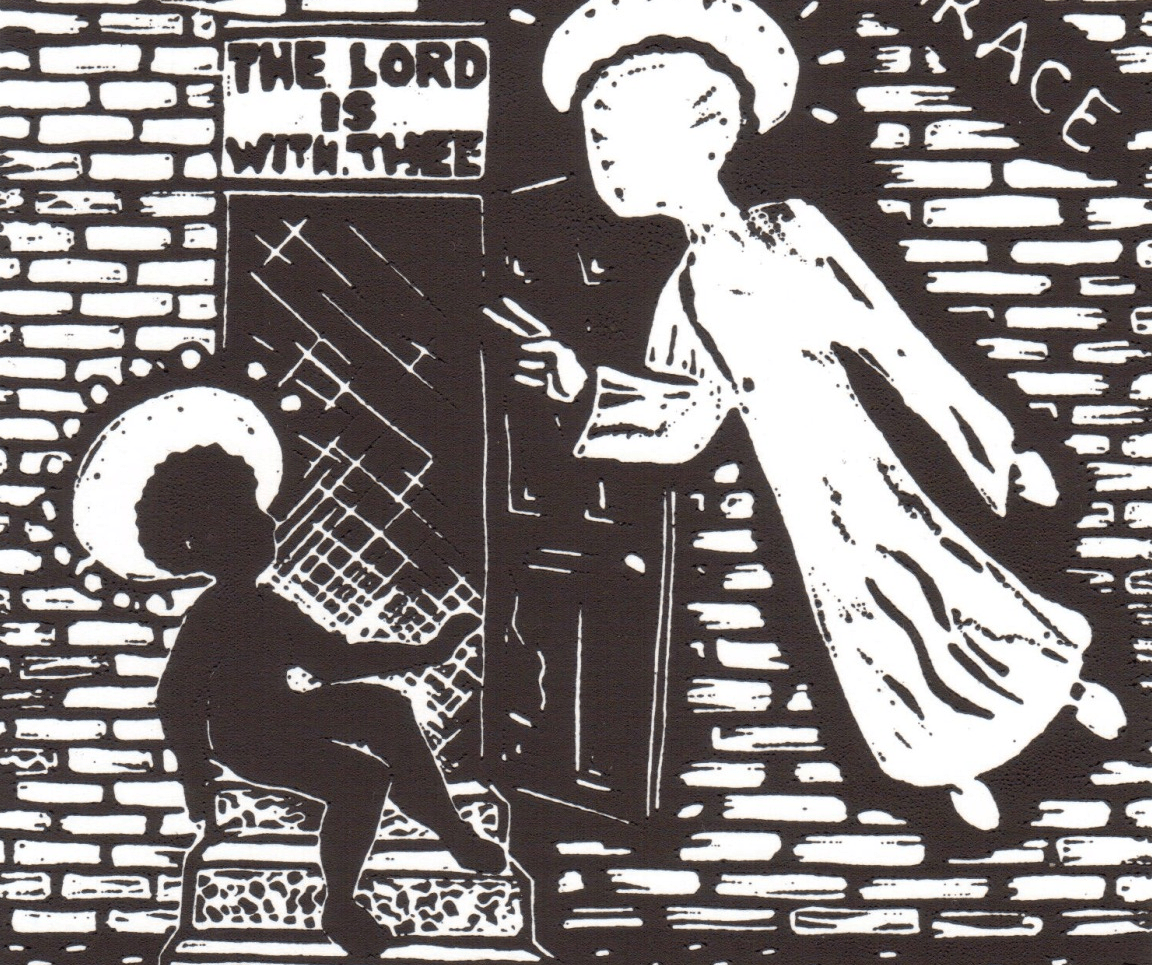
Black and white linocut of an angel appearing to Mary, who is depicted only in sillhouette but who as an afro hairstyle. She sits on a stoop outside a brick wall. Text above and below reads out the first part of the Hail Mary prayer: Hail Mary, full of grace, the Lord is with thee. Blessed art thou among women and blessed is the fruit of thy womb Jesus.
Annunciation, 2015” by Ben Wildflower

In Advent, God’s Spirit comes in dreams,
daring us to conceive of impossible things:
that wolf and lamb
might live in harmony;
that the world’s despised
might rise to greatest glory;
that war-torn wastes might bloom
and grow good fruit.
– my writing in Call to Worship 59.1

Then on to Christmas, when we celebrate how (to paraphrase Saint Athanasius) the divine became human so that humans might become divine.

At Christmas, Creation sings a new song;
God’s prophets proclaim good news:
The Word of God
has put on flesh
so that we may put on divinity.
Through Jesus, our newborn brother,
we are adopted into God’s chosen family.

– my writing in Call to Worship 59.1

In preparation for this holy time of the year, I want to share several resources created for Advent / Christmas 2025 that I had the honor of being part of.

First is More Light Presbyterians’ Advent devotional!

This resource offers a ~100 word devotion for every day of Advent. They will be posted daily on MLP’s Instagram and Facebook pages. It’ll also be published all at once in MLP’s monthly newsletter for December; sign up to receive it here.

Next, there’s Unbound’s Trans Advent/Christmas devotional!

Along with an Advent calendar that lists a trans organization or trans activist for each day of the season, Unbound’s devotional provides a reflection by a trans author for every Sunday & special day of Advent & Christmas. It’s a fantastic resource for communities or individuals who are hoping to queer up this season.

Click this readmore for a snippet of my reflection on the second Sunday of Christmas.
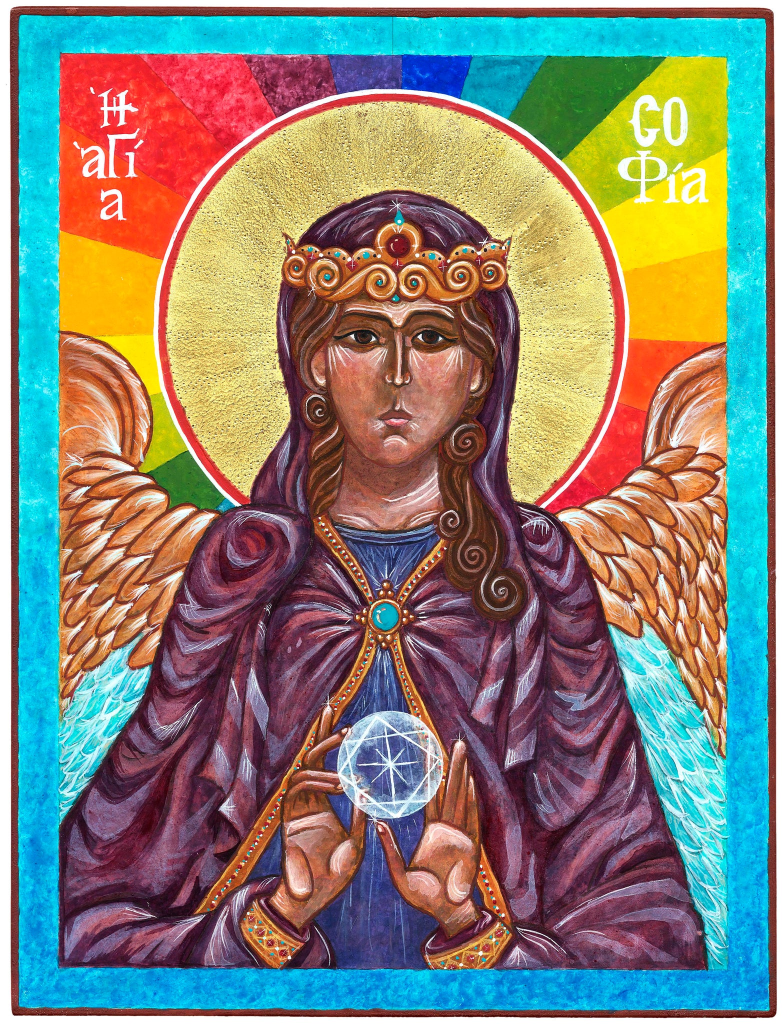
In the beginning, God spoke the Word; and God was the Word; and God was the breath that pushed that Word out into the void to spark life.

In the beginning was Wisdom, flowing forth from God’s mouth to unfurl Herself across the earth, seeking out those who’d welcome Her peculiar gifts.

Starting with Paul, who identified Christ as “the wisdom of God” (1 Cor 1:24), Christians have traditionally connected the Hebrew scriptures’ personified Wisdom — often called Sophia, the Greek word for wisdom — with Jesus. Yet while the Word took on a human body whose features led those present at Their birth to declare, “It’s a boy!”, Wisdom is described — and speaks of Herself — in feminine terms.

Sophia, Woman Wisdom, assigned male at birth! Now that’s a trans story if I ever heard one. […]

And yet…I still default to thinking of Jesus as male. Why, when many of us have expanded our language for God beyond exclusively masculine terms, does it still feel strange — even inappropriate — to speak of the Person of God who is Jesus as she or they?

…It’s the physical body, isn’t it? In many ways, Jesus is as constrained by his (/her/their/zir…) assigned gender as the rest of us.

From birth, we are bombarded by messages telling us that our flesh is our gender — that, as feminist philosopher Simone de Beauvoir put it, “biology is destiny.” From the moment the Word put on flesh, that flesh (or our assumptions about it, because the Gospels don’t actually tell us much about Jesus’s physical appearance beyond what we can deduce from his circumcision in Luke 2) sealed Their fate: Creator God can exist beyond human labels, and the Spirit is, well, Spirit; but God the Son is a human man.

But trans folk know deep in our bones that biology is not destiny. Trans wisdom cuts through the bonds of the binary’s imposed futures, freeing all of us to imagine new possibilities…and, sometimes, to remember old ones. [… read the full thing here]

Also check out Advent & Christmas liturgy in Call to Worship!

I wrote liturgy based on the Common Revised Lectionary for every Sunday and holy day of Advent 2025 and Christmas 2025/2026.

This liturgy is in many ways more “subtly queer” than Unbound’s devotional, as I wrote it to fit a broader range of contexts and church communities. However, I was delighted by the authorial freedom Call to Worship gave me; along with sticking to inclusive language for people (e.g. saying “siblings” instead of “brothers and sisters”), I was able to employ expansive language and pronouns for God! I also incorporate a lot of liberationist theology, from Ada María Isasi-Díaz’s concept of the Kin-dom of God to prayers emphasizing the goodness of embodied life.

To access all the Advent and Christmas material, you may need to subscribe to Call to Worship. If you are unable to do so, email me at queerlychristian36@gmail.com and I’ll get the material to you.

In the meantime, click this readmore for a sampling.

Fantastically scandalous God,
in being born into human life
you burst through the rigid binary between
worshiper and deity, Creator and creation.
Inspire us to proclaim your astonishing news
wherever we go — not only with words,
but through actions of justice and love.
Push us to prophecy
against hoarding and exploitation;
Empower us to rise up
with oppressed peoples everywhere;
Illuminate our path
as we tend to your poisoned planet,
so that all Creation may feel your embrace through us —
your hands, your feet, your body here on earth. Amen.

TWIBAR’s annual Christmas episode

Every Christmas, The Word in Black and Red podcast puts out an episode featuring the short reflections of largely Christian leftists; I’m one of them! Keep an eye out for the episode on the podcast feed.

digital art of a young Latino couple outside a convenient store in the rain; José is using a payphone while Maria, in a hoodie and visibly pregnant, sits on a toy horse
José y María by Everett Patterson

Other resources

I’m not part of these, but I always recommend the following resources:

  • Enfleshed – spiritual nourishment for collective liberation
  • A Sanctified Art – especially the illustrations they offer for Advent and for Christmas
  • I can’t recommend Cole Arthur Riley’s writings enough; check her out @blackliturgies on Instagram, Facebook, etc.

What about you? What are your favorite liberationist resources for Advent and Christmas?
Categories
Current Events / Activism LGBT/queer My poetry Other search markers

A poem on being trans during Trump’s return

The day after the inauguration
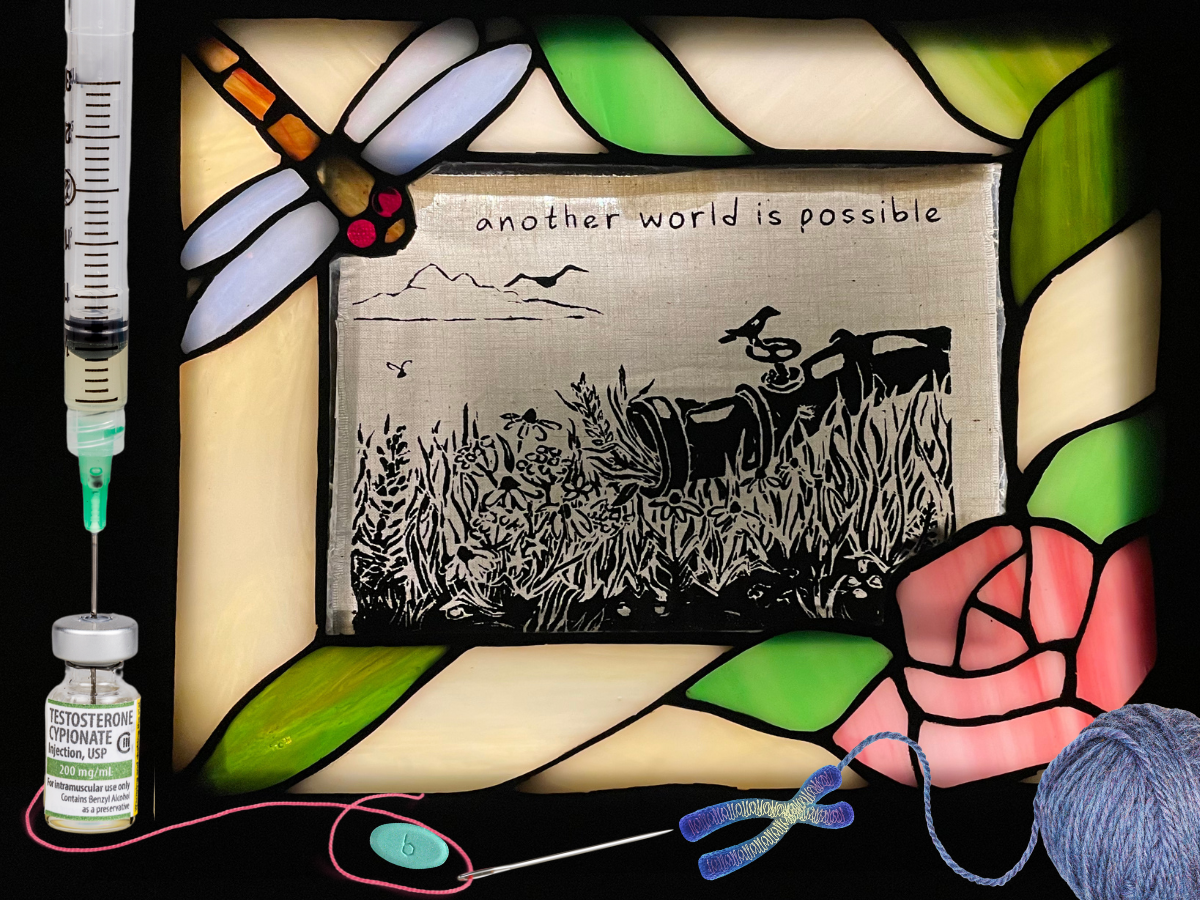
I give myself my hormone shot.

Every Tuesday since
I have done so again

in spite

of blowhards’ orders for
two sexes and impermeable borders.

Hrt — dear dermal border crosser — pays no mind 
to the blustering of fools who know nothing

of what it is to sew oneself 
into one’s body with a needle

pierced through thigh muscle; stitches across 
the chest; new names spun by fumbling fingers

into the threads that stretch heartstring to heart-
string. What could they who sever heartstrings know

of the transtemporal tapestry that interweaves
our unnumbered stories, our numberless ways to be?

Even now, they try

to tear our truth out of all legal records,
to blot us out from history and medical texts —

but we suffuse humanity’s warp and weft:
cut us out, mere tatters will be left.

And it may be they’ll pry

our protections and passports, our vials and blue pills
from our still-warm, still-alive, still-trans and intersex hands —

but our tapestry is stronger than their will,
twined tighter than chromosomes, and

we’ll give them hell for every sundered string.
We’ll fight like hell until their bitter end.

For now, it is Tuesday again

and my hand, with its wedding ring
and thickened skin,

is steady as I plunge the needle in.


You are welcome to circulate this poem around, including on social media (please make sure to include image descriptions if you share screenshots) or at any type of gathering. Please credit Avery Arden (they/ze) of binarybreakingworship.com.

I also ask that you keep in mind that this poem is first and foremost a personal piece; I am not attempting to speak to what other trans and/or intersex persons are feeling right now. What is more, I hope it is clear that none of the various things mentioned — hormones, surgery, document changes — are at all necessary to be trans; I only center hrt here because of how it has been a grounding ritual for me these past weeks.

I welcome conversation, and would love to hear about your rituals, your remembrance, your resistance.

(By the way, this post’s title isn’t the poem title; it’s untitled / the first line kinda serves as the title.)

More about the poem:

Since Trump’s intentionally overwhelming first-day flood of executive orders, I’ve been trying to sort my tangled-up feelings:

  • The rage and despair and dread inextricably mixed with love, and defiant dreams of a better world, and deepest pride in the vibrant, rebellious, eternal community of those whose very bodyminds expose Empire’s lie that humanity can be dichotomized.
  • The whiplash of mundanity in times such as these — the way “life as usual” can lure us into passivity if we are not careful; but also the way our everyday rituals and tasks (like my weekly hormone shot) ground us, and can even be little acts of resistance to nourish our larger, communal resistance.
  • The bitterness of all that could have been (and I’m not talking about a Democrat in the White House, upholding the same systems that enable a tyrant like Trump, just with more hand-wringing). The frustration that this is what it takes for more people to wake up to the evils that have festered in and fueled this nation from its conception. The relief that at least now there are more people ready to resist, and urgency to welcome and equip them.
  • The preemptive grief for all we will lose. The determination to lose as few as possible — to pray for the dead and fight like hell for the living.

Before finally managing to get this poem written out, I was able to channel some of that tangle into helping More Light Presbyterians write our statement on Trump’s executive order against gender diversity. Along with concrete actions we can take to support trans and intersex persons right now (see the link for those), one of the parts I wrote was a closing message of love and promise to my trans and intersex kin:

Hateful people want nothing more than to see you feeling hopeless and abandoned—but we promise you, there will always be people in your corner, ready to protect you with our lives. We will not leave you to fight alone, no matter how dire things get. Cling to your community, nurture your spirit however you can, and remember:

Politicians were never going to save us. We keep us safe, trusting in the love and solidarity of the One who created each of us with purpose and delight (Genesis 1:31; Psalm 139:14).

Categories
Confession and Pardon LGBT/queer Liturgy

Confession of Anti-Trans Violence & Assurance of God’s Grace

Drawing from Luke 4:16-30
and F-1.04 of the Book of Order of the Presbyterian Church (USA)

PRELUDE:

As Presbyterians, we believe in a God who takes up the cause of those whom human societies consider “least.”

In this era of escalating anti-trans rhetoric and legislation, in our own state and beyond, our faith calls us to affirm God’s movement among and through the trans community in particular.

Even as we leave room for some differences in belief, we can agree that there is no place in the life of the Church for discrimination against any person. 

United in this belief, let us confess together the ways in which we continue to fall short in protecting and celebrating the gender diverse members of God’s human family:

CONFESSION

When we refuse to recognize the unique ways
our transgender siblings participate in co-creation
and manifest the Divine Image
of a God far vaster than any rules we devise or boxes we build,

Forgive and transform us, Creator God.
Open us to choose respect over rejection,

conversation over misinformation,
relationship over alienation.

When we look on as oppressive forces hold our trans kin captive —

suffocate their free will, strip them of health and safety,
drive them to desperation and rob them of their very lives —
and we shrug off their plight, assuming it has nothing to do with us;

or else stay silent out of fear for our own security and comfort,

Forgive and transform us, Liberator God. 
Wake us to the life-or-death urgency of this struggle.
Open us to choose action over silence,
to risk much in the name of justice.

When our denomination’s promises
of full participation and representation for all persons and groups
remain unfulfilled —

with many queer candidates still finding their ministry obstructed,
and trans parishioners forced to choose
between staying in hostile spaces
or leaving their spiritual homes to seek belonging elsewhere,

Forgive and transform us, God who favors outcasts.
Open us to see both the possibilities and perils of our institution,
so that we may revise the things that harm
and bolster the things that liberate.

God who hears and joins in our lament,
God who speaks through unexpected prophets,

instill in us a hunger for your justice
that will drive our solidarity and action
until we have become — in fact as well as in faith —

a community of all people
made one in Christ by the power of your Holy Spirit.

PARDON

Friends, we have a long way to go, and much work to do —
but we rejoice now in the assurance that, through Jesus Christ,
we are forgiven and renewed to continue the journey.

Thanks be to God.

PEACE

Assured of God’s mercy, we may be bold in sharing Christ’s peace —
a peace built on justice, a peace that preserves diversity —
with all we meet. 

The peace of Christ be with you.
And also with you…


Please feel free to make use of this piece in worship or Sunday school, in ceremony or across social media. Just credit it to Avery Arden of binarybreakingworhsip.com — and I invite you to email me at queerlychristian36@gmail.com to let me know you’re using it!

You may make small adjustments to fit your own particular context.

About this piece:

I wrote this confession and pardon to be used during morning worship at the PC(USA)’s 226th General Assembly.

I was asked to center its call to acknowledge where we have failed our transgender kin around Luke 4′s account of Jesus reading from Isaiah in his local synagogue — the prophet’s proclamation of good news for the poor, the imprisoned, for disabled persons and all whom Empire oppresses.

When Jesus announces after he reads, “Today, this scripture has been fulfilled,” his audience raves, impressed by this local boy grown up into a wise teacher. It’s only when he continues his commentary to make it clear that gentiles will be receiving the Spirit of God’s liberation as well — for did not Elijah and Elisha minister to gentile widows and lepers? — that the crowd’s praise sours into rage.

What a fitting text to draw from when confronting our own resistance to expanding God’s liberation to those we consider outsiders. God is lavishing Their Spirit on Their queer children, freeing Their trans children from bondage and into ministry — and there are many who refuse to recognize this divine activity.

Just days before this confession was shared in worship, the General Assembly discussed and ultimately approved the Olympia Overture, which seeks to solidify protections for queer members — particularly queer ordination candidates — of our denomination. Though I rejoice that this overture passed, the debates were painful to witness, reminding me that I share this spiritual home with people who deny my humanity, my vocation, or God’s movement through me and those like me — and who balk at naming this denial “discrimination.”

If you’re interested, I wrote another piece — Beatitudes for the prophets who move our churches into truer welcome — in response to those overture debates.

I give thanks to all who courageously spoke up in support of the Olympia Overture; may they find themselves surrounded by support and love after living out such brave vulnerability. And I pray that those who feared or raged against its passing will find themselves broken open, bit by bit or all at once, by the Spirit of Wisdom who guides us all into understanding. Maybe this overture’s passing can be an opportunity for deeper conversations that will draw us all closer. Maybe. If we all are brave, and bold, and ignited by love. If we all commit ourselves to living into F-1.0404‘s call to openness:

"...a new openness to the sovereign activity of God in the Church and in the
world, to a more radical obedience to Christ, and to a more joyous celebration in
worship and work;

a new openness in its own membership, becoming in fact as well as in faith
a community of all people of all ages, races, ethnicities, abilities, genders, and
worldly conditions, made one in Christ by the power of the Spirit, as a visible
sign of the new humanity;

a new openness to see both the possibilities and perils of its institutional
forms in order to ensure the faithfulness and usefulness of these forms to God’s
activity in the world; and

a new openness to God’s continuing reformation of the Church ecumenical,
that it might be more effective in its mission."
Categories
Current Events / Activism LGBT/queer Prayers of the People Reflections for worship services

Beatitudes for the prophets who move our churches into truer welcome

To the ones who bear witness
to the church’s flaws and failings,
and still believe in everything that Church could be —
and work to make that holy vision real
though the labor is long, and tough, and often thankless —

Let us offer thanks,
remembering the unlikely blessings
our subversive Savior likes to lavish
on those the world least expects.

Blessed are you who make a way
out of no way: who pioneer a path
for those of God’s children who’ve been told they don’t belong
in the pews, in the pulpit, or in holy bonds of marriage.

Blessed are you when you come in bold and disruptive,
flipping the tables that make no room for you;
And blessed when you work behind the scenes,
change rippling out from constant conversation —

For we we need both: the Spirit of roaring flame, and gentle rain.

Blessed are you when your voice shakes
and you speak out anyway.

Blessed are you in patience, persistence, and grace;
Blessed also are you in frustration and righteous rage

For the psalmist joins you in crying, “God, how long?”

Blessed are you who endure judgment and scrutiny
from people who are meant to be neighbors in the Body of Christ

For the peacemaker’s crown, the friendship of God is yours.

Blessed are you when you tire,
and burn out, and wrestle with despair

For rest is your right, and others will take up your fight
as long as you need.

And when ignorant tongues defame you,
when they twist your words
and accuse you of being the divisive one,
when they try to shut you up and drive you out

Blessed, blessed are you!

For you belong to an unbroken line of prophets
stretching back to the cross
and forward to a feast laid out for all.

Yes! Blessed are you when “blessed” is the last thing you feel —
you who fight the good fight
even when it seems hopeless,
even when you lose, again and again,
even if you will not be around
when the drought on justice ends
and the fruits of your labor bloom into life at last

For future generations will remember you with pride.

For no matter how it looks right now,
your efforts are never in vain.

For you are part of what makes Church worth fighting for,
and what you sowed in sweat and tears,
tomorrow’s children reap rejoicing.

Blessed are you, for yours is the kin-dom
you are helping to build, one brave truth at a time.


Please feel free to make use of this piece in worship or Sunday school, in ceremony or across social media. Just credit it to Avery Arden of binarybreakingworship.com — and I invite you to email me at queerlychristian36@gmail.com to let me know you’re using it!

About this piece:

The past few days have been rough ones for queer Presbyterians and those who love us. The 226th General Assembly of the Presbyterian Church (USA) kicked off with the Olympia Overture, which sought to add sexuality & gender identity to a portion of our Book of Order that lists classes protected from discrimination; as well as to make it so candidates for ordination must be asked about their ability and commitment to uphold the “principles of participation, representation, and non-discrimination” found in that other part of the Book of Order.

Both parts of the overture ended up getting approved, but only after much discourse before the GA even began, and more debate before the committee. It was…really hard to watch (so hard that I didn’t watch most of it myself — but friends watching kept me informed of what was happening).

It was a reminder that there are people in my own denomination who, whether they would word it this way or not, don’t want to see me and my queer kin as fully human — to recognize us as called by God, as colleagues, as part of Christ’s movement in the world.

Also, part B only passed after the language was amended to take out the word “non-discrimination” — apparently the implication that a candidate might be discriminating against someone is Not Nice. I’m reminded how many of us — myself included as a white person — have it instilled in us from birth that it’s more important to be nice, and to avoid discomfort, than it is to call out harm.

But also, as many queer Presbyterians took their turn speaking — each granted just two minutes to make the case for their belonging, their right to have colleagues who recognize their equality in our church — I felt pride swell up deep in my soul. We are put through so much! We are scrutinized, we are shamed, we are accused of “causing division” just because we call it out — yet we remain faithful. We believe in God’s promise of justice rolling down, of a kin-dom where the last are first and the dignity and worth of all is recognized.

They can’t drive us out. We will stay, and we will persist in loving them back into their own humanity.

This prayer is for all the people across the decades, even centuries, who have fought in loud ways or quiet, in the spotlight or behind the scenes, to have their dignity recognized. For Black folk and queer folk, for women and immigrants and disabled persons, and for so many more, across all the different communities of faith.

We are Church. We are making the Church be what it was always meant to be. Blessed indeed are we.

Categories
bible study Current Events / Activism easter Holy Days LGBT/queer Queer Lectionary Reflections for worship services

Today is Easter Sunday. Today is Trans Day of Visibility. Today is day 176 of genocide.

This year the lectionary gives us Mark’s account of the Resurrection, with its fearful cliffhanger ending — an empty tomb, but Jesus’s body missing. And isn’t that unresolved note fitting?

In the face of so much suffering across the world, it feels right to be compelled to sit — even on this most jubilant of days — with the poor and disenfranchised in their continued suffering.

Mark’s account:

Just days before, the women closest to Jesus witnessed him slowly suffocate to death on a Roman cross. Now, now trudge to his tomb to anoint his corpse — and find the stone rolled away, his body gone. A strange figure inside tells them that Jesus is has risen, and will reunite with them in Galilee.

They respond not with joy, but trembling ekstasis — a sense of being beside yourself, taken out of your own mind with shock. They flee.

The women keep what they’ve seen and heard to themselves — because their beloved friend outliving execution is just too good to be true. When does fortune ever favor those who languish under Empire’s shadow?

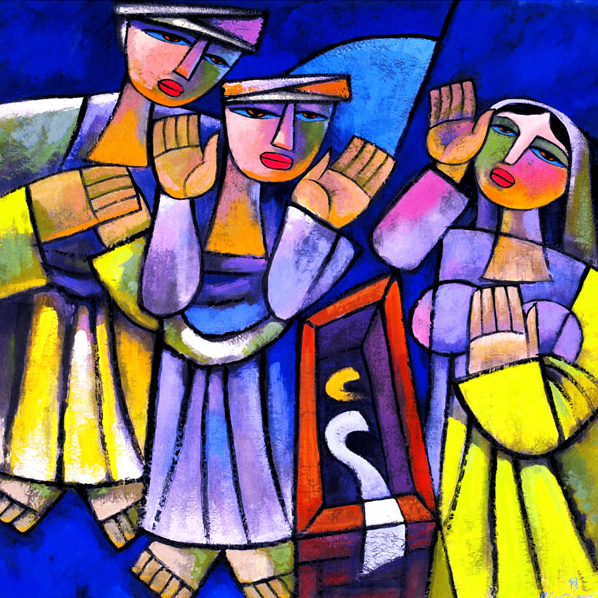
A painting in a style resembling stained glass of three women standing over a coffin, which is empty except for strips of white and yellow linen. The women's hands are raised in confusion and shock.
“The Empty Tomb” by He Qi.

Love wins, yet hate still holds us captive.

I’m grateful that Mark’s resurrection story is the one many of us are hearing in church this year. His version emphasizes the “already but not yet” experience of God’s liberation of which theologians write: Christians believe that in Christ’s incarnation — his life, death, and resurrection — all of humanity, all of Creation is already redeemed… and yet, we still experience suffering. The Kin(g)dom is already incoming, but not yet fully manifested.

Like Mark’s Gospel with its Easter joy overshadowed by ongoing fear, Trans Day of Visibility is fraught with the tension of, on the one hand, needing to be seen, to be known, to move society from awareness into acceptance into celebration; and, on the other hand, grappling with the increased violence and bigotry that a larger spotlight brings.

The trans community intimately understands the intermingling of life and death, joy and pain.

When we manage to roll back the stones on our tombs of silence and shame, self-loathing and social death, and stride boldly into new, transforming and transformative life — into trans joy! — death still stalks us.

We are blessedly, audaciously free — and we are in constant danger. There are many who would shove us back into our tombs.

An art piece structured like a collage featuring an elegant figure wreathed in fire, with text around them reading "& like any goddexx you are scorned & become the fire anyway." The figure is pouring pitchers of water into a pool at their feet; green hills with various flowers stretch up around the pool.
Art by Amir Khadar, based off the poem “litany in which you are still here” by kiki nicole

And of course, the trans community is by no means alone in experiencing the not-yet-ness of God’s Kin(g)dom.

Empire’s violence continues to overshadow God’s liberation.

The women who came to tend to their beloved dead initially experienced the loss of his body as one more indignity heaped upon them by Empire. Was his torture, their terror, not enough, that even their grief must be trampled upon, his corpse stolen away from them?

The people of Gaza are undergoing such horrors now. Indignity is heaped on indignity as they are bombed, assaulted, terrorized, starved, mocked. They are not given a moment’s rest to tend to their dead. They are not permitted to celebrate Easter’s joy as they deserve. They are forced to break their Ramadan fasts with little more than grass.

Photo of a blanket set with bowls of grass soup and slices of lemon
A photo of a Palestinian family’s meal, taken in Gaza.

Those of us who reside in the imperial core — as I do as a white Christian in the United States — must not look away from the violence our leaders are funding, enabling, justifying.

We must not celebrate God’s all-encompassing redemption without also bearing witness to the ways that liberation is not yet experienced by so many across the world.

This Easter, I pray for a free Palestine. I pray for an end to Western Empire, the severing of all its toxic tendrils holding the whole earth in a death grip.

I pray that faith communities will commit and recommit themselves to helping roll the stones of hate and fear away — and to eroding those stones into nothing, so they cannot be used to crush us once we’ve stepped into new life.

I pray for joy so vibrant it washes fear away, disintegrates all hatred into awe.

In the meantime, I pray for the energy and courage to bear witness to suffering; for the wisdom for each of us to discern our part in easing pain; for God’s Spirit to reveal Xirself to and among the world’s despised, over and over — till God’s Kin(g)dom comes in full at last.

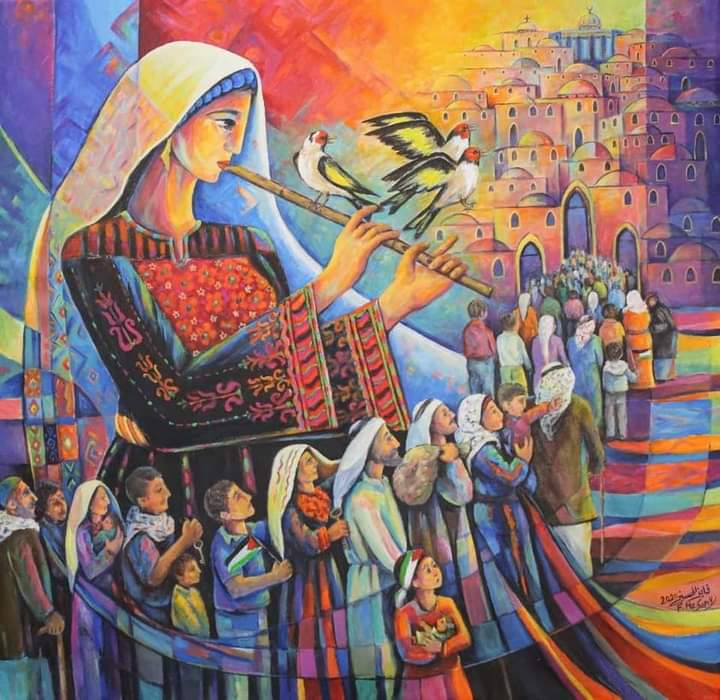
Painting of a woman playing a flute with several birds around her, as below her a line of Palestinians make their way up towards the city of Jerusalem. The colors are warm and bright.
Painting by Palestinian artist Fayez Al-Hasani
Categories
bible study LGBT/queer Queer Lectionary

Queering Hagar’s Story

A short reflection on this Sunday’s lectionary text, Genesis 21:8-21. Scroll to the end for further resources

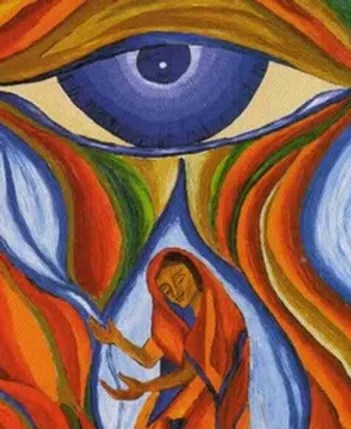
 a painting of a figure like Hagar who is smiling as water pours through her hands; above her is a giant eye.

Name changes occur throughout scripture, but there is only one instance in which a human being directly names God!

That person is Hagar — the woman enslaved and then cast off by God’s own chosen people, yet who recognizes God’s solidarity with her in a way that resonates with many marginalized folk, including queer & trans people of faith.

Back in Genesis 16, Hagar is forced to conceive a child with Abraham — her bodily autonomy denied — and then suffers abuse at Sarah’s hand so painful that she prefers almost-certain death in the wilderness. While waiting to die, God comes to her, nourishes her, encourages her with the promise of a better future. For a time, Hagar must return to her oppressors.

This is a hard message, but It may resonate with queer and trans people who make the hard choice to find what safety they can while in the closet, or who choose to remain in relationship with family or faith communities that have caused them harm.

It also isn’t the end of Hagar’s story: when the time is right, God leads her out — as told in this week’s text in Genesis 21.

Sarah continues to abuse Hagar, with Abraham as a passive bystander and enabler. In a society where only one of Abraham’s sons can inherit his wealth and blessing, Sarah sees Hagar’s son Ishmael as a threat to her son Isaac, simply by existing! In our own day and age, this myth of scarcity persists, causing us to hoard resources and compete needlessly.

Sarah cannot stand to see Hagar’s child playing with her own son — as if they were equals! As if a slave boy should be having a moment of fun! She reads something sinister into the play — not unlike how some people today read sinister things into queer play, into drag queens and gender expansive youth.

Having convinced herself that Hagar and her son are a threat, Sarah gets Abraham to cast them out.

But again, God is with the outcast; God comes again to Hagar, who in Genesis 16 had given God the name El Roi — “God sees me.” This God is the god of her oppressors, yet Hagar recognizes that this god is her God as well! This god is a God who sees the suffering of the lowest of society, and responds.

God sees queer and trans people, too. God is our God, too — those who hate us do not have a monopoly on the Divine!

And God walks with us through every struggle, fueling us to fight the good fight and promising blessings to come.

Questions for reflection:

  • When have you witnessed God coming to the Hagars in our midst?
  • When has your community behaved like Abraham & Sarah, hoarding God’s love as if there were not blessing enough to go around?
  • Can you imagine a world in which Sarah, Abraham, and Hagar meet again? What would Hagar need to feel safe to meet with her former abusers? What would Sarah & Abraham need to do to make things right?

Further Reading

Queer-specific resources:

Other resources:

a painting of two women with curly brown hair and brown skin embracing; the one being held has a blue shawl with “Sarah and Hagar” written in Hebrew on it, while the one embracing her has a bright blue dress. A dove with an olive branch hovers behind them
Sarah and Hagar” by Jewish artist Hilary Sylvester, who says: “Sarah the mother of the Jewish People and Hagar the mother of the Arab people finally find reconciliation through Mashiach.”
Categories
LGBT/queer Reflections for worship services

A Queer Reflection for Trinity Sunday

There’s something queer about a Triune God. 

A diagram of the Trinity featuring a triangle with each angle labeled The Father, The Son, and the Holy Spirit respectively. In the center of this triangle is the word "God." Connecting lines between each angle read "is not," so that it reads "the father is not the son is not the holy spirit is not the father," while lines that connect each angle to the center read "is" so that you get the message "the father is god, the son is god, the holy spirit is god."

How can one Being also be three Persons? The math doesn’t seem to add up! Some spend years attempting to articulate this theology in a way that doesn’t fall into “heresy”; others give up with a laugh and accept it as a Mystery. Ultimately, the God of the Universe is ineffable, beyond our understanding — yet we are called to seek ever deeper relationship with God, and promised that if we seek, we will find.

When people decry queer identities as nonexistent, overly complicated, or paradoxical, I can’t help but think of our impossibly Three-in-One God. I think also about my own gender journey: how I struggled as a child to name what I was feeling because I had no language to describe it; how once I discovered others had words for what I was experiencing, I delighted in every one I could uncover; and how, ultimately, even my favorite words I’ve found to describe myself fall short. 

Words like trans, nonbinary, and genderqueer certainly help others understand and relate to me better, but I’ve learned to be okay with the fact that they might never fully know me, just as I may never fully know them — or at least that the deepest understanding is beyond words. Turns out that the children of a Mysterious God are micro-mysteries in ourselves!

What I’m left with is this: if we worship a Triune God, why do we try to squeeze the humans made in that Infinite, Ineffable Being’s image into two narrow boxes? And if we celebrate how, in the Incarnation and Resurrection, Divinity burst through the binaries between Creator & Creation, Life & Death, surely the binary between male and female is not so insurmountable!

Together, let us pray:

Holy God, whose very existence is relationship, we marvel at your mystery. Protect this day and always those of your children who, like you, defy easy definition and resist restrictive categories. Teach us to recognize your wisdom and holiness shining within them, for only together in all our diversity do we reflect your image. Amen.

___

Further reading:

Categories
Invitation to the table LGBT/queer Liturgy

Invitation to the Table: “If the world tells you that you are unworthy…”

If the world tells you that you are unworthy of a seat at the table,
that your presence is unwelcome or even unwholesome,
know that Jesus extends an invitation to you personally.

This table does not belong to human beings,
but to the God who delights in you,
Who welcomes you without demanding you be anything
but your own beautiful self.

Come, join this joyful feast without fear.

God has set a place just for you.


About this piece:

I wrote this affirmation for my church’s More Light Sunday service, an LGBTQA/queer-focused service. Themes included learning how to love ourselves, our neighbors, and our God; reclaiming scripture from those who have weaponized it; and the power of story.

If you this piece it in your own service, please credit it to Avery Arden — and I invite you to email me at queerlychristian36@gmail.com to let me know you’re using it!

I thought of a poem by slats toole as I wrote this invitation. You can read the poem here. And you can buy their collection Queering Lent here.

Categories
Affirmation of Faith LGBT/queer Liturgy

Affirmation of Faith: Queer God who came out to Moses…& other biblical coming out stories

The love of our queer God
unites us into one Body —
not in spite of, but in celebration of
our varied gifts and roles in
the story God is telling even now.

As one, let us affirm some of what we believe
about the God who is for us
when we are in the closet, and when we come out,
when we receive our loved ones with rejoicing
and when we strive to understand.

We believe in the God who came out to Moses
from the midst of unburned branches
with a name They had never revealed before —

a name shared with love, shared as an invitation
into deeper relationship, deeper understanding
of the God Who Is and Who Will Be
the steadfast ally of shunned and shackled peoples.

We believe in the God of Joseph, 
who takes tattered lives
and weaves them into wholeness.

When Joseph came out to his brothers
as a dress-draped dreamer
and faced their violent rejection,

God went with Joseph into slavery, into imprisonment,
and out again, guiding his way into flourishing.

But They also stayed
with Joseph’s brothers,
never ceasing to work on their hard hearts,
preparing them for the tearful reunion
where they would embrace Joseph’s differences
as life-bringing gifts.

We believe in the God of Esther, 
who protected her from being outed unwillingly
in a place hostile to her very being;

and who, when the time came to act,
filled her with the courage and power she needed
to use what privilege she had
to save the more vulnerable members of her people.

We believe in the God of Mary,
the teenage girl who faced disgrace
by coming out as full of grace

pregnant with divinity —

yet she did so boldly, joyously,
recognizing the hand of God
in the status quo’s upturning.

We believe in Jesus, whose identity 
as God’s beloved son and God Themself,
as Word made Flesh and Life that died
is too complex for human minds to fathom —

yet Jesus yearned to be known,
to be understood by those who loved him most!
He asked them earnestly, “Who do you say that I am?”
but told them not to out him to the world
before he was ready to share his truth in his own time —
And oh, how he’d shine!

We believe that the God
who liberated Lazurus from his tomb,
and who overcame death
by rising from a tomb of his own,

is the selfsame Spirit
who enters into the tombs
we build around ourselves
or shove our neighbors into;

She looses our bindings
and pulls us into Her great Upturning.

Amen.


About this piece:

I wrote this affirmation for my church’s More Light Sunday service, an LGBTQA/queer-focused service. Themes included learning how to love ourselves, our neighbors, and our God; reclaiming scripture from those who have weaponized it; and the power of story.

If you this piece it in your own service, please credit it to Avery Arden — and I invite you to email me at queerlychristian36@gmail.com to let me know you’re using it!

Further Reading

For more on Joseph through a queer & trans lens:

For more on Esther through a queer lens:

For more on Mary through a queer & trans lens:

For more on Jesus through a queer & trans lens:

For more on Lazarus through a queer & trans lens:

[image: a digital painting of Joseph of Genesis by tomato-bird on tumblr, a figure with light brown skin, brown eyes, and curly dark hair sitting in a field. They have their head propped on one hand as they sit, gazing off into the distance with a sunset or sunrise blushed sky behind them. And from their shoulders extends a gorgeous, flowing cape, rising upward behind them as if caught on the wind so that its colors blend with the blushing sky – ripples of vibrant red and blue, with orange and yellow stars plus a moon and sun scattered along the fabric. / end id]

Categories
Call to worship LGBT/queer Liturgy Multifaith Opening prayer

Call to Worship & Opening Prayer: Queer God with diverse children

Call to Worship

Gracious God,
in this time of worship and wonder, story and song
into which you have gathered us,

we marvel at the wondrous diversity of your human creation.
Each of us — Black, white, Latine, Asian, Indigenous, and beyond — 
is an integral part of your magnificent spectrum.

You call us to join in joyous worship, just as we are.

Each of us — Christian, Jewish, Muslim, Hindu, Buddhist, atheist, and beyond —
is an integral part of your magnificent spectrum.

You call us into community, just as we are.

Each of us — with our bodies of diverse shapes, sizes, and abilities —
is an integral part of your magnificent spectrum.

You call us Good, you call us whole and holy, just as we are.

Each of us — of all sexualities and genders, all these ways of being and loving —
is an integral part of your magnificent spectrum.

You call us to share the gifts you gave us, just as we are.

Opening Prayer

Queer God beyond our knowing,
we glimpse your vastness in the diversity of your children
who together bear your image.

Queer Trinity, both One and Three,
your very Being shows us how to be:
honoring each person’s uniqueness,
and valuing our interconnectedness. 

Queer God, 
On this More Light Sunday, we humbly pray and act
for the full affirmation and inclusion of all of our LGBTQ+ siblings.

Amen.


About this piece:

I co-wrote this call to worship, and wrote the opening prayer, for my church’s More Light Sunday service, an LGBTQA/queer-focused service. You could edit the last two lines to take out the reference to More Light Sunday if using it for general worship.

If you use it in your own service, please credit it to Avery Arden — and I invite you to email me at queerlychristian36@gmail.com to let me know you’re using it!