Categories
Current Events / Activism LGBT/queer My poetry Other search markers

A poem on being trans during Trump’s return

The day after the inauguration
I give myself my hormone shot.

Every Tuesday since
I have done so again

in spite

of blowhards’ orders for
two sexes and impermeable borders.

Hrt — dear dermal border crosser — pays no mind 
to the blustering of fools who know nothing

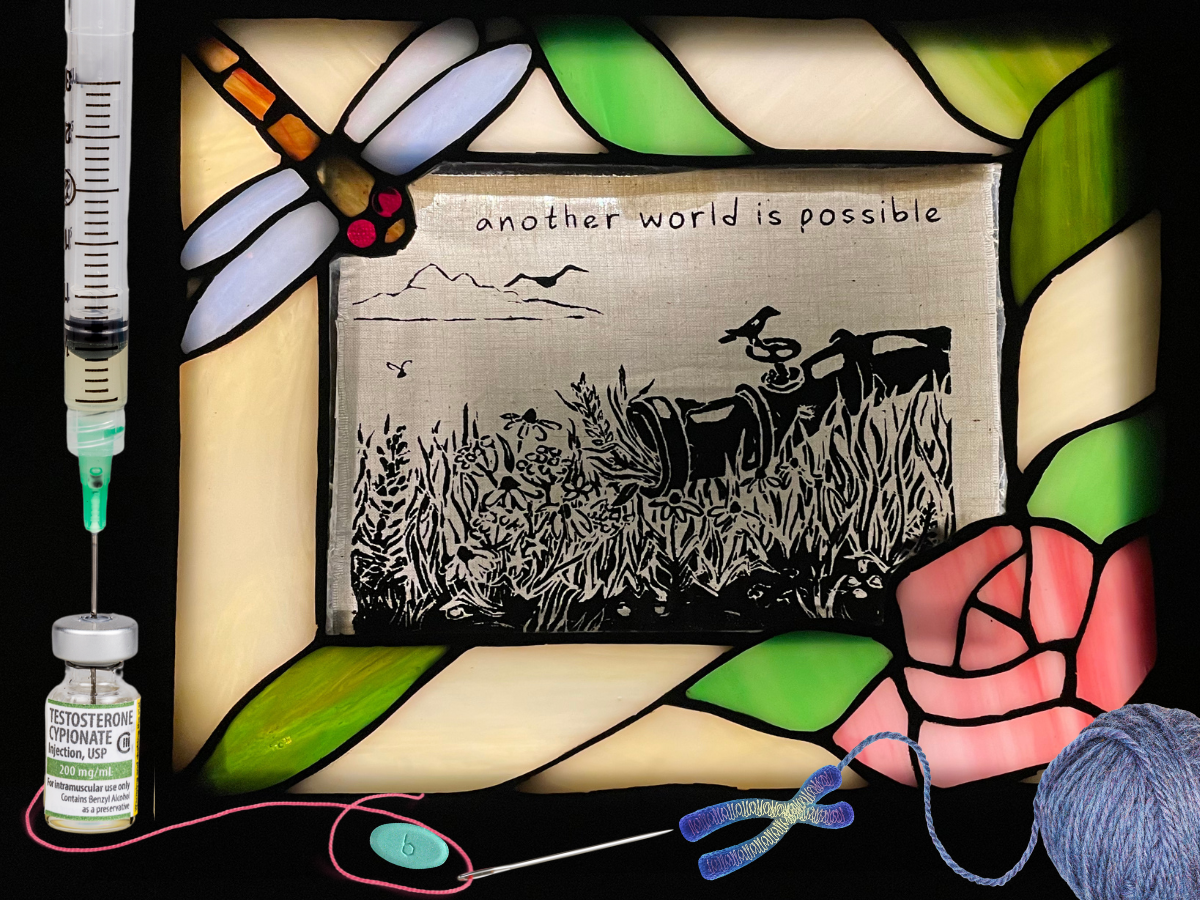
of what it is to sew oneself 
into one’s body with a needle

pierced through thigh muscle; stitches across 
the chest; new names spun by fumbling fingers

into the threads that stretch heartstring to heart-
string. What could they who sever heartstrings know

of the transtemporal tapestry that interweaves
our unnumbered stories, our numberless ways to be?

Even now, they try

to tear our truth out of all legal records,
to blot us out from history and medical texts —

but we suffuse humanity’s warp and weft:
cut us out, mere tatters will be left.

And it may be they’ll pry

our protections and passports, our vials and blue pills
from our still-warm, still-alive, still-trans and intersex hands —

but our tapestry is stronger than their will,
twined tighter than chromosomes, and

we’ll give them hell for every sundered string.
We’ll fight like hell until their bitter end.

For now, it is Tuesday again

and my hand, with its wedding ring
and thickened skin,

is steady as I plunge the needle in.


You are welcome to circulate this poem around, including on social media (please make sure to include image descriptions if you share screenshots) or at any type of gathering. Please credit Avery Arden (they/ze) of binarybreakingworship.com.

I also ask that you keep in mind that this poem is first and foremost a personal piece; I am not attempting to speak to what other trans and/or intersex persons are feeling right now. What is more, I hope it is clear that none of the various things mentioned — hormones, surgery, document changes — are at all necessary to be trans; I only center hrt here because of how it has been a grounding ritual for me these past weeks.

I welcome conversation, and would love to hear about your rituals, your remembrance, your resistance.

(By the way, this post’s title isn’t the poem title; it’s untitled / the first line kinda serves as the title.)

More about the poem:

Since Trump’s intentionally overwhelming first-day flood of executive orders, I’ve been trying to sort my tangled-up feelings:

  • The rage and despair and dread inextricably mixed with love, and defiant dreams of a better world, and deepest pride in the vibrant, rebellious, eternal community of those whose very bodyminds expose Empire’s lie that humanity can be dichotomized.
  • The whiplash of mundanity in times such as these — the way “life as usual” can lure us into passivity if we are not careful; but also the way our everyday rituals and tasks (like my weekly hormone shot) ground us, and can even be little acts of resistance to nourish our larger, communal resistance.
  • The bitterness of all that could have been (and I’m not talking about a Democrat in the White House, upholding the same systems that enable a tyrant like Trump, just with more hand-wringing). The frustration that this is what it takes for more people to wake up to the evils that have festered in and fueled this nation from its conception. The relief that at least now there are more people ready to resist, and urgency to welcome and equip them.
  • The preemptive grief for all we will lose. The determination to lose as few as possible — to pray for the dead and fight like hell for the living.

Before finally managing to get this poem written out, I was able to channel some of that tangle into helping More Light Presbyterians write our statement on Trump’s executive order against gender diversity. Along with concrete actions we can take to support trans and intersex persons right now (see the link for those), one of the parts I wrote was a closing message of love and promise to my trans and intersex kin:

Hateful people want nothing more than to see you feeling hopeless and abandoned—but we promise you, there will always be people in your corner, ready to protect you with our lives. We will not leave you to fight alone, no matter how dire things get. Cling to your community, nurture your spirit however you can, and remember:

Politicians were never going to save us. We keep us safe, trusting in the love and solidarity of the One who created each of us with purpose and delight (Genesis 1:31; Psalm 139:14).
Categories
advent Holy Days My poetry

Poem: Advent in (another) genocide

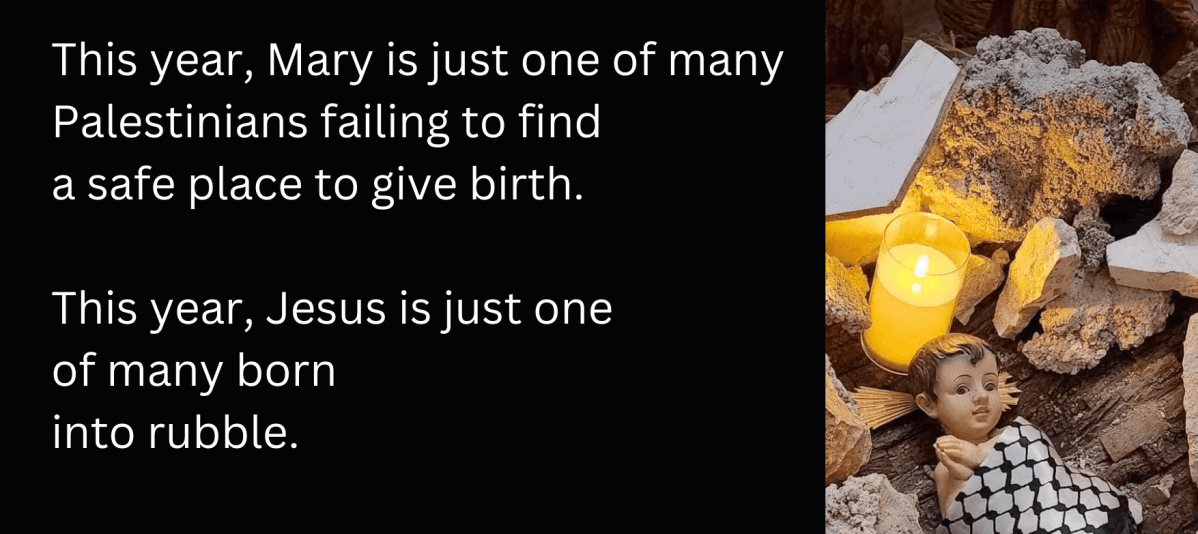
This poem came to me after learning that Christian leaders in the Holy Land have asked churches not to organize any “unnecessarily festive” activities, in solidarity with Gaza; as well as seeing the Nativity scene set among rubble in the Lutheran Church of Bethlehem this year.

Find resources on what’s happening in Palestine and how to help below the poem.

Please feel free to share around; credit to Avery Arden (they/them) with a link to binarybreakingworship.com.


This year, Mary is just one of many
Palestinians failing to find
a safe place to give birth.

This year, Jesus is just one
of countless born
into rubble.

This year, the newborn Christ

dies 

his little body bombed
and tossed aside
into the growing pile.

This time, Jesus never makes it to adulthood —
doesn’t even make it the eight days to circumcision.
He doesn’t die a grown man
making a conscious choice
to defy Empire armed with naught but dreams

of a world where all the nations live as one
where last are first 
and all wars done —

No. This year, his newborn life is threat enough —
his family’s mere existence is rebellion enough  —
to warrant eradication.

Actually, it was then, too, two thousand years ago
— for Empire always fears the ones it grinds
beneath its millstone — back then, though
Christ’s parents found safe passage into Egypt —

now, snipers shoot them as they try
to leave the hospital that scarce had room
for one more woman’s labor cries.

Stigmata are
that much more
chilling between
an infant’s eyes.

And now, as then, some may blame Jesus’s death
on his own Jewish people — but
resist this lie! Now, as then,
the crime is Empire’s

with Western Christians at the helm

and those who would cast stones, look first
for your own nation’s name etched on the bombs
and tear gas canisters!

And, God,
if there is any hope at all
to wrestle from the rubble

as churches all across the Holy Land
close their doors to Christmas joy this year —
a holy choice to mourn with those who mourn
as Christ’s homeland is made a massive grave —

it’s this: there are still children left to save.

It’s this: not every olive branch has burned.

It’s this: the sacred promise of a God
who dies whenever Empire’s outcasts die —
that those cast down 

will rise.

Palestine, Palestine! I swear we will not cease
to shout your name until, at last, your streets
sing with your children’s laughter, loud and free.

– Avery Arden


Notes on this poem

I am writing this note after revising some middle portions of this poem, and coming away still unhappy with the results.

As a Christian who believes that God expresses a solidarity with the oppressed so strong and intimate that They are literally one with every oppressed person, I cannot help but recognize Christ within the people being killed and expelled from their homes in Gaza right now. Christ is there among them, and that means he is among their dead as well as their displaced.

As the Rev. Munther Isaac of the Evangelical Lutheran Church in Bethlehem on the West Bank preached in October,

“God suffers with the people of this land, sharing the same fate with us. …God is under the rubble in Gaza. He is with the frightened and the refugees. He is in the operating room. This is our consolation. He walks with us through the valley of the shadow of death. …”

For Christians like Rev. Isaac, Christ’s intimate identification with those the world calls least, those whom Empire threatens to eradicate, is central to any sense of comfort they may have in the face of so much devastation. It’s also central to my own faith and personal understanding of the Divine.

Yet in this context, because modern-day Israel is a Jewish state, exploring that Divine solidarity comes with a great risk of perpetuating the long, harmful history of antisemitic blood libel and accusations of deicide. How do we affirm God’s presence with those suffering in Palestine without (implicitly or explicitly) adding to the poisonous lie that “the Jews killed Jesus”?

In wrestling with this complexity, I tried to write this poem to uplift both Jesus’s Jewishness and his solidarity with Palestinians. Jesus was born into a Jewish family, his entire worldview was shaped by his Jewishness, and he shared in his people’s suffering under the Roman Empire. His solidarity with Palestinians of various faiths suffering today does not erase that Jewishness. Nor does it mean that Jewish persons don’t “belong” in the region — only that modern Israel’s occupation of Palestine is in no way necessary for Jews to live and thrive there, or anywhere else in the world.

I also aimed to point out (sacrificing poetic flow to do so, lol) that Israel is by no means acting alone in this attack on Gaza or their decades-long occupation of Palestine. There is a much larger Empire at work, with my own country, the United States, as one of the nations at the helm. Israel is entangled in that imperial mess, and directly backed and funded by those forces — not because of what politicians claim, that we have to back Israel or else we’re antisemitic, but because Israel is our strategic foothold in the so-called Middle East. How do we name our complicity as our tax dollars are funneled into violence across the world, and act to end that violence?

Ultimately, I don’t know that this poem is a successful one. I don’t know if it avoids perpetuating harm. If nothing else, I hope it sparks conversation about resisting antisemitism as much as we resist Zionism.


Palestine Resources

HISTORY

CURRENT EVENTS

DREAMING OF A BETTER FUTURE

WAYS TO HELP

  • Urge your University/School/Organization to put out a statement denouncing Israel
  • Organize a Protest/Participate in a local one
  • While calling your reps, tell them that as a voter, you’re unwilling to support them in the upcoming election unless they urge the White House to take a stand against Israel and stop funding them
  • Share art/writing/films around Palestinian culture (see this tumblr post for Palestinian media to watch; I also recommend Oriented (2015) for an un-pinkwashed queer Palestinian story)
  • If you’re part of a union, ask them what they’re doing to urge their industry leaders to take a stand against Israel + pressure the White House OR urge them to start a strike/walkout/etc if they’re not doing anything already
  • Talk with your friends IRL about Palestine; keep spreading information on social media — don’t let talk of Palestine die down!
  • See if your city/state council has put out a statement in support of Gazans. If not, try to push them to do so.
Categories
advent Holy Days Liturgy Multifaith My poetry Reflections for worship services

intertwined inceptions:

written upon realizing that the first days
of Chanukah and Advent coincided this year

Happy Chanukah to those who celebrate it, and blessed Advent to those who observe it! Constructive criticism on this poem is invited and appreciated — particularly from any Jewish folks who take the time to point out any accidental misrepresentations of your holiday.

Image description below; or you can read the poem in its original format outside of screenshots in this google doc.

If you are interested in using this piece in a worship service or elsewhere, email me at queerlychristian36@gmail.com.


Images show the text of a poem titled “intertwined inceptions: written upon realizing that the first days of Chanukkah and Advent coincided this year.”

The poem’s format places lines about Advent to the left, and lines about Hanukkah to the right, with lines about both in the center. This is difficult to transliterate in a screen-reader friendly way, so I’ll put an “A” before each Advent bit, an “H” before each Hanukkah bit, and a “B” for shared lines.

A:
four tall tapers
ring round a fifth
on their bed of pine branches

H:
eight tall tapers
proudly flank the ninth
along their branching arms

B:
and one candle
lights another

A:
upon an altar draped
in royal purple.

H:
where passersby may glimpse
through windowpanes.

B:
we marvel at

A:
the Word made Flesh —
the miracle of Yes:

“I, Most High sovereign, will become
the lowest, weakest, poorest one!”

“I’ll bear my own Creator in my womb
— with joy, let it be done!”

H:
“a great miracle happened here” —
the miracle of
Enough:

a mighty army brought to shame
by one small hammer in God’s name

and a pittance of oil stretched
across eight days’ flames…

B:
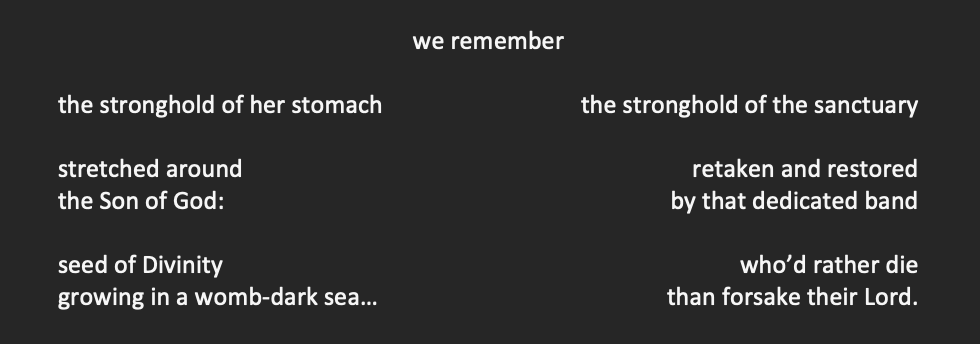
we remember

A:
the stronghold of her stomach

stretched around
the Son of God:

seed of Divinity
growing in a womb-dark sea…

H:
the stronghold of the sanctuary
retaken and restored

by that dedicated band who’d rather die
than forsake their Lord.

B:
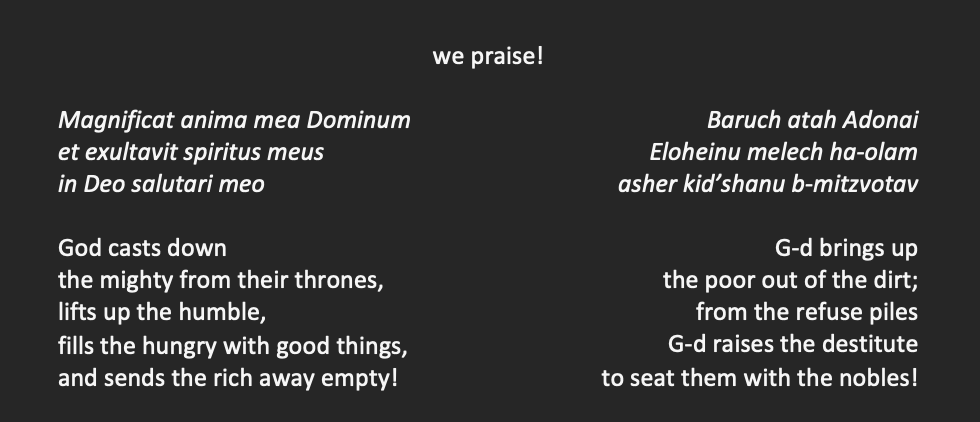
we praise!

A:
Magnificat anima mea Dominum
et exultavit spiritus meus
in Deo salutari meo

God casts down
the mighty from their thrones,
lifts up the humble,
fills the hungry with good things,
and sends the rich away empty!

H:
Baruch atah Adonai
Eloheinu melech ha-olam
asher kid’shanu b-mitzvotav

G-d brings up the poor out of the dirt;
from the refuse piles
G-d raises the destitute
to seat them with the nobles!

B:
we await

A:
the Kin-dom of God —
the world made whole!
a table set for all!

H:
tikkun olam —
the righting of the world!
and we must play our role.

B:
we join
we wait
we eat
we praise

H:
and the candlelight

A:
and the candlelight

B:
and the candlelight extends
a hand to shadow —
scoops her up into a flickering dance
across the walls

H:
across the pains

A:
across our upturned faces

B:
and singing fills the darkness round and full
and rises to the One who blesses
all