Categories
Current Events / Activism Holy Days lent Other search markers

Gaza’s Gethsemane

Today is Maundy Thursday, when Christians remember Jesus’s Last Supper, his final meal with his closest friends before his arrest and execution by the Roman Empire.
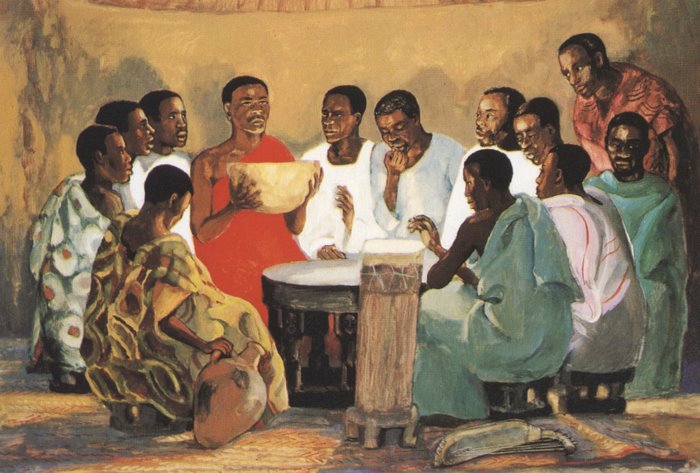
Painting of the last supper in which Jesus and his disciples all have deep brown skin; they gather around a low table as Jesus raises up a large bowl. They look solemn.
The Lord’s Supper,” from the JESUS MAFA project of Cameroon

Meanwhile, right now, in Jesus’ own homeland, millions suffer starvation and terror, displacement and death under Western-funded Israeli colonialism and continued military assault. Israel blocks food from reaching them, leaving Palestinians in fear that any “supper” they can scrounge up might be their last.
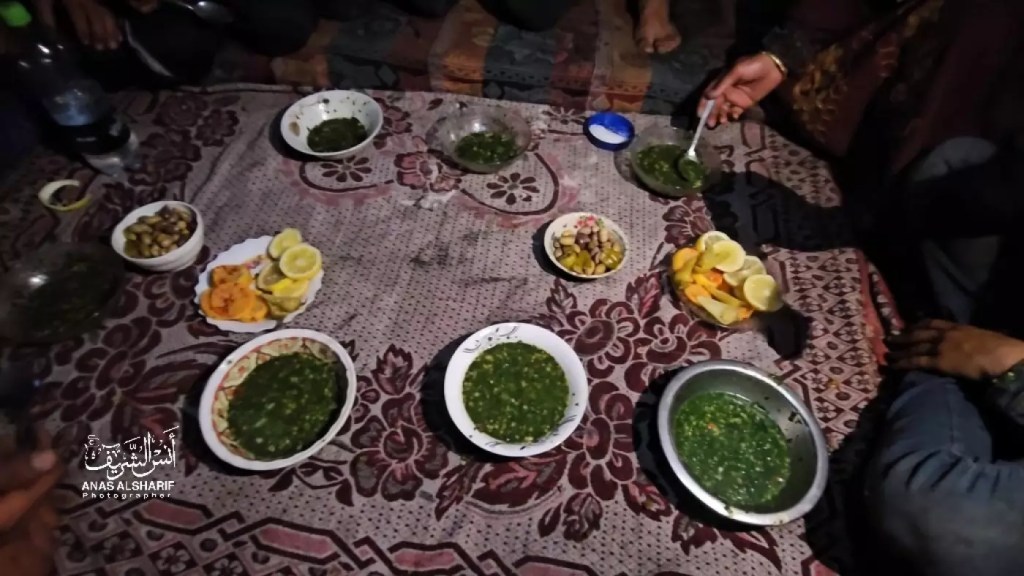
A tablecloth is spread with bowls of soupy grass and a few plates of lemon slices
A Palestinian Muslim family’s fast-breaking meal: grass soup with some lemon.

After their meal, Jesus led his friends into the Garden of Gethsemane, where he prayed in anguish, fearing all he was about to endure: criminalization, torture, and a painful public death.

Jesus prays on the ground, looking agonized and raising his hands towards the dark sky, as three figures sleep in the background.
Gethsemane – Matthew 26:36-46

Jesus begs his friends to “stay awake” as he wrestles — just to be present, to make him feel a little less alone. How do we respond to Jesus’ plea by “staying awake” to Palestine’s current agony?
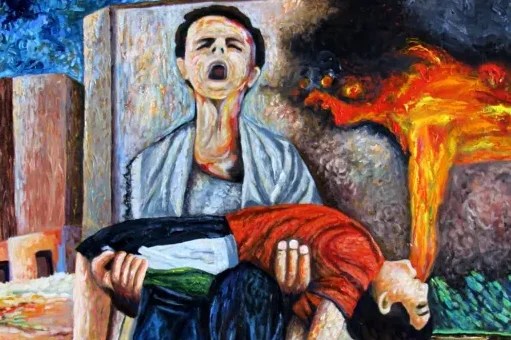
A painting of a young person, maybe a teen, mouth open in grief as he kneels and holds a child's body in his arms. Buildings on fire form the backdrop. The boy's clothes are in the colors of the Palestinian flag.
Detail from “Cry” (2016) by Mohammed Almadhoun.

That question also leads me to ponder another: how does God join Palestinians in their agony? Where is God in their suffering?

Palestinian Christian Mitri Raheb seeks to answer this question of where God is in his 2015 book Faith in the Face of Empire.
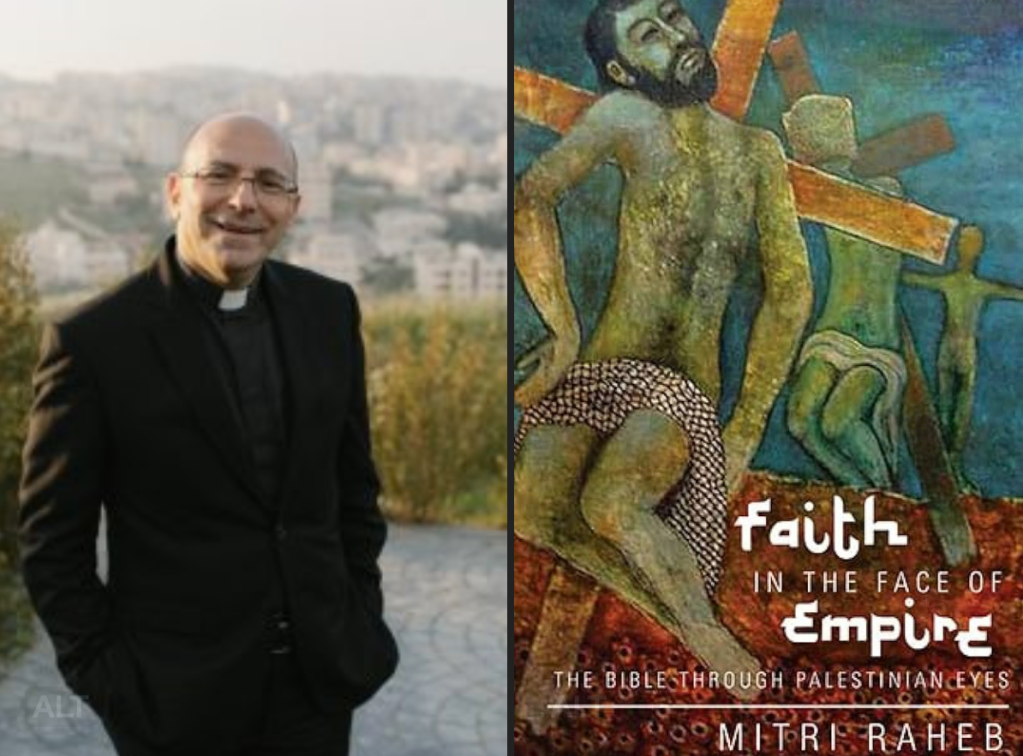
Photo of Mitri Raheb wearing clerical black with the white clerical collar, standing outside and smiling at the viewer. Cover of Faith in the Face of Empire, which features a painting of Christ on the cross with two other crucified behind him.

Raheb looks at the history of the Palestinian region, from ancient times to today, as a long chain of different empires — from the Assyrians to the Romans, Ottomans to Western-funded modern Israel.

He says that this long history of occupation is what gave Palestinians the ability to notice God where those in power do not: among the powerless. It is this revelation, Raheb declares, that has empowered Palestinians — Jewish, Christian, and Muslim — to survive and resist Empire again and again.

Raheb writes about how in ancient times, the divine was made

“…visible and omnipresent in the empire with shrines and temples that represented not only his glory but also that of the empire. God’s omnipotence and that of the empire were almost interchangeable. He was a victorious God, a fitting deity for a victorious empire.

At the other end of the spectrum there was the God of the people of Palestine, whose tiny territory resembled a corridor in Middle Eastern geography. …This God was a loser. He lost almost all wars, and his people were forced to pay the price of those defeats. In short, this God did not appear to be up to the challenge of the various empires. His people in Palestine were forced to hear the mocking voices of their neighbors who taunted them, ‘Where is your God?’ (Ps 42: 3, 10).

The revelation the people of Palestine received was the ability to spot God where no one else was able to see him. When his people were driven as slaves into Babylon, they witnessed him accompanying them. When his capital, Jerusalem, was destroyed and his temple plundered, they saw him there. When his people were defeated, he was also present. The salient feature of this God was that he didn’t run away when his people faced their destiny but remained with them, showing solidarity and choosing to share their destiny.

Consequently and ultimately, Jesus revealed this God on the cross, in a situation of terrible agony and pain, when he was brutally crushed by the empire and hung like a rebellious freedom fighter. The people of Palestine could then say with great certainty [that their God] ‘in every respect has been tested as we are’ (Heb 4:15).

For the people of Palestine this meant that defeat in the face of the empire was not an ultimate defeat. It meant that after the country was devastated by the Babylonians, when everything seemed to be lost, a new beginning was possible. Even when the dwelling place of God was destroyed, God survived that destruction, developing in response a dwelling that was indestructible. And when Jesus cried on the cross, “My God, my God, why have you forsaken me?” (Mk 15:34), that soul-rending plea was just the prelude to the resurrection…”

It is this revelation that God sides against empire, Raheb continues, that keeps the Palestinian spirit alive through horrible oppression. Though the world may call such faith foolish — how can you believe God is with you and that God will have the final say, when all evidence points to your abandonment and defeat? — it is wisdom to the oppressed. Raheb describes how this wisdom feeds Palestinian resistance, over and over across the millennia:

“The art of survival and starting anew is a highly developed form of expression in Palestine, and one I see daily. People’s lives, businesses, and education are interrupted by wars and the aftermath of wars over and over again, and yet I witness people refusing to give up, taking a deep breath, and beginning again. Logically, it is foolish, and yet there is deep wisdom in such a course of action.

I’m often asked by visitors how I can keep going. Everything seems to be lost, the land “settled” by Israel, the wall suffocating Palestinian land and spirit, the world silent, and hope almost gone.”

Raheb’s answer to them is that God’s presence in and among the suffering, and God’s promised resurrection, of renewal in the face of all terror and death, is what keeps him and his people going.

As we enter into these final days of Lent, I pray for hearts and minds opened to witnessing God’s solidarity with and resurrection for Palestinians suffering imperial brutality. I pray that the Palestinians will survive as they always have — “afflicted in every way, but not crushed; perplexed, but not driven to despair; persecuted, but not forsaken; struck down, but not destroyed” (2 Cor 4:8–9).

Categories
Confession and Pardon Holy Days lent Liturgy My poetry Reflections for worship services

Combatting Antisemitism on Good Friday: An Alternative to the “Solemn Reproaches of the Cross”

Oh my church, my hands and feet on earth,
why do you not heed me on the cross?
Answer me!

From the moment I shaped humanity from the mud
and gifted you with my own Breath
I delighted in you, and called you good,

invited you to serve my diverse Creation,
promising that as long as you cared for it,
it would care for you  –

yet you trample my good works under your feet!
You consume and consume and consume beyond your need
even while many of your siblings starve.

In sentencing your siblings and the land
to a torturous death,
you sentence me.

Holy God,
we have no defense.

Holy God,
do what you deem just.

Holy God,
redeem and renew us!

Oh my church, my hands and feet on earth,
why do you not heed me on the cross?
Answer me!

I chose the children of Israel as my own
not despite but because Jacob dared to wrestle me;
I chose the enslaved Hebrews as my own
not despite but because of their littleness,
the way their neighbors sought to dominate or destroy them.

My covenant with them is eternal;
My Torah instructs them well on how to love me
by loving the stranger, the Other, the defenseless –

Yet you claim your relationship with me negates theirs!

You call their testament “old,”
and claim the God you find there
is bloodthirsty, barbaric, not the same God;

Across the centuries you have listened to the story
of how I was charged by Roman powers with sedition,
died on a Roman cross –
and then went out and blamed “the Jews” for my death!

You have coerced conversion,
enacted or enabled hate crimes against them;
you have shunned and slandered them
when you ought to have
embraced them as your kin!

When you reject and persecute my Jewish people,
truly, truly you reject and persecute me.

Holy God,
we have no defense.

Holy God,
do what you deem just.

Holy God,
redeem and renew us!

Oh my church, my hands and feet on earth,
why do you not heed me on the cross?
Answer me!

I so loved you, I wrapped my divinity in frail flesh
so I could share with you
both joy and pain, feast and famine, friendship and loss;

I so loved you, I accepted Rome’s cross
to show my solidarity with all
whom worldly powers crush —

But still you idolize the very forces
that brutalized my body unto death!

When you regard a flag above a life
and let your siblings perish
on the other side of a border you invented;

when you wage war against Black and Indigenous peoples
or look away as they are killed
you also kill me.

Holy God,
we have no defense.

Holy God,
do what you deem just.

Holy God,
redeem and renew us!

Oh my church, my hands and feet on earth,
why do you not heed me on the cross?
Answer me!

Why do you not help me when I cry out
in thirst and hunger, or nakedness?
Why do you not welcome me when I come to you as a stranger?
Where are you when I am sick, but can’t afford care?
Where are you when I am abused or contracting COVID in prison?

Oh, my church! when will you truly become
my hands and feet on earth?
Answer, answer me!

Holy God,
we have no defense.

Holy God,
do what you deem just.

Holy God,
redeem and renew us
and we will be your hands and feet.

We will care for your Creation
and show gratitude for its care of us.

We will respect your Jewish people,
repenting of and uprooting our antisemitism;
we will learn to recognize your face
among persons of all faiths.

We will care for the most oppressed among us,
joining in solidarity with Black, Indigenous people of color,
with the LGBTQA+ community,
with the disability community, and all the disenfranchised,

uplifting their voices
and making good trouble
until the needs of all are met.

Truly, then, you will be my church
and I will give you strength, 
and you shall journey in the name of
God Who Draws All Peoples To Themself. 


You can hear me read this piece and explain it in other words in episode 39 of my podcast – find links here.

I wrote this piece to be used as an alternative in churches that on Good Friday traditionally read the Improperia, the “Solemn Reproaches of the Cross, the original version of which you can read here. My intention is to encourage Christians to examine our antisemitism during this week, rather than fueling it with language that blames the Jewish people past and present for Jesus’s death.

Holy Week has long been a dangerous time of the year for Jewish persons (See this article for the history of antisemitic hate crimes on Good Friday in medieval Europe; and this article arguing that “Centuries of Christian Antisemitism Led to the Holocaust“). The scriptures and liturgy that we choose to read in our churches during this time fuels that antisemitism not only this week, but the whole year round. 

As Jewish woman and New Testament professor Amy-Jill Levine writes in this article,

“Jesus of Nazareth, charged by the Roman authorities with sedition, dies on a Roman cross. But Jews ― the collective, all Jews ― become known as “Christ-killers.” Still haunting, the legacy of that charge becomes acute during Holy Week, when pastors and priests who speak about the death of Jesus have to talk about “the Jews.” Every year, the same difficulty surfaces: how can a gospel of love be proclaimed, if that same gospel is heard to promote hatred of Jesus’s own people?”

Among the most poisonous of liturgy read by many churches across the centuries is the “Reproaches.” As Elizabeth Palmer explains in her 2020 article “Thinking about Good Friday during a Pandemic,”

In the Solemn Reproaches, Jesus addresses people who have harmed him — and the text has a long history of stirring up violence against Jewish people. Many times over the centuries, in many places, Christians bowed before the cross on Good Friday and heard or sang some version of these words: “I led thee through the wilderness 40 years, fed thee with manna, and brought thee into a land exceeding good, and thou hast prepared a cross for thy Savior.” Then they’d leave the church, form a mob, and attack Jewish communities.

The “Reproaches” are coated in the blood of our Jewish neighbors. They should not be read or sung in our worship — but neither should they be hidden away outside of worship. We can’t pretend this text does not exist. We must grapple with it, guide congregations in understanding why it is so evil, and in doing so move towards acknowledging and dealing with our antisemitism, past and present.

My hope is that this alternative text, which includes a well-earned reproach for our antisemitism with examples of what that antisemitism looks like in our churches today, can be a jumping off point for conversations on this topic.

For more on antisemitism during Holy Week and what to do about it, I highly recommend Levine’s article ““Holy Week and the hatred of the Jews: How to avoid anti-Judaism this Easter.” In this article, Levine describes how the anti-Jewish language got into the Gospels to begin with; how interfaith conversations today help stem the tide of antisemitism; and explores and ranks the 6 strategies Levine has seen people use when trying to resolve these problems with the New Testament.

From least useful to most useful, she names these strategies as excision (just removing the problematic stuff and pretending it was never there); retranslation (changing up the way we translate problematic texts, such as changing “the Jews” to “Judeans”); romanticizing (this includes Christians holding their own Passover seders – read this part of the article to see why we should Not Do That); allegorizing; historicizing; and, best of all, just admitting the problem:

We come finally to our sixth option: admit to the problem and deal with it. There are many ways congregations can address the difficult texts. Put a note in service bulletins to explain the harm the texts have caused. Read the problematic texts silently, or in a whisper. Have Jews today give testimony about how they have been hurt by the texts.

Those who proclaim the problematic verses from the pulpit might imagine a Jewish child sitting in the front pew and take heed: don’t say anything that would hurt this child, and don’t say anything that would cause a member of the congregation to hurt this child.

Better still: educate the next generation, so that when they hear the problematic words proclaimed, they have multiple contexts – theological, historical, ethical – by which to understand them.

Christians, hearing the Gospels during Holy Week, should no more hear a message of hatred of Jews than Jews, reading the Book of Esther on Purim, should hate Persians, or celebrating the seder and reliving the time when “we were slaves in Egypt,” should hate Egyptians.

We choose how to read. After two thousand years of enmity, Jews and Christians today can recover and even celebrate our common past, locate Jesus and his earliest followers within rather than over and against Judaism, and live into the time when, as both synagogue and church proclaim, we can love G-d and our neighbour.’

For more resources for dealing with antisemitism within our Christian communities, see below.


RESOURCES:

First, let’s get educated on the basic facts about antisemitism in Holy Week’s typical scriptures, and alternatives to concluding that “the Jews killed Jesus”:

Next, let’s reimagine the stories we read during Holy Week in ways that don’t do harm to our Jewish neighbors!

  • I most highly recommend Jewish scholar Amy-Jill Levine’s book Entering the Passion of Jesus: A Beginner’s Guide to Holy Week.
  • Get a summary of and link to a pdf of her chapter on Palm Sunday and the “cleansing of the temple” (Jesus flipping tables) here
  • And if reading a whole book isn’t your thing, Levine also has a video series where she talks about the Passion story – here’s the first video, just 9 minutes long
  • And here’s an article interviewing Levine that sums up the purpose of her work with the Christian Gospels – “A number of Christian commentators feel the need to make Judaism look bad in order to make Jesus look good. Instead of portraying Jesus as a Jew talking to other Jews, he becomes in their views the first Christian, the one who invented divine grace, mercy, and love, and all that other good stuff. Such views neglect the presence of these same virtues within Jesus’ own Jewish context. There should be no reason this Jewish Jesus is used to promote anti-Judaism.”

Categories
Holy Days lent LGBT/queer My poetry

poem for Holy Thursday: Jesus, you knew isolation too

Jesus
you knew
isolation too.

not of closing walls and stale air
but of a horizon unreachable
beyond stretching dunes.

you who were so sensitive to touch
you’d notice a woman’s fingers barely brush
the hem of your cloak

went untouched
for forty days
forty nights.

after that
did cradling the feet of your closest friends
washing clean the sweat and sand
etched into the sole’s every callus
feel almost too intimate to bear?

gazing up into their questioning eyes
after no one but devils and dust to talk to for so long
did you have to stop and catch your breath?

Jesus,
did your beloved’s fingers brushing your palm
as you passed him broken bread
set your skin on fire
with an anguished sort of pleasure?

was his head resting warm in your lap
after the meal, the wine, the storytelling
heavier than the whole world
leaning on your back?

and after the wine-warm room
after isolation revisited
in a tear-soaked garden
where best friends slept oblivious
i wonder

were even the press of trembling lips
the hands that bound your wrists
the shoves of soldiers eager to get home for the night –
even these, were even these cherished
after weeks without the warmth of others’ skin?

…….

Jesus
you knew
isolation too –

know better than any
the devils that come to keep one company
when wandering alone from room to room
or over wasteland sands…

so come. teach us
to make an upper room
of any room we’re trapped in.

cook us a meal out of our distress
and break it like bread with us.
nourish our bone-deep loneliness
into a yearning deep enough to drink

so that when this is over, we never again
shirk the feet that await our washing
shun the hands outstretched for bread to share
shake off the cross a stranger needs help bearing –

and Jesus, as we wait out isolation
in temporary helplessness and fear
remind us there are some who dwell
always, always here.


If you this piece it in your own service, please credit it to Avery Arden and link to binarybreakingworship.com. I also invite you to email me at queerlychristian36@gmail.com to let me know you’re using it!

About this poem:

My prayer for Maundy Thursday, 2020, in the midst of pandemic: come, Jesus, teach us to make an upper room of any room we’re trapped in.

Categories
Holy Days My poetry

poem for Good Friday: Jesus, let me pray for you

my God,
would it be odd
if i prayed for you?

Jesus, heart of my heart,
heart of all the cosmos – your heart
struggled –
             stammered –
                                      stopped.

thank you.

(i am
so sorry.)

thank you.

when you walked the earth you lived to liberate,
to serve, to ease, to lead towards flourishing:

you broke down and sobbed
when those you loved were crying,
extended your hands to those
desperate for human touch,
invited the high-up
to come down and dine
with the ones you’d raised from the dirt –

and still, today, right now,
your very Breath rushes down
to comfort, to stir up, to galvanize:

unfurls Herself in hospital rooms
where breaths come labored – slow – and
stop;

gusts through grocery stores, buoys up
the worker with the fearful mind
and aching feet;

sweeps through power’s halls
upturning spreadsheets,
tugging at shirtsleeves.

but
just for today
the day you died

please

let me
pray for you

let me cry out with you
the cry ripped from your chest
as the cross claimed your breath,
dripped out your lifeblood,
throttled your lungs’ rising

My God! My God!…

Jesus, heart of my heart,
heart of all the cosmos!

will you take a little rest
in these hours your heart was stopped?

let us attend to the aching world
for just this little while.

how urgently i wish
i could stop your pain

pull out the nails my kin drove in-
to your skin and sinew

staunch the whole world’s bleeding
while you sleep the deep,
dreamless sleep of the tomb…

if i cannot do any of that,
then let me do this:

you who ache
with every broken heart,
who bruise alongside
every trampled body,

today
let me ache with you.


If you use this piece, please credit it to Avery Arden and link this website. I also invite you to email me at queerlychristian36@gmail.com to let me know how you’re using it!

About this poem:

This was my prayer for Good Friday, 2020: Jesus, every day of the year, every instant of eternity, you care for the oppressed, the sick, the despairing. You suffer alongside us. For just this day, let us suffer with you.

Categories
Holy Days LGBT/queer Liturgy My poetry Reflections for worship services

A queer reflection on the Agony in the Garden – Holy Thursday / Maundy Thursday

Tonight we follow Jesus to the Garden of Gethsemane. 

As we kneel with him in the dark, see his hands clenched in prayer,
the blood on his brow, in his tears,
as we hear the cry wrench out of him, “Take this cup away from me!” 

…we hear also the cry of so many of our siblings.

“I cannot bear this part of myself, O God. Why are you calling me to this? Why did you make me to be this way, when all it has done for me is cause loved ones to abandon me? Take this cup away. Please take this cup away.”

Let us not be like the disciples who slept,
ignorant of Jesus’s agony.

Let us not be like them when they fled the scene
leaving him to the ones who chained him and dragged him away.

O God, set our hearts on fire with a fierce compassion for your oppressed children, so that we cannot sleep when they cry out. 

We go to them. We stay awake with them. We. stay.

We remember the one who broke bread and called it his body,
who knelt to wash our feet.
We remember the one who commanded us to love in such a way –
to serve and be served.

Let us go now into a world full of cries,
all anxiously awaiting a day that seems far off, a dawn past all suffering
when we will rise transformed,
when relationships will be reconciled
and all will know God’s love. 

In the meantime – this time of anxious waiting – we leave no one alone in their agony. We cry out with them.
We stay awake with them.
We stay.