Categories
Current Events / Activism Holy Days lent Other search markers

Gaza’s Gethsemane

Today is Maundy Thursday, when Christians remember Jesus’s Last Supper, his final meal with his closest friends before his arrest and execution by the Roman Empire.
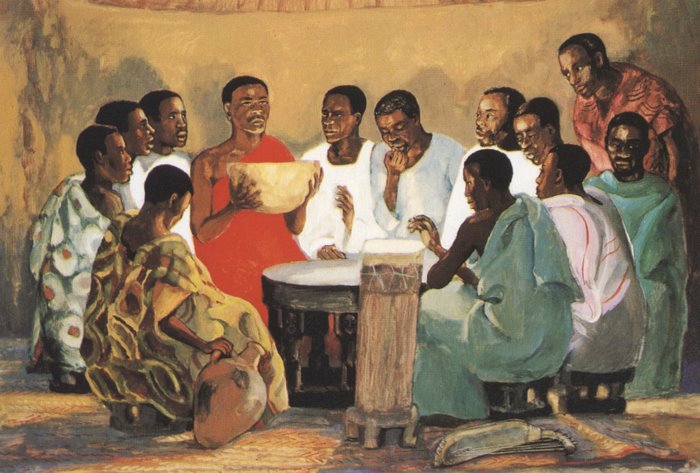
Painting of the last supper in which Jesus and his disciples all have deep brown skin; they gather around a low table as Jesus raises up a large bowl. They look solemn.
The Lord’s Supper,” from the JESUS MAFA project of Cameroon

Meanwhile, right now, in Jesus’ own homeland, millions suffer starvation and terror, displacement and death under Western-funded Israeli colonialism and continued military assault. Israel blocks food from reaching them, leaving Palestinians in fear that any “supper” they can scrounge up might be their last.
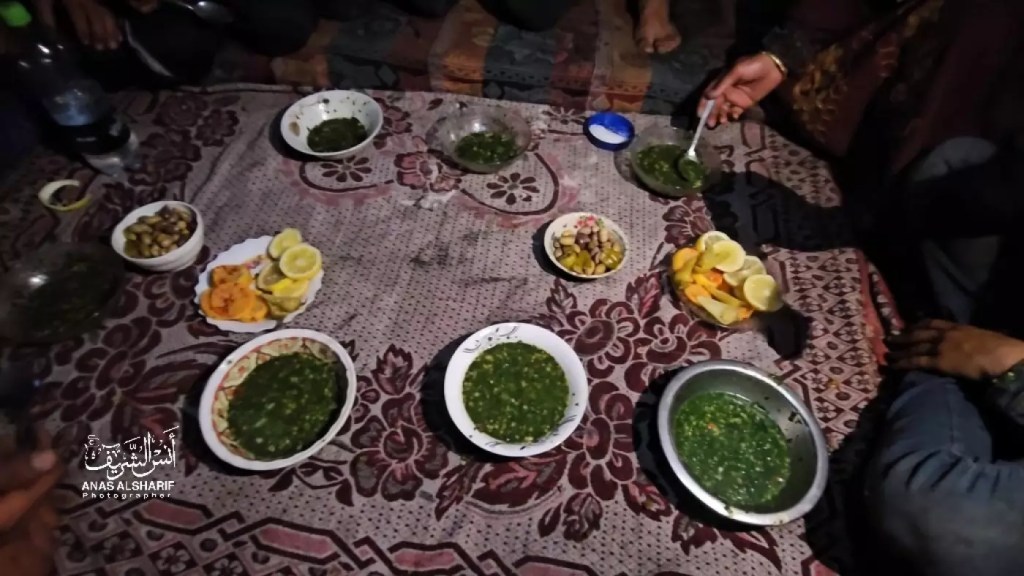
A tablecloth is spread with bowls of soupy grass and a few plates of lemon slices
A Palestinian Muslim family’s fast-breaking meal: grass soup with some lemon.

After their meal, Jesus led his friends into the Garden of Gethsemane, where he prayed in anguish, fearing all he was about to endure: criminalization, torture, and a painful public death.

Jesus prays on the ground, looking agonized and raising his hands towards the dark sky, as three figures sleep in the background.
Gethsemane – Matthew 26:36-46

Jesus begs his friends to “stay awake” as he wrestles — just to be present, to make him feel a little less alone. How do we respond to Jesus’ plea by “staying awake” to Palestine’s current agony?
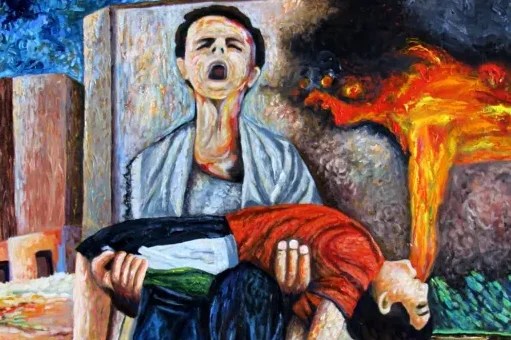
A painting of a young person, maybe a teen, mouth open in grief as he kneels and holds a child's body in his arms. Buildings on fire form the backdrop. The boy's clothes are in the colors of the Palestinian flag.
Detail from “Cry” (2016) by Mohammed Almadhoun.

That question also leads me to ponder another: how does God join Palestinians in their agony? Where is God in their suffering?

Palestinian Christian Mitri Raheb seeks to answer this question of where God is in his 2015 book Faith in the Face of Empire.
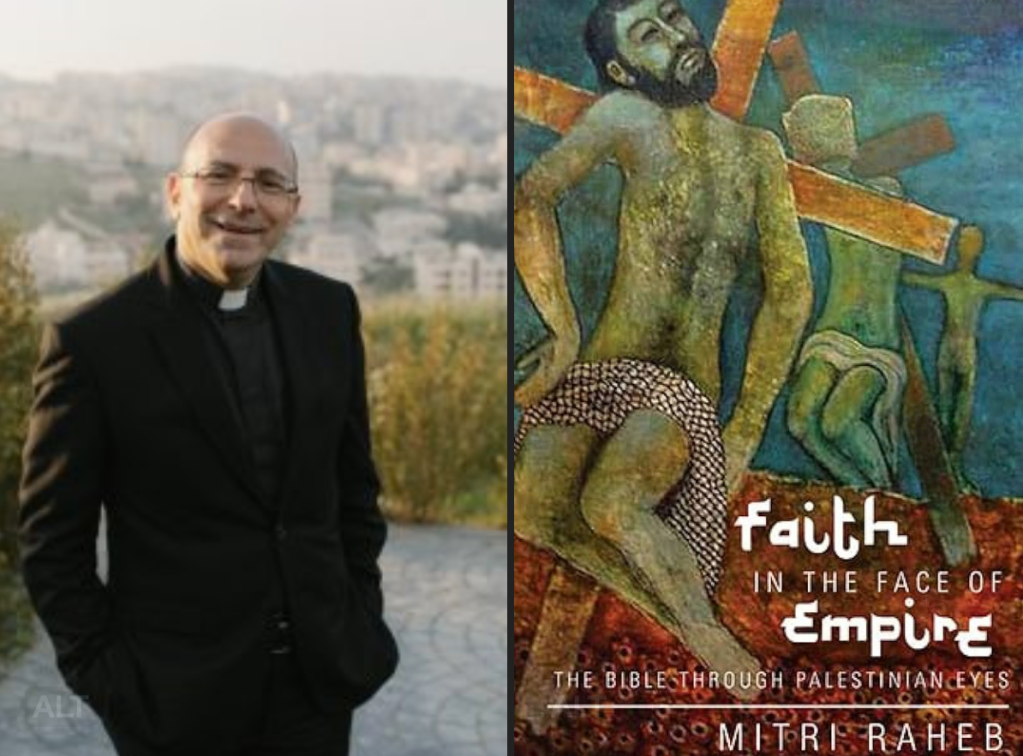
Photo of Mitri Raheb wearing clerical black with the white clerical collar, standing outside and smiling at the viewer. Cover of Faith in the Face of Empire, which features a painting of Christ on the cross with two other crucified behind him.

Raheb looks at the history of the Palestinian region, from ancient times to today, as a long chain of different empires — from the Assyrians to the Romans, Ottomans to Western-funded modern Israel.

He says that this long history of occupation is what gave Palestinians the ability to notice God where those in power do not: among the powerless. It is this revelation, Raheb declares, that has empowered Palestinians — Jewish, Christian, and Muslim — to survive and resist Empire again and again.

Raheb writes about how in ancient times, the divine was made

“…visible and omnipresent in the empire with shrines and temples that represented not only his glory but also that of the empire. God’s omnipotence and that of the empire were almost interchangeable. He was a victorious God, a fitting deity for a victorious empire.

At the other end of the spectrum there was the God of the people of Palestine, whose tiny territory resembled a corridor in Middle Eastern geography. …This God was a loser. He lost almost all wars, and his people were forced to pay the price of those defeats. In short, this God did not appear to be up to the challenge of the various empires. His people in Palestine were forced to hear the mocking voices of their neighbors who taunted them, ‘Where is your God?’ (Ps 42: 3, 10).

The revelation the people of Palestine received was the ability to spot God where no one else was able to see him. When his people were driven as slaves into Babylon, they witnessed him accompanying them. When his capital, Jerusalem, was destroyed and his temple plundered, they saw him there. When his people were defeated, he was also present. The salient feature of this God was that he didn’t run away when his people faced their destiny but remained with them, showing solidarity and choosing to share their destiny.

Consequently and ultimately, Jesus revealed this God on the cross, in a situation of terrible agony and pain, when he was brutally crushed by the empire and hung like a rebellious freedom fighter. The people of Palestine could then say with great certainty [that their God] ‘in every respect has been tested as we are’ (Heb 4:15).

For the people of Palestine this meant that defeat in the face of the empire was not an ultimate defeat. It meant that after the country was devastated by the Babylonians, when everything seemed to be lost, a new beginning was possible. Even when the dwelling place of God was destroyed, God survived that destruction, developing in response a dwelling that was indestructible. And when Jesus cried on the cross, “My God, my God, why have you forsaken me?” (Mk 15:34), that soul-rending plea was just the prelude to the resurrection…”

It is this revelation that God sides against empire, Raheb continues, that keeps the Palestinian spirit alive through horrible oppression. Though the world may call such faith foolish — how can you believe God is with you and that God will have the final say, when all evidence points to your abandonment and defeat? — it is wisdom to the oppressed. Raheb describes how this wisdom feeds Palestinian resistance, over and over across the millennia:

“The art of survival and starting anew is a highly developed form of expression in Palestine, and one I see daily. People’s lives, businesses, and education are interrupted by wars and the aftermath of wars over and over again, and yet I witness people refusing to give up, taking a deep breath, and beginning again. Logically, it is foolish, and yet there is deep wisdom in such a course of action.

I’m often asked by visitors how I can keep going. Everything seems to be lost, the land “settled” by Israel, the wall suffocating Palestinian land and spirit, the world silent, and hope almost gone.”

Raheb’s answer to them is that God’s presence in and among the suffering, and God’s promised resurrection, of renewal in the face of all terror and death, is what keeps him and his people going.

As we enter into these final days of Lent, I pray for hearts and minds opened to witnessing God’s solidarity with and resurrection for Palestinians suffering imperial brutality. I pray that the Palestinians will survive as they always have — “afflicted in every way, but not crushed; perplexed, but not driven to despair; persecuted, but not forsaken; struck down, but not destroyed” (2 Cor 4:8–9).

Categories
Holy Days lent LGBT/queer My poetry

poem for Holy Thursday: Jesus, you knew isolation too

Jesus
you knew
isolation too.

not of closing walls and stale air
but of a horizon unreachable
beyond stretching dunes.

you who were so sensitive to touch
you’d notice a woman’s fingers barely brush
the hem of your cloak

went untouched
for forty days
forty nights.

after that
did cradling the feet of your closest friends
washing clean the sweat and sand
etched into the sole’s every callus
feel almost too intimate to bear?

gazing up into their questioning eyes
after no one but devils and dust to talk to for so long
did you have to stop and catch your breath?

Jesus,
did your beloved’s fingers brushing your palm
as you passed him broken bread
set your skin on fire
with an anguished sort of pleasure?

was his head resting warm in your lap
after the meal, the wine, the storytelling
heavier than the whole world
leaning on your back?

and after the wine-warm room
after isolation revisited
in a tear-soaked garden
where best friends slept oblivious
i wonder

were even the press of trembling lips
the hands that bound your wrists
the shoves of soldiers eager to get home for the night –
even these, were even these cherished
after weeks without the warmth of others’ skin?

…….

Jesus
you knew
isolation too –

know better than any
the devils that come to keep one company
when wandering alone from room to room
or over wasteland sands…

so come. teach us
to make an upper room
of any room we’re trapped in.

cook us a meal out of our distress
and break it like bread with us.
nourish our bone-deep loneliness
into a yearning deep enough to drink

so that when this is over, we never again
shirk the feet that await our washing
shun the hands outstretched for bread to share
shake off the cross a stranger needs help bearing –

and Jesus, as we wait out isolation
in temporary helplessness and fear
remind us there are some who dwell
always, always here.


If you this piece it in your own service, please credit it to Avery Arden and link to binarybreakingworship.com. I also invite you to email me at queerlychristian36@gmail.com to let me know you’re using it!

About this poem:

My prayer for Maundy Thursday, 2020, in the midst of pandemic: come, Jesus, teach us to make an upper room of any room we’re trapped in.

Categories
Holy Days LGBT/queer Liturgy My poetry Reflections for worship services

A queer reflection on the Agony in the Garden – Holy Thursday / Maundy Thursday

Tonight we follow Jesus to the Garden of Gethsemane. 

As we kneel with him in the dark, see his hands clenched in prayer,
the blood on his brow, in his tears,
as we hear the cry wrench out of him, “Take this cup away from me!” 

…we hear also the cry of so many of our siblings.

“I cannot bear this part of myself, O God. Why are you calling me to this? Why did you make me to be this way, when all it has done for me is cause loved ones to abandon me? Take this cup away. Please take this cup away.”

Let us not be like the disciples who slept,
ignorant of Jesus’s agony.

Let us not be like them when they fled the scene
leaving him to the ones who chained him and dragged him away.

O God, set our hearts on fire with a fierce compassion for your oppressed children, so that we cannot sleep when they cry out. 

We go to them. We stay awake with them. We. stay.

We remember the one who broke bread and called it his body,
who knelt to wash our feet.
We remember the one who commanded us to love in such a way –
to serve and be served.

Let us go now into a world full of cries,
all anxiously awaiting a day that seems far off, a dawn past all suffering
when we will rise transformed,
when relationships will be reconciled
and all will know God’s love. 

In the meantime – this time of anxious waiting – we leave no one alone in their agony. We cry out with them.
We stay awake with them.
We stay.

Categories
Holy Days LGBT/queer Liturgy My poetry Reflections for worship services

A queer prayer for foot washing – Maundy Thursday / Holy Thursday

Jesus,

I do not know if I could let you, my God,
my Savior, to whom I owe all things
kneel below me
and take into your warm brown hands
my feet, dirty and cold.

I also do not know if I could take
the feet of my betrayers, my deniers –

those who declare my identity a falsehood or a phase,
those who sentence me to suffering by their hate,
those who wield you against me,
those who do not yet know all that I am, but when they do
might cease to associate themselves with me –

I don’t know if I could take their feet
in my hands, 
kneel before them in a pose of the same lowliness
they often make me feel

and wash their feet
just as you did for your friends, who would very soon abandon you.

Must I let you serve me?

And must I serve them?


…And if I do these things, will I really grow closer
to you?

to them?

Oh! You who stripped off Divinity
and took on the frail finitude of flesh…for me!
teach me this humility.

Give me the courage to ask them
if they will even let me wash their feet
and whether, maybe, they might wash mine too.

Intimacy like this is a fearful thing.

But if it truly leads to fuller life
and if you are with me,

I will take the bowl of water,
the washing rag,
and I will sit with bare feet
and I will kneel with warm hands.