Categories
advent Christmas Holy Days LGBT/queer Liturgy Other search markers

Advent/Christmas Resources

Greetings, it’s been a while and Advent is soon upon us!

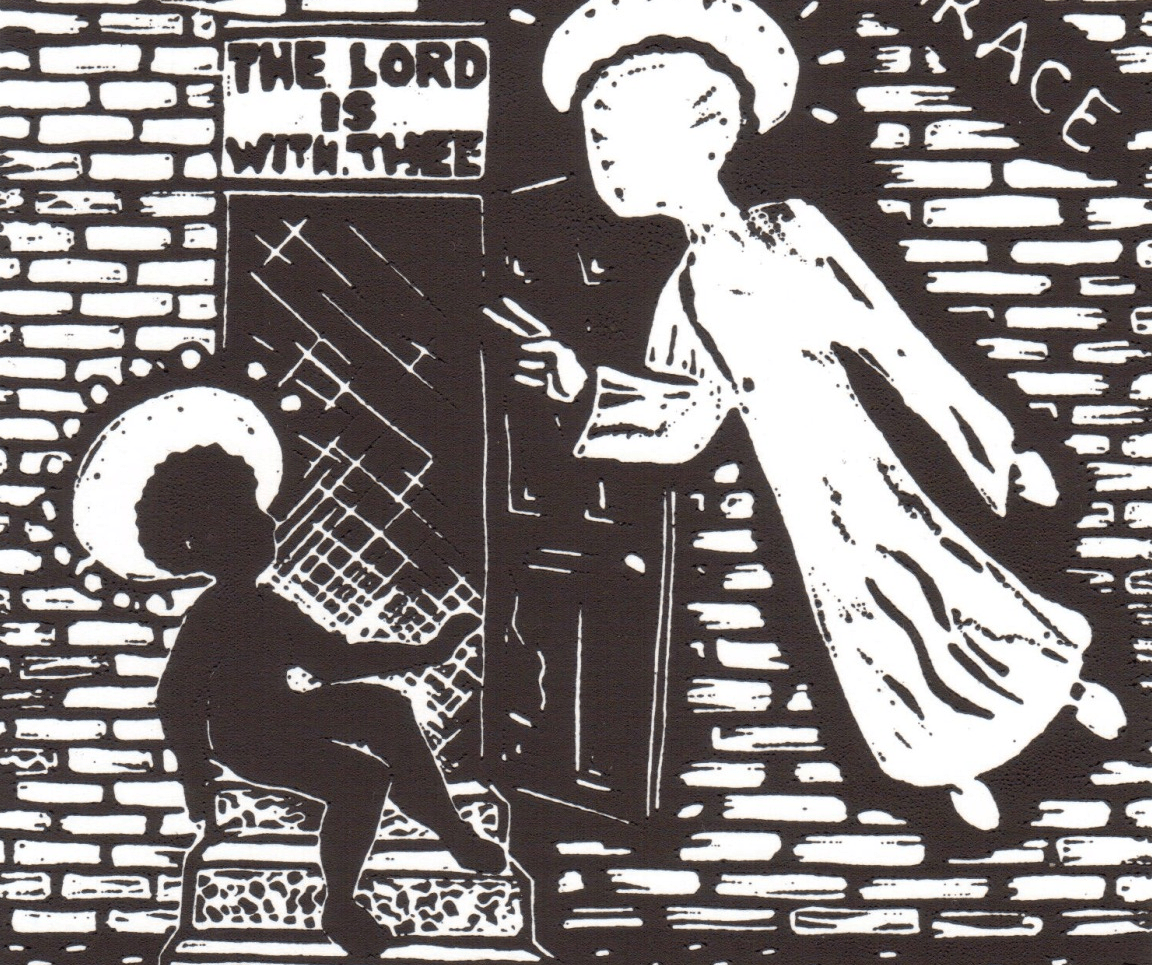
Black and white linocut of an angel appearing to Mary, who is depicted only in sillhouette but who as an afro hairstyle. She sits on a stoop outside a brick wall. Text above and below reads out the first part of the Hail Mary prayer: Hail Mary, full of grace, the Lord is with thee. Blessed art thou among women and blessed is the fruit of thy womb Jesus.
Annunciation, 2015” by Ben Wildflower

In Advent, God’s Spirit comes in dreams,
daring us to conceive of impossible things:
that wolf and lamb
might live in harmony;
that the world’s despised
might rise to greatest glory;
that war-torn wastes might bloom
and grow good fruit.
– my writing in Call to Worship 59.1

Then on to Christmas, when we celebrate how (to paraphrase Saint Athanasius) the divine became human so that humans might become divine.

At Christmas, Creation sings a new song;
God’s prophets proclaim good news:
The Word of God
has put on flesh
so that we may put on divinity.
Through Jesus, our newborn brother,
we are adopted into God’s chosen family.

– my writing in Call to Worship 59.1

In preparation for this holy time of the year, I want to share several resources created for Advent / Christmas 2025 that I had the honor of being part of.

First is More Light Presbyterians’ Advent devotional!

This resource offers a ~100 word devotion for every day of Advent. They will be posted daily on MLP’s Instagram and Facebook pages. It’ll also be published all at once in MLP’s monthly newsletter for December; sign up to receive it here.

Next, there’s Unbound’s Trans Advent/Christmas devotional!

Along with an Advent calendar that lists a trans organization or trans activist for each day of the season, Unbound’s devotional provides a reflection by a trans author for every Sunday & special day of Advent & Christmas. It’s a fantastic resource for communities or individuals who are hoping to queer up this season.

Click this readmore for a snippet of my reflection on the second Sunday of Christmas.
In the beginning, God spoke the Word; and God was the Word; and God was the breath that pushed that Word out into the void to spark life.

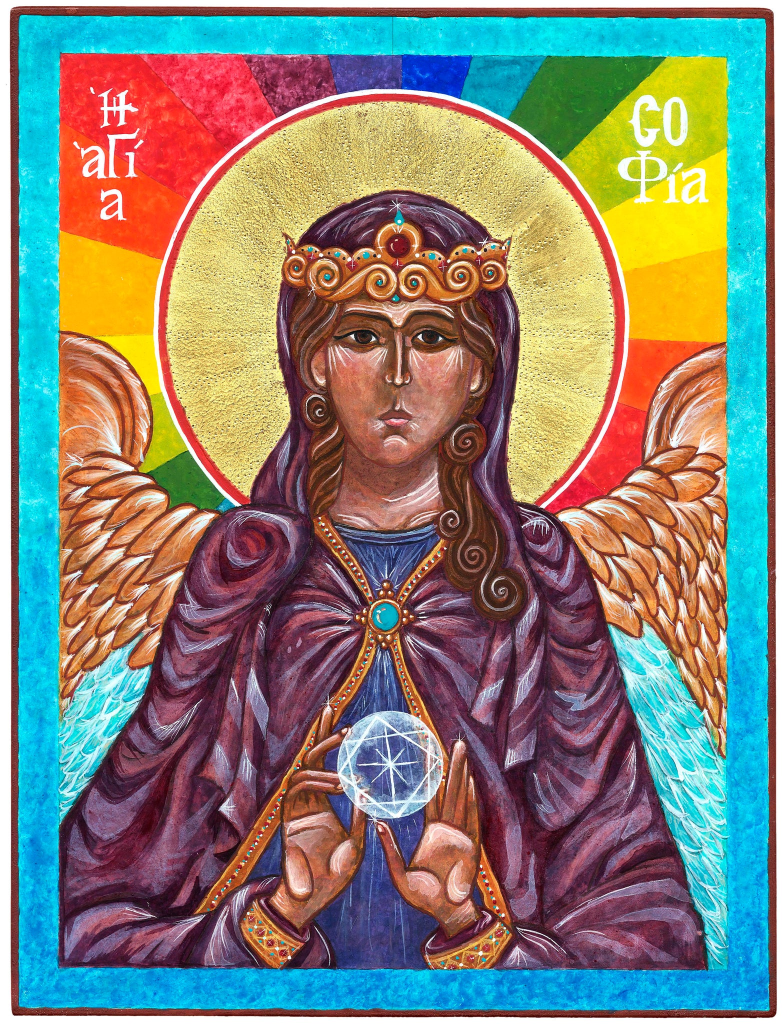
In the beginning was Wisdom, flowing forth from God’s mouth to unfurl Herself across the earth, seeking out those who’d welcome Her peculiar gifts.

Starting with Paul, who identified Christ as “the wisdom of God” (1 Cor 1:24), Christians have traditionally connected the Hebrew scriptures’ personified Wisdom — often called Sophia, the Greek word for wisdom — with Jesus. Yet while the Word took on a human body whose features led those present at Their birth to declare, “It’s a boy!”, Wisdom is described — and speaks of Herself — in feminine terms.

Sophia, Woman Wisdom, assigned male at birth! Now that’s a trans story if I ever heard one. […]

And yet…I still default to thinking of Jesus as male. Why, when many of us have expanded our language for God beyond exclusively masculine terms, does it still feel strange — even inappropriate — to speak of the Person of God who is Jesus as she or they?

…It’s the physical body, isn’t it? In many ways, Jesus is as constrained by his (/her/their/zir…) assigned gender as the rest of us.

From birth, we are bombarded by messages telling us that our flesh is our gender — that, as feminist philosopher Simone de Beauvoir put it, “biology is destiny.” From the moment the Word put on flesh, that flesh (or our assumptions about it, because the Gospels don’t actually tell us much about Jesus’s physical appearance beyond what we can deduce from his circumcision in Luke 2) sealed Their fate: Creator God can exist beyond human labels, and the Spirit is, well, Spirit; but God the Son is a human man.

But trans folk know deep in our bones that biology is not destiny. Trans wisdom cuts through the bonds of the binary’s imposed futures, freeing all of us to imagine new possibilities…and, sometimes, to remember old ones. [… read the full thing here]

Also check out Advent & Christmas liturgy in Call to Worship!

I wrote liturgy based on the Common Revised Lectionary for every Sunday and holy day of Advent 2025 and Christmas 2025/2026.

This liturgy is in many ways more “subtly queer” than Unbound’s devotional, as I wrote it to fit a broader range of contexts and church communities. However, I was delighted by the authorial freedom Call to Worship gave me; along with sticking to inclusive language for people (e.g. saying “siblings” instead of “brothers and sisters”), I was able to employ expansive language and pronouns for God! I also incorporate a lot of liberationist theology, from Ada María Isasi-Díaz’s concept of the Kin-dom of God to prayers emphasizing the goodness of embodied life.

To access all the Advent and Christmas material, you may need to subscribe to Call to Worship. If you are unable to do so, email me at queerlychristian36@gmail.com and I’ll get the material to you.

In the meantime, click this readmore for a sampling.

Fantastically scandalous God,
in being born into human life
you burst through the rigid binary between
worshiper and deity, Creator and creation.
Inspire us to proclaim your astonishing news
wherever we go — not only with words,
but through actions of justice and love.
Push us to prophecy
against hoarding and exploitation;
Empower us to rise up
with oppressed peoples everywhere;
Illuminate our path
as we tend to your poisoned planet,
so that all Creation may feel your embrace through us —
your hands, your feet, your body here on earth. Amen.

TWIBAR’s annual Christmas episode

Every Christmas, The Word in Black and Red podcast puts out an episode featuring the short reflections of largely Christian leftists; I’m one of them! Keep an eye out for the episode on the podcast feed.

digital art of a young Latino couple outside a convenient store in the rain; José is using a payphone while Maria, in a hoodie and visibly pregnant, sits on a toy horse
José y María by Everett Patterson

Other resources

I’m not part of these, but I always recommend the following resources:

  • Enfleshed – spiritual nourishment for collective liberation
  • A Sanctified Art – especially the illustrations they offer for Advent and for Christmas
  • I can’t recommend Cole Arthur Riley’s writings enough; check her out @blackliturgies on Instagram, Facebook, etc.

What about you? What are your favorite liberationist resources for Advent and Christmas?

Categories
Confession and Pardon Current Events / Activism Liturgy

Confession of Western Christian complicity in Palestine’s plight

As a church that aims to live into God’s call
to do justice, love kindness, and walk humbly,
we must acknowledge where we’ve fallen short —

particularly when it comes to the horrors
that Palestinians have faced in a Western-backed colonial project
since the British Mandate for Palestine in 1922,
into the Nakba, or great catastrophe of ethnic cleansing in 1948,

and up through the present day,
in these many months of violence escalated to genocidal levels.

If our desire for peace is true,
we will let go of any false peace
built on top of silenced voices and disenfranchised bodies.

We will cease to cry “Peace! Peace!”
at a people that has not known peace for over 100 years.

As one step towards a true peace, let us confess together the ways in which, individually and collectively, through action or inaction,
we have aided and abetted atrocities
against fellow human beings with whom we share God’s image:

We confess our compliant silence
from inside the heart of Empire.

Allowing hopelessness to collapse us into inaction,
we shrug in despair as Western powers fuel our excess
with African, Asian, Latin American, and Arab suffering,
and the stealing and stripping of Indigenous lands
all across the weeping Earth,
including in Palestine.

We confess our complicity as Christians
with our long and ongoing marriage to Empire —

our bloody past of crusades and pogroms,
missionary schools, eugenics, and all kinds of evil
wrapped in a guise of Christian “love” —
that extends into our present.

We confess our ties to Christian Zionism
begun in the nineteenth century British Empire
and continued through our “progressive” theologies of the late 1900s.

We confess the ways we reduce all Jewish people into a monolith
instead of respecting the diversity of perspectives and allegiances therein.
We confess how we treat our Jewish siblings as pawns
in our guilt and savior complexes, our various redemption myths:

We imply our faith supersedes Jews’ own on the one hand,
while on the other, we twist the very real issue of antisemitism
into a weapon to forward our colonial projects and anti-Arab racism.

When nationalism and Christian supremacy
erect murderous walls and stifle the reality
of one Beloved Community of all human beings,
Forgive us, redeemer God. Move us into honesty.

In our complicity, we confess our willful ignorance,
our failure to seek out accurate information —
allowing vital stories to be silenced
or twisted into lies.

We allow ourselves to be lulled by pretty propaganda
lifting up modern Israel as a “promised land” for Holocaust survivors,
for environmental justice and queer inclusion,
because that feels better than the truth:
survivors silenced and kept in poverty;
desert biomes forced into European molds,
ancient olive trees obliterated,
and the searing truth that no place that enables racism and apartheid
can ever be a queer friendly or environmental paradise.

When fear or uncertainty keeps us from speaking up;
When we choose our own comfort over courageous conversations,
Forgive us, redeeming God. Move us into courage.

Finally, we confess a collective failure of imagination.

We have fallen for the lies that this conflict
is too complicated to resolve,
that justice is impossible,
that hope is dead —
instead of listening for Spirit’s wisdom
and noticing God’s inbreaking Kin-dom
in the vision and voice of Palestinians
who have never given up on justice,
on believing in peace,
on believing in a multicultural, interfaith future for the land.

Forgive us, redeemer God.
Move us to seek, center, and celebrate
Palestinian visions of justice and peace.

In repentance and hope,
we pray to the God of both Sarah and Hagar, both Isaac and Ishmael,
Parent of all peoples and protector of the oppressed:

Help us recommit to seeking your Spirit at work among ruins,
to lifting up the voices Empire aims to silence,
to God’s Kin-dom where all peoples, all Creation,

can live together in joy.

__

Friends, our shortcomings are great, but God’s love is greater.

In his invitation to peace
after his execution and resurrection,
Letting go of the betrayals of the past
in order to initiate a faithful future,
Jesus reminds us that it is never too late
for collective wholeness and healing.

Thus reminded and redeemed by the God who crosses every border
and tears down every wall,
we may extend the peace of Christ to one another — 

not an easy peace, not a halfhearted peace,
but a peace built on justice and mutuality —

both here in this space, and across the world.

The peace of Christ be with you…


Please feel free to make use of this piece in worship or Sunday school, in ceremony or across social media. Just credit it to Avery Arden of binarybreakingworhsip.com — and I invite you to email me at queerlychristian36@gmail.com to let me know you’re using it!

You may make small adjustments to fit your own particular context.

About this piece:

We are many months into genocide, and misinformation still abounds; the USA and other Western nations continue to fund Israel’s violence; Palestinians continue to be bombed, starved, imprisoned, defamed.

We cannot lose steam; we must continue to speak up, to educate one another and get active till Palestine is finally free.

My hope is that this Confession can be one piece igniting further conversation and action in faith communities. If your community is not at a place where a confession like this could be shared in worship, make it the subject of a Sunday School lesson or coffee hour conversation instead.

For resources describing the various claims in this piece, see this post.

  • My top recommendation on Palestine & Christianity is Mitri Raheb’s book Decolonizing Palestine; read a summary of it here.
  • For discussions on fighting antisemitism while supporting Palestine, my top rec is Safety through Solidarity by Shane Burley and Ben Lorber.
Categories
Confession and Pardon LGBT/queer Liturgy

Confession of Anti-Trans Violence & Assurance of God’s Grace

Drawing from Luke 4:16-30
and F-1.04 of the Book of Order of the Presbyterian Church (USA)

PRELUDE:

As Presbyterians, we believe in a God who takes up the cause of those whom human societies consider “least.”

In this era of escalating anti-trans rhetoric and legislation, in our own state and beyond, our faith calls us to affirm God’s movement among and through the trans community in particular.

Even as we leave room for some differences in belief, we can agree that there is no place in the life of the Church for discrimination against any person. 

United in this belief, let us confess together the ways in which we continue to fall short in protecting and celebrating the gender diverse members of God’s human family:

CONFESSION

When we refuse to recognize the unique ways
our transgender siblings participate in co-creation
and manifest the Divine Image
of a God far vaster than any rules we devise or boxes we build,

Forgive and transform us, Creator God.
Open us to choose respect over rejection,

conversation over misinformation,
relationship over alienation.

When we look on as oppressive forces hold our trans kin captive —

suffocate their free will, strip them of health and safety,
drive them to desperation and rob them of their very lives —
and we shrug off their plight, assuming it has nothing to do with us;

or else stay silent out of fear for our own security and comfort,

Forgive and transform us, Liberator God. 
Wake us to the life-or-death urgency of this struggle.
Open us to choose action over silence,
to risk much in the name of justice.

When our denomination’s promises
of full participation and representation for all persons and groups
remain unfulfilled —

with many queer candidates still finding their ministry obstructed,
and trans parishioners forced to choose
between staying in hostile spaces
or leaving their spiritual homes to seek belonging elsewhere,

Forgive and transform us, God who favors outcasts.
Open us to see both the possibilities and perils of our institution,
so that we may revise the things that harm
and bolster the things that liberate.

God who hears and joins in our lament,
God who speaks through unexpected prophets,

instill in us a hunger for your justice
that will drive our solidarity and action
until we have become — in fact as well as in faith —

a community of all people
made one in Christ by the power of your Holy Spirit.

PARDON

Friends, we have a long way to go, and much work to do —
but we rejoice now in the assurance that, through Jesus Christ,
we are forgiven and renewed to continue the journey.

Thanks be to God.

PEACE

Assured of God’s mercy, we may be bold in sharing Christ’s peace —
a peace built on justice, a peace that preserves diversity —
with all we meet. 

The peace of Christ be with you.
And also with you…


Please feel free to make use of this piece in worship or Sunday school, in ceremony or across social media. Just credit it to Avery Arden of binarybreakingworhsip.com — and I invite you to email me at queerlychristian36@gmail.com to let me know you’re using it!

You may make small adjustments to fit your own particular context.

About this piece:

I wrote this confession and pardon to be used during morning worship at the PC(USA)’s 226th General Assembly.

I was asked to center its call to acknowledge where we have failed our transgender kin around Luke 4′s account of Jesus reading from Isaiah in his local synagogue — the prophet’s proclamation of good news for the poor, the imprisoned, for disabled persons and all whom Empire oppresses.

When Jesus announces after he reads, “Today, this scripture has been fulfilled,” his audience raves, impressed by this local boy grown up into a wise teacher. It’s only when he continues his commentary to make it clear that gentiles will be receiving the Spirit of God’s liberation as well — for did not Elijah and Elisha minister to gentile widows and lepers? — that the crowd’s praise sours into rage.

What a fitting text to draw from when confronting our own resistance to expanding God’s liberation to those we consider outsiders. God is lavishing Their Spirit on Their queer children, freeing Their trans children from bondage and into ministry — and there are many who refuse to recognize this divine activity.

Just days before this confession was shared in worship, the General Assembly discussed and ultimately approved the Olympia Overture, which seeks to solidify protections for queer members — particularly queer ordination candidates — of our denomination. Though I rejoice that this overture passed, the debates were painful to witness, reminding me that I share this spiritual home with people who deny my humanity, my vocation, or God’s movement through me and those like me — and who balk at naming this denial “discrimination.”

If you’re interested, I wrote another piece — Beatitudes for the prophets who move our churches into truer welcome — in response to those overture debates.

I give thanks to all who courageously spoke up in support of the Olympia Overture; may they find themselves surrounded by support and love after living out such brave vulnerability. And I pray that those who feared or raged against its passing will find themselves broken open, bit by bit or all at once, by the Spirit of Wisdom who guides us all into understanding. Maybe this overture’s passing can be an opportunity for deeper conversations that will draw us all closer. Maybe. If we all are brave, and bold, and ignited by love. If we all commit ourselves to living into F-1.0404‘s call to openness:

"...a new openness to the sovereign activity of God in the Church and in the
world, to a more radical obedience to Christ, and to a more joyous celebration in
worship and work;

a new openness in its own membership, becoming in fact as well as in faith
a community of all people of all ages, races, ethnicities, abilities, genders, and
worldly conditions, made one in Christ by the power of the Spirit, as a visible
sign of the new humanity;

a new openness to see both the possibilities and perils of its institutional
forms in order to ensure the faithfulness and usefulness of these forms to God’s
activity in the world; and

a new openness to God’s continuing reformation of the Church ecumenical,
that it might be more effective in its mission."
Categories
Current Events / Activism LGBT/queer Prayers of the People Reflections for worship services

Beatitudes for the prophets who move our churches into truer welcome

To the ones who bear witness
to the church’s flaws and failings,
and still believe in everything that Church could be —
and work to make that holy vision real
though the labor is long, and tough, and often thankless —

Let us offer thanks,
remembering the unlikely blessings
our subversive Savior likes to lavish
on those the world least expects.

Blessed are you who make a way
out of no way: who pioneer a path
for those of God’s children who’ve been told they don’t belong
in the pews, in the pulpit, or in holy bonds of marriage.

Blessed are you when you come in bold and disruptive,
flipping the tables that make no room for you;
And blessed when you work behind the scenes,
change rippling out from constant conversation —

For we we need both: the Spirit of roaring flame, and gentle rain.

Blessed are you when your voice shakes
and you speak out anyway.

Blessed are you in patience, persistence, and grace;
Blessed also are you in frustration and righteous rage

For the psalmist joins you in crying, “God, how long?”

Blessed are you who endure judgment and scrutiny
from people who are meant to be neighbors in the Body of Christ

For the peacemaker’s crown, the friendship of God is yours.

Blessed are you when you tire,
and burn out, and wrestle with despair

For rest is your right, and others will take up your fight
as long as you need.

And when ignorant tongues defame you,
when they twist your words
and accuse you of being the divisive one,
when they try to shut you up and drive you out

Blessed, blessed are you!

For you belong to an unbroken line of prophets
stretching back to the cross
and forward to a feast laid out for all.

Yes! Blessed are you when “blessed” is the last thing you feel —
you who fight the good fight
even when it seems hopeless,
even when you lose, again and again,
even if you will not be around
when the drought on justice ends
and the fruits of your labor bloom into life at last

For future generations will remember you with pride.

For no matter how it looks right now,
your efforts are never in vain.

For you are part of what makes Church worth fighting for,
and what you sowed in sweat and tears,
tomorrow’s children reap rejoicing.

Blessed are you, for yours is the kin-dom
you are helping to build, one brave truth at a time.


Please feel free to make use of this piece in worship or Sunday school, in ceremony or across social media. Just credit it to Avery Arden of binarybreakingworship.com — and I invite you to email me at queerlychristian36@gmail.com to let me know you’re using it!

About this piece:

The past few days have been rough ones for queer Presbyterians and those who love us. The 226th General Assembly of the Presbyterian Church (USA) kicked off with the Olympia Overture, which sought to add sexuality & gender identity to a portion of our Book of Order that lists classes protected from discrimination; as well as to make it so candidates for ordination must be asked about their ability and commitment to uphold the “principles of participation, representation, and non-discrimination” found in that other part of the Book of Order.

Both parts of the overture ended up getting approved, but only after much discourse before the GA even began, and more debate before the committee. It was…really hard to watch (so hard that I didn’t watch most of it myself — but friends watching kept me informed of what was happening).

It was a reminder that there are people in my own denomination who, whether they would word it this way or not, don’t want to see me and my queer kin as fully human — to recognize us as called by God, as colleagues, as part of Christ’s movement in the world.

Also, part B only passed after the language was amended to take out the word “non-discrimination” — apparently the implication that a candidate might be discriminating against someone is Not Nice. I’m reminded how many of us — myself included as a white person — have it instilled in us from birth that it’s more important to be nice, and to avoid discomfort, than it is to call out harm.

But also, as many queer Presbyterians took their turn speaking — each granted just two minutes to make the case for their belonging, their right to have colleagues who recognize their equality in our church — I felt pride swell up deep in my soul. We are put through so much! We are scrutinized, we are shamed, we are accused of “causing division” just because we call it out — yet we remain faithful. We believe in God’s promise of justice rolling down, of a kin-dom where the last are first and the dignity and worth of all is recognized.

They can’t drive us out. We will stay, and we will persist in loving them back into their own humanity.

This prayer is for all the people across the decades, even centuries, who have fought in loud ways or quiet, in the spotlight or behind the scenes, to have their dignity recognized. For Black folk and queer folk, for women and immigrants and disabled persons, and for so many more, across all the different communities of faith.

We are Church. We are making the Church be what it was always meant to be. Blessed indeed are we.

Categories
Affirmation of Faith easter Liturgy Other search markers

Affirmation of Faith in the Wounded God who calls us Good

We worship a Mystery, a Being too vast to capture in words,
who reveals Godself to each of us in different ways.

While making room for different understandings,
let us affirm the faith that draws us together:

We believe in the God whose Word birthed the cosmos,

Who shaped human beings from the rich topsoil,
breathed Her own breath into us,
blessed both our earthy bodies and celestial spark,
and declared us Good, very Good!

When evil taught us shame
for those very bodies God had blessed,

God became a seamstress,
tenderly dressing Her children, Adam and Eve —
never dismissing our distress
but giving us what we need
to believe in our inherent dignity again.

This God reminds us at every opportunity
That we are destined for freedom:

God did what it took to liberate Her people
from enslavement in Egypt — and from countless future captors,
human powers who wield control through violence and fear.

The God who walked through Eden put on wheels —
the throne Ezekiel saw rolling through the heavens
to follow Their people into exile, and back again.

And then, this same God settled into flesh: 

For God so loved the world They’d made
that They entered into it Themself,
weaving Godself a human form within a human womb.

From boundless power to an infant in the lap
of his teenage mother, God learned to crawl, to walk,
to speak with human tongue the news They’d been proclaiming
through pillars of flame and cloud, 
through prophets’ cries and in the stillest silence.

In Jesus, God brought restoration to bodies and spirits aching
under the yoke of empire, the shackles of shame —

and then God died. 

But no tomb can restrain Life itself for long:
Christ rose with wounds — reminders of what happens
when we allow violence and fear to reign unchallenged.

This wounded Christ ascended into heaven,
but his Spirit abides with us still —
stirring up our indifference, whispering hope into our despair,
and whisking us up into the hard but holy work
of unrolling a kin-dom accessible to all.

Amen.


About this piece:

If you this piece it in your own service, please credit it to Avery Arden — and I invite you to email me at queerlychristian36@gmail.com to let me know you’re using it!

I wrote this affirmation for a worship service centered around John 20:19-30’s account of Jesus inviting Thomas to touch his wounds.

God created us to be inspirited bodies, embodied spirits — in Genesis 1, God calls not just our spirits but our bodies good — and not just some bodies, but all bodies, disabled bodies included.

Disability theologians have long been inspired by the idea that Jesus’s resurrected body keeps its wounds — wounds that would impair mobility and fine motor skills, that would cause chronic pain.

In rising with a disabled body, Jesus “redeems” disability: he evinces that disability is not brokenness, is not shameful or the result of sin; and he evinces that disability can exist separate from suffering — that suffering is not intrinsic to disability.

The idea of a wounded Christ also connects to Henri Nouwen’s concept of the “wounded healer,” which I recommend looking into if that phrase resonates with you.

The description of God as seamstress restoring a sense of dignity to Adam and Eve is inspired by Cole Arthur Riley’s book This Here Flesh, where she writes:

“On the day the world began to die, God became a seamstress. This is the moment in the Bible that I wish we talked about more often.

When Eve and Adam eat from the tree, and decay and despair begin to creep in, when they learn to hide from their own bodies, when they learn to hide from each other—no one ever told me the story of a God who kneels and makes clothes out of animal skin for them.

I remember many conversations about the doom and consequence imparted by God after humans ate from that tree. I learned of the curses, too, and could maybe even recite them. But no one ever told me of the tenderness of this moment. It makes me question the tone of everything that surrounds it.

In the garden, when shame had replaced Eve’s and Adam’s dignity, God became a seamstress. He took the skin off of his creation to make something that would allow humans to stand in the presence of their maker and one another again.

Isn’t it strange that God didn’t just tell Adam and Eve to come out of hiding and stop being silly, because he’s the one who made them and has seen every part of them? He doesn’t say that in the story, or at least we do not know if he did. But we do know that God went to great lengths to help them stand unashamed. Sometimes you can’t talk someone into believing their dignity. You do what you can to make a person feel unashamed of themselves, and you hope in time they’ll believe in their beauty all on their own.

People say we are unworthy of salvation. I disagree. Perhaps we are very much worth saving. It seems to me that God is making miracles to free us from the shame that haunts us. Maybe the same hand that made garments for a trembling Adam and Eve is doing everything he can that we might come a little closer. I pray his stitches hold. Our liberation begins with the irrevocable belief that we are worthy to be liberated, that we are worthy of a life that does not degrade us but honors our whole selves. When you believe in your dignity, or at least someone else does, it becomes more difficult to remain content with the bondage with which you have become so acquainted. You begin to wonder what you were meant for.

The idea of God on wheels comes primarily from Julia Watts Belser’s article “God on Wheels: Disability and Jewish Feminist Theology.” I highly recommend the whole article (check out the gorgeous art piece that accompanies it, if nothing else), but here’s one excerpt:

“…On the morning of the holiday of Shavuot, Jewish communities around the world chant from the book of Ezekiel, reciting the Israelite prophet’s striking image of God. The prophet speaks of a radiant fire borne on a vast chariot, lifted up by four angelic creatures with fused legs, lustrous wings, and great wheels. …One recent Shavuot, Ezekiel’s vision split open my own imagination. Hearing those words chanted, I felt a jolt of recognition, an intimate familiarity. I thought: God has wheels!

When I think of God on wheels, I think of the delight I take in my own chair. I sense the holy possibility that my own body knows, the way wheels set me free and open up my spirit. I like to think that God inhabits the particular fusions that mark a body in wheels: the way flesh flows into frame, into tire, into air. This is how the Holy moves through me, in the intricate interplay of muscle and spin, the exhilarating physicality of body and wheel, the rare promise of a wide-open space, the unabashed exhilaration of a dance floor, where wing can finally unfurl.

On wheels, I feel the tenor of the path deep in my sinews and sit bones. I come to know the intimate geography of a place: not just broad brushstrokes of terrain, but the minute fluctuations of topography, the way the wheel flows. When I roll, I pay particular attention to the interstices and intersections: the place where concrete seams together uneasily, the buckle of tree roots pushing up against asphalt, the bristle of crumbling brick.

I have come to believe this awareness reflects a quality of divine attention. Perhaps the divine presence moves through this world with a bone-deep knowledge of every crack and fissure. Perhaps God is particularly present at junctions and unexpected meetings, alert to points of encounter where two things come together…”

A similar theology around God on wheels can be found in the perspective of a Christian teen named Becky Tyler, found here. Becky says:

“When I was about 12 years old, I felt God didn’t love me as much as other people because I am in a wheelchair and because I can’t do lots of the things that other people can do. I felt this way because I did not see anyone with a wheelchair in the Bible, and nearly all the disabled people in the Bible get healed by Jesus – so they are not like me.”

She felt alienated by much of what she read in the Bible – until she was given new food for thought.

“My mum showed me a verse from the Book of Daniel (Chapter 7, Verse 9), which basically says God’s throne has wheels, so God has a wheelchair.

“In fact it’s not just any old chair, it’s the best chair in the Bible. It’s God’s throne, and it’s a wheelchair. This made me feel like God understands what it’s like to have a wheelchair and that having a wheelchair is actually very cool, because God has one.”

Categories
advent Holy Days Liturgy Multifaith My poetry Reflections for worship services

intertwined inceptions:

written upon realizing that the first days
of Chanukah and Advent coincided this year

Happy Chanukah to those who celebrate it, and blessed Advent to those who observe it! Constructive criticism on this poem is invited and appreciated — particularly from any Jewish folks who take the time to point out any accidental misrepresentations of your holiday.

Image description below; or you can read the poem in its original format outside of screenshots in this google doc.

If you are interested in using this piece in a worship service or elsewhere, email me at queerlychristian36@gmail.com.


Images show the text of a poem titled “intertwined inceptions: written upon realizing that the first days of Chanukkah and Advent coincided this year.”

The poem’s format places lines about Advent to the left, and lines about Hanukkah to the right, with lines about both in the center. This is difficult to transliterate in a screen-reader friendly way, so I’ll put an “A” before each Advent bit, an “H” before each Hanukkah bit, and a “B” for shared lines.

A:
four tall tapers
ring round a fifth
on their bed of pine branches

H:
eight tall tapers
proudly flank the ninth
along their branching arms

B:
and one candle
lights another

A:
upon an altar draped
in royal purple.

H:
where passersby may glimpse
through windowpanes.

B:
we marvel at

A:
the Word made Flesh —
the miracle of Yes:

“I, Most High sovereign, will become
the lowest, weakest, poorest one!”

“I’ll bear my own Creator in my womb
— with joy, let it be done!”

H:
“a great miracle happened here” —
the miracle of
Enough:

a mighty army brought to shame
by one small hammer in God’s name

and a pittance of oil stretched
across eight days’ flames…

B:
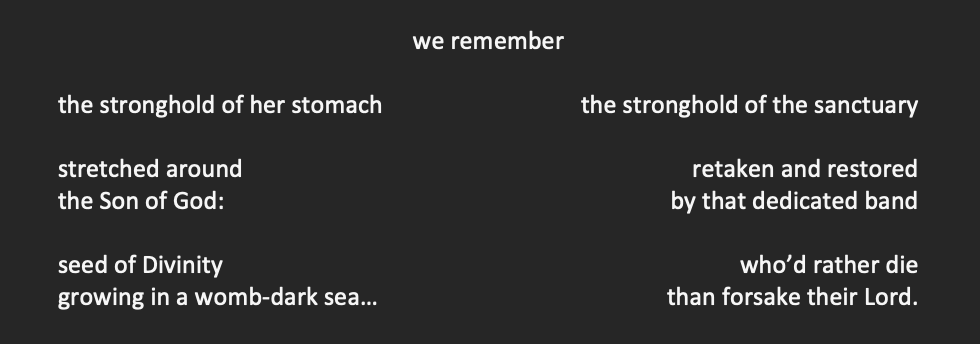
we remember

A:
the stronghold of her stomach

stretched around
the Son of God:

seed of Divinity
growing in a womb-dark sea…

H:
the stronghold of the sanctuary
retaken and restored

by that dedicated band who’d rather die
than forsake their Lord.

B:
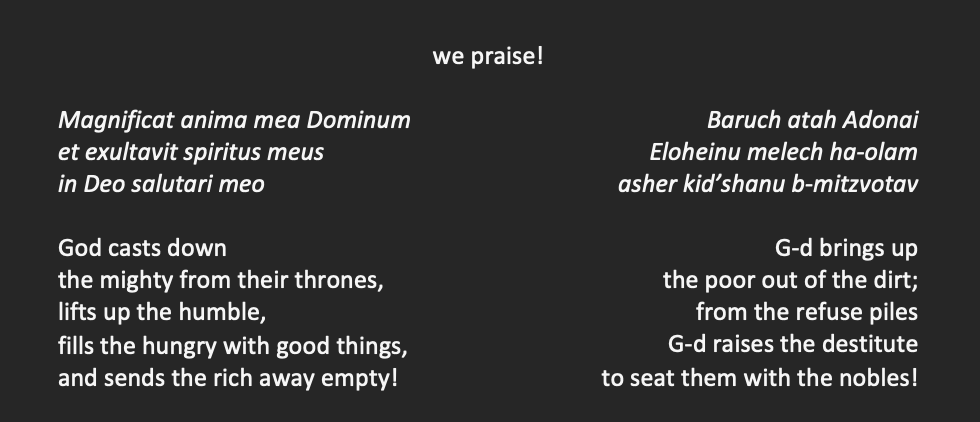
we praise!

A:
Magnificat anima mea Dominum
et exultavit spiritus meus
in Deo salutari meo

God casts down
the mighty from their thrones,
lifts up the humble,
fills the hungry with good things,
and sends the rich away empty!

H:
Baruch atah Adonai
Eloheinu melech ha-olam
asher kid’shanu b-mitzvotav

G-d brings up the poor out of the dirt;
from the refuse piles
G-d raises the destitute
to seat them with the nobles!

B:
we await

A:
the Kin-dom of God —
the world made whole!
a table set for all!

H:
tikkun olam —
the righting of the world!
and we must play our role.

B:
we join
we wait
we eat
we praise

H:
and the candlelight

A:
and the candlelight

B:
and the candlelight extends
a hand to shadow —
scoops her up into a flickering dance
across the walls

H:
across the pains

A:
across our upturned faces

B:
and singing fills the darkness round and full
and rises to the One who blesses
all

Categories
Invitation to the table LGBT/queer Liturgy

Invitation to the Table: “If the world tells you that you are unworthy…”

If the world tells you that you are unworthy of a seat at the table,
that your presence is unwelcome or even unwholesome,
know that Jesus extends an invitation to you personally.

This table does not belong to human beings,
but to the God who delights in you,
Who welcomes you without demanding you be anything
but your own beautiful self.

Come, join this joyful feast without fear.

God has set a place just for you.


About this piece:

I wrote this affirmation for my church’s More Light Sunday service, an LGBTQA/queer-focused service. Themes included learning how to love ourselves, our neighbors, and our God; reclaiming scripture from those who have weaponized it; and the power of story.

If you this piece it in your own service, please credit it to Avery Arden — and I invite you to email me at queerlychristian36@gmail.com to let me know you’re using it!

I thought of a poem by slats toole as I wrote this invitation. You can read the poem here. And you can buy their collection Queering Lent here.

Categories
Affirmation of Faith LGBT/queer Liturgy

Affirmation of Faith: Queer God who came out to Moses…& other biblical coming out stories

The love of our queer God
unites us into one Body —
not in spite of, but in celebration of
our varied gifts and roles in
the story God is telling even now.

As one, let us affirm some of what we believe
about the God who is for us
when we are in the closet, and when we come out,
when we receive our loved ones with rejoicing
and when we strive to understand.

We believe in the God who came out to Moses
from the midst of unburned branches
with a name They had never revealed before —

a name shared with love, shared as an invitation
into deeper relationship, deeper understanding
of the God Who Is and Who Will Be
the steadfast ally of shunned and shackled peoples.

We believe in the God of Joseph, 
who takes tattered lives
and weaves them into wholeness.

When Joseph came out to his brothers
as a dress-draped dreamer
and faced their violent rejection,

God went with Joseph into slavery, into imprisonment,
and out again, guiding his way into flourishing.

But They also stayed
with Joseph’s brothers,
never ceasing to work on their hard hearts,
preparing them for the tearful reunion
where they would embrace Joseph’s differences
as life-bringing gifts.

We believe in the God of Esther, 
who protected her from being outed unwillingly
in a place hostile to her very being;

and who, when the time came to act,
filled her with the courage and power she needed
to use what privilege she had
to save the more vulnerable members of her people.

We believe in the God of Mary,
the teenage girl who faced disgrace
by coming out as full of grace

pregnant with divinity —

yet she did so boldly, joyously,
recognizing the hand of God
in the status quo’s upturning.

We believe in Jesus, whose identity 
as God’s beloved son and God Themself,
as Word made Flesh and Life that died
is too complex for human minds to fathom —

yet Jesus yearned to be known,
to be understood by those who loved him most!
He asked them earnestly, “Who do you say that I am?”
but told them not to out him to the world
before he was ready to share his truth in his own time —
And oh, how he’d shine!

We believe that the God
who liberated Lazurus from his tomb,
and who overcame death
by rising from a tomb of his own,

is the selfsame Spirit
who enters into the tombs
we build around ourselves
or shove our neighbors into;

She looses our bindings
and pulls us into Her great Upturning.

Amen.


About this piece:

I wrote this affirmation for my church’s More Light Sunday service, an LGBTQA/queer-focused service. Themes included learning how to love ourselves, our neighbors, and our God; reclaiming scripture from those who have weaponized it; and the power of story.

If you this piece it in your own service, please credit it to Avery Arden — and I invite you to email me at queerlychristian36@gmail.com to let me know you’re using it!

Further Reading

For more on Joseph through a queer & trans lens:

For more on Esther through a queer lens:

For more on Mary through a queer & trans lens:

For more on Jesus through a queer & trans lens:

For more on Lazarus through a queer & trans lens:

[image: a digital painting of Joseph of Genesis by tomato-bird on tumblr, a figure with light brown skin, brown eyes, and curly dark hair sitting in a field. They have their head propped on one hand as they sit, gazing off into the distance with a sunset or sunrise blushed sky behind them. And from their shoulders extends a gorgeous, flowing cape, rising upward behind them as if caught on the wind so that its colors blend with the blushing sky – ripples of vibrant red and blue, with orange and yellow stars plus a moon and sun scattered along the fabric. / end id]

Categories
Call to worship LGBT/queer Liturgy Multifaith Opening prayer

Call to Worship & Opening Prayer: Queer God with diverse children

Call to Worship

Gracious God,
in this time of worship and wonder, story and song
into which you have gathered us,

we marvel at the wondrous diversity of your human creation.
Each of us — Black, white, Latine, Asian, Indigenous, and beyond — 
is an integral part of your magnificent spectrum.

You call us to join in joyous worship, just as we are.

Each of us — Christian, Jewish, Muslim, Hindu, Buddhist, atheist, and beyond —
is an integral part of your magnificent spectrum.

You call us into community, just as we are.

Each of us — with our bodies of diverse shapes, sizes, and abilities —
is an integral part of your magnificent spectrum.

You call us Good, you call us whole and holy, just as we are.

Each of us — of all sexualities and genders, all these ways of being and loving —
is an integral part of your magnificent spectrum.

You call us to share the gifts you gave us, just as we are.

Opening Prayer

Queer God beyond our knowing,
we glimpse your vastness in the diversity of your children
who together bear your image.

Queer Trinity, both One and Three,
your very Being shows us how to be:
honoring each person’s uniqueness,
and valuing our interconnectedness. 

Queer God, 
On this More Light Sunday, we humbly pray and act
for the full affirmation and inclusion of all of our LGBTQ+ siblings.

Amen.


About this piece:

I co-wrote this call to worship, and wrote the opening prayer, for my church’s More Light Sunday service, an LGBTQA/queer-focused service. You could edit the last two lines to take out the reference to More Light Sunday if using it for general worship.

If you use it in your own service, please credit it to Avery Arden — and I invite you to email me at queerlychristian36@gmail.com to let me know you’re using it!

Categories
Confession and Pardon Liturgy

Confession & Pardon: Learning to Face Hard Truths with the Prophet Amos

Call to Confession

God sent the prophet Amos to Israel
to warn the rich and powerful
that the natural consequence of their mistreatment of the vulnerable 
would be destruction for all.

In many ways, the modern United States 
is not unlike that ancient nation —

A land of plenty only for the powerful few,
while the oppressed go hungry and unheard.

So come, let us confess our failings
by hearing some of Amos’s words
as if they were proclaimed to us.

Prayer of Confession

“Alas for those who are at ease in Zion,
and for those who feel secure…
Alas for those who ignore the evil day
        causing violent rule to draw near:
  for those who lie on beds of ivory,
   and lounge on their couches…” 
(Amos 6:1, 3-4a)

“…They have been led astray by the same lies
    after which their ancestors walked.” 
(Amos 2:4)

We cannot bear to hear of the atrocities
inflicted past and present by our fellow Christians
against Indigenous peoples

such news shatters our faith in the Church,
wracks us with grief and guilt 
we don’t know what to do with.

We cannot bear to believe all the stories 
of violence committed by police
against Black persons and other persons of color

such stories shake our trust in our country,
leave us wondering where else we could go
when our own safety is threatened.

We cannot bear the knowledge that
our world is burning due to human greed
don’t we need the gas that poisons our planet
to power our cars and homes?

God, when we think we cannot bear these truths,
give us the strength to face them — 
for in avoiding them, we move towards our collective doom.

“I raised up some of your children to be prophets…
But you…command the prophets, 
Saying, ‘You shall not prophesy!’”
(Amos 2:11-12)

“[You] hate the one who reprimands in the city gate,
abhor the one who speaks the truth.” 
(Amos 5:10)

We cannot bear the messages of
people we have individually harmed,
or of communities whose oppression
is the price of our own prosperity

because they pierce through our illusions
about ourselves as “nice” people,
and expose the pretty lie of the American Dream
for the nightmare it is, accessible only to the privileged;

they make us feel bad and defensive,
and expose the poison festering beneath
our “respectable” facades.

God, when we think we cannot bear these truths,
urge us all the harder to face them. 
Do not let us look away!

“They do not know how to do right, says the HOLY ONE…”
(3:10)

You alone, O God, can teach us how to do right. 
Open our hearts. Help us lower our defenses.
We will face the harm we have done
so that we can move forward.

Assurance of Pardon 

God declares, “Let justice roll down like waters,
and righteousness like an ever-flowing stream!”
(Amos 5:24)

Through the life, death, and resurrection of Jesus,
such justice is possible!

God will make all things right,
and empowers us to join Them in that task.


I wrote this confession for a service centered around Amos chapter 7, which includes the metaphor of the plumbline, which God has used to measure Israel only to find its very foundation is completely skewed; the whole thing must be leveled and rebuilt.

Israel’s high priest Amaziah cries that “the land cannot bear [Amos’s] words,” and tells Amos to go on back home to Judah, because his prophecies are not welcome in Israel. But in reality, it isn’t the message that Israel “cannot bear,” but the avoidance of that message: because Amaziah rejects this message and the repentance and reform it necessitates, Israel will be invaded and driven into exile by the Neo-Assyrian Empire; by 722 BCE, the Northern Kingdom of Israel will have fallen, leaving her sister nation Judah standing alone.

There are so many truths that we likewise avoid because we believe that we and our communities cannot bear the guilt, grief, and upheaval those truths would bring. But to fail to face those realities and respond with active reform spells doom for us all.

As James Baldwin writes in The Fire Next Time, “Not everything that is faced can be changed. But nothing can be changed until it is faced.”

What realities are the members of your faith community avoiding? How can the community come together to face them together?

_____

In the case of how white Christians can and must face our complicity in antiblack racism, I recommend Good White Racist? by Kerry Connelly as a good starting point. Connelly goes into the neuroscience behind why we react to our words or actions being called out as if such a thing were a life-threatening attack; how we value being “nice” and not making others uncomfortable to seeking justice; and how to move past that hardwiring.