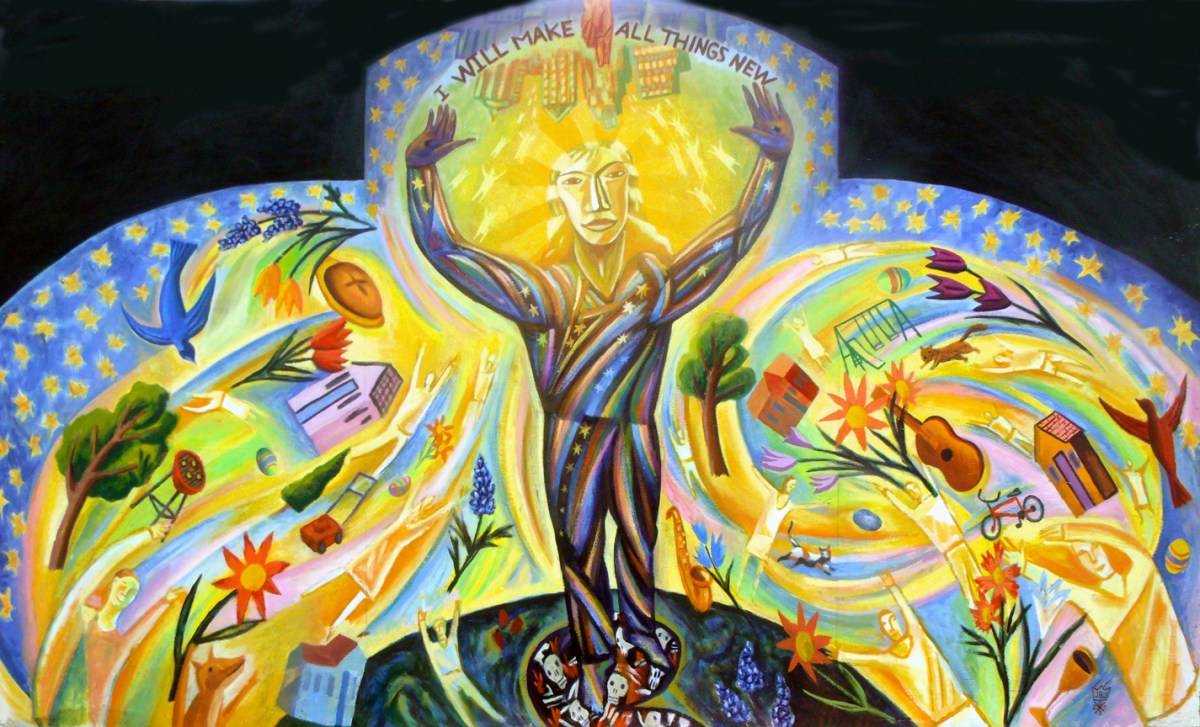
See below for credit info and an explanation of changes made.
What wondrous love is this, o my soul, o my soul!
What wondrous love is this, o my soul!
What wondrous love is this
that caused the God of bliss
to join earth’s wretchedness
and our woe, and our woe —
join brokenness to make
all things whole.
When I was sinking down, sinking down, sinking down —
oppressed and sinking down, o my soul!
When I had nearly drowned
in suffering’s waves around
Christ cast aside his crown
for my soul, for my soul!
In weakness he was bound,
for my soul.
To God and to the Lamb I will sing, I will sing,
to God and to the Lamb I will sing —
to God and to the Lamb,
who is the great I AM,
while billions join the theme,
I will sing, I will sing!
while billions join the theme,
I will sing.
And when from death we’re free, we’ll sing on, we’ll sing on;
And when from death we’re free, we’ll sing on.
And when from death we’re free,
we’ll build community
in peace and equity
in the Son, in the Son —
shalom community
in the Son.
So all disciples, go, share the news, share the news!
All you disciples, go, share the news!
All you disciples, go
to where injustice grows
and be Christ’s truth that sows
life anew, life anew!
Yes, be Christ’s love that sows
life anew.
Credit Info:
Please feel free to spread this around, to sing it in your own communities, etc.! Just include credit to Avery Arden at binarybreakingworship.com.
If your community does make use of my revised verses, I would love to know about it. If you post a video of it being sung anywhere, I would love to hear it!! You can contact me at queerlychristian36@gmail.com.
And if you have any suggestions for further revision, please do let me know that too. Let us all join together in the endless effort to draw our circles wider!
Reasons for Revision
I know too many people — mostly exvangelicals — who grew up with the message “Jesus died for YOUR sins; YOU are the reason God had to suffer and die on the cross; every single sin YOU make is a nail in Christ’s body” drilled into them until they were drowning in shame. In Christian Doctrine, Shirley Guthrie shares an anecdote that conveys this terror and shame:
“Once upon a time a boy went to a revival meeting. …The preacher held up a dirty glass. ‘See this glass? That’s you. Filthy, stained with sin, inside and outside.’
He picked up a hammer. ‘This hammer is the righteousness of God. It is the instrument of God’s wrath against sinners. God’s justice can be satisfied only by punishing and destroying people whose lives are filled with vileness and corruption.’
The preacher put the glass on the pulpit and slowly, deliberately drew back the hammer, took deadly aim, and with all his might let the blow fall.
But a miracle happened! At the last moment he covered the glass with a pan. The hammer struck with a crash that echoed through the hushed church. He held up the untouched glass with one hand and the mangled pan with the other.
‘Jesus Christ died for your sins. He took the punishment that ought to have fallen on you. He satisfied the righteousness of God so that you might go free if you believe in him.’
“What Wondrous Love” perpetuates this kind of substitutionary atonement theology, especially in stanza 2. So I decided to change that.
Removing substitutionary atonement in favor of divine solidarity
We are sinking down to hell “beneath God’s righteous frown,” and that’s why Jesus had to lower himself and suffer. It’s our “fault” — it’s your fault. Don’t you feel horrible? Wallow in your guilt!
Guthrie continues his anecdote by pondering the fruit of such theology:
When the boy went to bed that night, he could not sleep. Meditating on what he had seen and heard, he decided that he was terribly afraid of God. But could he love such a God? He could love Jesus, who had sacrificed himself for him. But how could he love a God who wanted to ‘get’ everyone and was only kept from doing it because Jesus got in the way? The thought crossed the boy’s mind that he could only hate such a hammer-swinging God who had to be bought off at such a terrible price. But he quickly dismissed that thought. That very God might read his mind and punish him.
…Finally, he wondered what good it had all done in the end. The glass had escaped being smashed to bits, but nothing had really changed. After the drama was over, it was still just as dirty as it was before. Even if Jesus did save him from God, how did Jesus’ sacrifice help him to be a better person?
There are other ways to understand the salvific power of Jesus’s incarnation, life, death, and resurrection. That’s why I revised “What Wondrous Love Is This.” My changes remove the disconnect between the will of different Persons of the Trinity: God the Father was wrathful and would have destroyed us; God the Son therefore had to get between us and the Father. As Guthrie says,
“Jesus came to express, not to change, God’s mind. …Reconciliation is the work of God, not…purchased from God. What Jesus does is not done over or against God; his work is God’s work, for he himself is God-with-us.”
So as noted, I removed the sinners in the hands of an angry God type language in stanza 2. What I replaced it with was an emphasis on Christ’s incarnation as kenosis, the divine self-emptying, and as the ultimate act of solidarity — joining in our “wretchedness” in order to transform it into joy. “For God became human so that humans might become God” (Athanasius, On the Incarnation, p. 60).
Moving from the individual to the communal
The other big thing I wanted to change about the song was its individualistic view of salvation.
I kept some uses of “I / my” in order to honor the intimacy of the original, but included shifts into the communal “we” to stress that all humanity together enjoys the love and liberation of God — e.g. “when from death I’m free” becomes “when from death we’re free.”
Still looking forward to the Kin-dom, but also emphasizing the now
“What Wondrous Love” offers us a beautiful, poetic vision of heaven’s eternity of joyful worship. I kept that in (with a small tweak to its heavenly choir of “millions,” making it “billions” in keeping with my universalist views of how many people “get” to heaven).
But I also added a stanza to the end that reminds us that before that happy day, we are called to be the Kin-dom here and now. (By the way, I built that last stanza, “So all disciples go…”, off of a stanza original to the hymn but usually taken out: “Ye wingéd seraphs fly.” There are several other such stanzas; check them out and see if any stand out to you as worth revising!)
 Binary-Breaking Worship