Categories
Current Events / Activism LGBT/queer My poetry Other search markers

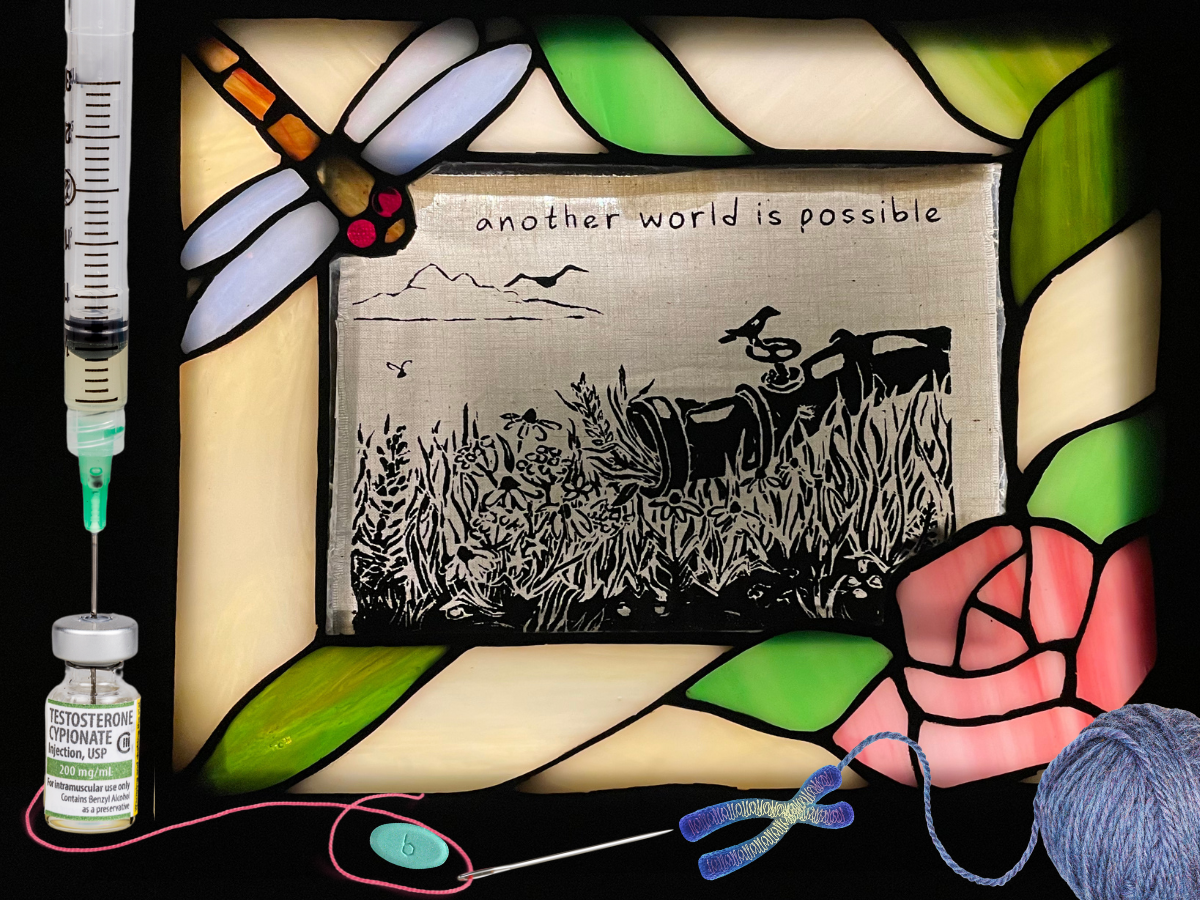
A poem on being trans during Trump’s return

The day after the inauguration
I give myself my hormone shot.

Every Tuesday since
I have done so again

in spite

of blowhards’ orders for
two sexes and impermeable borders.

Hrt — dear dermal border crosser — pays no mind 
to the blustering of fools who know nothing

of what it is to sew oneself 
into one’s body with a needle

pierced through thigh muscle; stitches across 
the chest; new names spun by fumbling fingers

into the threads that stretch heartstring to heart-
string. What could they who sever heartstrings know

of the transtemporal tapestry that interweaves
our unnumbered stories, our numberless ways to be?

Even now, they try

to tear our truth out of all legal records,
to blot us out from history and medical texts —

but we suffuse humanity’s warp and weft:
cut us out, mere tatters will be left.

And it may be they’ll pry

our protections and passports, our vials and blue pills
from our still-warm, still-alive, still-trans and intersex hands —

but our tapestry is stronger than their will,
twined tighter than chromosomes, and

we’ll give them hell for every sundered string.
We’ll fight like hell until their bitter end.

For now, it is Tuesday again

and my hand, with its wedding ring
and thickened skin,

is steady as I plunge the needle in.


You are welcome to circulate this poem around, including on social media (please make sure to include image descriptions if you share screenshots) or at any type of gathering. Please credit Avery Arden (they/ze) of binarybreakingworship.com.

I also ask that you keep in mind that this poem is first and foremost a personal piece; I am not attempting to speak to what other trans and/or intersex persons are feeling right now. What is more, I hope it is clear that none of the various things mentioned — hormones, surgery, document changes — are at all necessary to be trans; I only center hrt here because of how it has been a grounding ritual for me these past weeks.

I welcome conversation, and would love to hear about your rituals, your remembrance, your resistance.

(By the way, this post’s title isn’t the poem title; it’s untitled / the first line kinda serves as the title.)

More about the poem:

Since Trump’s intentionally overwhelming first-day flood of executive orders, I’ve been trying to sort my tangled-up feelings:

  • The rage and despair and dread inextricably mixed with love, and defiant dreams of a better world, and deepest pride in the vibrant, rebellious, eternal community of those whose very bodyminds expose Empire’s lie that humanity can be dichotomized.
  • The whiplash of mundanity in times such as these — the way “life as usual” can lure us into passivity if we are not careful; but also the way our everyday rituals and tasks (like my weekly hormone shot) ground us, and can even be little acts of resistance to nourish our larger, communal resistance.
  • The bitterness of all that could have been (and I’m not talking about a Democrat in the White House, upholding the same systems that enable a tyrant like Trump, just with more hand-wringing). The frustration that this is what it takes for more people to wake up to the evils that have festered in and fueled this nation from its conception. The relief that at least now there are more people ready to resist, and urgency to welcome and equip them.
  • The preemptive grief for all we will lose. The determination to lose as few as possible — to pray for the dead and fight like hell for the living.

Before finally managing to get this poem written out, I was able to channel some of that tangle into helping More Light Presbyterians write our statement on Trump’s executive order against gender diversity. Along with concrete actions we can take to support trans and intersex persons right now (see the link for those), one of the parts I wrote was a closing message of love and promise to my trans and intersex kin:

Hateful people want nothing more than to see you feeling hopeless and abandoned—but we promise you, there will always be people in your corner, ready to protect you with our lives. We will not leave you to fight alone, no matter how dire things get. Cling to your community, nurture your spirit however you can, and remember:

Politicians were never going to save us. We keep us safe, trusting in the love and solidarity of the One who created each of us with purpose and delight (Genesis 1:31; Psalm 139:14).

Categories
Current Events / Activism

Palestine: history, current events, ways to help

I originally had these resources pasted to the end of poem, but by request I am pasting them as their own post now, with more links added.

Please feel free to recommend more resources. Let us all do our part — Palestine will be free!

HISTORY

CURRENT EVENTS

DREAMING OF A BETTER FUTURE

WAYS TO HELP

  • Urge your University/School/Organization to put out a statement denouncing Israel
  • Organize a Protest/Participate in a local one
  • While calling your reps, tell them that as a voter, you’re unwilling to support them in the upcoming election unless they urge the White House to take a stand against Israel and stop funding them
  • Share art/writing/films around Palestinian culture (see this tumblr post for Palestinian media to watch; I also recommend Oriented (2015) for an un-pinkwashed queer Palestinian story)
  • If you’re part of a union, ask them what they’re doing to urge their industry leaders to take a stand against Israel + pressure the White House OR urge them to start a strike/walkout/etc if they’re not doing anything already
  • Talk with your friends IRL about Palestine; keep spreading information on social media — don’t let talk of Palestine die down!
  • See if your city/state council has put out a statement in support of Gazans. If not, try to push them to do so.
Categories
Current Events / Activism My poetry

“What words can do” — A poem for Palestine

Half a world away from me
they are killing a people they claim does not exist
using my taxes, my country’s ghoulish gifts —
our bullets and bone-eating phosphorous,
our bombs, and our blessing to use them ­—

they are killing the doctors to kill all hope of healing
they are killing the journalists to kill all calls for justice

and what can I do? With what can I fight
to end this nightmare I’m complicit in
by birthright?

All I have, it seems to me, are words.

I scrawl them on protest signs,
arrange them into stilted, inept poems,
deposit them into the answering machines
of politicians who persist
in signing over all our souls for oil.

they are killing the old women
with nothing left to their names
but tales of how things were

and, God! they are killing the children
who listen to the tales and spin
them into dreams of how things yet could be

And what, in God’s name, can I do? What
can all the words
winging forth from all the corners of the earth
do?

what dream can rise unscathed from so much ruin?
what song is not drowned out
by the drones’ constant humming?

I pull up a lecture by Refaat Alareer
who believed in the power of a poem

to soar above the rubble
crushing its poet’s corpse.

they are killing the poets
whose words are seeds are kites are embryonic deeds

In the lecture, his voice speaks
to me from beyond the grave, haunted
by that soft electric hum
endemic, it seems, to classrooms all over.

In the lecture, he is saying

there was an Israeli general
for whom one poem by Fadwa Tuqan
packed a punch more potent than the guns
of twenty enemy fighters.

In the lecture, he is pleading:

“Don’t ever say Tuqan was arrested
‘just’ for writing poems”

and how could I, how could I
do anything but promise him, “I won’t!”

when he himself was killed a month ago
“just” for nurturing the poems in others,
“just” for reeling those poems out,
slim and supple as kites, into the world?

what song or verse, what thin prophetic cry
can scale a wall eight meters high?
one built to be buffeted, bombed — and still fly.

In the lecture, he is promising

as long as we can imagine Palestine free,
we can unlock that future reality

from a classroom that is rubble now —
the IDF bombed his university in October.
They say it was an important Hamas site.

Maybe it was

or maybe it was a danger “just” because
its teachers, its students, kept slipping their poems
past checkpoint gates

filling the world with prophecies of freedom
that “just” might make
a battered but persistent people free.

they can kill children women journalists
they can kill doctors dreamers prophets poets
but still (we must believe!) the poem lives on.

So take up your pen, or take up Gaza’s song
and spread the word forth: Palestine lives on.


Please feel free to spread this poem around online or offline. Just credit Avery Arden of binarybreakingworship.com.

You can find me reciting this poem in video format on TikTok here and on Instagram here.

If you’re interested in more poetry for Palestine, check out my podcast episode here.

About this poem:

These last few months, I have been reading a great deal of Palestinian poetry. Poems are my heart’s language, and I have been deeply moved by the long proud history of Palestine’s resistance poets, who have used their art to defy the colonialist lie that there is no Palestinian people or culture. For decades, these poets have been targeted by Israel’s government because the power of their words cannot be denied.

Before he was killed by an Israeli airstrike on December 7, 2023, Professor Refaat Alareer was a professor of creative writing and world literature at the Islamic University of Gaza, where he worked to nurture his people’s creative powers and broadcast Palestinian poetry to the world through efforts like the We Are Not Numbers project.

Many of Alareer’s lectures are available on YouTube; around nine minutes into an introduction to poetry, he discusses how art helps us imagine what we have never experienced so that we can work to make those dreams reality. In it, he speaks to his students:

“We’ve never been to other parts of Palestine because of the Israeli occupation, but we’ve been told so many times by our parents and grandparents, especially our mothers, have been telling us stories about Palestine…the good old days how Palestine was, all nice and beautiful, unoccupied, un-raped… Our homeland turns into a story. In reality we can’t have it, we don’t have it. But it can turn into poems, into poetry, into literature, into stories.

So our homeland turns into a story. We love our homeland because of the story. …And we love the story because it’s about [class joins in] our homeland. And this connection is significant. Israel wants to sever this relationship between Palestinians and land, Palestinians and Jerusalem, and other places and cities. And literature attaches us back, connects us strongly to Palestine,…creating realities, making the impossible sound possible.”

When we look at the weapons the IDF wields, courtesy of imperialist powers like the United States, what are words? Why bother speak up? Alareer assures us that our words do matter. In the same lecture as above, he speaks of the Palestinian resistance poet Fadwa Tuqan (1917-2003), whom Israel arrested. Why, Alareer urges us to consider, would Israel feel so threatened by someone who wields no weapon but a pen?

“…We always fall into this trap of saying, ‘She [Fadwa Tuqan] was arrested for just writing poetry!’ …So we contradict ourselves sometimes; we believe in the power of literature changing lives as a means of resistance, as a means of fighting back, and then at the end of the day, we say, ‘She just wrote a poem!’ We shouldn’t be saying that.

Moshe Dayan, an Israeli general, said that ‘the poems of Fadwa Tuqan were like facing 20 enemy fighters.’ … And the same thing happened to Palestinian poet Dareen Tatour. She wrote poetry celebrating Palestinian struggle, encouraging Palestinians to resist, not to give up, to fight back. She was put under house arrest, she was sent to prison for years.

And therefore, I end here, with a very significant point: Don’t forget that Palestine was first and foremost occupied in Zionist literature and Zionist poetry. …It took them years — over 50 years — of thinking, of planning, all the politics, money and everything else. But literature played one of the most crucial roles here. …Palestine in Zionist Jewish literature was presented to the Jewish people around the world … [as] a land without a people to a people without a land. ‘Palestine flows with milk and honey. There’s no one there, so let’s go.’ … And there were people — there have always been people in Palestine. These are examples of how poetry can be a very significant part of life.”

Professor Refaat Alareer in a 2019 poetry lecture

It turns out that words are working — slowly but surely.

Since October 2023, the journalists and everyday people in Gaza who have been bravely broadcasting their stories to the world, and those across the world who have been spreading those stories, and organizing protests, and refusing to be silent in the face of government powers and heavy propaganda, are having an effect. Israel is concerned about its public image, which our collective words and actions are damaging.

So keep sharing Palestinians’ stories; keep writing; keep contacting your representatives; keep protesting.

We won’t stop till Palestine is free.