Categories
Hymns Hymns Multifaith Other search markers worship-planning

“We Are One in the Spirit” revised for interfaith use

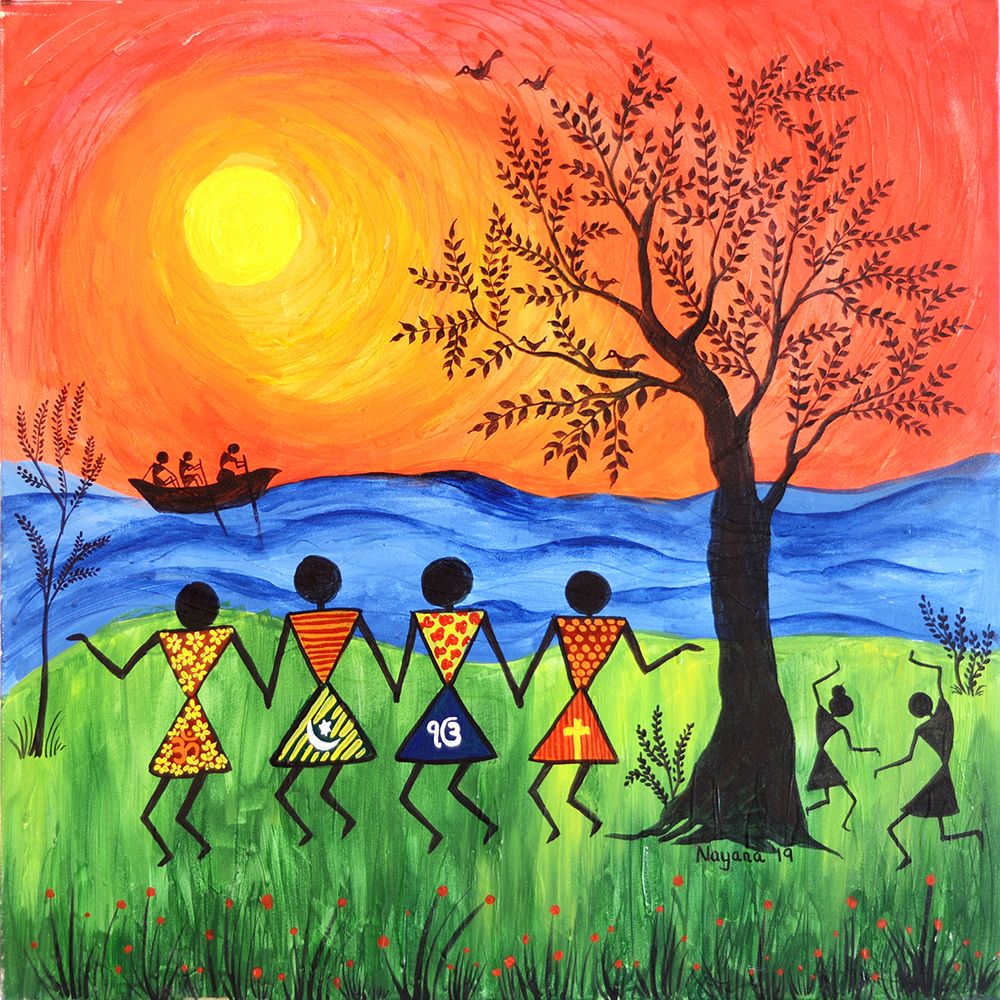
This hymn (original lyrics here) is a beautiful call to solidarity and activism among Christians of all denominations; what if we made it interfaith, too? Revisions alter Christian-specific language and also add in two new verses.

Credit info & explanations of changes are below the lyrics.

We are one in the Spirit,
we are one in the Lord,
we are one in the Spirit,
we are one in the Lord,
and we pray that our unity
will one day be restored —

Refrain:
And they’ll know God is with us
by our love, by our love;
yes, they’ll know God is with us
by our love.

We will move with each other,
we will move hand in hand,
we will move with each other,
we will move hand in hand,
and together we’ll spread the news
that God is in the land —

(Refrain)

We will work with each other,
we will work side by side,
we will work with each other,
we will work side by side,
and we’ll guard each one’s dignity
and save each one’s pride —

(Refrain)

All praise to our Maker,
from whom all things come
and in whose holy image
every human belongs.
Let us join our rich harmonies
in one holy song —

(Refrain)

Credit Info

Please feel free to spread this around, to sing it in your own communities, etc.! Just include credit to Avery Arden at binarybreakingworship.com.

If your community does make use of my revised verses, I would love to know about it. If you post a video of it being sung anywhere, I would love to hear it!! You can contact me at queerlychristian36@gmail.com.

And if you have any suggestions for further revision, please do let me know that too. Let us all join together in the endless effort to draw our circles wider!

Reasons for Revision

Also called “They Will Know We Are Christians,” this hymn was written in the 1960s by Catholic priest Peter Scholtes for use at ecumenical and interracial events. Its themes reflect the post-Vatican II urge to bring Catholic tradition to life in new and active ways, and to interact with our neighbors in faith more intentionally.

As such, “We Are One in the Spirit” “has become an important piece in the church’s efforts to sing a theology of active participation and discipleship in and for the world.”

The songs we sing in worship shape the people’s conception of who God is and what God is doing in the world. I think this song excellent as it is! But I think it could be powerful to utilize at interfaith, not only ecumenical, gatherings — particularly gatherings of persons of the Abrahamic faiths, who share our one God and for whom language of spirit and Lord is familiar.

At this moment in time, I am thinking of places like Minneapolis, where leaders of many faiths — particularly so many Jews and Christians! — have joined together to broadcast the message that God is on the side of the immigrant.

My revisions are light, simply taking out the word Christians and altering the last verse so that it is not longer Trinitarian (praising Father, Son, and Spirit) but emphasizes a shared Creator.

Another small revision is altering “walk with each other” to “move with each other” to include wheelchair users and other modes of transportation. (It could also be interpreted as moving together in the form of dancing, or marching, etc.!)


Categories
Hymns Other search markers worship-planning

Why (& when) might we revise a hymn?

What are your favorite hymns? What hymns does your community hold most dear? What makes those specific songs resonate so deeply — their powerful melodies? words of love, of comfort or challenge? Messages that seem to put your most treasured values into words?

On the other hand, are there parts of any of those hymns that don’t sit right with you?

Maybe there’s language that leaves you out as a non-binary person, or implies that your disability makes you broken. Or maybe you have only just noticed that a song you’ve been singing your whole life carries binary language, ableist language, language that equates whiteness with goodness and purity, darkness with sin.

These songs hold a special place in your heart and in your faith; you don’t want to throw them out (or you know that members of your congregation will protest if you try).

But you also know that the words we sing at worship matter — that many people’s beliefs are largely shaped by the hymns we choose. If we keep singing these songs as is, people will continue to absorb their harmful messages.

These hymns call for some wording updates as we seek to draw our circles ever wider, to ensure that we sing out welcome and belonging to all those made in the Divine Image.

For example, For Everyone Born” is a beloved hymn that Shirley Erena Murray wrote with deep love and a desire to draw people together in our diversity; however, much of the language sets up binaries that unintentionally leave some people out. When I revised it, most of the verses just required breaking out of those binaries — such as expanding “woman and man” to include “all those between, beyond, and besides.”

Hearing these changes to the hymn’s language while in worship was deeply meaningful to me. To have my concerns heard and recommendations acted on, to be acknowledged in that way, explicitly in the song, after so often feeling unheard and left out in faith spaces, was genuinely healing.

…But then there are the hymns that don’t just need some wording tweaks. Some hymns are founded on downright harmful theology — are laden with implications that Christians are supreme; that God’s power is patriarchal; that suffering is either punishment or test; that we are “sinners in the hands of an angry God” who is only kept from smiting us because Jesus puts his body between us and divine wrath (rather than Jesus being God-with-us, expressing the Triune God’s united will).

So what are we to do with a hymn that perpetuates bad theology?

We might choose to dispose of it completely.

Maybe some songs can’t be redeemed. Maybe no changes to it could ever ease the pain you or your community members feel about it.

For me, a song goes straight in the trash if I look into the songwriter and find that they were racist, antisemitic, or even guilty of sexual abuse; if the writer was violently bigoted or abusive, I am not going to try to “fix” their music. There is no fixing the harm that person did. I’m not going to sing any of an abuser’s words in a space where we’re trying to ensure that all belong, especially the most vulnerable.

Even outside that exception, I respect any person or community who decides they would rather retire any given song from their worship, for any reason.

However, I have found that many people find it extremely healing to sing a once-hurtful hymn anew, now with lyrics that talk back to and refute the original message. In bringing the song back transformed instead of quietly discarding it, a more overt, unambiguous message is made about what we believe, who God is, and who we are as a community.

To return to the example of “For Everyone Born,” there is one stanza that needed more than updated wording. The verse beginning “for just and unjust, a place at the table” doesn’t just leave some people out; it has brought deep pain to many survivors of abuse.

The stanza envisions a “table,” a community, where both “abuser, abused” are present, “with need to forgive.” However, ethical frameworks for responding to abuse emphasize the abuser’s accountability and the victim/survivor’s safety, comfort, and even their right to withhold forgiveness if they choose.

So I had to make a choice: throw the stanza out, or rewrite it in a way that directly addresses the old harm? I chose the latter:

For just and unjust, a place at the table,
a chance to repent, reform, and rebuild,
protecting the wronged, without shame or pressure,
for just and unjust, God’s vision fulfilled.

More people have reached out to me about this stanza than any other that I’ve revised, expressing how healing it was to be in worship and hear the old message refuted and replaced with one that prioritizes the person harmed.

If your community simply never speaks of a toxic hymn again, the memory of the pain the song caused you may remain deep in your psyche. You may even believe that that bad theology is the only traditional or “authentic” Christian theology — that you’re a “bad Christian” for hating it. You might think, “my church isn’t singing that hymn anymore because it makes people feel bad; but that doesn’t mean the hymn is wrong.”

But if you can receive the song anew, now with words that tear down that bad theology to build up something better, you receive an explicit message that yes, you were right, that theology was harmful. Your memories, your trauma, can be rewritten or re-woven into a new narrative:

This was a song that hurt; now it is a song that reminds us that we as Christians are constantly reforming and being reformed — constantly being called by God to unlearn and relearn divine love.

What do you think? Which hymns would you love to see transformed — and which would you simply like to never hear again?

Categories
Holy Days Hymns Other search markers

“Holy, Holy, Holy” revised

Scroll lower for credit info, reasons for revision, and downloadable sheet music.

Unaltered lines are in light gray; altered lines are in black.

Holy, holy, holy!
Lord God Almighty
Early in the morning our song shall rise to thee
Holy, holy, holy!

Justice wed to mercy,
God in three persons, blessed Trinity!

Holy, holy, holy!
All the saints adore thee,
Casting down their golden crowns around the glassy sea.
Cherubim and seraphim,
falling down before thee,
Who was and is and evermore shall be.

Holy, holy, holy!
Sacred darkness cloaks thee,
Granting us mere glimpses of thine untold Mystery.
Still, thine image shows thee
in each human body:
Thou art our breath, our love and artistry.

Holy, holy, holy,
Although almighty,
Thou stripped off omnipotence to share our frailty.
Only Thou are holy,
yet thou chose the lowly —
With the despised, there shall thy Spirit be.

Holy, holy, holy!
God of the lowly!
All thy works shall praise thy name
In earth and sky and sea
Holy, holy, holy!

Justice wed to mercy,
God in three persons, blessed Trinity!

Credit Info:

Please feel free to spread this around, to sing it in your own communities, etc.! Just include credit to Avery Arden at binarybreakingworship.com.

If your community does make use of my revised verses, I would love to know about it. If you post a video of it being sung anywhere, I would love to hear it!! You can contact me at queerlychristian36@gmail.com.

And if you have any suggestions for further revision, please do let me know that too. Let us all join together in the endless effort to draw our circles wider!

Reasons for Revision

This hymn by Anglican archbishop Reginald Heber (1783–1826) is a lovely piece of pure adoration of the Triune God. My personal appreciation of it centers on how it spans centuries — published the year Heber died, it’ll be two hundred years old next year! — and traditions:

I grew up singing it in Catholic Mass; I sing it now in a Presbyterian church; and I enjoy queer musician Sufjan Stevens’s cover of it. Heck, even the non-Trinitarian Latter Day Saints/Mormons sing it (altering “God in three persons, blessed Trinity” to “God in His glory, blessed Deity”). Thus when we sing this song we do so together not only with “cherubim and seraphim,” but with a vast cloud of human witnesses.

To better encapsulate the hymn’s expansive nature, and to infuse it with key concepts from liberationist theologies, I have revised parts of it with several goals:

  • To move from an emphasis on God’s “might” to God’s solidarity and abiding Presence.
  • To remove an instance of patriarchal language (“sinful man”).
  • To move from an equation of darkness and sightlessness with sinfulness (“Though the darkness hide thee / though the eye of sinful man thy glory may not see”) into an appreciation for the thick darkness — Hebrew עֲרָפֶל arafel — from which God guided the liberated Hebrews.
  • ^ That stanza on God’s hiddenness is the part of the hymn I changed most — I ended up turning it into two stanzas! Refocusing that hiddenness around Mystery rather than sin, and taking the opportunity that afforded me to explore how the Trinity chooses to relate to humanity in the Imago Dei, in the Incarnation, and through the Holy Spirit.

I am thankful to Dr. Matt Webb for his input on my revisions. If you notice anything more to change up in this hymn, let me know!

Sheet Music

Categories
Hymns LGBT/queer Other search markers

“For Everyone Born” revised to be even more inclusive

“For Everyone Born” by the wonderful Shirley Erena Murray is a well-loved hymn among progressive Christians, for good reason! However, to honor the original song’s spirit of expanding our table ever wider, some revisions were called for. See below my revised lyrics for a discussion on what changes were made and why.

See below for credit info, explanations of why revisions were needed and what changes I made, and sheet music.

The Lyrics

Note: verses to which no revisions were made are in brackets.

[For everyone born, a place at the table,
for everyone born, clean water and bread,
a shelter, a space, a safe place for growing,
for everyone born, a star overhead.]

Chorus:

And God will delight when we are creators
of justice and joy, compassion and peace:
yes, God will delight when we are creators
of justice, justice and joy!

For woman and man, a place at the table —
and all those between, beyond, and besides;
expanding our world, dismantling power,
each valued for what their voice can provide.

[chorus]

For gay, bi, and straight, a place at the table,
Invited to wed, to baptize and preach,
a rainbow of race and gender and color,
for queer, trans, and ace, God’s justice in reach.

[chorus]

[For young and for old, a place at the table,
a voice to be heard, a part in the song,
the hands of a child in hands that are wrinkled,
for young and for old, the right to belong.]

[chorus]

For bodies diverse, a place at the table,
All manner of speech and movement and minds;
Enabled to lead and teach us new language,
For bodies diverse, a church redesigned.

[chorus]

For just and unjust, a place at the table,
a chance to repent, reform, and rebuild,
protecting the wronged, without shame or pressure,
for just and unjust, God’s vision fulfilled.

[chorus]

[For everyone born, a place at the table
to live without fear, and simply to be,
to work, to speak out, to witness and worship,
for everyone born, the right to be free.]

[chorus]

Credit info:

Please feel free to spread this around, to sing it in your own communities, etc.! Just include credit to Avery Arden at binarybreakingworship.com.

If your community does make use of my revised verses, I would love to know about it. If you post a video of it being sung anywhere, I would love to hear it!! You can contact me at queerlychristian36@gmail.com.

And if you have any suggestions for further revision, please do let me know that too. Let us all join together in the endless effort to draw our circles wider!

Why Make Revisions?

“For Everyone Born” is a popular and beloved hymn in my sphere of progressive Christianity, and I love it too – except for the parts that don’t feel inclusive or expansive enough. Because of those places, singing this song sometimes feels more hurtful than healing for me and others I know.

The intention of this hymn is a beautiful one: it’s meant to make everyone feel welcome at the table, and to challenge us when we limit who’s welcome at the table. However, its dualistic language leaves out a lot of people!

When I hear “For woman and man,” “For gay and for straight,” sung during worship, my heart shrivels up — I and so many others don’t belong to either of those binary categories.

I am confident that Shirley Erena Murray’s intention was well-meaning, and I am thankful to her for writing a song emphasizing the gifts of diversity. Still, as language for queerness shifts and expands, the language used in our worship songs must shift and expand too.

…And then there’s the ever-controversial “for just and unjust” verse — the wording of which puts the impetus for reconciliation fully on the “abused” in the “abuser, abused” equation, pressuring them tojust forgive already, without acknowledging their safety or comfort or right to be hurt, their right to withhold forgiveness. Many churches I know simply leave this verse out to prevent harm.

But I don’t want to leave it out! I want to believe that in God’s Kin(g)dom, injustice will give way to justice; that sometimes, with work on the part of the wrongdoer, ruptured relationships might be repaired. And I want to sing about it! I want to sing a promise into being, a promise that, once sung, must be honored in truth and action: that all who have been hurt can come here for protection; that we will prioritize their safety always.

I first revised the “for gay and for straight” verse simply by tucking lots of other identities into the verse. I know it’s not perfect, and still leaves some out…but hearing my church sing the verse that way was a moment of real healing for me. To have my concerns heard and recommendations acted on, to be acknowledged in that way, explicitly in the song, after so often feeling unheard and left out in faith spaces, was genuinely healing.

Later, I revised the other tricky verses at the request of a seminary professor who wanted a revised version to sing in chapel. Again, I felt such healing and relief at being heard.

Since then, my revised verses have been sung in many different faith communities. Quite a few people have reached out to tell me how much the changes meant to them, which brings me so much joy. I would love for it to continue to spread — and to be further revised, however necessary, as time goes on!

Finally, I’ve now added a verse that centers disability. Disability justice is a great passion of mine, and something that tends to go overlooked even in the most “progressive” faith communities and institutions. (For a list of my recommended resources around disability theology and activism, see here.)


More notes on some of my choices:

If you’d like to see an image of my verses side-by-side with the original verses, just to help you see what changes were made, visit this tumblr post.

In the “for woman and man” verse:

  • “for all those between, beyond, and besides” – there are many persons who are not exclusively “man” or “woman,” myself included; but we don’t all fit into one third box. We aren’t trying to turn a binary into a “trinary” here! I think I myself would fit best into the “beyond” category in this phrasing, while I have lots of friends who would describe themselves as being more “between” woman and man, or something altogether besides that (such as agender, bigender, genderfluid….).
  • I changed “dividing the power” to “dismantling power” to emphasize that we should resist a simple redistribution of oppressive power; rather, we must work to dismantle that power altogether. A somewhat simplified example of this out in the world is when people celebrate women who have made it to high executive positions like CEO of a company that exploits workers and/or harms the environment. That’s not a victory, just because a woman is in charge! We have to get rid of that whole system!

In the dis/ability verse:

  • This verse was the trickiest for me to write. How can one possibly fit a community that makes up at least one in five people on the planet, and that encompasses a massive spectrum of different types of bodyminds, into a scanty four lines?
  • Luckily, a comment from Amanda Udis-Kessler below helped spark my mind in other directions than I’d started! I ended up scrapping the attempt to include naming many specific identities / types of disability, as I believe that was the main problem Shirley Erena Murray ran into with some of her verses: there are just too many to name them all, and naming some while leaving out others will just end up leaving those unnamed feeling excluded.
  • So instead, I named broad categories of action that a great many disabilities may present with “All manner of speech and movement and minds.”
  • With “all manner of speech,” I’m talking about accepting all forms of communication as valid — from verbal communication with ticks, long pauses, stuttered words, Autistic echolalia, and more; to communication beyond verbal speech, such as sign languages and the communication possibilities of AAC.
  • With “movements,” I mean both the way that mobility impaired bodies move — in wheelchairs, on crutches, with walkers, or not at all — and the ways many neurodivergent people move: the rocking and pacing and hand flapping and so much more.
  • With “minds” I of course mean neurodiversity.
  • And with the last two lines, “Enabled to lead and teach us new language, For bodies diverse, a church redesigned,” I focus on disabled persons as agents of divine blessing, with gifts that the Church too often rejects or ignores. How do we completely redesign our spaces and our ways of thinking to ensure that disabled people can even get into our buildings and contribute as fully as any other person? Only by seeking their knowledge out, and re-prioritizing our budgets, and making sure disabled ministers and other leaders have full access.
  • The one thing I wasn’t able to explicitly work in is the concept of the bodymind — that human beings are not so dualistic as we sometimes pretend to be (think of the concept that we “are” a soul and only “have” a body).
  • (If anyone wants to know what my earlier lyrics were, I’ll paste them here: For sighted and blind, a place at the table, / for hearing and Deaf, all brain types and speech, / accessible space, rethinking our language, / all eager to learn from those who would teach.)

Sheet music: