Categories
Current Events / Activism Holy Days lent Other search markers

Gaza’s Gethsemane

Today is Maundy Thursday, when Christians remember Jesus’s Last Supper, his final meal with his closest friends before his arrest and execution by the Roman Empire.
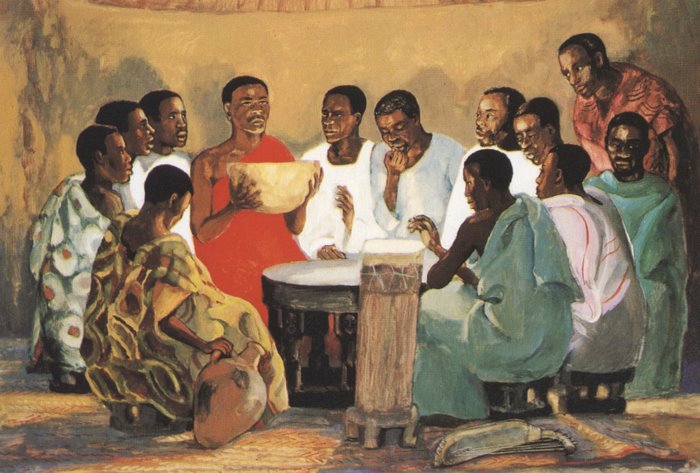
Painting of the last supper in which Jesus and his disciples all have deep brown skin; they gather around a low table as Jesus raises up a large bowl. They look solemn.
The Lord’s Supper,” from the JESUS MAFA project of Cameroon

Meanwhile, right now, in Jesus’ own homeland, millions suffer starvation and terror, displacement and death under Western-funded Israeli colonialism and continued military assault. Israel blocks food from reaching them, leaving Palestinians in fear that any “supper” they can scrounge up might be their last.
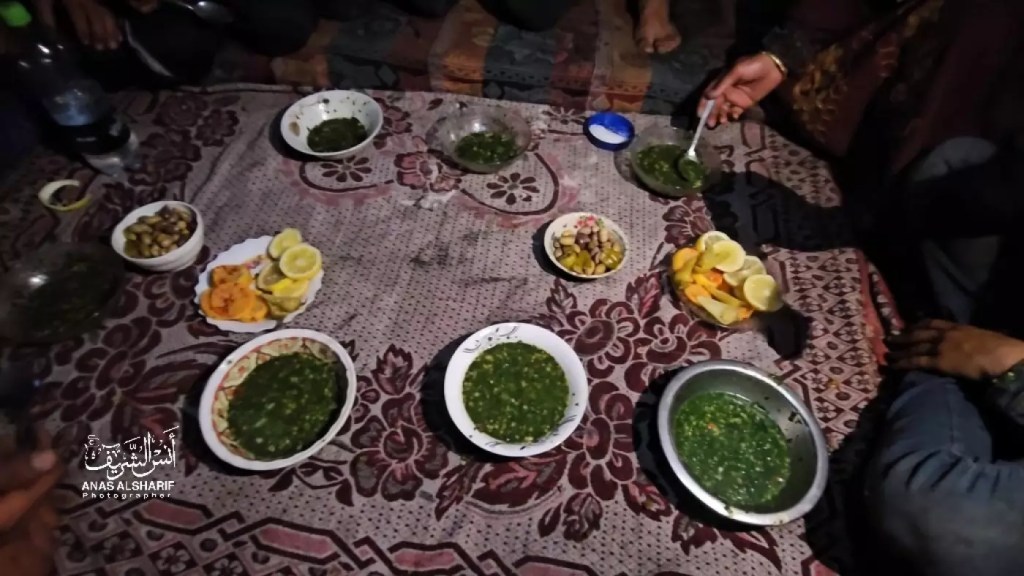
A tablecloth is spread with bowls of soupy grass and a few plates of lemon slices
A Palestinian Muslim family’s fast-breaking meal: grass soup with some lemon.

After their meal, Jesus led his friends into the Garden of Gethsemane, where he prayed in anguish, fearing all he was about to endure: criminalization, torture, and a painful public death.

Jesus prays on the ground, looking agonized and raising his hands towards the dark sky, as three figures sleep in the background.
Gethsemane – Matthew 26:36-46

Jesus begs his friends to “stay awake” as he wrestles — just to be present, to make him feel a little less alone. How do we respond to Jesus’ plea by “staying awake” to Palestine’s current agony?
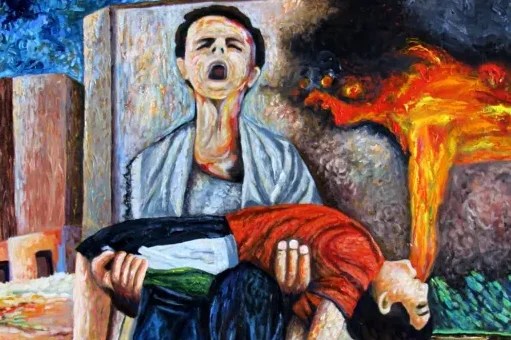
A painting of a young person, maybe a teen, mouth open in grief as he kneels and holds a child's body in his arms. Buildings on fire form the backdrop. The boy's clothes are in the colors of the Palestinian flag.
Detail from “Cry” (2016) by Mohammed Almadhoun.

That question also leads me to ponder another: how does God join Palestinians in their agony? Where is God in their suffering?

Palestinian Christian Mitri Raheb seeks to answer this question of where God is in his 2015 book Faith in the Face of Empire.
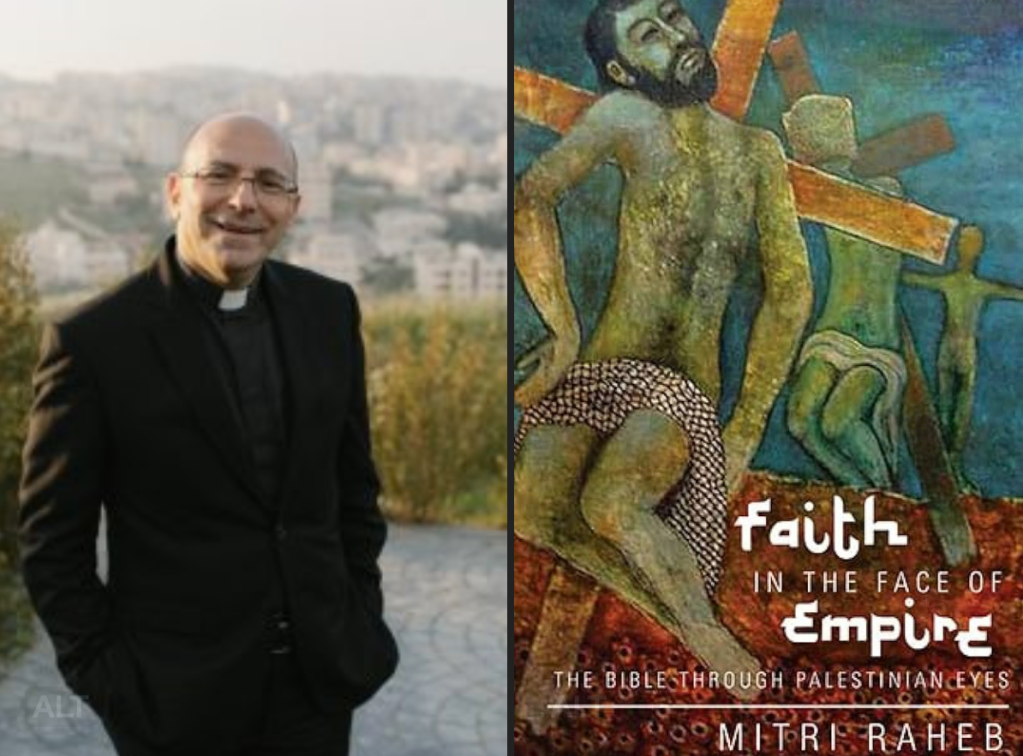
Photo of Mitri Raheb wearing clerical black with the white clerical collar, standing outside and smiling at the viewer. Cover of Faith in the Face of Empire, which features a painting of Christ on the cross with two other crucified behind him.

Raheb looks at the history of the Palestinian region, from ancient times to today, as a long chain of different empires — from the Assyrians to the Romans, Ottomans to Western-funded modern Israel.

He says that this long history of occupation is what gave Palestinians the ability to notice God where those in power do not: among the powerless. It is this revelation, Raheb declares, that has empowered Palestinians — Jewish, Christian, and Muslim — to survive and resist Empire again and again.

Raheb writes about how in ancient times, the divine was made

“…visible and omnipresent in the empire with shrines and temples that represented not only his glory but also that of the empire. God’s omnipotence and that of the empire were almost interchangeable. He was a victorious God, a fitting deity for a victorious empire.

At the other end of the spectrum there was the God of the people of Palestine, whose tiny territory resembled a corridor in Middle Eastern geography. …This God was a loser. He lost almost all wars, and his people were forced to pay the price of those defeats. In short, this God did not appear to be up to the challenge of the various empires. His people in Palestine were forced to hear the mocking voices of their neighbors who taunted them, ‘Where is your God?’ (Ps 42: 3, 10).

The revelation the people of Palestine received was the ability to spot God where no one else was able to see him. When his people were driven as slaves into Babylon, they witnessed him accompanying them. When his capital, Jerusalem, was destroyed and his temple plundered, they saw him there. When his people were defeated, he was also present. The salient feature of this God was that he didn’t run away when his people faced their destiny but remained with them, showing solidarity and choosing to share their destiny.

Consequently and ultimately, Jesus revealed this God on the cross, in a situation of terrible agony and pain, when he was brutally crushed by the empire and hung like a rebellious freedom fighter. The people of Palestine could then say with great certainty [that their God] ‘in every respect has been tested as we are’ (Heb 4:15).

For the people of Palestine this meant that defeat in the face of the empire was not an ultimate defeat. It meant that after the country was devastated by the Babylonians, when everything seemed to be lost, a new beginning was possible. Even when the dwelling place of God was destroyed, God survived that destruction, developing in response a dwelling that was indestructible. And when Jesus cried on the cross, “My God, my God, why have you forsaken me?” (Mk 15:34), that soul-rending plea was just the prelude to the resurrection…”

It is this revelation that God sides against empire, Raheb continues, that keeps the Palestinian spirit alive through horrible oppression. Though the world may call such faith foolish — how can you believe God is with you and that God will have the final say, when all evidence points to your abandonment and defeat? — it is wisdom to the oppressed. Raheb describes how this wisdom feeds Palestinian resistance, over and over across the millennia:

“The art of survival and starting anew is a highly developed form of expression in Palestine, and one I see daily. People’s lives, businesses, and education are interrupted by wars and the aftermath of wars over and over again, and yet I witness people refusing to give up, taking a deep breath, and beginning again. Logically, it is foolish, and yet there is deep wisdom in such a course of action.

I’m often asked by visitors how I can keep going. Everything seems to be lost, the land “settled” by Israel, the wall suffocating Palestinian land and spirit, the world silent, and hope almost gone.”

Raheb’s answer to them is that God’s presence in and among the suffering, and God’s promised resurrection, of renewal in the face of all terror and death, is what keeps him and his people going.

As we enter into these final days of Lent, I pray for hearts and minds opened to witnessing God’s solidarity with and resurrection for Palestinians suffering imperial brutality. I pray that the Palestinians will survive as they always have — “afflicted in every way, but not crushed; perplexed, but not driven to despair; persecuted, but not forsaken; struck down, but not destroyed” (2 Cor 4:8–9).

Categories
Current Events / Activism My poetry

“What words can do” — A poem for Palestine

Half a world away from me
they are killing a people they claim does not exist
using my taxes, my country’s ghoulish gifts —
our bullets and bone-eating phosphorous,
our bombs, and our blessing to use them ­—

they are killing the doctors to kill all hope of healing
they are killing the journalists to kill all calls for justice

and what can I do? With what can I fight
to end this nightmare I’m complicit in
by birthright?

All I have, it seems to me, are words.

I scrawl them on protest signs,
arrange them into stilted, inept poems,
deposit them into the answering machines
of politicians who persist
in signing over all our souls for oil.

they are killing the old women
with nothing left to their names
but tales of how things were

and, God! they are killing the children
who listen to the tales and spin
them into dreams of how things yet could be

And what, in God’s name, can I do? What
can all the words
winging forth from all the corners of the earth
do?

what dream can rise unscathed from so much ruin?
what song is not drowned out
by the drones’ constant humming?

I pull up a lecture by Refaat Alareer
who believed in the power of a poem

to soar above the rubble
crushing its poet’s corpse.

they are killing the poets
whose words are seeds are kites are embryonic deeds

In the lecture, his voice speaks
to me from beyond the grave, haunted
by that soft electric hum
endemic, it seems, to classrooms all over.

In the lecture, he is saying

there was an Israeli general
for whom one poem by Fadwa Tuqan
packed a punch more potent than the guns
of twenty enemy fighters.

In the lecture, he is pleading:

“Don’t ever say Tuqan was arrested
‘just’ for writing poems”

and how could I, how could I
do anything but promise him, “I won’t!”

when he himself was killed a month ago
“just” for nurturing the poems in others,
“just” for reeling those poems out,
slim and supple as kites, into the world?

what song or verse, what thin prophetic cry
can scale a wall eight meters high?
one built to be buffeted, bombed — and still fly.

In the lecture, he is promising

as long as we can imagine Palestine free,
we can unlock that future reality

from a classroom that is rubble now —
the IDF bombed his university in October.
They say it was an important Hamas site.

Maybe it was

or maybe it was a danger “just” because
its teachers, its students, kept slipping their poems
past checkpoint gates

filling the world with prophecies of freedom
that “just” might make
a battered but persistent people free.

they can kill children women journalists
they can kill doctors dreamers prophets poets
but still (we must believe!) the poem lives on.

So take up your pen, or take up Gaza’s song
and spread the word forth: Palestine lives on.


Please feel free to spread this poem around online or offline. Just credit Avery Arden of binarybreakingworship.com.

You can find me reciting this poem in video format on TikTok here and on Instagram here.

If you’re interested in more poetry for Palestine, check out my podcast episode here.

About this poem:

These last few months, I have been reading a great deal of Palestinian poetry. Poems are my heart’s language, and I have been deeply moved by the long proud history of Palestine’s resistance poets, who have used their art to defy the colonialist lie that there is no Palestinian people or culture. For decades, these poets have been targeted by Israel’s government because the power of their words cannot be denied.

Before he was killed by an Israeli airstrike on December 7, 2023, Professor Refaat Alareer was a professor of creative writing and world literature at the Islamic University of Gaza, where he worked to nurture his people’s creative powers and broadcast Palestinian poetry to the world through efforts like the We Are Not Numbers project.

Many of Alareer’s lectures are available on YouTube; around nine minutes into an introduction to poetry, he discusses how art helps us imagine what we have never experienced so that we can work to make those dreams reality. In it, he speaks to his students:

“We’ve never been to other parts of Palestine because of the Israeli occupation, but we’ve been told so many times by our parents and grandparents, especially our mothers, have been telling us stories about Palestine…the good old days how Palestine was, all nice and beautiful, unoccupied, un-raped… Our homeland turns into a story. In reality we can’t have it, we don’t have it. But it can turn into poems, into poetry, into literature, into stories.

So our homeland turns into a story. We love our homeland because of the story. …And we love the story because it’s about [class joins in] our homeland. And this connection is significant. Israel wants to sever this relationship between Palestinians and land, Palestinians and Jerusalem, and other places and cities. And literature attaches us back, connects us strongly to Palestine,…creating realities, making the impossible sound possible.”

When we look at the weapons the IDF wields, courtesy of imperialist powers like the United States, what are words? Why bother speak up? Alareer assures us that our words do matter. In the same lecture as above, he speaks of the Palestinian resistance poet Fadwa Tuqan (1917-2003), whom Israel arrested. Why, Alareer urges us to consider, would Israel feel so threatened by someone who wields no weapon but a pen?

“…We always fall into this trap of saying, ‘She [Fadwa Tuqan] was arrested for just writing poetry!’ …So we contradict ourselves sometimes; we believe in the power of literature changing lives as a means of resistance, as a means of fighting back, and then at the end of the day, we say, ‘She just wrote a poem!’ We shouldn’t be saying that.

Moshe Dayan, an Israeli general, said that ‘the poems of Fadwa Tuqan were like facing 20 enemy fighters.’ … And the same thing happened to Palestinian poet Dareen Tatour. She wrote poetry celebrating Palestinian struggle, encouraging Palestinians to resist, not to give up, to fight back. She was put under house arrest, she was sent to prison for years.

And therefore, I end here, with a very significant point: Don’t forget that Palestine was first and foremost occupied in Zionist literature and Zionist poetry. …It took them years — over 50 years — of thinking, of planning, all the politics, money and everything else. But literature played one of the most crucial roles here. …Palestine in Zionist Jewish literature was presented to the Jewish people around the world … [as] a land without a people to a people without a land. ‘Palestine flows with milk and honey. There’s no one there, so let’s go.’ … And there were people — there have always been people in Palestine. These are examples of how poetry can be a very significant part of life.”

Professor Refaat Alareer in a 2019 poetry lecture

It turns out that words are working — slowly but surely.

Since October 2023, the journalists and everyday people in Gaza who have been bravely broadcasting their stories to the world, and those across the world who have been spreading those stories, and organizing protests, and refusing to be silent in the face of government powers and heavy propaganda, are having an effect. Israel is concerned about its public image, which our collective words and actions are damaging.

So keep sharing Palestinians’ stories; keep writing; keep contacting your representatives; keep protesting.

We won’t stop till Palestine is free.

Categories
advent Holy Days Hymns Other search markers Unpacking Antisemitism

“O Come Emmanuel” revised for Palestine’s plight

This Advent, some progressive Christians have discussed whether to table one of our religion’s most ancient hymns: “O Come, O Come Emmanuel.” When we sing of God coming to “ransom captive Israel,”
will our congregations recognize we don’t mean the modern Israeli nation?

Honestly, a conversation around this song is long past due (and many have had it over the decades). The truth is, it’s always been laden with supersessionist implications. Depicting the Jewish people as living “in lonely exile here / Until the son of God appear” perpetuates the idea that Jews’ relationship with God is incomplete because they “didn’t accept” Jesus as their Messiah.

How do we resist both antisemitism and Zionism, while seeking to maintain a connection to Christians who came before us? One option may be to reimagine the songs we cherish so that, instead of perpetuating deep-seated hate and Christian supremacy, they challenge us towards joining God in solidarity with the world’s oppressed.

In that spirit, below is my reworking of “O Come Emmanuel” to center the plight of Palestinians (and that removes, I hope, the supersessionism — let me know if I missed any). May our worship songs plant in us a deep desire for justice, and spark our action towards a future where all peoples, all religions live in mutual relationship and respect.

Please feel free to use and share around — just credit Avery Arden of binarybreakingworship.com.

__

O come, o come compassionate Divine,
And ransom captive Palestine
That mourns with tears that will not be soothed
Till empires fall and nations’ hearts are moved.

Rejoice! Rejoice! God’s justice is at hand
To liberate the people and the land.


O come, o bright and ever-burning star;
Bring Gaza comfort from afar!
Dispel from her the shadow of death
That murders dignity and chokes out breath.

Rejoice! Rejoice! God’s justice is at hand
To liberate the people and the land.


O come, o Wisdom from on high,
Take up the outcast’s cause, the captive’s cry.
Guide us to build your kingdom on earth
Where all faiths flourish, and the last are first.

Rejoice! Rejoice! God’s justice is at hand
To liberate the people and the land.


O come, o King of Peace and Justice, break
All weapons down, and from them ploughshares make.
Let all tears dry, all peoples respond:
“We are each other’s magnitude and bond.”

Rejoice! Rejoice! God’s justice is at hand
To liberate the people and the land.

Categories
advent Holy Days My poetry

Poem: Advent in (another) genocide

This poem came to me after learning that Christian leaders in the Holy Land have asked churches not to organize any “unnecessarily festive” activities, in solidarity with Gaza; as well as seeing the Nativity scene set among rubble in the Lutheran Church of Bethlehem this year.

Find resources on what’s happening in Palestine and how to help below the poem.

Please feel free to share around; credit to Avery Arden (they/them) with a link to binarybreakingworship.com.


This year, Mary is just one of many
Palestinians failing to find
a safe place to give birth.

This year, Jesus is just one
of countless born
into rubble.

This year, the newborn Christ

dies 

his little body bombed
and tossed aside
into the growing pile.

This time, Jesus never makes it to adulthood —
doesn’t even make it the eight days to circumcision.
He doesn’t die a grown man
making a conscious choice
to defy Empire armed with naught but dreams

of a world where all the nations live as one
where last are first 
and all wars done —

No. This year, his newborn life is threat enough —
his family’s mere existence is rebellion enough  —
to warrant eradication.

Actually, it was then, too, two thousand years ago
— for Empire always fears the ones it grinds
beneath its millstone — back then, though
Christ’s parents found safe passage into Egypt —

now, snipers shoot them as they try
to leave the hospital that scarce had room
for one more woman’s labor cries.

Stigmata are
that much more
chilling between
an infant’s eyes.

And now, as then, some may blame Jesus’s death
on his own Jewish people — but
resist this lie! Now, as then,
the crime is Empire’s

with Western Christians at the helm

and those who would cast stones, look first
for your own nation’s name etched on the bombs
and tear gas canisters!

And, God,
if there is any hope at all
to wrestle from the rubble

as churches all across the Holy Land
close their doors to Christmas joy this year —
a holy choice to mourn with those who mourn
as Christ’s homeland is made a massive grave —

it’s this: there are still children left to save.

It’s this: not every olive branch has burned.

It’s this: the sacred promise of a God
who dies whenever Empire’s outcasts die —
that those cast down 

will rise.

Palestine, Palestine! I swear we will not cease
to shout your name until, at last, your streets
sing with your children’s laughter, loud and free.

– Avery Arden


Notes on this poem

I am writing this note after revising some middle portions of this poem, and coming away still unhappy with the results.

As a Christian who believes that God expresses a solidarity with the oppressed so strong and intimate that They are literally one with every oppressed person, I cannot help but recognize Christ within the people being killed and expelled from their homes in Gaza right now. Christ is there among them, and that means he is among their dead as well as their displaced.

As the Rev. Munther Isaac of the Evangelical Lutheran Church in Bethlehem on the West Bank preached in October,

“God suffers with the people of this land, sharing the same fate with us. …God is under the rubble in Gaza. He is with the frightened and the refugees. He is in the operating room. This is our consolation. He walks with us through the valley of the shadow of death. …”

For Christians like Rev. Isaac, Christ’s intimate identification with those the world calls least, those whom Empire threatens to eradicate, is central to any sense of comfort they may have in the face of so much devastation. It’s also central to my own faith and personal understanding of the Divine.

Yet in this context, because modern-day Israel is a Jewish state, exploring that Divine solidarity comes with a great risk of perpetuating the long, harmful history of antisemitic blood libel and accusations of deicide. How do we affirm God’s presence with those suffering in Palestine without (implicitly or explicitly) adding to the poisonous lie that “the Jews killed Jesus”?

In wrestling with this complexity, I tried to write this poem to uplift both Jesus’s Jewishness and his solidarity with Palestinians. Jesus was born into a Jewish family, his entire worldview was shaped by his Jewishness, and he shared in his people’s suffering under the Roman Empire. His solidarity with Palestinians of various faiths suffering today does not erase that Jewishness. Nor does it mean that Jewish persons don’t “belong” in the region — only that modern Israel’s occupation of Palestine is in no way necessary for Jews to live and thrive there, or anywhere else in the world.

I also aimed to point out (sacrificing poetic flow to do so, lol) that Israel is by no means acting alone in this attack on Gaza or their decades-long occupation of Palestine. There is a much larger Empire at work, with my own country, the United States, as one of the nations at the helm. Israel is entangled in that imperial mess, and directly backed and funded by those forces — not because of what politicians claim, that we have to back Israel or else we’re antisemitic, but because Israel is our strategic foothold in the so-called Middle East. How do we name our complicity as our tax dollars are funneled into violence across the world, and act to end that violence?

Ultimately, I don’t know that this poem is a successful one. I don’t know if it avoids perpetuating harm. If nothing else, I hope it sparks conversation about resisting antisemitism as much as we resist Zionism.


Palestine Resources

HISTORY

CURRENT EVENTS

DREAMING OF A BETTER FUTURE

WAYS TO HELP

  • Urge your University/School/Organization to put out a statement denouncing Israel
  • Organize a Protest/Participate in a local one
  • While calling your reps, tell them that as a voter, you’re unwilling to support them in the upcoming election unless they urge the White House to take a stand against Israel and stop funding them
  • Share art/writing/films around Palestinian culture (see this tumblr post for Palestinian media to watch; I also recommend Oriented (2015) for an un-pinkwashed queer Palestinian story)
  • If you’re part of a union, ask them what they’re doing to urge their industry leaders to take a stand against Israel + pressure the White House OR urge them to start a strike/walkout/etc if they’re not doing anything already
  • Talk with your friends IRL about Palestine; keep spreading information on social media — don’t let talk of Palestine die down!
  • See if your city/state council has put out a statement in support of Gazans. If not, try to push them to do so.