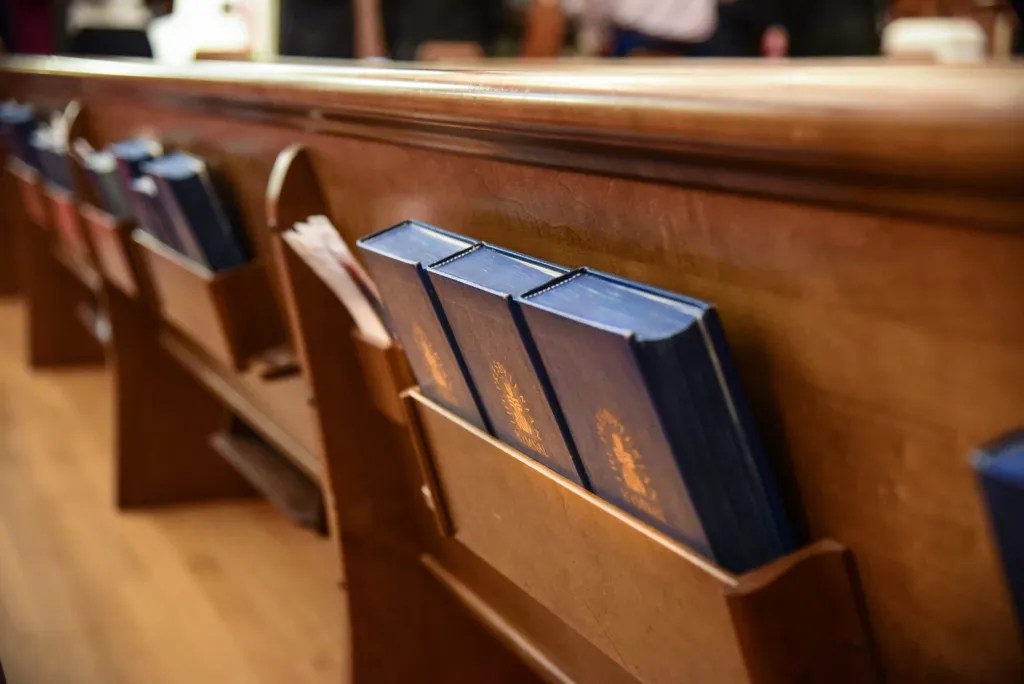
What are your favorite hymns? What hymns does your community hold most dear? What makes those specific songs resonate so deeply — their powerful melodies? words of love, of comfort or challenge? Messages that seem to put your most treasured values into words?
On the other hand, are there parts of any of those hymns that don’t sit right with you?
Maybe there’s language that leaves you out as a non-binary person, or implies that your disability makes you broken. Or maybe you have only just noticed that a song you’ve been singing your whole life carries binary language, ableist language, language that equates whiteness with goodness and purity, darkness with sin.
These songs hold a special place in your heart and in your faith; you don’t want to throw them out (or you know that members of your congregation will protest if you try).
But you also know that the words we sing at worship matter — that many people’s beliefs are largely shaped by the hymns we choose. If we keep singing these songs as is, people will continue to absorb their harmful messages.
These hymns call for some wording updates as we seek to draw our circles ever wider, to ensure that we sing out welcome and belonging to all those made in the Divine Image.
For example, “For Everyone Born” is a beloved hymn that Shirley Erena Murray wrote with deep love and a desire to draw people together in our diversity; however, much of the language sets up binaries that unintentionally leave some people out. When I revised it, most of the verses just required breaking out of those binaries — such as expanding “woman and man” to include “all those between, beyond, and besides.”
Hearing these changes to the hymn’s language while in worship was deeply meaningful to me. To have my concerns heard and recommendations acted on, to be acknowledged in that way, explicitly in the song, after so often feeling unheard and left out in faith spaces, was genuinely healing.
…But then there are the hymns that don’t just need some wording tweaks. Some hymns are founded on downright harmful theology — are laden with implications that Christians are supreme; that God’s power is patriarchal; that suffering is either punishment or test; that we are “sinners in the hands of an angry God” who is only kept from smiting us because Jesus puts his body between us and divine wrath (rather than Jesus being God-with-us, expressing the Triune God’s united will).
So what are we to do with a hymn that perpetuates bad theology?
We might choose to dispose of it completely.
Maybe some songs can’t be redeemed. Maybe no changes to it could ever ease the pain you or your community members feel about it.
For me, a song goes straight in the trash if I look into the songwriter and find that they were racist, antisemitic, or even guilty of sexual abuse; if the writer was violently bigoted or abusive, I am not going to try to “fix” their music. There is no fixing the harm that person did. I’m not going to sing any of an abuser’s words in a space where we’re trying to ensure that all belong, especially the most vulnerable.
Even outside that exception, I respect any person or community who decides they would rather retire any given song from their worship, for any reason.
However, I have found that many people find it extremely healing to sing a once-hurtful hymn anew, now with lyrics that talk back to and refute the original message. In bringing the song back transformed instead of quietly discarding it, a more overt, unambiguous message is made about what we believe, who God is, and who we are as a community.
To return to the example of “For Everyone Born,” there is one stanza that needed more than updated wording. The verse beginning “for just and unjust, a place at the table” doesn’t just leave some people out; it has brought deep pain to many survivors of abuse.
The stanza envisions a “table,” a community, where both “abuser, abused” are present, “with need to forgive.” However, ethical frameworks for responding to abuse emphasize the abuser’s accountability and the victim/survivor’s safety, comfort, and even their right to withhold forgiveness if they choose.
So I had to make a choice: throw the stanza out, or rewrite it in a way that directly addresses the old harm? I chose the latter:
For just and unjust, a place at the table,
a chance to repent, reform, and rebuild,
protecting the wronged, without shame or pressure,
for just and unjust, God’s vision fulfilled.More people have reached out to me about this stanza than any other that I’ve revised, expressing how healing it was to be in worship and hear the old message refuted and replaced with one that prioritizes the person harmed.
If your community simply never speaks of a toxic hymn again, the memory of the pain the song caused you may remain deep in your psyche. You may even believe that that bad theology is the only traditional or “authentic” Christian theology — that you’re a “bad Christian” for hating it. You might think, “my church isn’t singing that hymn anymore because it makes people feel bad; but that doesn’t mean the hymn is wrong.”
But if you can receive the song anew, now with words that tear down that bad theology to build up something better, you receive an explicit message that yes, you were right, that theology was harmful. Your memories, your trauma, can be rewritten or re-woven into a new narrative:
This was a song that hurt; now it is a song that reminds us that we as Christians are constantly reforming and being reformed — constantly being called by God to unlearn and relearn divine love.
What do you think? Which hymns would you love to see transformed — and which would you simply like to never hear again?
 Binary-Breaking Worship