In Jesus, God incarnate suffered and died on a cross, an imperial tool of torture, terror, and humiliation.
Ever since, some of the most dehumanized and oppressed peoples of the world have seen themselves in Christ’s execution. For them, Jesus expressed ultimate solidarity with all whom Empire criminalizes and murders — from the “untouchable” dalit class, to Black persons lynched or shot by police in the United States; and from Latin America’s “disappeared” across the 20th century to queer persons dying of AIDS in the 90s.

A painting by Sri Lankan pastor Jebasingh Samuvel, who preaches and paints the Dalit-ness of Jesus. 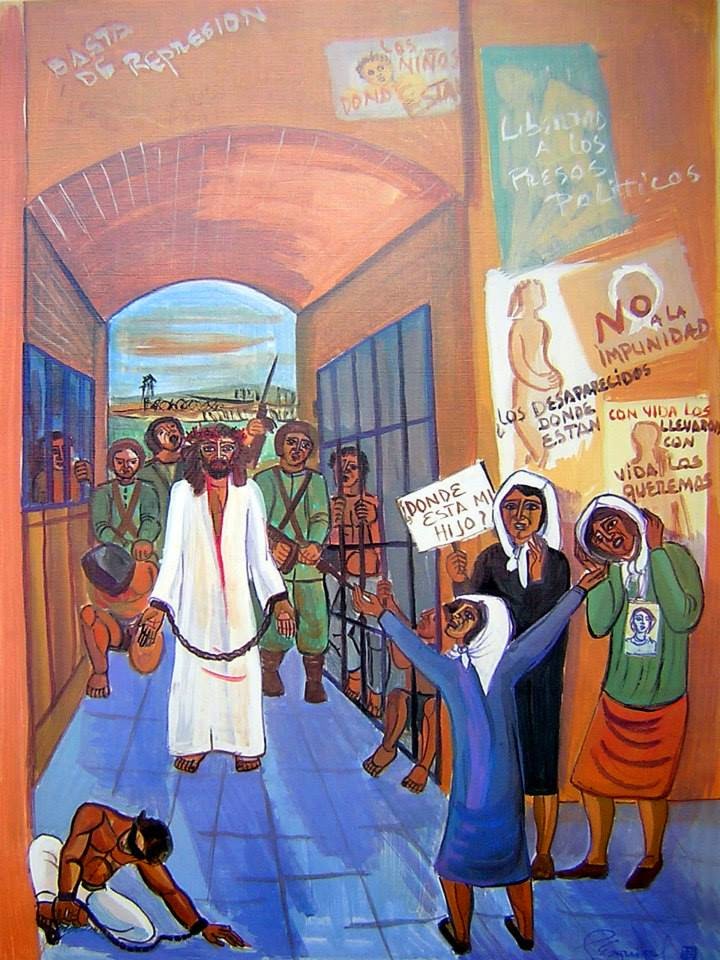
The first station in Adolfo Pérez Esquivel’s “El Via Crucis Latinoamericano” (“The Latin American Way of the Cross,” 1992). Christ is led in chains by military officers of the Argentine dictatorship (1976-83). 
“Man of Sorrows: Christ with AIDS” (1993) by Maxwell Lawton. Archbishop Desmond Tutu loved and defended Lawton’s painting. 
Charles Cullen’s frontispiece to Countee Cullen’s “The Black Christ and Other Poems,” 1929.
In the mid-1900s, the symbol of crucifixion was uplifted by many Arabic poets as an image of unjust, collective suffering. Decades later, in 2021, Palestinian poet Najwan Darwish likewise made crucifixion the central image of his collection of poems Exhausted on the Cross.
Throughout this text, Darwish grapples with despair and uplifts resistance in the face of Israeli occupation, with all its “tedious” daily terrors interspersed with waves of escalated violence. He sees these decades of occupation as a long, drawn-out, collective crucifixion. When will it end? When will Palestinians know rest — and maybe, just maybe, resurrection?
I want to share two of the poems in Exhausted on the Cross.

“They Woke You at Dawn” by Najwan Darwish, 2021
In this first poem, Darwish imagines Christ as a fedayee, an Arabic term for various military groups willing to sacrifice themselves for a larger movement.
Palestinian Fedayeen are often smeared as terrorists by Israel and its allies, while their self-sacrifice is celebrated by the oppressed — not unlike how the Roman Empire viewed Jesus as a threat to be eradicated, while the poorest of his own people loved him.
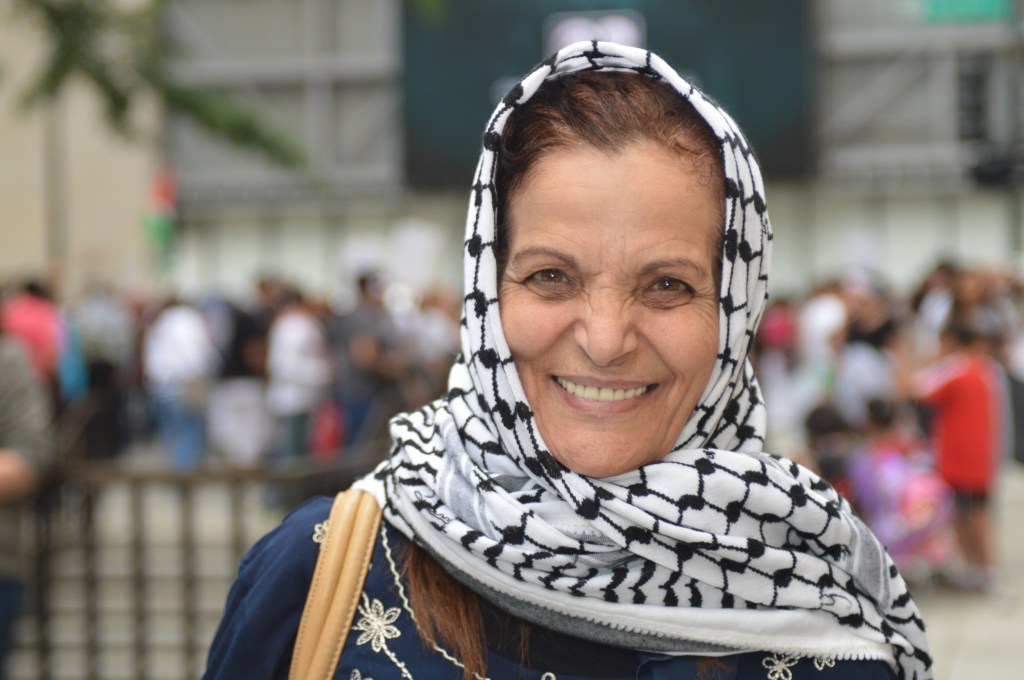
Darwish dedicated this poem, “They Awoke You at Dawn,” to Rasmea Odeh, a Palestinian activist whom some see as a convicted terrorist – despite her confession being made under Israeli torture — and others see as a hero and representative of collective Palestinian denigration.
“They Awoke You at Dawn”
When they woke you at dawn,
when they hung you up for slaughter
. . .
Christ was a fedayee, just like you,
but he was condemned and crucified
in the sea of a single day, while you—
your cross is raised with every dawn.
His name was on their blacklist,
his mother slept on a pillow of nightmares.
Which of these few women outside the Moscovia jail
can catch her when she falls,
hanging as she is
from the farthest star of the cosmos?
They’ve woken you at dawn again.
They’ve hung you up for slaughter.
“Exhausted on the Cross” by Najwan Darwish
In this second poem from — and, as it happens, the titular poem of — Exhausted on the Cross, Darwish expands the image of crucifixion from a singular victim (e.g. Christ, Rosmea Odeh) to all Palestinians.
Darwish sees the long decades of Israeli occupation as a drawn-out, collective crucifixion. Christ’s suffering is their suffering; their suffering is Darwish’s suffering. When will Palestinians know rest — and maybe, just maybe, resurrection?
“Exhausted on the Cross”
The ones hanging
are tired,
so bring us down
and give us some rest.
We drag histories behind us
here
where there’s neither land
nor sky.
Lord,
sharpen your knife
and give your sacrifice its rest.
◆◆◆
You had no mother or father
and you never saw your brothers
hanging
from the cold talons of dawn.
You loved no one
and no one ever abandoned you
and death never ate from your hands.
You cannot know our pain.
◆◆◆
I’m not King David—
I won’t sit at the gate of regret
and sing you psalms of lamentation
after the sins.
◆◆◆
Bring me down,
let me have my rest.
Further Reading
- An article exploring Darwish’s cross imagery
- Article on Rasmea Odeh’s situation
- A video on Maxwell Lawton’s “Christ with AIDS” painting, and a blog post on it
- Article sharing all of the stations in Adolfo Pérez Esquivel’s “El Via Crucis Latinoamericano” (“The Latin American Way of the Cross,” 1992)
- ” ‘Painting Against Caste Violence Is My Resistance’: A Q&A with Sri Lankan Artist and Priest Rev. Jebasingh Samuvel
- A book review on James Cones‘ The Cross and the Lynching Tree (2013), with various artists’ depictions connecting Christ’s crucifixion and the lynching of Black Americans
 Binary-Breaking Worship